


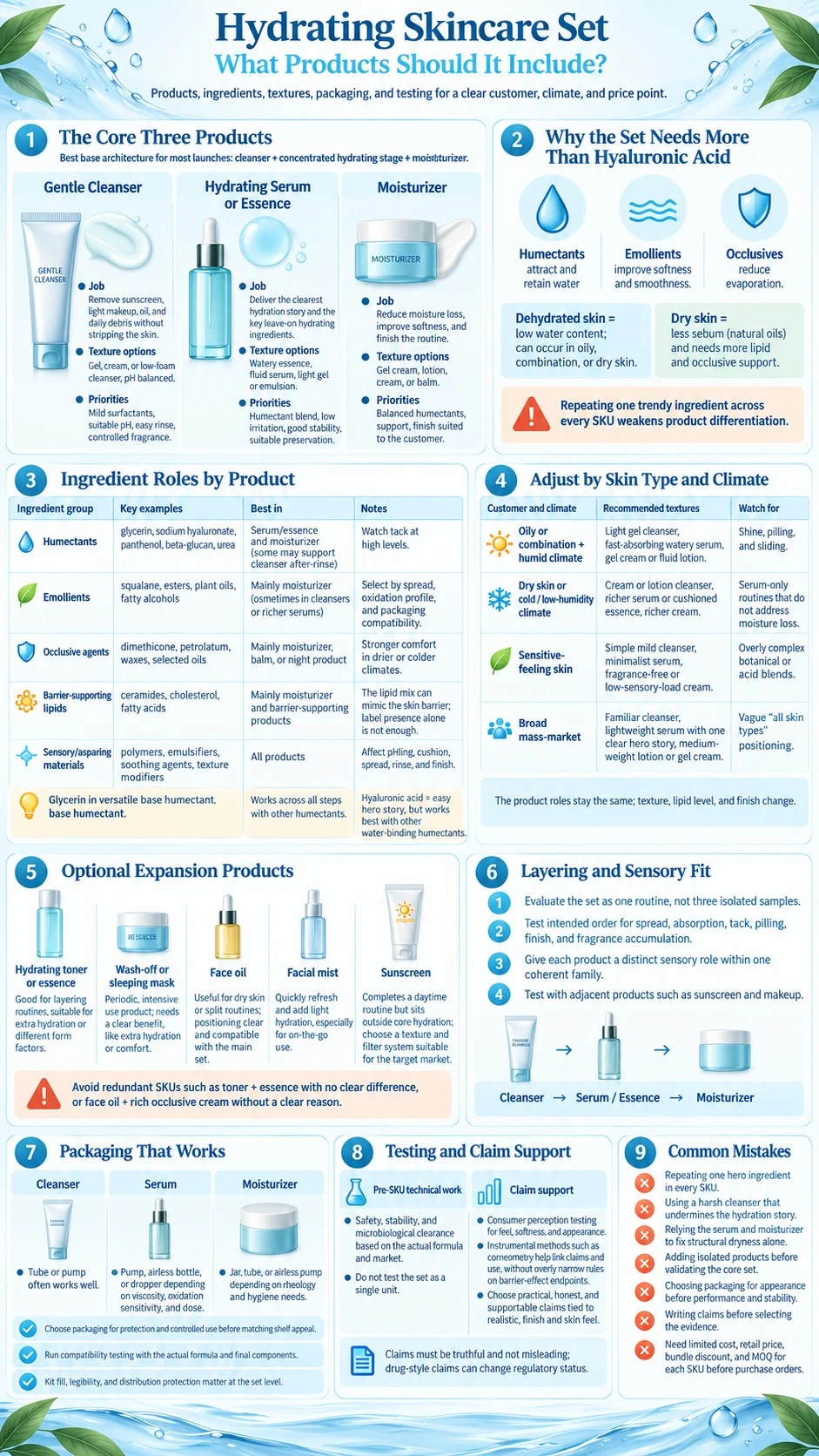
A hydrating set looks simple on a product page, but its development requires several coordinated decisions. The cleanser must not undermine the leave-on products. The serum needs a reason to exist beyond being a thinner moisturizer. The moisturizer must provide enough comfort without feeling too heavy for the intended market.
For a skincare brand, the useful question is therefore not only “Which products should we include?” It is “What role will each formula own, and why would the customer use all of them together?” This guide treats the set as a product architecture decision rather than a generic consumer routine.
The Core Three Products in a Hydrating Skincare Set
For most launches, a cleanser, concentrated hydrating step and moisturizer form the most coherent base. This architecture covers cleansing, water-binding hydration and reduction of moisture loss without forcing customers into a long routine. It also lets a brand sell a complete set while keeping each SKU understandable on its own.
| Product | Primary job in the set | Useful texture options | Formula priorities | When to modify the choice |
|---|---|---|---|---|
| Gentle cleanser | Remove sunscreen, light makeup, oil and daily debris without a tight after-feel | Low-foam gel, cream cleanser or lotion cleanser | Mild surfactant system, suitable pH, easy rinsing and controlled fragrance strategy | Choose a creamier, lower-foam profile for dry or cold-climate positioning; choose a light gel for humid or combination-skin markets |
| Hydrating serum or essence | Deliver the most concentrated hydration story and a noticeable first layer of slip or cushion | Watery essence, fluid serum or light gel serum | Humectant blend, low tack, compatibility with the moisturizer and stable preservation | Use an essence when fast spread and layering are central; use a serum when the brand needs a stronger hero-SKU identity |
| Moisturizer | Hold water at the skin surface, improve softness and finish the routine | Gel cream, lotion or cream | Balanced humectants, emollients and occlusive agents, plus a finish suited to the customer | Use a gel cream for lightness and humid climates; use a richer cream when comfort and reduced moisture loss matter more |
This three-product logic is also easier to brief, sample and compare than a five- or six-SKU launch. Brands evaluating broader private label skincare sets can still begin with these three functional roles, then expand only after a clear gap appears.
Why a Hydrating Set Needs More Than Hyaluronic Acid
Hydration is not a single-ingredient task. Humectants attract and retain water in the outer skin layer; emollients improve softness and smooth the spaces between surface cells; occlusive materials reduce evaporation. Well-designed moisturizers commonly combine these functions rather than relying on one fashionable ingredient.[1]
Hyaluronic acid can support a compelling serum concept, but placing it in the cleanser, serum, toner and cream does not automatically make the set more effective. Repetition may weaken product differentiation and create an ingredient-led story without a complete formula system. A serum rich in humectants may feel temporarily comfortable, while a suitable moisturizer supplies the lipid-rich and film-forming elements that help maintain that effect.
Brands should also distinguish dehydrated-feeling skin from dry skin in positioning. Dehydration describes low water content and can be experienced by oily, combination or dry skin. Dry skin generally needs more lipid and occlusive support. This distinction changes the preferred textures: an oily-dehydrated audience may want a light serum and gel cream, while a dry-skin audience may prefer a milky serum and richer cream.
Which Ingredients Belong in Each Product?
An ingredient should be assigned according to formula role, sensory effect, stability and claim strategy—not because it appears on a trend list. The same ingredient can behave differently depending on concentration, vehicle and the rest of the formula, so the finished product remains the real unit of evaluation.
| Formula role | Common examples | Best placement in the set | Development considerations |
|---|---|---|---|
| Humectants | Glycerin, sodium hyaluronate, panthenol, beta-glucan and urea | Serum or essence and moisturizer; selected humectants may also support cleanser after-feel | High total humectant load can increase tack; balance immediate slip with dry-down |
| Emollients | Squalane, esters, plant oils and fatty alcohols | Primarily moisturizer; limited use in creamy cleansers or richer serums | Select by spread, oxidation profile, weight and compatibility with packaging |
| Occlusive agents | Dimethicone, petrolatum, waxes and selected oils | Moisturizer, balm or targeted night product | Greater occlusion can improve comfort for dry skin but may feel too heavy for humid-market positioning |
| Barrier-supporting lipids | Ceramides, cholesterol and fatty acids | Moisturizer or specialized barrier-support product | The complete lipid system, processing and finished formula matter more than label presence alone |
| Sensory and supporting materials | Polymers, emulsifiers, soothing agents and texture modifiers | Across the set as needed | These determine pilling, cushion, spread, rinse and finish, even when they are not headline ingredients |
Glycerin is a versatile foundation humectant, while hyaluronic acid is often easier to communicate as a hero ingredient. Squalane contributes emollience rather than the same water-binding function. The distinction is useful when deciding whether the serum should lead with hyaluronic acid and the moisturizer should add a complementary emollient such as squalane.
How Should the Set Change by Skin Type and Climate?
The core product roles can stay the same while textures, lipid level and finish change. Targeting “all skin types” without a sensory definition usually produces a vague brief. A more useful brief identifies the main customer, climate and acceptable after-feel.
| Target condition | Cleanser direction | Serum or essence direction | Moisturizer direction | Main watchout |
|---|---|---|---|---|
| Oily or combination skin in a humid climate | Light, easy-rinse gel with controlled foam | Fast-absorbing watery serum with low tack | Oil-light gel cream or fluid lotion | Excessive film, shine or pilling under sunscreen |
| Dry skin or a cold, low-humidity climate | Cream or lotion cleanser with a comfortable after-feel | Milky serum or cushioned essence | Cream with stronger emollient and occlusive support | A serum-only story that does not address moisture loss |
| Sensitive-feeling skin | Simple mild cleanser with a restrained fragrance strategy | Minimalist serum with carefully selected supporting ingredients | Fragrance-free or low-sensory-load cream where appropriate | Too many botanical extracts, acids or competing actives |
| Broad mass-market positioning | Familiar gel or cream cleanser | Lightweight serum with one clear hero story | Medium-weight lotion or gel cream | Trying to satisfy every climate and skin type with one extreme texture |
Seasonal variation can be handled through a richer night cream, an optional face oil or a campaign message rather than reformulating the entire set. If the moisturizer is the set’s main adaptability lever, a structured moisturizer texture decision should be made before sample approval.
Which Optional Products Can Expand the Set?

Optional products should create a new usage moment, not repeat the serum in another bottle. The following additions can be useful when the brand has a clear reason for them:
- Hydrating toner or essence: Adds a light prep step, supports layering rituals and can suit markets where multi-step routines are expected. It should be visibly thinner or sensorially different from the serum.
- Wash-off or sleeping mask: Creates a periodic intensive-use product and a giftable format. It needs a benefit and texture distinct from the daily moisturizer.
- Face oil: Adds emollience for dry-skin or night-routine positioning. It does not replace the water phase or humectant role of a serum and may not suit every audience.
- Facial mist: Offers convenience and an on-the-go touchpoint, but the formula, spray pattern and consumer instructions must justify more than momentary wetness.
- Sunscreen: Can complete a daytime routine, but it introduces a different regulatory, testing and formulation workload. It should be included only when the target market, launch budget and sunscreen compliance plan support it.
A startup should generally resist adding both toner and essence, or both facial oil and a rich occlusive cream, unless research shows that customers understand the difference. More SKUs increase minimum-order commitments, packaging components, testing work and the risk of uneven sell-through.
How Should the Products Layer and Feel Together?
A set should be evaluated as one routine, not as three isolated samples. Apply the products in the intended order and observe spread, absorption, tack, pilling, finish and fragrance accumulation. A serum that performs well alone may roll up under the set’s moisturizer or sunscreen. Two pleasant fragrances may become overpowering when layered.
Give each product a distinct sensory signature within one coherent family. The cleanser can rinse clean with a soft after-feel, the serum can provide slip and rapid absorption, and the moisturizer can deliver the final cushion or seal. Matching every product to the same viscosity, fragrance intensity or sticky humectant profile makes the set feel repetitive.
Sample evaluation should include realistic quantities, waiting times and morning and evening use. Test the intended order with common adjacent products such as makeup and sunscreen, even when those products are not part of the bundle. This exposes routine-level failures before packaging and claims are finalized.
What Packaging Works for a Hydrating Skincare Set?
Packaging should protect each formula and support controlled use before it creates a matching shelf appearance. A tube or pump often works for cleanser. A pump, airless bottle or dropper may suit a serum depending on viscosity, oxidation sensitivity and dose. Moisturizers can use jars, tubes or airless pumps, but the formula’s rheology and hygiene assumptions must fit the dispensing system.
Visual consistency can come from color, typography, cap treatment and bottle geometry without forcing every product into the same package. Using one bottle family for formulas with very different viscosities can cause poor evacuation, leaking, clogging or inaccurate dosing. Run packaging compatibility testing with the actual formula and final component rather than approving appearance alone.
Set-level logistics also matter. Confirm that the products fit the carton or kit insert, remain legible in the intended order, and can withstand distribution together. A heavy glass jar next to a thin dropper bottle may require more protection than three individually shipped cartons.
How Should a Brand Test and Support Hydration Claims?
Every SKU needs safety, stability and microbiological decisions appropriate to its formula and market. In the United States, the company marketing a cosmetic is responsible for ensuring safety under labeled or customary conditions of use; regulators do not prescribe one universal test list for every cosmetic.[2] A water-based cleanser, serum and cream may also present different preservation and packaging risks, so a set should not be treated as one test unit.
Claim support should match the exact wording and time frame. Consumer perception testing can support statements about feel, softness or appearance when designed appropriately. Instrumental methods such as corneometry can measure stratum corneum hydration, while transepidermal water loss measurements may help evaluate water-loss or barrier-related endpoints. The protocol, controls, application schedule, subjects and statistical plan should be selected for the proposed claim—not copied from another product.
Cosmetic labeling claims must be truthful and not misleading, and claims that treat or prevent disease or affect body structure or function may cause a product to be regulated as a drug in the United States.[3] Advertising also needs adequate support for both express and reasonably implied claims.[4] A complete skincare product testing plan should therefore be set after formulas, markets and claims are defined but before launch dates are promised.
Common Hydrating Skincare Set Mistakes
- Repeating one hero ingredient in every SKU: This can make the range easy to describe but difficult to differentiate. Build a complementary system instead.
- Using a harsh or high-after-feel cleanser: A cleanser that leaves skin tight undermines the set’s hydration position. Gentle cleansing and timely moisturizer use are standard dry-skin care principles.[5]
- Making the serum and moisturizer sensorially identical: Customers need to understand why both products belong in the routine.
- Adding optional products before validating the core set: A larger assortment increases inventory and testing exposure before the brand knows which role drives repeat purchase.
- Choosing packaging as a matching set first: Shared decoration is useful only after every formula dispenses, remains stable and survives distribution.
- Writing claims before selecting evidence: “Hydrates,” “24-hour hydration,” “repairs the skin barrier” and disease-related language do not carry the same substantiation or regulatory implications.
- Ignoring set economics: Calculate the landed cost, retail price, bundle discount and minimum order quantity for each SKU. A three-product bundle can still create excess inventory if one product sells more slowly; the cost of launching a three-product skincare line should be modeled before purchase orders are placed.
Develop a Hydrating Skincare Set with ZICAIL
ZICAIL can help skincare brands turn a hydration concept into a coordinated cleanser, serum or essence, and moisturizer range, with optional products selected for a defined customer rather than added by default. Development can cover formula and texture selection, sample evaluation, packaging compatibility, testing requirements and set-level presentation.
Prepare a brief with the target market, skin profile, climate, desired product count, texture references, hero ingredients, claims, packaging direction, target price and launch quantity. ZICAIL can then recommend a stock-formula, modified-formula or custom-development path for each SKU and identify where one formula should lead the set.


