
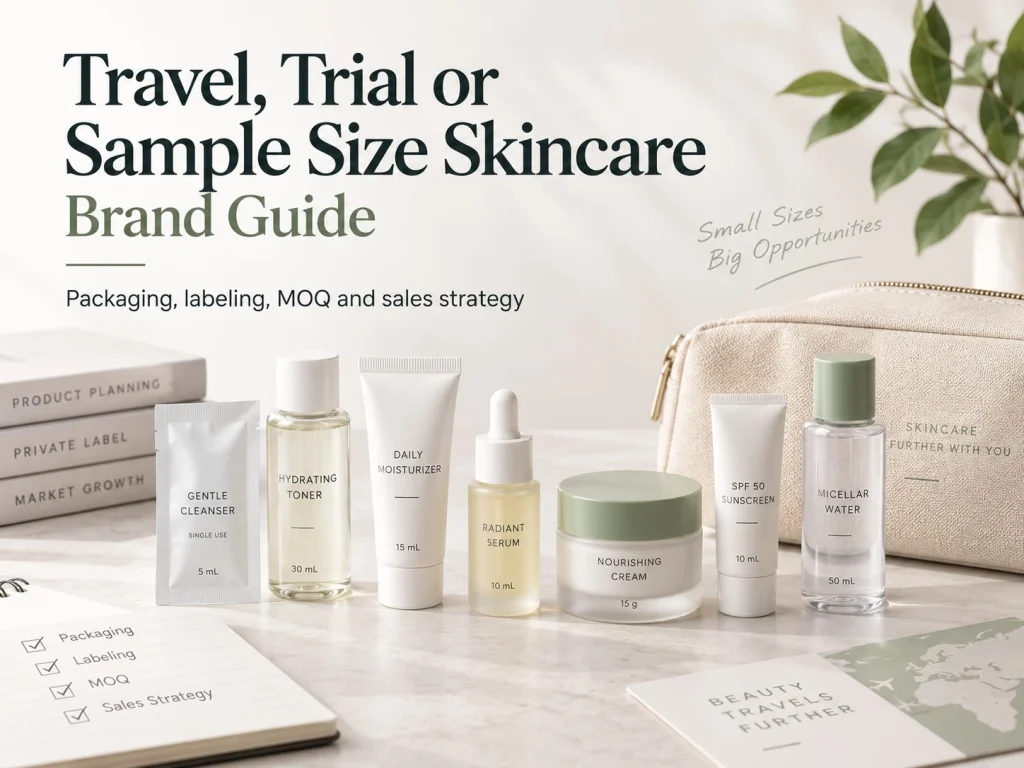

Travel size, trial size and sample size are often treated as three names for a miniature product. For a skincare brand, however, they solve different commercial problems. A sachet that creates one first impression cannot validate a two-week routine, while a 30 mL mini cleanser may be too expensive for mass sampling but valuable as a travel retail SKU.
The right choice depends on what the customer should do next: notice the texture, evaluate routine fit, or buy a convenient portable product. Capacity follows that decision. Packaging, labeling, minimum order quantities, testing and unit economics must then be developed around the intended use.
What Do Travel Size, Trial Size and Sample Size Mean?
These terms are commercial descriptions, not universal legal size classes. A brand, retailer or manufacturer may use different capacity thresholds. Define each format in the product brief by purpose, target uses and distribution model instead of relying on the name alone.
| Format | Primary purpose | Typical user experience | Common distribution model | Common package direction | Main success measure |
|---|---|---|---|---|---|
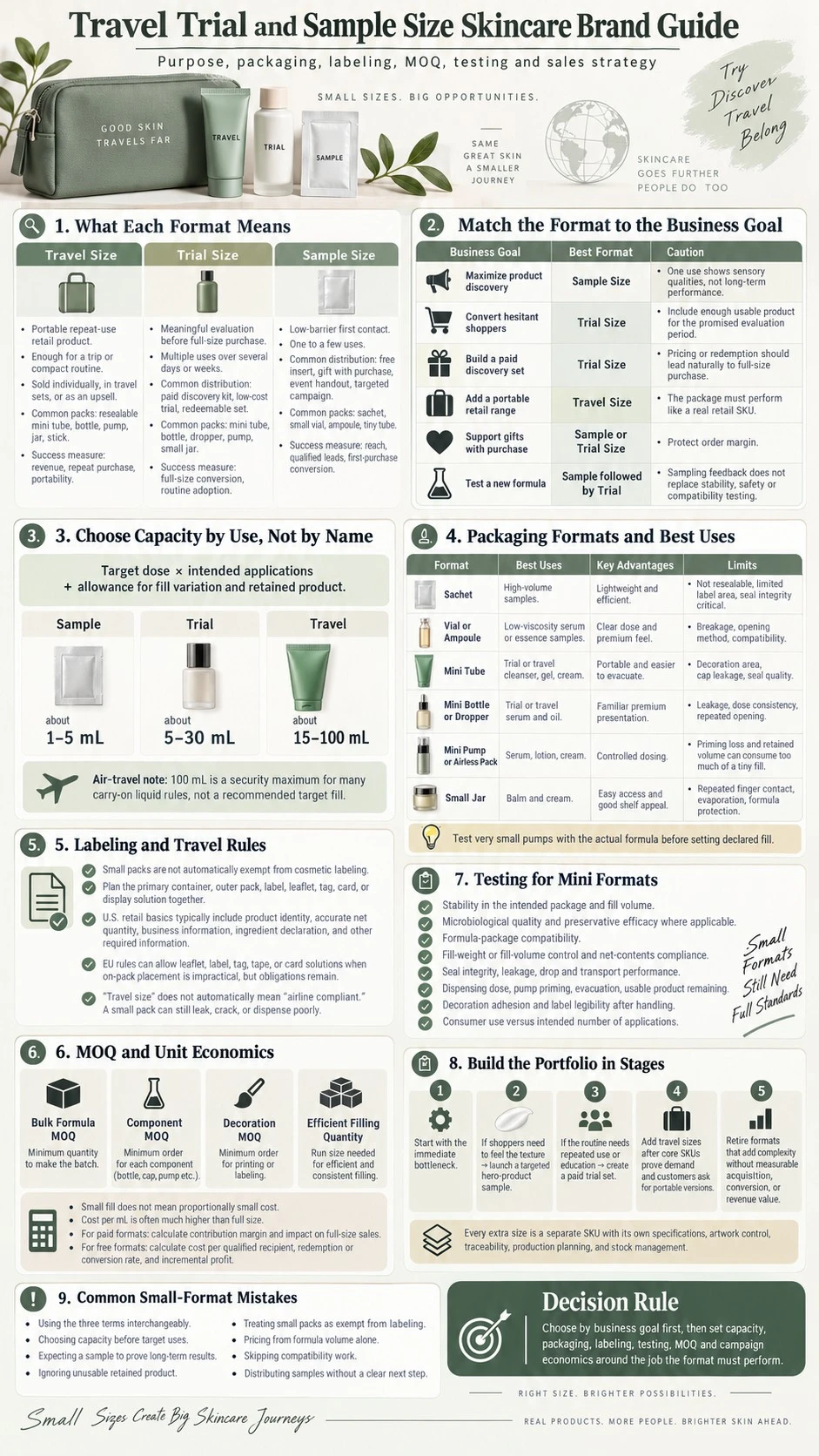
| Travel size | Portable, repeat-use retail product | Enough for a trip, gym bag or compact daily routine | Sold individually, in travel sets or as an upsell | Resealable mini tube, bottle, pump, jar or stick | Revenue, repeat purchase and portability |
| Trial size | Meaningful evaluation before full-size purchase | Multiple uses over several days or weeks, depending on product dose | Paid discovery kit, low-cost trial or redeemable set | Mini tube, bottle, dropper, pump or small jar | Full-size conversion and routine adoption |
| Sample size | Low-barrier first contact with the formula | One to a few uses, usually focused on texture, scent and immediate feel | Free insert, gift with purchase, event handout or targeted campaign | Sachet, small vial, ampoule or tiny tube | Reach, qualified leads and first-purchase conversion |
A brand may use the same formula across all three formats, but that does not make the formats commercially equivalent. The package, fill quantity, instructions, label solution and campaign economics can turn one bulk formula into three different SKUs with three different customer expectations.
Which Format Fits Each Business Goal?
Use sample size when the goal is efficient product discovery. It is especially useful for introducing a sensorial formula, supporting a new-product launch, adding a relevant item to an e-commerce order or reducing uncertainty about texture and fragrance. Sampling works best when distribution is targeted. Sending an anti-aging cream sample to every order may create less value than matching it to customers already buying a related serum.
Use trial size when the customer needs repeated applications to make a reasonable purchase decision. A serum, moisturizer or gentle cleanser often needs more than one use for the customer to judge routine fit, dispensing, after-feel and basic tolerability. Trial kits can also introduce a product sequence, collect leads and create a redeemable path to the full-size purchase.
Use travel size when the small format should stand on its own as a retail product. Customers expect a secure closure, repeatable dispensing, adequate fill, durable decoration and a package that survives bags, bathrooms and transport. Travel products can also make a brand more accessible without discounting its full-size SKU.
| Business goal | Best starting format | Why | Important caution |
|---|---|---|---|
| Maximize qualified product discovery | Sample size | Low customer commitment and broad campaign reach | A single use may show sensory qualities but not longer-term performance |
| Convert hesitant shoppers | Trial size | Provides multiple uses before the full-size decision | The trial must contain enough usable product to support the promised evaluation period |
| Create a paid discovery set | Trial size | Supports a coordinated routine and can offset packaging cost | Set pricing and any redemption credit should lead naturally to full-size purchase |
| Add a portable retail range | Travel size | Delivers convenience and direct revenue | The package must work like a real retail SKU, not a fragile promotional sample |
| Support gifts with purchase | Sample or trial size | Choice can match campaign value and customer qualification | Do not let the gift cost erase the margin of the qualifying order |
| Test demand for a new formula | Sample followed by trial | Separates initial interest from deeper routine evaluation | Sampling feedback is not a substitute for stability, safety or compatibility testing |
How Should Brands Choose the Capacity?
Start with target uses, not a familiar round number. Estimate the intended dose per application, multiply it by the desired number of applications, and add an appropriate allowance for filling variation and product that may remain in the package. Then confirm the result through dispensing and consumer-use checks.
The same capacity creates very different trial periods across categories. Five milliliters of serum may provide many applications, while 5 mL of cleanser may last only a few washes. A thick cream in a pump can also leave more retained product than the same cream in a well-matched tube.
The ranges below are planning examples, not legal definitions or universal recommendations:
| Planning category | Illustrative capacity range | Intended use pattern | Suitable examples |
|---|---|---|---|
| Sample | About 1–5 mL | Single use to a few uses | Serum sachet, cream sachet, small vial or ampoule |
| Trial | About 5–30 mL | Multi-use evaluation | Mini serum, moisturizer, cleanser or discovery-set component |
| Travel | About 15–100 mL | Portable repeat use | Mini cleanser, lotion, mist, tube, jar or pump product |
For air travel in the United States, TSA allows liquids, aerosols and gels in carry-on baggage when each container is 3.4 ounces or 100 mL or less and the containers fit within the applicable quart-sized bag.[1] That 100 mL limit is a security maximum, not a recommendation that every travel-size skincare product should contain 100 mL. The best fill may be much smaller based on usage rate, trip length, price and pack dimensions.
Which Packaging Formats Work Best?
Packaging selection should balance dose control, formula protection, user experience, decoration area, line capability and cost. Review the options through a broader skincare packaging guide before committing to a component.
| Package format | Best suited to | Advantages | Limitations to resolve |
|---|---|---|---|
| Sachet | High-volume samples | Lightweight, compact and efficient for one-use distribution | Usually not resealable; limited label area; fill and seal integrity are critical |
| Vial or ampoule | Low-viscosity serum or essence samples | Clear dose and premium discovery experience | Breakage, opening method, material compatibility and secondary packaging require review |
| Mini tube | Trial or travel cleanser, gel and cream | Resealable, portable and often easier to evacuate | Decoration area, cap leakage and seal quality must be verified |
| Mini bottle or dropper | Trial or travel serum and oil | Familiar application and premium presentation | Repeated opening, leakage, dose consistency and product exposure need assessment |
| Mini pump or airless pack | Trial or travel serum, lotion or cream | Controlled dosing and reduced direct handling | Priming and retained volume can consume too much of a very small fill |
| Small jar | Trial or travel balm and cream | Easy access to viscous products and strong visual presence | Repeated finger contact, evaporation, seal performance and formula protection need review |
Very small pumps deserve special attention. If several actuations are needed for priming, a meaningful part of the trial fill may never reach the user. Test the production-intent pump with the actual formula, record average dose per actuation, and assess evacuation before setting the declared fill.
What Labeling and Travel Rules Apply?
Small packaging does not create a blanket exemption from cosmetic labeling. In the United States, retail cosmetic labeling generally includes product identity, an accurate net-quantity statement, name and place of business, an ingredient declaration and any other required information for the product.[2] Federal rules also prescribe how net quantity must be declared on cosmetic packages.[3]
Some small-package or display situations allow required information to be presented through an outer package, tag, tape, card or nearby display arrangement, but those alternatives are conditional. A brand should not approve a tiny bottle first and assume the missing information can be solved later. Plan the primary container, carton, label, leaflet and sales presentation together. Brands selling in the United States can use this private-label cosmetic labeling guide as a starting checklist.
The EU Cosmetics Regulation also provides specific mechanisms for information that is impractical to place on a small product, including certain leaflet, label, tag, tape or card solutions under Article 19.[4] These mechanisms do not remove the underlying obligations. The responsible person and regulatory reviewer should approve the final artwork for each destination market.
“Travel size” should also be separated from “airline compliant.” A package may be below the TSA liquid limit but still leak, crack or dispense poorly during temperature and pressure changes. Conversely, a solid stick or balm may follow different screening treatment from a liquid. Avoid unqualified universal travel claims when the product will be sold across countries and transport systems.
How Do MOQ and Unit Economics Change?
A small fill does not mean a proportionally small cost. Formula consumption falls, but the container, closure, decoration, label, carton, assembly, quality checks and filling-line setup still apply. A 3 mL sample can therefore cost far more per milliliter than the full-size product.
Review at least four quantity constraints:
- Bulk formula MOQ: The minimum batch the manufacturer can produce consistently.
- Component MOQ: The minimum order for the sachet film, vial, tube, pump, cap or jar.
- Decoration MOQ: The minimum for printing, coating, labeling or other customization.
- Efficient filling quantity: The run size at which setup, changeover and inspection costs become commercially reasonable.
These quantities may not match. A brand can have enough bulk formula for tens of thousands of sachets but face a higher printed-film MOQ, or it may buy mini pumps that cannot be used efficiently with the selected viscosity. Model the total program rather than comparing only quoted fill prices. The MOQ guide for private-label skincare explains how formula, packaging and customization minimums interact.
For paid formats, calculate contribution margin and the effect on full-size sales. For free formats, calculate cost per qualified recipient, redemption or conversion rate, and incremental profit from the customers who convert. A sample campaign with high distribution but poor audience fit can be more expensive than a smaller targeted trial program.
What Testing Is Needed for Mini Formats?
Using an approved bulk formula does not eliminate package-specific verification. In the United States, the manufacturer or distributor is responsible for ensuring cosmetic safety, and FDA does not prescribe one universal test list for every cosmetic product.[5] The testing plan should reflect the formula, package, use instructions, market and foreseeable storage conditions.
For each small format, assess:
- Formula stability in the intended package and fill volume.
- Microbiological quality and preservative efficacy where applicable.
- Formula-package compatibility, including swelling, corrosion, discoloration, odor change and component interaction.
- Fill-weight or fill-volume control and net-contents compliance.
- Seal integrity, leakage, drop and transport performance.
- Dispensing dose, pump priming, evacuation and usable product remaining.
- Decoration adhesion and label legibility after realistic handling.
- Consumer use against the intended number of applications.
A formula packaged in a sachet has a different oxygen, light, seal and opening profile from the same formula in a dropper bottle. Run packaging compatibility testing with production-intent components rather than relying only on the successful full-size pack.
How Should a Brand Build a Small-Size Portfolio?

Most emerging brands do not need all three formats at launch. Begin with the format closest to the immediate commercial bottleneck.
If shoppers hesitate because they cannot experience the texture, start with one targeted sample of the hero product. If the routine requires repeated use or several coordinated products, create a paid trial set. Add travel sizes after core SKUs have proven demand and customers are asking for portable versions.
A practical staged portfolio can look like this:
- Launch one sample format for the hero SKU and distribute it only in relevant channels.
- Measure redemption, first-purchase conversion and feedback rather than distribution volume alone.
- Build a trial set when customers need multi-use evaluation or routine education.
- Add travel retail sizes for proven products with repeat demand and suitable packaging economics.
- Retire formats that create operational complexity without measurable acquisition, conversion or revenue value.
This sequence also limits packaging inventory. Each extra size is a separate finished SKU that needs specifications, artwork control, traceability, production planning and stock management even when the formula is shared.
Common Small-Format Development Mistakes
- Using the three terms interchangeably: The customer offer becomes unclear and capacity decisions have no business rationale.
- Choosing capacity before target uses: A standard 5 mL or 30 mL fill may be wrong for the product’s real dose.
- Expecting a sample to prove long-term results: One or two applications can demonstrate texture and immediate feel, not every performance claim.
- Ignoring unusable retained product: Tiny pumps and viscous formulas can leave a large share of the declared fill inaccessible.
- Treating small packs as exempt from labeling: Required information still needs a compliant presentation solution.
- Pricing from formula volume alone: Components, decoration, assembly and filling setup can dominate small-format cost.
- Skipping compatibility work: A formula that passes in the full-size pack may behave differently in sachet film, a miniature pump or another closure system.
- Distributing samples without a next step: Include a clear path to the matching full-size product, routine instructions and measurable campaign code where appropriate.
Develop Small-Format Skincare Products with ZICAIL
ZICAIL can help brands develop sample, trial and travel formats around a defined acquisition, conversion or retail objective. The process can cover stock or custom formulas, capacity planning, packaging selection, sampling, compatibility work, filling, labeling coordination and production.
Prepare a brief with the destination market, product category, formula status, intended format, target uses, distribution channel, required quantity, packaging references, customization level, target unit cost and desired launch date. ZICAIL can then assess whether a sachet, vial, tube, bottle, pump or jar is practical and identify the MOQ, testing and labeling decisions that must be resolved before production.


