

A well-designed eye cream is more than a face moisturizer placed in a smaller jar. It is a leave-on product used in small amounts near the eye, where migration, sting, pilling, residue, and dispensing accuracy can decide whether a technically stable formula succeeds in everyday use.
For private label brands, the formulation brief must connect the intended cosmetic benefit with texture architecture, ingredient compatibility, packaging, claims, safety, testing, and production. This guide provides that decision framework without treating any ingredient, percentage, or package as universally correct.
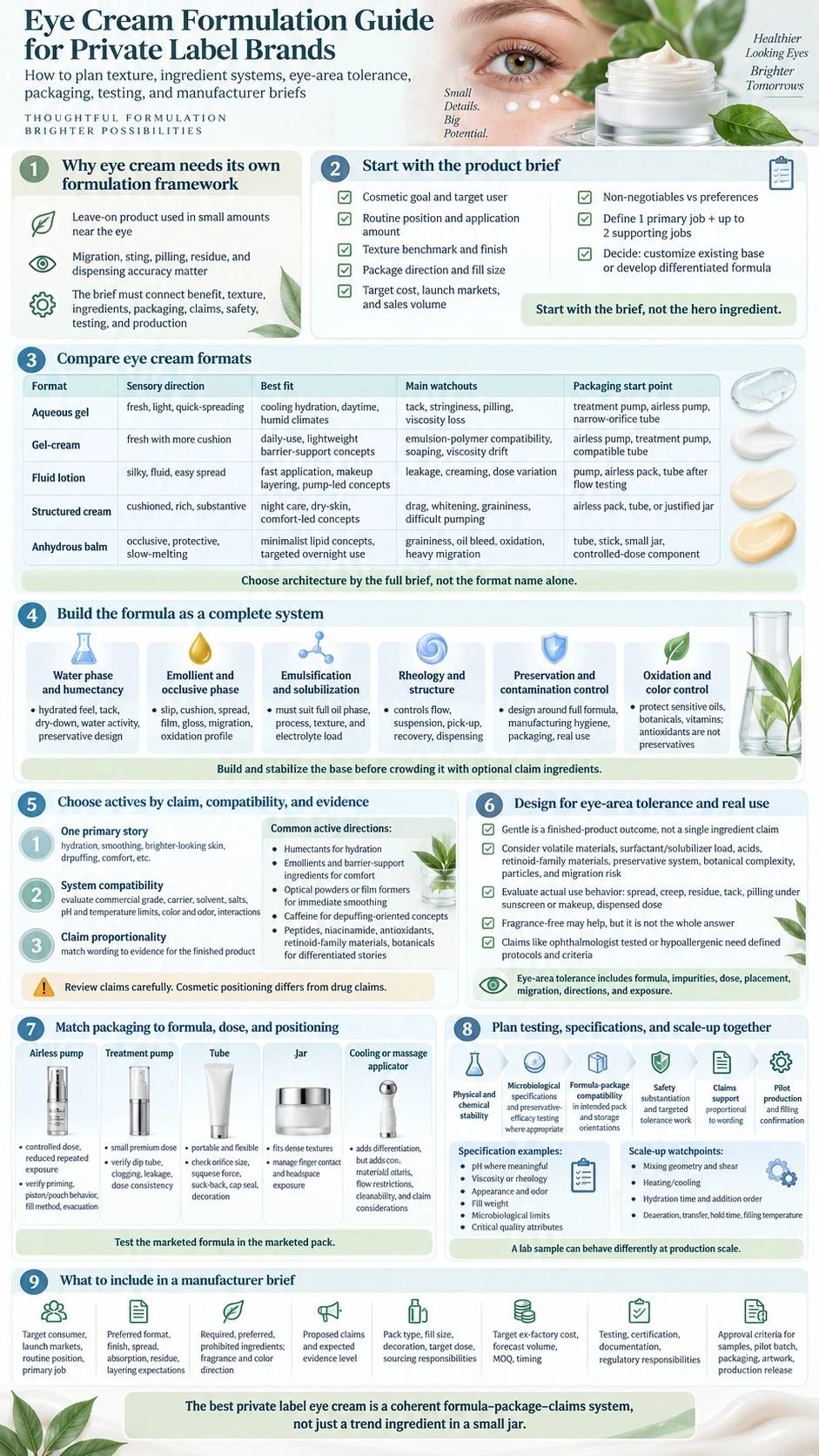
Start With the Product Brief, Not the Hero Ingredient
Begin by defining what the product must do and how the consumer should experience it. “Premium anti-aging eye cream with peptides” is a marketing direction, not yet a development brief. The laboratory still needs to know the intended user, routine step, application amount, sensory benchmark, claims territory, packaging direction, price target, sales markets, and launch volume.
A strong brief separates non-negotiables from preferences. A fragrance-free requirement, a pump format, a specified launch market, and a target fill size may be fixed. A pale color, one botanical extract, or a particular marketing texture may be negotiable if it conflicts with stability, tolerance, cost, or supply.
Define one primary product job and no more than two supporting jobs. Hydration and smoother-looking fine lines can form a coherent brief. Adding depuffing, brightening, lifting, instant blurring, makeup priming, cooling, and overnight repair can create competing sensory, ingredient, and evidence demands. For concepts centered on uneven-looking under-eye tone, review the limits described in ZICAIL’s dark circles under eyes guide before promising that one topical formula can address every cause.
The brief should also state whether the project will customize an existing base or develop a more differentiated formula. That choice affects sampling rounds, technical freedom, test work, documentation, timing, and minimum order economics.
Compare Eye Cream Formats Before Formulation
The commercial name does not define one technical architecture. A “cream” may be a light oil-in-water emulsion, while a “gel-cream” can contain a meaningful oil phase. Use format labels as starting directions, then convert them into measurable sensory and dispensing targets.
| Format | Typical structure | Sensory direction | Strong project fit | Main development watchouts | Packaging starting point |
|---|---|---|---|---|---|
| Aqueous gel | Water-continuous system structured with a compatible polymer or gum | Fresh, light, quick-spreading, low-oil feel | Cooling hydration, daytime use, humid climates, light layering | Tack, stringiness, pilling, air bubbles, electrolyte or pH-related viscosity loss | Treatment pump, airless pump, or narrow-orifice tube |
| Gel-cream | Emulsion or dispersed oil phase supported by a gel network | Fresh first touch with more cushion than a clear gel | Broad daily-use positioning and lightweight barrier-support concepts | Emulsion-polymer compatibility, soaping, viscosity drift, pump recovery | Airless pump, treatment pump, or compatible tube |
| Fluid lotion | Low- to medium-viscosity emulsion | Silky, fluid, easy to spread | Fast application, makeup layering, pump-led concepts | Leakage, creaming, dose variation, insufficient suspension or body | Pump, airless pack, or tube after flow testing |
| Structured cream | More highly structured emulsion or semisolid | Cushioned, rich, substantive | Night care, dry-skin positioning, comfort-led concepts | Drag, whitening, graininess, separation, difficult pumping or evacuation | Airless pack, tube, or jar where justified |
| Anhydrous balm | Water-free blend structured with oils, butters, waxes, or related materials | Occlusive, protective, slow-melting | Minimalist lipid concepts and targeted overnight use | Graininess, oil bleed, oxidation, heat response, heavy migration | Tube, stick, small jar, or controlled-dose component |
Do not select from texture alone. The preferred architecture must carry the requested actives, remain stable in the required pH and temperature window, deliver an appropriate dose, fill efficiently, and support the intended claim and price. If two formats remain credible, prototype both against one scorecard rather than arguing from names.
Build the Formula as a Complete System
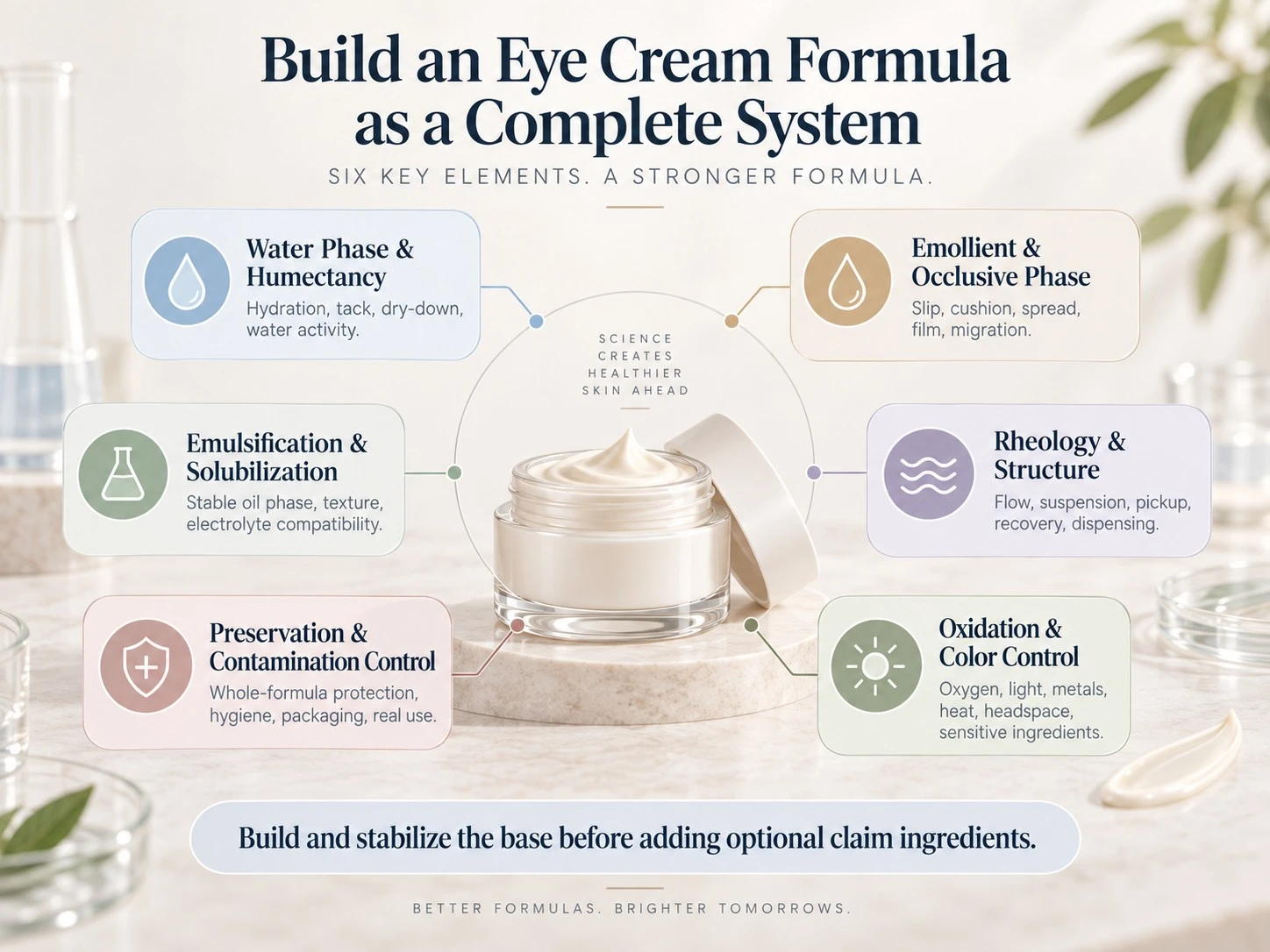
An ingredient list is not a formula strategy. Every material changes the environment in which the others must work. The useful question is not “Which eye cream ingredients are popular?” but “Which functions must this system deliver, and which compatible materials can deliver them?”
- Water phase and humectancy: Water and humectants can support a hydrated feel, but they also influence tack, dry-down, freeze-thaw behavior, water activity, and preservative design. More humectant does not automatically mean a more elegant or better-tolerated product.
- Emollient and occlusive phase: Esters, hydrocarbons, silicones, oils, butters, and other lipophilic materials shape slip, cushion, spread, film, gloss, and migration. Their oxidation profile, odor, color, polarity, sourcing, and compatibility with the emulsion and package matter.
- Emulsification and solubilization: The system must suit the complete oil phase, processing route, target texture, and electrolyte load. Increasing emulsifier is not a universal correction for separation and can change rub-in or residue.
- Rheology and structure: Polymers, gums, fatty alcohols, waxes, and other structurants control flow, suspension, pick-up, recovery, and package dispensing. A single viscosity number cannot describe whether the product strings, pills, leaks, migrates, or recovers after pumping.
- Preservation and contamination control: Water-containing products need a preservation strategy designed around the whole formula, manufacturing hygiene, packaging, and foreseeable use. Chelators and multifunctional materials may support the system, but they do not eliminate the need to verify finished-product protection.
- Oxidation and color control: Oils, botanical materials, vitamins, and other sensitive ingredients may require attention to oxygen, light, metals, heat, headspace, and package protection. Antioxidants address oxidation; they are not substitutes for antimicrobial preservation.
Build and stabilize the base before crowding it with optional claim ingredients. A simpler, coherent formula with a clear sensory identity can be more defensible than a long label whose actives create conflicts or appear only to support marketing copy.
Choose Actives by Claim, Compatibility, and Evidence
Start with the exact cosmetic outcome. Hydration, softer feel, reduced appearance of dry fine lines, temporary smoothing, and brighter-looking skin each imply different formulation levers and evidence needs. Puffiness and dark-circle positioning require particular care because their visible causes vary and a cosmetic cannot correct every underlying factor.
Common directions include humectants for hydration, emollients and barrier-support ingredients for comfort, film formers or optical powders for immediate smoothing, caffeine for depuffing-oriented concepts, and selected peptides, niacinamide, antioxidants, retinoid-family materials, or botanical extracts for differentiated stories. None is automatically suitable merely because it is familiar. Confirm supplier specifications, identity, solubility, recommended use conditions, pH and temperature limits, electrolyte contribution, color and odor, interactions, regulatory status, and evidence for the exact material and final claim.
Active selection should follow three rules:
- One primary story: Choose the main consumer outcome first, then use supporting materials only when they reinforce it.
- System compatibility: Evaluate the commercial ingredient grade and carrier, not just the highlighted INCI name. A supplied blend can introduce solvents, preservatives, salts, or color.
- Claim proportionality: Match wording to the evidence actually available for the finished product. An ingredient study does not automatically substantiate the same result for a different finished formula.
In the United States, intended use determines whether a product is regulated as a cosmetic, a drug, or both. Claims about beautifying or altering appearance generally sit within cosmetic scope, while claims to treat disease or affect body structure or function may create drug status.[1] Review proposed web copy, carton text, product names, visuals, and sales materials together; the label is not the only place where intended use can be established. ZICAIL’s skincare product claims guide explains how to connect wording with substantiation planning.
Design for Eye-Area Tolerance and Real Use
“Gentle” and “suitable for sensitive skin” are not formula architectures. Eye-area tolerance is an outcome of the finished product, its impurities, dose, application zone, migration behavior, directions, and consumer exposure. Fragrance-free may be a sensible positioning choice, but removing fragrance alone does not prove that the formula will not sting or irritate.
Screen the complete system for foreseeable contact near the eye. Consider volatile materials, surfactant or solubilizer load, acids, retinoid-family materials, sensitization potential, preservative system, botanical complexity, particles, and any ingredient likely to migrate with sweat, sebum, or a rich film. The European Union’s Cosmetic Product Safety Report framework specifically calls for particular attention to microbiological quality for cosmetics used around the eyes and focuses the toxicological profile on local effects including skin and eye irritation.[2] This is a useful risk signal even for brands launching elsewhere, although the applicable legal requirements depend on the destination market.
Evaluate use behavior, not just a static sample. Apply the intended dose and observe spread, product creep, residue, tack, pilling under sunscreen or makeup, and whether the pack dispenses more than the user needs. A formula can pass a basic compatibility screen yet create complaints because it travels toward the eye, forms flakes, or leaves a glossy film that conflicts with daytime positioning.
Avoid using “ophthalmologist tested,” “hypoallergenic,” “non-irritating,” or similar language as decoration. Define the protocol, population, endpoints, controls, and acceptance criteria with qualified safety and regulatory professionals before the claim is approved.
Match Packaging to Formula, Dose, and Positioning
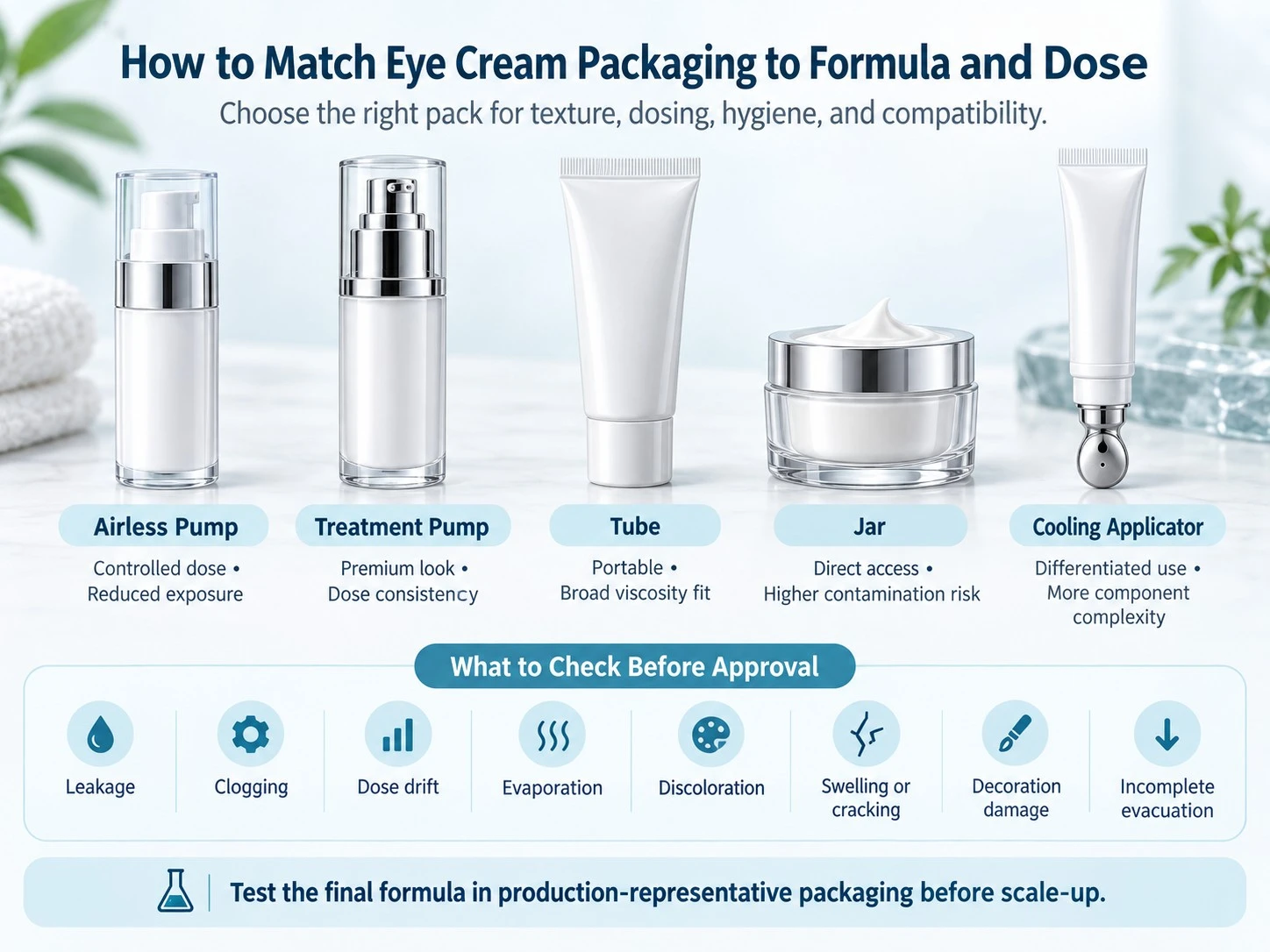
Eye cream packs are small, but their technical role is large. The dispenser controls dose, exposure, evacuation, hygiene, application feel, and perceived value. Select a direction during the brief and introduce representative components before the formula is finalized.
- Airless pump: Useful for controlled dosing and reduced repeated exposure, but performance depends on viscosity, priming, actuator output, piston or pouch behavior, fill method, and evacuation.
- Treatment pump: Can provide a small dose and premium presentation. Check dip-tube reach, clogging, leakage, spring and gasket compatibility, and dose consistency over the use cycle.
- Tube: Flexible, portable, and compatible with many viscosity ranges. Orifice size, squeeze force, suck-back, cap seal, panel recovery, and decoration must suit the bulk.
- Jar: Offers direct access and accommodates dense textures, but finger contact and headspace exposure must be addressed in the microbiological and stability strategy. FDA notes that consumer behaviors such as dipping fingers into a jar can affect contamination risk.[3]
- Cooling or massage applicator: Metal tips, ceramic tips, and roller components can differentiate use, but they add contact materials, flow restrictions, cleanability questions, assembly tolerances, and claim considerations. A cooling sensation from the component should not be confused with evidence for a biological effect.
Test the final bulk in production-representative components. Look for leakage, clogging, dose drift, evaporation, discoloration, swelling, cracking, delamination, corrosion, product drying at the orifice, decoration damage, and incomplete evacuation. Use the packaging compatibility testing guide to plan the study before components are purchased at scale.
Plan Testing, Specifications, and Scale-Up Together
There is no single universal test package for every eye cream. The formula architecture, pack, launch market, claims, shelf-life target, manufacturing process, and foreseeable use determine what must be justified. FDA does not prescribe one test list for each cosmetic, but the manufacturer or distributor remains responsible for marketed product safety.[3]
The development plan commonly covers:
- physical and chemical stability, including appearance, odor, color, pH where meaningful, viscosity or rheology, separation, crystallization, oxidation indicators, and package function;
- microbiological specifications and preservative-efficacy testing where appropriate to the formula and risk assessment;
- formula-package compatibility using the intended bulk, contact materials, fill conditions, storage orientations, and dispensing cycle;
- safety substantiation and any targeted tolerance work needed for the intended eye-area use and claims;
- instrumental, clinical, consumer, or other substantiation proportionate to the exact claims; and
- pilot production and filling confirmation before the master formula and process are locked.
ISO/TR 18811 states that cosmetic stability testing cannot follow one universal method across all products and that manufacturers should specify and justify the protocol, methods, specifications, and conditions.[4] ISO 11930 provides a reference framework for preservation-efficacy testing and microbiological risk assessment of cosmetic products.[5] Neither standard turns a passing accelerated result into an automatic shelf-life guarantee; the protocol must fit the product and its risks.
Specifications should be measurable and reproducible. Define test methods and conditions for pH, viscosity or rheology, appearance, odor, fill weight, microbiological limits, and other critical quality attributes. “Silky,” “light,” and “premium” belong in the sensory benchmark, but manufacturing needs ranges and approved references.
During scale-up, review mixing geometry, shear, heating and cooling, hydration time, addition order, deaeration, transfer, hold time, and filling temperature. A laboratory cream can change body, droplet structure, or pump behavior when batch size and equipment change. Approve the pilot against the same specifications and sensory scorecard used for the laboratory sample.
What to Include in an Eye Cream Manufacturer Brief
Send enough information for feasibility review without pretending that every preference is fixed. A practical brief includes:
- target consumer, launch markets, routine position, and primary product job;
- preferred format, sensory references, finish, spread, absorption, residue, and layering expectations;
- required, preferred, and prohibited ingredients, plus fragrance and color direction;
- proposed cosmetic claims and the evidence level expected;
- pack type, fill size, decoration, target dose, and whether the brand or manufacturer sources components;
- target ex-factory cost, forecast volume, initial order quantity, and timing;
- testing, certification, documentation, and regulatory responsibilities by party; and
- approval criteria for samples, pilot batch, packaging, artwork, and production release.
Ask the manufacturer to flag conflicts, not merely quote the requested list. If a low-pH active system, rich texture, narrow metal applicator, short schedule, and low target cost cannot coexist reliably, the most useful response is an early tradeoff discussion.
Develop a Private Label Eye Cream With ZICAIL
ZICAIL can help translate an eye care concept into a development route covering texture, ingredient direction, packaging, testing, and production. Review our private label eye cream capabilities to define the product category and customization scope.
When you are ready, contact ZICAIL with your target market, benchmark products, format, ingredient policy, claims direction, package idea, fill size, expected order quantity, budget range, and launch timing. A clearer brief makes feasibility review and sample feedback more efficient.


