


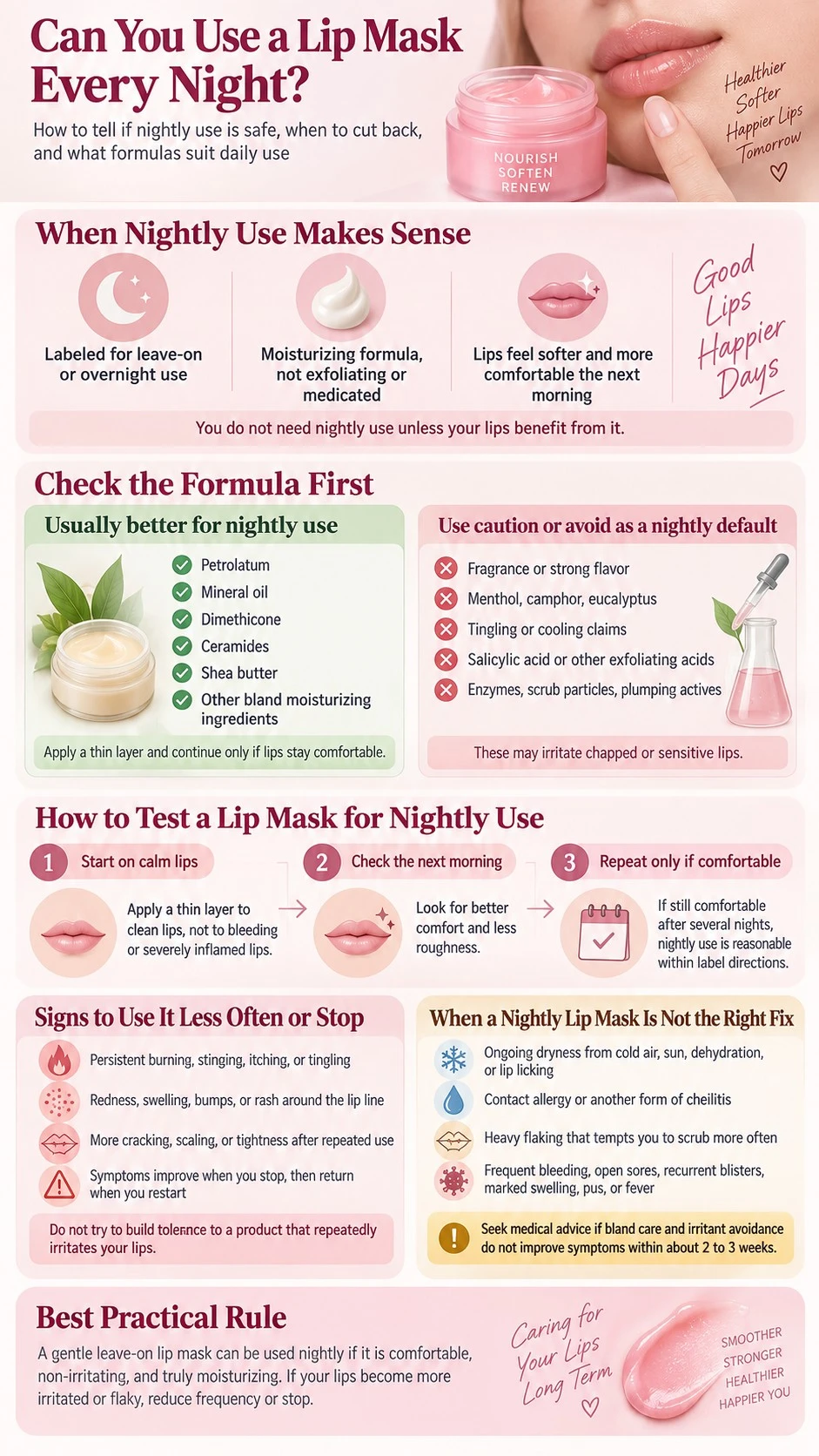
A lip mask can be a useful last step before bed, especially when cold air, indoor heating, wind, or lip licking leaves your lips dry. But the word “mask” does not tell you whether a product is gentle enough for nightly use. The label, formula, and your response matter more than the category name.
When Nightly Lip Mask Use Makes Sense
Nightly use makes the most sense when the product is a simple leave-on moisturizer and your lips feel comfortable after repeated applications. Applying a non-irritating lip moisturizer before bed is a standard part of dry-lip care, and thicker ointment-style products can keep water from escaping longer than lighter waxes or oils.[1]
A nightly lip mask is a reasonable option when all three conditions are true:
- The directions describe it as an overnight or leave-on product and do not set a lower frequency.
- The formula is moisturizing rather than exfoliating, plumping, peeling, or medicated.
- Your lips feel softer or more comfortable the next morning, without persistent sting, itch, redness, swelling, or extra scaling.
You do not need to use a lip mask every night just because the package permits it. If your lips are comfortable, a lighter balm or no overnight product may be enough. The practical difference between a balm and a mask is often texture, wear time, and use occasion rather than a strict scientific category; the lip balm vs lip mask comparison can help you choose the more useful format.
Check the Formula Before Using It Every Night
For frequent use, look for a bland formula that softens the lip surface and leaves a protective film. Occlusives reduce water loss, emollients smooth rough areas, and humectants help hold water near the surface. A balanced product may combine these roles; our guide to humectants, emollients, and occlusives explains the distinction.
| Formula signal | What it means for nightly use | Practical response |
|---|---|---|
| Petrolatum, mineral oil, dimethicone, ceramides, shea butter, or similar moisturizing ingredients | Often suitable in a non-irritating leave-on formula | Start with a thin layer and continue if your lips remain comfortable |
| Fragrance, strong flavor, menthol, camphor, eucalyptus, or cooling and tingling claims | More likely to bother already-chapped or sensitive lips | Choose a simpler formula if you notice discomfort; “tingling” is not proof that the mask is working |
| Salicylic acid, other exfoliating acids, enzymes, scrub particles, or plumping actives | Not a default nightly moisturizer | Follow the label’s frequency and do not add extra sessions to treat flaking |
The American Academy of Dermatology lists fragrance, several flavorings, menthol, camphor, eucalyptus, lanolin, phenol, and salicylic acid among ingredients that can irritate chapped lips. It also notes that petrolatum, ceramides, dimethicone, mineral oil, castor seed oil, and shea butter can be useful in lip products.[1] These are screening clues, not a guarantee: any ingredient can be unsuitable for a particular person. If you are sensitive to scent, also check the difference between fragrance-free and unscented.
How to Test a Lip Mask for Nightly Use
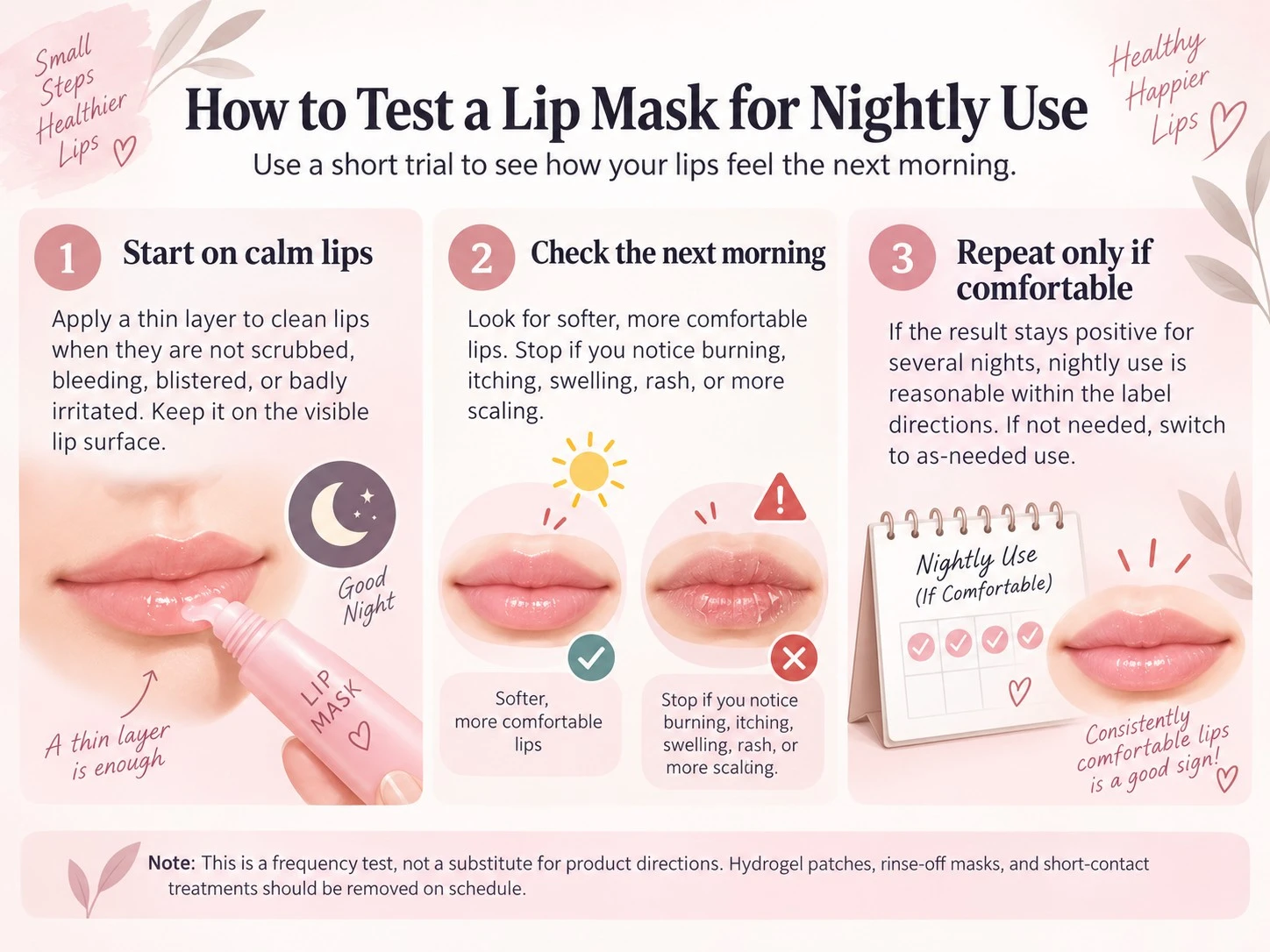
Do not judge a new mask only by how glossy it looks immediately after application. Use a short trial that makes your next-morning response easier to compare.
- Start on calm lips. Apply a thin layer to clean lips on a night when they are not newly scrubbed, bleeding, blistered, or severely inflamed. Keep the product mainly on the visible lip surface.
- Check the next morning. Look for improved comfort and less roughness. Stop if you notice burning, itching, swelling, a new rash, or increased scaling. Do not assume that discomfort is an adjustment period.
- Repeat for several nights only if comfortable. If the response stays positive, nightly use is reasonable within the label directions. If the benefit seems unnecessary, switch to as-needed use rather than continuing from habit.
This is a frequency test, not a substitute for the product directions. Hydrogel patches, rinse-off treatments, and short-contact masks should be removed on schedule. For application amounts, preparation, and morning care, use the full guide on how to use a lip mask.
Signs to Use It Less Often or Stop
Reduce the frequency or stop the product when the pattern points to irritation rather than ordinary dryness:
- Burning, stinging, itching, or tingling that persists after application
- New redness, swelling, bumps, or a rash around the lip line
- More cracking, scaling, or tightness after several uses
- A repeated urge to lick the lips because the flavor or sensation draws attention to them
- A clear pattern in which symptoms ease after you stop the mask but return after later exposure
Lip cosmetics can cause irritant or allergic contact cheilitis. A delayed allergic reaction may look like redness, dryness, scaling, cracking, itching, burning, or mild swelling, and it can continue while exposure continues.[2] Stop the suspected product rather than trying to “build tolerance.” If reactions recur, save the ingredient list or packaging so a healthcare professional can review it.
Frequent use by itself does not prove that a lip mask is damaging your lips. The more useful question is whether the same formula repeatedly leaves your lips calmer or more irritated. A bland product used nightly can be more comfortable than an occasional strongly flavored or exfoliating treatment.
When a Nightly Lip Mask Is Not the Right Fix
A cosmetic mask can reduce surface dryness, but it cannot correct every cause of sore or peeling lips. Cold or dry weather, sun exposure, dehydration, repeated licking, medications, contact allergy, infection, and other forms of cheilitis can all contribute to ongoing symptoms.[3]
Do not respond to heavy flaking by scrubbing more often. Removing attached skin can deepen cracks, and an exfoliating mask can add irritation when the barrier is already compromised. If exfoliation is part of your routine, follow a conservative schedule and see how often to exfoliate your lips rather than treating nightly peeling as a signal to exfoliate nightly.
Seek medical advice if careful use of a bland product and avoidance of irritants do not produce noticeable improvement within about two to three weeks, or if symptoms keep worsening.[1] Arrange earlier evaluation for frequent bleeding, open sores, crusting, recurrent blisters, a persistent change in one spot, marked swelling, pus, or fever. Seek urgent care for trouble breathing or swallowing. Those signs call for diagnosis, not another cosmetic layer.
FAQs About Nightly Lip Mask Use
Can a lip mask make your lips drier?
Yes. A lip mask can worsen dryness if it contains an ingredient that irritates you, encourages lip licking, or exfoliates more often than your lips tolerate. Stop using it if dryness, burning, redness, itching, or scaling increases. A simpler fragrance-free leave-on product may be a better choice for sensitive or chapped lips.
Should you apply lip balm before or after a lip mask?
Usually, you do not need both. A rich overnight mask often already performs the softening and sealing jobs of a balm. If the mask is light and the directions permit layering, a thin bland balm can go on last, but stop if the combination migrates beyond the lip line or causes irritation.
Do you need to wash off a lip mask in the morning?
Not always. If an overnight mask has mostly worn away and your lips feel comfortable, continue with your daytime routine. If sticky residue remains, gently blot or rinse it away rather than scrubbing. Follow different removal directions for short-contact masks and patches.
How long should dry lips take to improve?
Simple chapping should show noticeable improvement within two to three weeks when you avoid irritants and use a non-irritating protective product consistently.[1] If your lips do not improve, or they become more painful, swollen, crusted, or persistently cracked, arrange an evaluation for another cause.
Sources
[1] American Academy of Dermatology Association. 7 Dermatologists’ Tips for Healing Dry, Chapped Lips
[2] DermNet. Contact Reactions to Lipsticks and Other Lipcare Products
[3] Cleveland Clinic. Chapped Lips: Causes, Treatment and Prevention


