
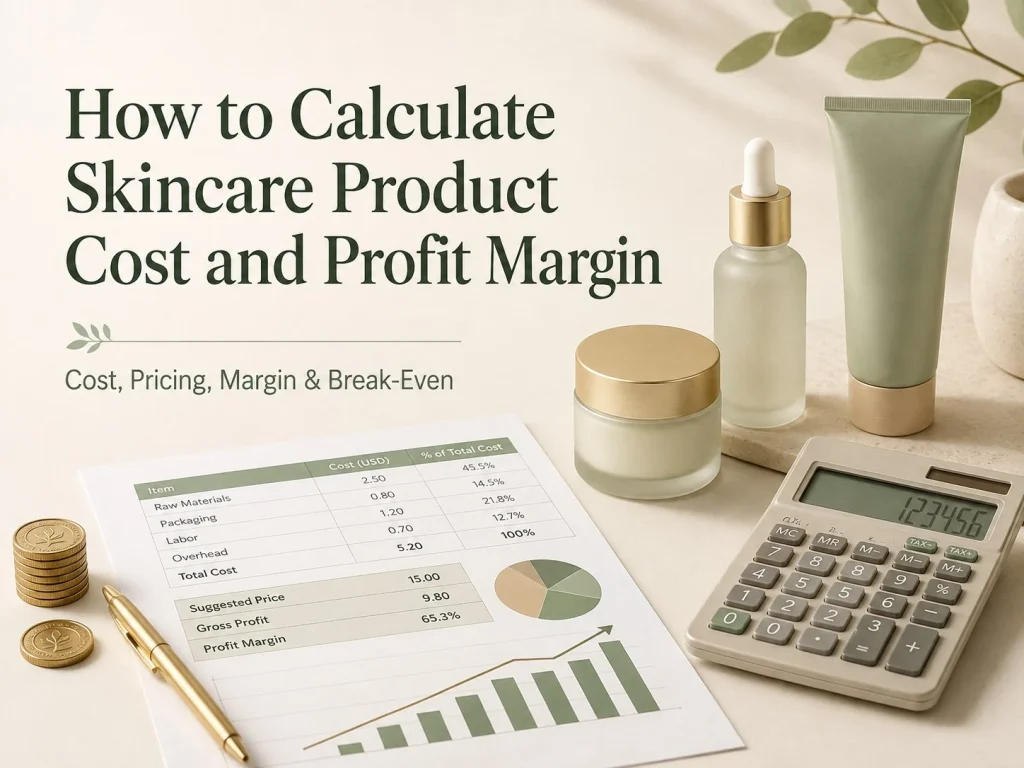


A skincare product can look profitable when you compare the factory quote with the retail price and still lose money after freight, fulfillment, discounts, payment fees, returns, marketing, and wholesale margins are included. The solution is to calculate profitability in layers instead of relying on one markup number.
For a skincare brand, the most useful sequence is: calculate recurring unit cost, determine landed cost, set the realistic selling price for each channel, calculate gross margin, then subtract variable selling costs to see contribution margin. One-time development expenses should be tracked separately so they do not distort the recurring economics of every future reorder.
Start With the Right Skincare Product Cost
The first mistake in skincare pricing is treating the manufacturer’s unit quote as the complete product cost. A quote may include the bulk formula, filling, primary packaging, labeling, cartons, assembly, or quality checks—or only some of them. Ask exactly what is included before building a margin model.
For accounting, inventory cost generally includes purchase costs, conversion costs, and other costs incurred to bring inventory to its present location and condition.[1] For internal pricing decisions, brands often use a practical landed-unit-cost model that makes the recurring cost of getting one sellable unit into inventory visible.
| Cost Component | Examples | How to Treat It in Planning |
|---|---|---|
| Formula and manufacturing | Bulk formula, mixing, filling, production labor, standard QC | Recurring product cost |
| Primary packaging | Bottle, jar, tube, pump, dropper, cap | Recurring product cost |
| Secondary packaging | Carton, insert, label, seal, sleeve | Recurring product cost when used on every unit |
| Inbound logistics | Freight, insurance, customs clearance, brokerage, receiving | Allocate across sellable units using a consistent method |
| Import duties or non-recoverable taxes | Market- and shipment-specific charges | Include when they are a true cost of bringing inventory into the business |
| Inspection or per-shipment testing | Third-party inspection or batch-specific checks | Allocate to units when the cost recurs with orders or shipments |
| Development and setup | Formula development, testing, molds, design, registration, initial artwork | Track separately as one-time or launch cost unless your accounting treatment requires otherwise |
| Variable selling costs | Payment fee, fulfillment, marketplace commission, shipping subsidy, returns allowance, affiliate commission | Do not hide these inside gross margin; use them for contribution margin |
Packaging and MOQ can change unit economics as much as the formula. A premium airless pump may increase product cost, while a lower MOQ can protect cash but spread setup and decoration costs across fewer units. Review the Skincare Packaging Guide and Private Label Skincare MOQ before treating a supplier’s lowest unit quote as the final cost.
Separate Recurring Unit Cost From One-Time Launch Cost
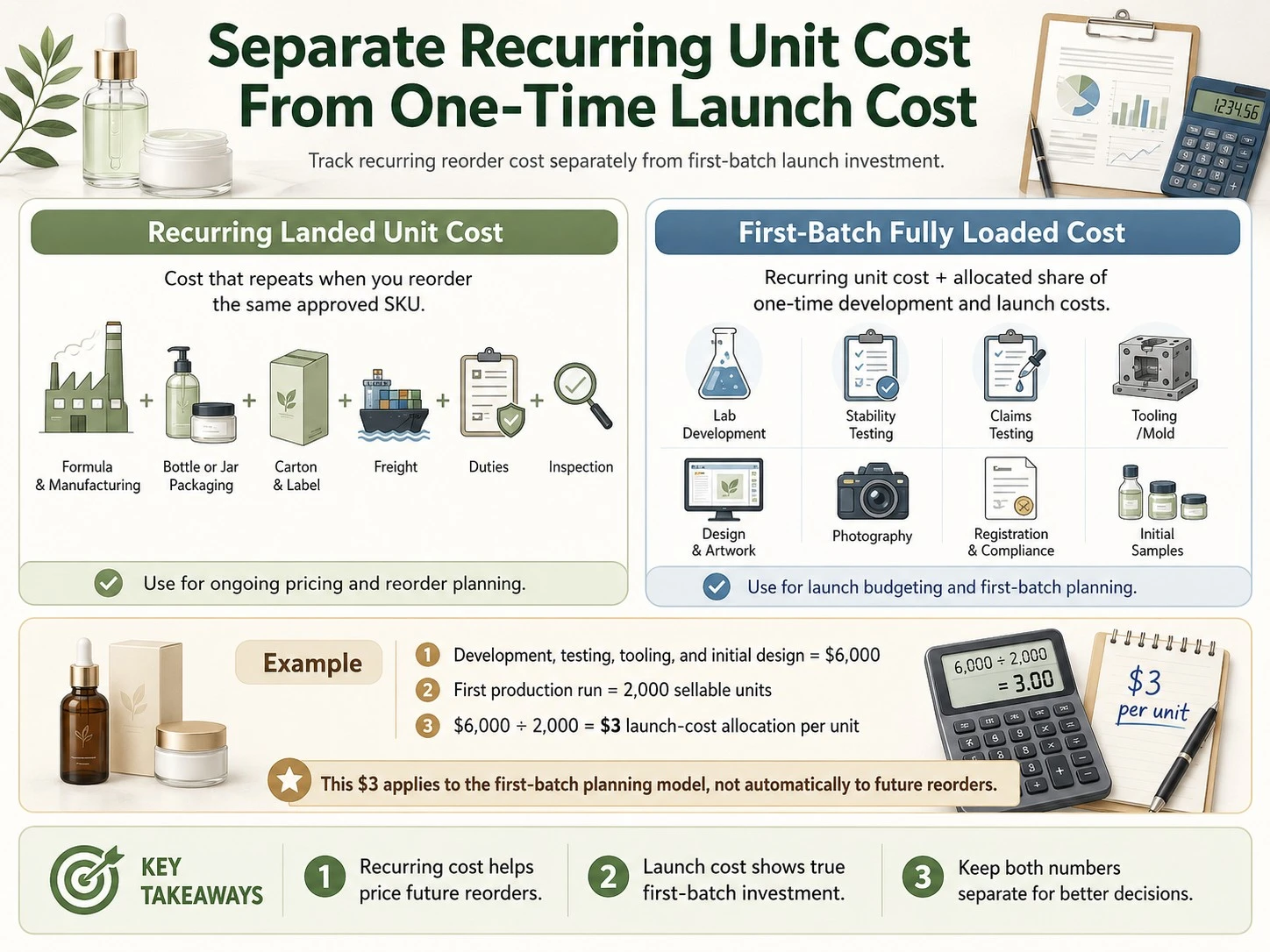
A new skincare product usually has costs that do not repeat in the same way on every reorder. Custom formulation, stability work, claims testing, mold charges, design, photography, registration support, and initial samples can be important launch investments without being part of the recurring cost of every future unit.
For commercial planning, keep two numbers:
- Recurring landed unit cost: The cost that should approximately repeat when you replenish the same approved SKU under similar conditions.
- First-batch fully loaded cost: Recurring unit cost plus an allocated share of one-time development and launch costs.
For example, if development, testing, tooling, and initial design total $6,000 and the first production run contains 2,000 sellable units, the first-batch planning allocation is $3 per unit. That does not mean the next reorder will automatically carry the same $3. Keeping the two figures separate prevents founders from either ignoring launch investment or permanently overstating reorder cost.
The exact accounting treatment of development, tooling, taxes, freight, and other costs depends on the business and accounting framework. Use the operational model for pricing decisions, but reconcile it with your accountant’s COGS and inventory treatment before relying on it for financial statements.
Gross Margin vs Markup: Do Not Confuse Them
Markup and gross margin use the same selling price and cost numbers but divide by different bases. A 100% markup does not mean a 100% margin; if a product costs $10 and sells for $20, the markup is 100% but the gross margin is 50%.[2]
| Cost | Selling Price | Markup | Gross Margin |
|---|---|---|---|
| $10 | $15 | 50% | 33.3% |
| $10 | $20 | 100% | 50% |
| $10 | $25 | 150% | 60% |
| $10 | $40 | 300% | 75% |
For brand planning, margin is usually the more useful language because it shows how much of sales remains after the selected product cost. Markup is still useful when manufacturers, wholesalers, or retailers discuss pricing as a multiple of cost.
Calculate Margin From the Price You Actually Realize
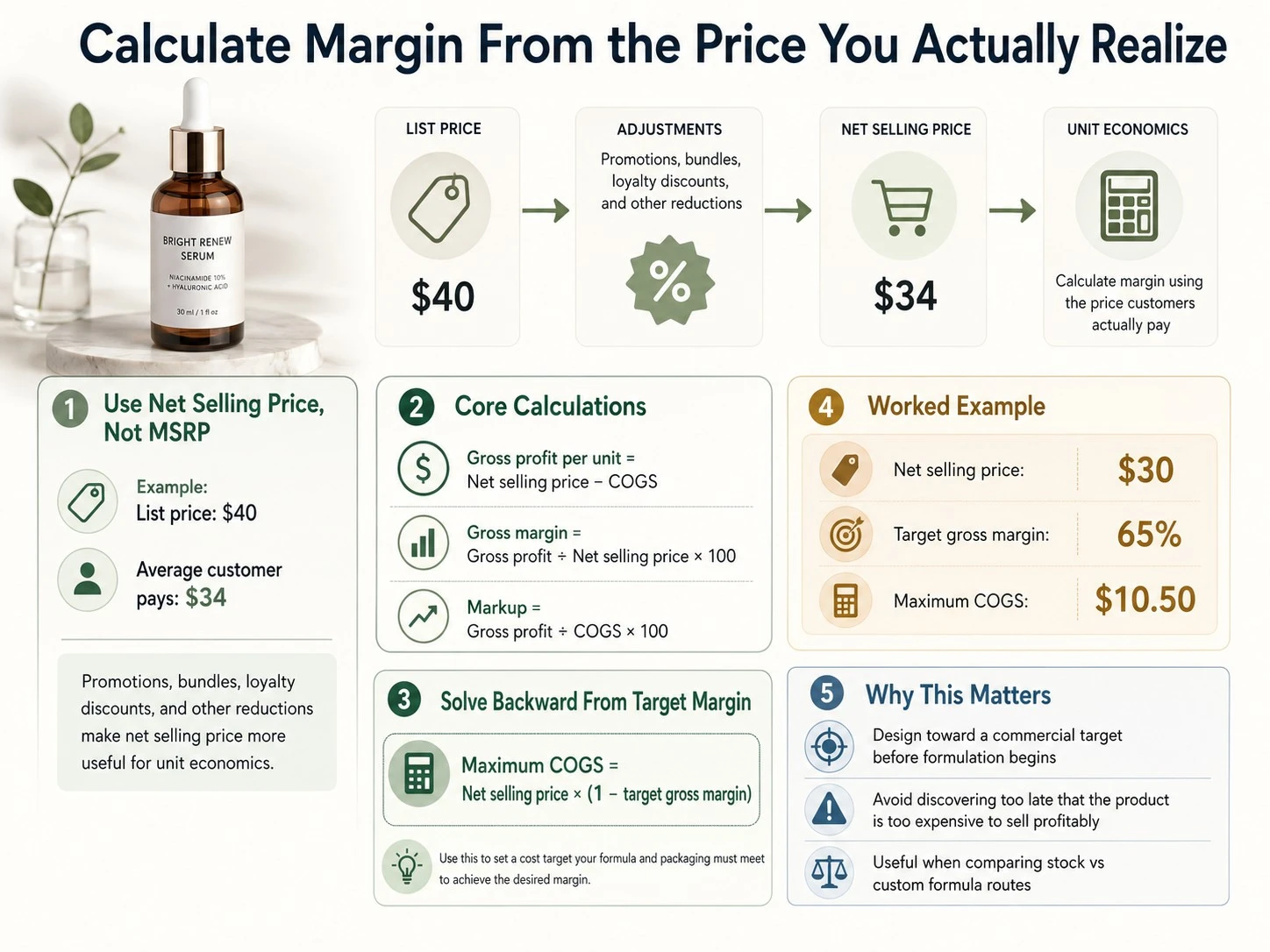
Do not calculate profitability only from MSRP. If a serum has a $40 list price but the average customer pays $34 after promotions, bundles, loyalty discounts, and other reductions, $34 is the more useful starting point for unit economics.
Use net selling price consistently. Then calculate:
- Gross profit per unit: Net selling price − COGS.
- Gross margin: Gross profit ÷ net selling price × 100.
- Markup: Gross profit ÷ COGS × 100.
If you know the margin you want to preserve, solve backward from the selling price:
Maximum COGS = Net selling price × (1 − target gross margin)
This formula is useful before formulation begins. If the market can realistically support a $30 net selling price and your business model requires a 65% gross margin, the COGS ceiling is $10.50. The formulator and packaging team can then design toward a commercial target instead of discovering after development that the product is too expensive to sell profitably.
If you are still deciding between stock and custom formula routes, the Skincare Formulation Guide explains how formulation choices affect technical complexity, MOQ, packaging, testing, and cost.
Gross Margin Is Not Your Real Profit
A strong gross margin can still produce weak economics when the brand spends heavily to complete and acquire each sale. Contribution margin helps answer a more practical question: after the product itself and the variable costs created by the sale are paid, how much money is left to cover salaries, software, rent, professional fees, fixed marketing overhead, and eventual profit?[3]
Common variable costs for a DTC skincare order can include:
- Payment processing
- Pick-and-pack fulfillment
- Outbound shipping paid or subsidized by the brand
- Marketplace or platform commissions that vary with sales
- Affiliate or creator commissions
- Returns, refunds, reshipments, and damage allowance
- Variable samples or gifts included with orders
- Customer acquisition cost when analyzing contribution after paid acquisition
Keep your definition consistent. Some teams calculate contribution before marketing and then a second level after customer acquisition. Either approach can work if everyone reading the model understands which costs have been deducted.
Worked Example: From Factory Cost to Contribution Margin
Consider a hypothetical moisturizer sold primarily through the brand’s own website. The numbers below are examples only; they are designed to show the calculation sequence rather than provide an industry benchmark.
| Item | Per Unit Sold |
|---|---|
| Net selling price after average discounts | $30.00 |
| Landed COGS | $8.00 |
| Gross profit | $22.00 |
| Gross margin | 73.3% |
| Payment processing allocation | $1.00 |
| Fulfillment | $2.00 |
| Shipping subsidy | $3.00 |
| Returns / reshipment allowance | $1.00 |
| Paid acquisition allocation | $6.00 |
| Contribution margin per unit after these variable costs | $9.00 |
| Contribution margin % | 30.0% |
The product appears to have a 73.3% gross margin, but after the example variable selling costs it contributes 30% of net revenue toward fixed overhead and profit. This is why a high retail-price-to-factory-cost multiple should never be described automatically as net profit.
Model DTC and Wholesale Separately
A product can work on your own website and fail in wholesale because the brand receives a lower selling price. The retailer also needs room between its buying price and consumer price, and a distributor can create another pricing layer.
Suppose the same moisturizer has a $35 MSRP and an $8 COGS. If a retailer buys it for $17.50, the brand’s gross profit is $9.50 and its wholesale gross margin is about 54.3%. The retailer’s margin at a $35 full-price sale is 50%. Those percentages come from different revenue bases and belong to different businesses.
| Channel | Revenue Base to Model | Costs That Matter Most |
|---|---|---|
| DTC website | Average net selling price after discounts | COGS, payment fees, fulfillment, shipping, returns, acquisition, promotions |
| Marketplace | Net receipts after marketplace discounts where applicable | COGS, marketplace commission, fulfillment, advertising, storage, returns |
| Wholesale to retailer | Wholesale price received by the brand | COGS, freight terms, sales commission, allowances, samples, chargebacks where applicable |
| Distributor | Price paid by the distributor | Lower sell-in price plus any freight, support, samples, rebates, or market-development costs |
Plan channel economics before approving an expensive formula or package. A brand that may enter retail later should test whether the SKU still works at wholesale revenue, not only at full DTC MSRP.
Use Contribution Margin to Calculate Break-Even
Once contribution margin per unit is known, you can estimate how many units must be sold to cover a selected pool of fixed costs. A standard break-even calculation divides fixed costs by contribution margin per unit.[4]
Break-even units = Fixed costs ÷ contribution margin per unit
If the moisturizer above contributes $9 per unit and you want the first launch to recover $18,000 of fixed launch and operating costs, the simplified break-even point is 2,000 units. If contribution falls to $6 because discounts or acquisition costs rise, the same $18,000 requires 3,000 units.
This is why MOQ should be compared with sell-through and break-even, not treated only as a supplier purchasing requirement. A low unit cost on a large MOQ can still be a poor decision when too much cash is locked in inventory or the sales volume needed to recover fixed costs is unrealistic.
Stress-Test the Price Before You Approve the Product

A pricing model should survive conditions that are less favorable than the launch spreadsheet. Test the SKU at more than one scenario before formula and packaging are locked.
- Discount scenario: What happens if average realized price is 10% or 20% below MSRP?
- Freight scenario: What happens if inbound shipping or duties increase?
- Lower production volume: What happens if the reorder does not reach the best quoted price tier?
- Wholesale scenario: Can the brand still make an acceptable margin at sell-in price?
- Higher return or damage rate: Is the contribution margin still positive?
- Higher acquisition cost: How much paid marketing can the product support before the first order stops contributing?
- Promotion scenario: Can bundles, free shipping, samples, and affiliate commissions be funded without destroying the economics?
Do this before finalizing the brief with a manufacturer. A product should be designed to fit its intended price architecture, not developed first and priced afterward. If you are evaluating partners, use How to Choose a Skincare Manufacturer to compare MOQ, formulation support, packaging, testing, and commercial fit together.
Common Skincare Product Costing Mistakes
- Using the factory unit quote as the full landed cost.
- Calling markup and gross margin the same percentage.
- Calculating margin from MSRP while most units sell at a discount.
- Ignoring fulfillment, payment fees, shipping subsidies, marketplace commissions, returns, or acquisition cost.
- Mixing one-time development expenses into recurring reorder cost without labeling the difference.
- Setting retail price before testing whether wholesale economics work.
- Choosing premium packaging without calculating its effect on cost ceiling and MOQ.
- Assuming a lower unit cost is always better even when it requires much more inventory.
- Using gross margin as if it were net profit.
- Building only one optimistic pricing scenario.
Final Thoughts
A useful skincare pricing model separates recurring landed cost, one-time launch investment, gross margin, markup, contribution margin, and fixed overhead. Calculate each channel from the price the brand actually receives, then stress-test discounts, freight, MOQ, returns, and customer acquisition before approving the product.
If your brand is planning a new skincare SKU, ZICAIL can help connect formula direction, packaging, MOQ, testing, and manufacturing cost to the price point and channel you want to support. Share your product type, target price, expected order quantity, packaging direction, and intended sales channels so the project can be evaluated against a realistic unit-cost target before final development.


