


Mini packs serve different jobs: a one-application sample, a multi-day trial, a gift-with-purchase, a travel SKU or a compact retail set. The same 10 mL fill can require very different packaging depending on which job the brand expects it to do.
Why Mini Packaging Is Not Just a Smaller Full-Size Pack
Reducing capacity changes the relationship between the formula and the package. A pump’s priming loss or a tube’s headspace may be minor in a 50 mL pack but material in a 5 or 10 mL pack. Small components also offer less label area, can be harder to fill and decorate, and may raise unit assembly costs.
Start with the use case, then choose the delivery system. If the project is still defining whether the SKU is a sample, paid trial or reusable travel product, settle that distinction before requesting packaging quotations. ZICAIL’s guide to travel size, trial size and sample size explains why those formats should not share one commercial brief.
Tubes vs Airless Pumps vs Bottles vs Sachets
| Format | Typical formula fit | Best use model | Main strengths | Main watchouts |
|---|---|---|---|---|
| Tube | Cleanser, gel, cream, balm | Multi-use trial or travel | Squeezable, familiar, good control when the orifice is matched | Seal quality, cap retention, paneling, decoration area, product at the shoulder or crimp |
| Airless pump | Serum, lotion, light-to-medium cream | Premium trial or travel | Metered dispensing and limited air return in a validated system | Priming, incomplete evacuation, actuator lock or cap, component count, filling method |
| Bottle | Toner, essence, oil, mist, fluid serum | Multi-use trial or travel | Many closure and actuator choices; suitable for low-viscosity products | Leak paths, uncontrolled pouring, dip-tube performance, cap or pump compatibility |
| Sachet | Serum, cream, gel, cleanser or mask dose | Single-use or few-use sample | Low shipping volume, broad printable face, efficient distribution | Tear behavior, dose removal, seal integrity, limited reclosure, flexible-material waste |
This table is a screening tool, not a final specification. A thick gel may work in one tube and fail in another because the orifice differs; a fluid serum may work with one pump engine but drip from another. The finished formula and complete pack must be evaluated together.
Choose the Format by Formula and Use Model
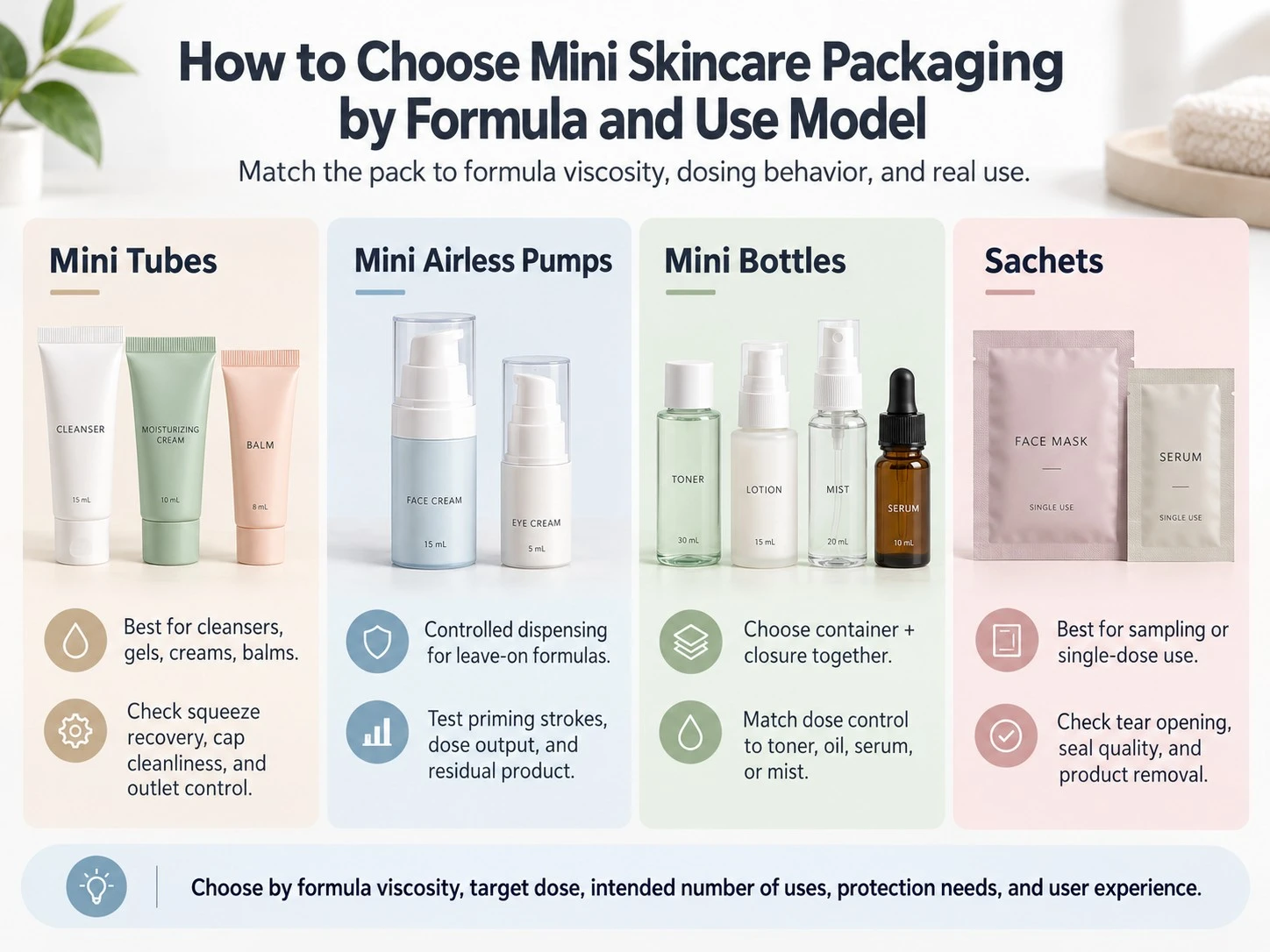
Mini Tubes
Mini tubes are often the simplest multi-use answer for products users already expect to squeeze: face wash, gel moisturizer, cream, balm and some masks. They can work upright or inverted, and a small orifice can limit accidental over-dispensing. See the more detailed face cleanser packaging comparison when the mini contains a wash-off formula.
Ask whether the tube body recovers after squeezing, whether the formula strings or plugs at the opening, and whether product migrates into the cap. The closure should remain attached through repeated use, while the seal or crimp must survive transport and temperature cycling. For very fluid products, a tube can dispense too quickly unless the outlet and viscosity are well matched.
Mini Airless Pumps
Airless systems can support controlled dispensing and reduce repeated air return, but “airless” is not a guarantee that every formula will pump or remain stable. Commercial systems span mini capacities; for example, Aptar lists its Nano platform in 5, 10 and 15 mL formats.[4] Its wider airless portfolio covers multiple viscosity ranges.[5] Those supplier specifications show that small airless formats exist, not that one system suits every formula.
For a 5 or 10 mL pack, record how many full strokes are required before first product delivery, the nominal output per stroke and the mass left after normal consumer use. A beautiful pack that consumes a meaningful share of the fill during priming or leaves product below the piston may deliver poor perceived value. Compare pack options with the criteria in ZICAIL’s dropper, pump and airless serum packaging guide.
Mini Bottles
“Bottle” is a container family, not a dispensing method. A mini bottle may use a screw cap, reducer insert, treatment pump, mist sprayer, dropper or flip-top closure. Choose the finish and closure together based on viscosity, target dose and use environment.
Low-viscosity toner or essence may need a reducer to prevent pouring too much. A facial oil may need a controlled dropper or treatment pump. A mist needs a spray pattern that remains acceptable across the fill range and orientation. For pumps with dip tubes, test reach, cut angle and performance when the bottle is tilted or nearly empty.
Sachets
Sachets are strongest when the planned unit is a dose rather than a small bottle. They can place a formula into subscription boxes, mailers, events or retail sampling programs without the volume of a rigid container. Flexible-pack suppliers offer barrier structures for cosmetic sampling and travel applications, but the film structure must still be selected for the product and filling process.[6]
Specify the target dose, tear notch, opening direction, seal width, print registration and how a user will remove viscous product. A flat sachet that technically contains enough cream may still frustrate users if product remains in the corners. If more than one use is intended, define how the opened pack will be stored hygienically and whether a fitment or reclosure is required.
Sample, Trial or Travel Size Changes the Packaging Brief
A sample answers, “Can the customer experience the texture or one application?” A trial gives enough product to evaluate a short routine. A travel SKU must remain usable across repeated openings, transport and varied orientations. Those goals drive different choices even when the formula is identical.
Do not use “TSA size” as a complete packaging specification. For U.S. carry-on screening, TSA limits liquids, aerosols, gels, creams and pastes to containers of 3.4 oz or 100 mL or less within the 3-1-1 system.[7] That limit does not establish an ideal skincare fill, prevent leakage or prove that a closure will survive a flight. The pack still needs brand-specific transit, use and compatibility testing.
Check Priming, Dose and Usable Product
Nominal fill is not the same as usable product. For each candidate, measure the filled mass, the mass dispensed under a defined use method and the mass remaining when a typical user would consider the pack empty.
For pumps, capture priming strokes, output consistency and partial-stroke behavior. For tubes, test the force needed to dispense at expected temperatures and the product left in the shoulder and crimp. For bottles, observe drips, flooding and closure contamination. For sachets, evaluate tear control and how much product can be removed without tools.
These results should be reviewed as percentages as well as grams. One gram of residual product has a very different commercial impact in a 5 g mini than in a 50 g full-size pack. Define an acceptance criterion for each SKU rather than applying one universal target.
Match Protection to the Formula
The pack must protect the product through manufacturing, shipping, storage and consumer use. Consider light exposure, oxygen and moisture transfer, volatile loss, formula contact with plastics, liners and elastomers, and the chance of contamination after opening. FDA identifies inadequate protective packaging as one possible route to cosmetic microbial contamination.[3]
Material names alone do not answer compatibility. PET, PP, PE, glass, multilayer tube laminates and flexible films behave differently, but resin grade, colorant, closure and contact surface also matter. Use ZICAIL’s skincare packaging materials guide for initial screening, then run packaging compatibility testing on the complete decorated pack.
Plan Labeling and Decoration Before Tooling
Mini components compress the artwork area, but required information does not disappear. FDA’s U.S. cosmetics labeling guide states that required information must be prominent and conspicuous; it also describes provisions for tags, tapes or cards on certain decorative or small containers.[1] The right layout depends on the market, whether an outer carton or display card is used, and whether the inner pack is sold separately.
Ask the artwork team to test real dielines early. Confirm the printable zone, seam or crimp exclusions, barcode readability, overlabel feasibility and whether the chosen decoration tolerates flexing, product contact and transit abrasion. Do not approve a component based only on a blank sample.
Compare Total Pack Economics, Not Container Price Alone
The lowest empty-component quote may not create the lowest finished cost. Compare the container, actuator or closure, cap, label or decoration, sachet film, carton or card, filling loss, assembly labor, leak testing, freight volume, tooling and supplier minimums as one system.
Also ask whether the pack runs on existing equipment. A standard bottle may be inexpensive but require a new small-dose filling setup; a sachet may be economical at scale but introduce artwork cylinders, film minimums or outsourced conversion. Request quotations at the same annual volume and configuration so the options are comparable.
How to Validate Mini Skincare Packaging

- Define the job. State whether the mini is a single-use sample, multi-day trial, gift, travel SKU or retail set component, including the intended number of uses.
- Set the dispensing target. Record the formula viscosity range, target dose, use orientation and how the user should open, dispense and close the pack.
- Shortlist complete systems. Select the container, closure or actuator, liner, cap, decoration and any secondary pack as one configuration, not as independent parts.
- Fill production-representative samples. Use the intended formula, target fill, filling method and component lot so priming, sealing and headspace can be assessed realistically.
- Run performance and compatibility checks. Evaluate leakage, actuation, dose, evacuation, appearance, odor, weight change, decoration and formula-package interaction under the project’s test protocol.
- Lock specifications and acceptance criteria. Approve drawings, materials, artwork, fill tolerances, functional limits, inspection points and change-control responsibilities before purchase.
FDA’s cosmetics GMP checklist advises manufacturers to store and handle primary packaging to prevent mix-ups, contamination and decomposition from environmental exposure.[2] Packaging approval should therefore connect to incoming inspection, line clearance, batch documentation and finished-product specifications—not end with a visual sample.
Questions to Put in the Packaging RFQ
- What are the exact capacity, brimful capacity, dimensions, materials and component weights?
- Which formula viscosity range and filling method does the supplier recommend for this configuration?
- What is the nominal pump output or dispensing-orifice size, and what tolerances apply?
- How is the pack primed, sealed, leak-tested and oriented during shipping?
- What are the standard colors, decoration methods, artwork limits, tooling charges and lead times?
- What are the MOQ and price breaks for every component, including caps, pumps, labels, cartons and spares?
- Which compatibility, transit and functional data can the supplier provide, and which tests remain the brand’s responsibility?
- How will component, resin, colorant, mold, plant or sub-supplier changes be controlled and communicated?
These questions turn a visual packaging request into a testable commercial specification. For broader options, review ZICAIL’s packaging customization overview before sending the RFQ.
Build the Mini Pack Around Its Real Job
Choose a tube for practical repeated squeezing, an airless pump when validated dosing and protection earn their complexity, a bottle when a closure can control a fluid formula, and a sachet when the unit is fundamentally a sample dose. Then validate the exact filled configuration.
For a private label project, send the manufacturer the formula type, intended use count, target fill, market, decoration goal and required launch quantity—not just a reference photo. If you need help translating those inputs into a packaging shortlist, contact ZICAIL with your project brief.


