

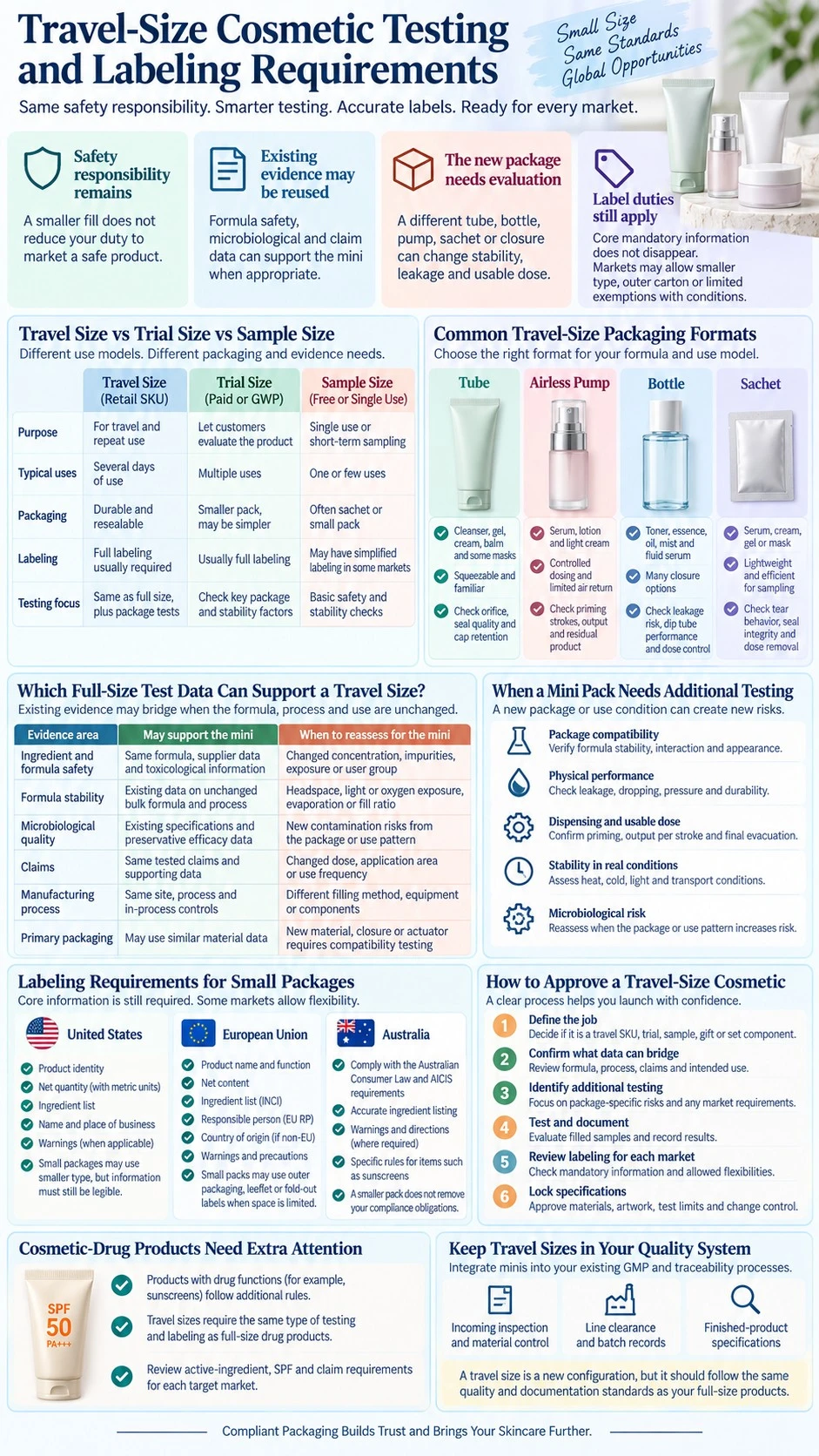
A travel-size launch is often described as a packaging extension, but regulators and quality teams evaluate the finished product configuration—not just the bulk formula. The central question is therefore not “Is it the same formula?” It is “Which parts of the safety, performance and label file are still representative of this exact mini SKU?”
Same Compliance Responsibility, Different Evidence Gaps
For U.S. cosmetics, regulations do not prescribe one universal test list, but the responsible person must ensure and maintain records supporting adequate safety substantiation.[1] Existing ingredient data and evidence from similar formulations can be used, while additional testing may be needed to close remaining safety gaps.[2] Product size alone neither creates a mandatory duplicate test program nor excuses the brand from substantiation.
Treat the travel size as a new configuration of an existing product. Compare the mini with the full size across formula, raw-material specifications, manufacturing site and process, fill method, primary packaging, intended use, directions, claims, target user and market. Any material difference becomes a documented question to resolve before release.
First decide whether the unit is a retail travel SKU, paid trial, free sample or single-use pack. These terms describe different commercial and use models, as explained in ZICAIL’s guide to travel size, trial size and sample size. The classification affects expected use duration, label layout, secondary packaging and the evidence needed from the final pack.
Which Full-Size Test Data Can Support a Travel Size?
The table below separates evidence that may bridge from work that normally needs a mini-specific decision. “May bridge” means the brand has documented why the evidence remains relevant; it does not mean automatic acceptance.
| Evidence area | What may support the mini | What must be reassessed |
|---|---|---|
| Ingredient and formula safety | Same quantitative formula, supplier data, toxicological information and finished-formula assessment | Changed concentration, impurities, exposure, application area, user group or directions |
| Formula stability | Existing data on the unchanged bulk formula and manufacturing process | Headspace, light or oxygen exposure, evaporation, fill ratio and behavior in the mini pack |
| Microbiological quality and preservation | Existing microbiological specifications and preservative efficacy evidence for the same formula and process | New contamination routes, applicator contact, repeated opening, dose removal and package protection |
| Packaging compatibility | Data only when contact materials, closures and product-contact geometry are genuinely equivalent | Migration, sorption, discoloration, stress cracking, paneling, seal integrity, leakage and dispenser function |
| Claim substantiation | Evidence for the same finished formula, benefit, directions and conditions of use | New claims, changed dose, applicator, regimen, user instruction or presentation that changes claim meaning |
| Finished-product specification | Shared formula attributes and methods where scientifically appropriate | Mini-specific fill quantity, dimensions, closure, output, leak, appearance, coding and pack-function criteria |
The evidence decision should reference the actual reports, specifications and protocol versions. “Same as full size” is not a sufficient justification by itself. ZICAIL’s comparison of stability, compatibility and challenge testing helps separate these related but different evidence jobs.
When a Mini Pack Needs Additional Testing
The Packaging System Changes
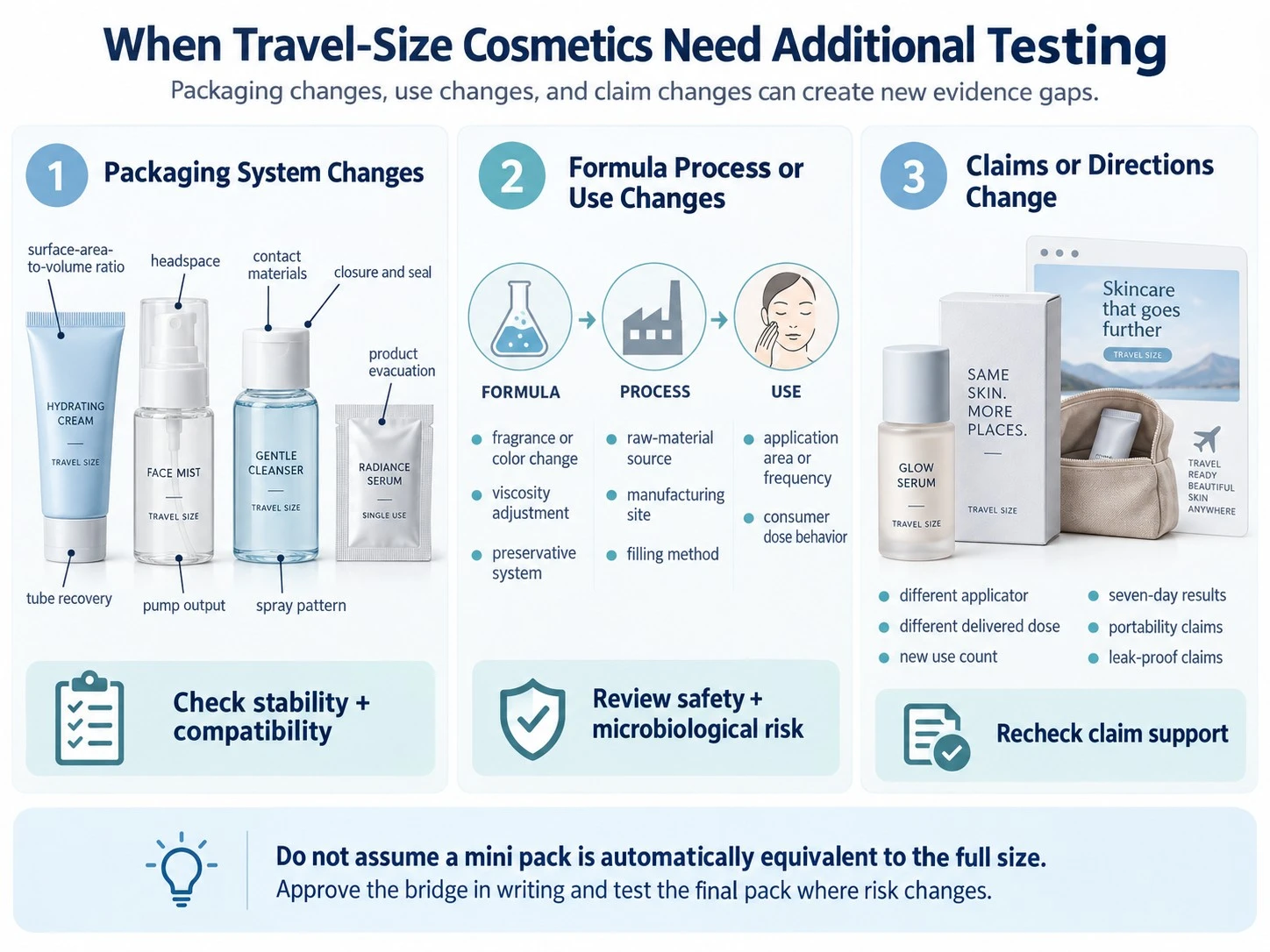
A smaller version commonly changes the surface-area-to-volume ratio, headspace, product-contact materials, closure geometry, wall thickness, seal area or dispensing system. EU safety-report guidance specifically treats the combination of formulation, packaging material and external environment as relevant to finished-product safety, and it calls for stability work using the intended market packaging.[3] This makes packaging equivalence a technical conclusion, not a visual one.
Use filled, production-representative components to assess appearance, odor, color, pH, viscosity or other relevant formula attributes alongside package changes. Check weight loss, leakage, seal integrity, torque or crimp, pump priming and output, spray pattern, tube recovery, sachet opening and product evacuation as applicable. Compatibility work should cover the complete product-contact system, not only the bottle resin. See ZICAIL’s packaging compatibility testing guide for a fuller protocol framework.
Packaging can also change contamination risk. Inadequate protection is one recognized route by which cosmetics may become microbiologically contaminated.[4] A single-use sachet, repeated-use jar, treatment pump and squeeze tube expose the formula differently, even when each contains the same bulk batch.
The Formula, Process or Use Pattern Changes
Repeat or extend the relevant assessment when the mini uses a different fragrance level, color, viscosity adjustment, preservative system, raw-material source, manufacturing site, batch process or filling method. A formula marketed for a different application area, age group, frequency or duration also needs a new exposure and safety review rather than a packaging-only bridge.
A smaller fill can change user behavior. Consumers may squeeze out proportionally larger doses, use a shorter dropper, apply a concentrated amount from a sachet or keep an opened multi-use sample under less controlled conditions. These differences do not automatically require every laboratory study to be repeated, but they must be considered in the safety, microbiological and functional gap assessment.
For preservative efficacy, do not repeat a challenge test solely because the printed fill quantity changed. Instead, document whether the formula, manufacturing controls and expected contamination exposure remain representative, then close any evidence gaps with scientifically sound work.[2] Repeat or supplement the assessment when the preservation system, formula, process, dispenser, opening size, application method or repeated-use contamination risk changes. ZICAIL’s cosmetic microbiological testing guide provides the broader product-quality context.
The Claims or Directions Change
Existing claim evidence can support a mini only to the extent that the marketed claim remains the same and the evidence still represents how the mini is used. Objective advertising claims require a reasonable basis before they are disseminated.[5] A different applicator, delivered dose, number of applications or instruction such as “seven-day results” can make the full-size study a poor match even when the formula is unchanged.
Review the front label, carton, product page, retailer listing, set name and campaign copy together. Claims communicated by the full presentation matter, not only the sentence printed on the bottle. If the mini adds a performance, duration, portability, leak-proof or use-count claim, define and substantiate that claim separately. ZICAIL’s cosmetic claim testing methods overview can help match the claim to an appropriate evidence type.
How to Approve a Travel-Size Cosmetic
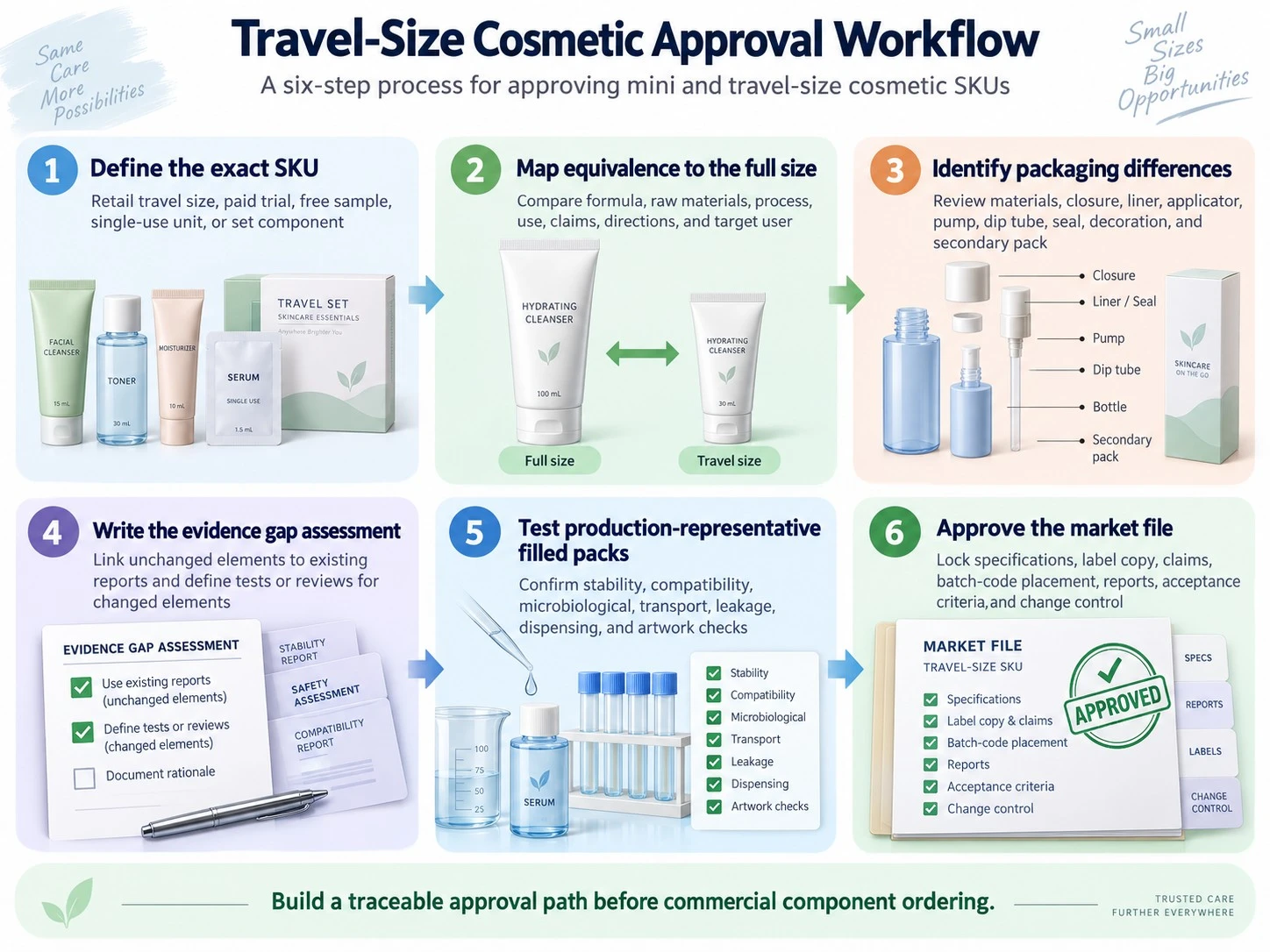
- Define the exact SKU. Record whether it is a retail travel size, paid trial, free sample, single-use unit or component of a set, plus the target markets and sales channels.
- Map equivalence to the full size. Compare formula, raw materials, process, site, fill method, use, claims, directions, target user and storage conditions.
- Identify packaging differences. Document every product-contact material, closure, liner, applicator, pump, dip tube, seal, decoration and secondary-pack change.
- Write the evidence gap assessment. Link each unchanged element to existing reports and assign each changed element a risk decision, test, calculation, supplier document or regulatory review.
- Test production-representative filled packs. Complete the approved stability, compatibility, microbiological, transport, leakage, dispensing and artwork checks that the risk assessment requires.
- Approve the market file. Lock specifications, label copy, claims, batch-code placement, reports, acceptance criteria and change-control responsibilities before ordering commercial components.
This sequence creates a traceable reason for reusing evidence and a controlled route for the work that remains. It also prevents a late discovery—such as an unreadable ingredient list, incompatible pump or unsupported use-count claim—from delaying production.
Does a Travel-Size Label Need the Same Information?
Usually, the same categories of mandatory information apply to a retail travel-size cosmetic as to its full-size counterpart. In the United States, a retail cosmetic label generally needs the product identity, net quantity, name and place of business, ingredient declaration, applicable directions or warnings, and other required information presented prominently and conspicuously.[6] MoCRA also requires a domestic address, domestic phone number or electronic contact information through which the responsible person can receive adverse-event reports.[7]
The mini label should not be created by shrinking the full-size artwork until everything fits. Confirm:
- the correct product identity and intended use;
- the actual mini net contents rather than the full-size quantity;
- the correct ingredient declaration for the mini formula;
- the responsible business and required adverse-event contact route;
- warnings and directions that remain readable and complete;
- batch or lot code, durability information and symbols required by the target market;
- country-of-origin and language requirements where applicable;
- consistency between the immediate container, outer packaging and online claims.
Use the market’s legal type-size, placement and language rules to build the dieline. ZICAIL’s U.S. cosmetic labeling requirements page provides a wider private-label checklist.
How Small-Package Label Rules Work in the United States
U.S. rules include limited ways to accommodate small cosmetics, but they are not a blanket permission to omit information. The ingredient declaration is generally at least 1/16 inch high; when the total labeling surface available is under 12 square inches, it may be at least 1/32 inch high. Ingredient information may also appear on a firmly attached tag, tape or card for a decorative or small container.[8]
For certain cosmetics with a capacity of 1/4 ounce or less, the principal display panel may be a tear-away tag or tape, or the display panel of a card to which the container is attached. Packages below specified weight or fluid-measure thresholds may qualify for a net-quantity exemption on the immediate container when they are attached to a properly labeled display card or sold in a properly labeled outer container.[8] These provisions have exact conditions; brands should not convert them into a general “small bottle exemption.”
Sets need another decision. If mini units are sold only inside one retail assortment and are not customarily separated for individual retail sale, ingredient declarations may be handled on the outside retail package under the applicable multiunit provisions. If units are customarily sold separately, their individual label obligations can differ.[8] Approve the retail configuration before finalizing artwork, because changing from “set component only” to individual sale can change the label analysis.
EU Rules Show Why Market-Specific Review Matters
EU cosmetic rules illustrate why a global mini label cannot be approved from U.S. logic alone. Article 19 provides an exception from stating nominal content for packages containing less than 5 g or 5 mL, free samples and single-application packs.[9] That is a specific exception for nominal content, not an exemption from the regulation’s broader safety, responsible-person, ingredient, warning, batch-reference and product-information obligations.
EU label language also depends on the Member State where the product is made available.[9] The responsible person should therefore approve the exact pack, outer carton, leaflet or other permitted labeling solution for each market rather than relying on an English master artwork that merely fits the component.
Free Samples, Trial Sizes and Travel Sets Are Not Interchangeable
A paid retail mini, free promotional sample, single-application sachet and multi-product travel set may contain the same formula but occupy different legal and operational configurations. Free distribution does not remove the need for a safe product.[1] A “not for sale” statement also does not create a general substitute for required warnings, identification or traceability; any specific labeling relief must come from the target market’s rules, not from the marketing name.
For a set, decide whether each unit can be removed and sold separately. For a sachet, decide whether it is truly single application or expected to be stored after opening. For a trial, define the intended number of uses rather than assuming that “deluxe sample” has a regulatory meaning. Record these decisions in the artwork brief and product file so that e-commerce, retail and distributor teams do not silently change the approved use model.
Cosmetic-Drug Products Follow Additional Rules
In the United States, a product can be both a cosmetic and a drug because of its intended use or claims. Examples include moisturizers or makeup marketed with sun-protection claims, antiperspirants and certain acne or anti-dandruff products; these products must comply with the requirements that apply to both categories.[10]
Do not apply a cosmetics-only bridge analysis to a travel-size sunscreen, acne treatment or other OTC drug-cosmetic. Drug labeling, active-ingredient, stability and monograph or application requirements may control the new pack configuration. Classification should be settled before artwork, testing and commercial quotations are approved.
Keep Travel Sizes in the Same Quality and Traceability System
Even when most evidence is shared, the mini needs its own controlled commercial specification. Include product name and code, formula and bulk reference, target fill and tolerances, component drawings and materials, closure or pump requirements, artwork version, batch-code location, functional tests, acceptance criteria, sampling plan and storage conditions. ZICAIL’s guide to a finished cosmetic product specification explains how these fields support consistent release decisions.
Connect the SKU to complaints, adverse events, retain samples and change control using a traceable lot or batch identifier. Smaller packaging should not become an untracked promotional item outside the brand’s normal quality system. Review ZICAIL’s cosmetic batch-code and traceability guide when setting coding and record links.
Prepare the Compliance Brief Before Requesting Production
For a travel-size private label inquiry, define the formula or product type, target fill, packaging format, intended number of uses, claims, sales markets, retail configuration and launch quantity. Include the full-size reports and label files you expect to reuse so the manufacturer can evaluate whether the proposed configuration fits its current options and identify package- and market-specific gaps.
Before requesting samples or a quotation, confirm who owns safety substantiation, label review, claim evidence, testing approval and responsible-person duties. ZICAIL’s MoCRA responsible person guide explains the U.S. brand-side role. To discuss the manufacturing brief, contact ZICAIL with the intended SKU configuration and markets.


