

Barrier repair is an attractive skincare position because it can serve dry, sensitive-feeling, overprocessed or climate-stressed skin. It is also easy to oversimplify. Adding ceramides to several products does not automatically create a coherent set, and a rich cream alone may not fit customers in humid markets or those with oily skin.
For a private label brand, the task is to translate the barrier concept into product roles, textures, claims and tests that fit one target customer. The moisturizer will usually carry the strongest barrier-support story, while the cleanser and any serum should make it easier—not harder—to use that moisturizer consistently.
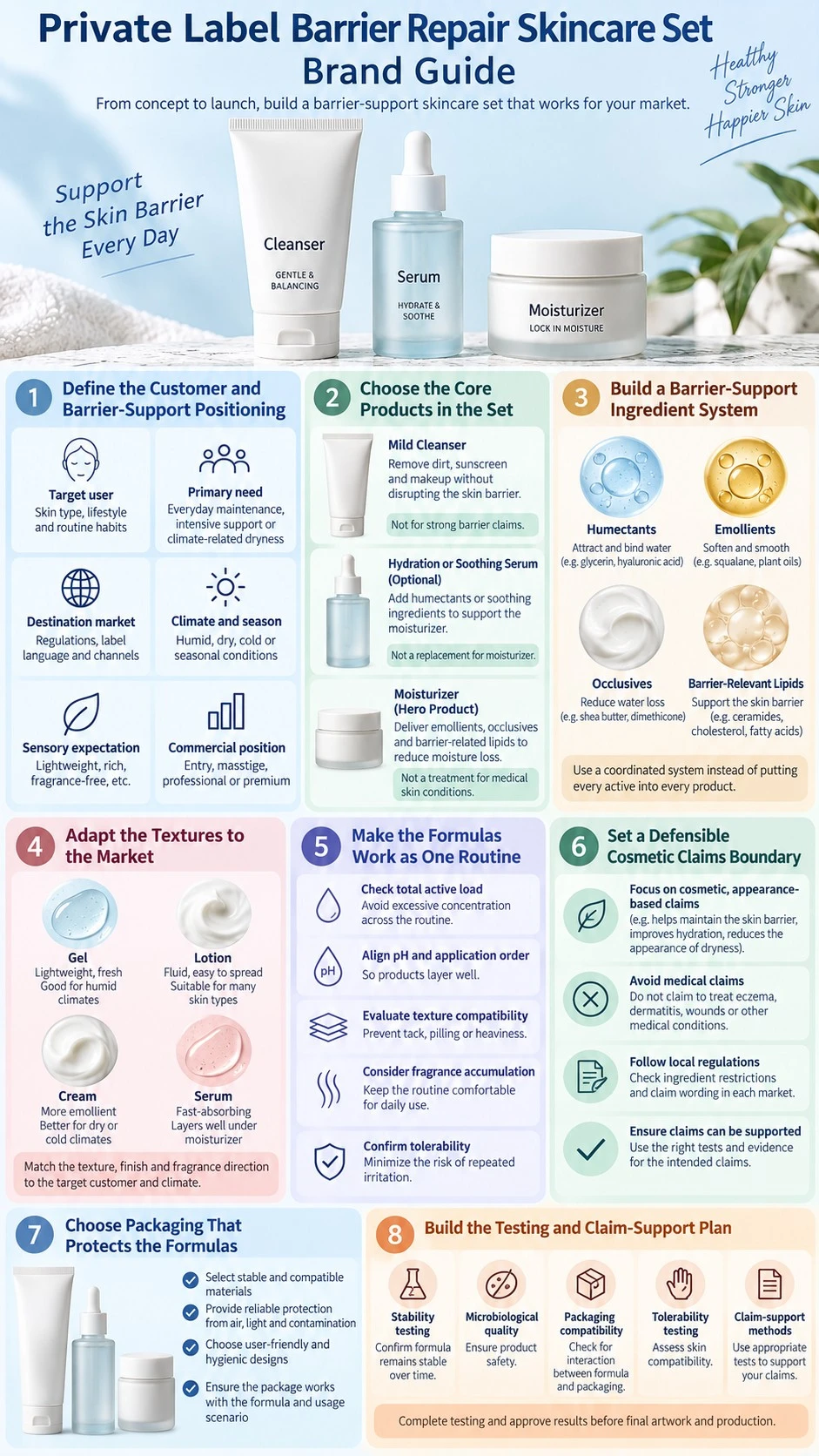
Define the Customer and Barrier-Support Positioning
Start by defining what “barrier repair” means in the intended market. For a cosmetic set, useful positioning may focus on reducing the feeling of dryness, supporting the skin’s moisture barrier, improving hydration, helping skin feel more comfortable, or reducing the appearance of roughness associated with dryness. These are different from promising to treat eczema, dermatitis, wounds or another medical condition.
A useful development brief should identify:
- Target user: Dry, sensitive-feeling, oily but dehydrated, blemish-prone or mature customers, including people who use exfoliating acids or retinoids.
- Primary need: Everyday barrier maintenance, intensive moisture support, recovery from an overcomplicated cosmetic routine, or climate-related dryness.
- Destination market: Country, sales channel, regulatory classification, label language and local ingredient restrictions.
- Climate and season: Humid, tropical, dry, cold or highly seasonal conditions.
- Sensory expectation: Weightless, cushiony, rich, fragrance-free, quick-absorbing or occlusive.
- Commercial position: Entry, masstige, professional-inspired or premium, with a target price for each SKU and the full set.
Do not define the audience as “all skin types.” A gel-cream built for a humid market and a rich cream designed for very dry winter skin can both be credible barrier-support products, but they require different emollient levels, finishes and packaging choices. ZICAIL’s barrier repair skincare solutions can be evaluated more usefully after the customer, climate and price architecture are fixed.
Choose the Core Products in the Set
Most startup barrier-support lines can begin with three products: a mild cleanser, a hydration or soothing serum, and a moisturizer. The serum is optional; the cleanser and moisturizer are the functional core. If the budget supports only two SKUs, prioritize those two before adding a toner, essence, mask or face oil.
| Product | Primary role | Suitable formula direction | What it should not be asked to do |
|---|---|---|---|
| Mild cleanser | Remove sunscreen, makeup residue, excess oil and daily soil without an excessively tight after-feel | Low-foam gel, cream cleanser or cleansing lotion built around a mild surfactant system | Carry the set’s strongest long-term barrier or moisturization claim |
| Hydration or soothing serum | Add a lightweight humectant and comfort layer, especially when a multi-step routine is commercially useful | Watery serum, fluid gel or light emulsion with a focused supporting active system | Duplicate the moisturizer’s full lipid and occlusive load |
| Barrier-support moisturizer | Provide the main hydration, emollient, lipid and moisture-retention story | Gel-cream, lotion or cream selected for climate, skin profile and price | Become so heavy that the target customer avoids regular use |
Cleansing still matters even though a cleanser is rinsed off. Surfactant type, concentration, interaction and formula design influence mildness; a “sulfate-free” label alone does not establish that the finished cleanser is gentle.[1] Brands can use a structured approach to choosing private label cleanser surfactants instead of approving the formula from one excluded-ingredient claim.
The moisturizer should normally be the hero SKU because it stays on the skin and can combine water-binding ingredients, emollients and more occlusive materials in one base. The serum should exist only when it creates a distinct light layer, ingredient story, price point or use occasion. Add a mist, essence, sleeping mask or balm later only when it earns a separate role.
Build a Barrier-Support Ingredient System
Build the set around complementary ingredient functions rather than a checklist of fashionable names. Ceramides are important structural lipids in the stratum corneum, but their performance in a cosmetic depends on the selected ceramide material, supporting lipids, vehicle, processing, stability and finished formula.[2]
| Ingredient function | Examples brands may consider | Best product roles | Development questions |
|---|---|---|---|
| Humectants | Glycerin, hyaluronic acid, betaine, panthenol and selected polyols | Serum, essence and moisturizer | Does the level improve hydration without excessive tack, pilling or a sticky finish? |
| Barrier-relevant lipids | Ceramides, cholesterol and suitable fatty acids | Primarily moisturizer; selected serum emulsions | Is the material properly dispersed and compatible with the base, process and target texture? |
| Emollients | Squalane, esters, triglycerides, shea-derived materials and selected plant oils | Moisturizer, balm and emulsion serum | Does the blend create the desired slip and softness without excessive heaviness? |
| Occlusive materials | Petrolatum, dimethicone, waxes and richer lipid systems where suitable | Cream, balm or targeted intensive product | Is the moisture-retention benefit appropriate for the market’s climate and finish expectations? |
| Supporting actives | Niacinamide, panthenol, ectoin, beta-glucan, allantoin, bisabolol and selected oat materials | Serum or moisturizer | What is the lead story, and which ingredients are genuinely needed at useful, stable levels? |
Panthenol-containing formulations have shown improved stratum corneum hydration and reduced transepidermal water loss, but results remain dependent on the finished vehicle and use conditions.[3] Niacinamide is another useful supporting option because topical use has been associated with improved moisture content and barrier-related effects, including ceramide synthesis.[4] Neither ingredient needs to appear in every product.
Avoid prescribing one universal ceramide-to-cholesterol-to-fatty-acid ratio for every private label brief. Raw material systems, ceramide types, delivery technologies, total lipid load and emulsion structure vary. A physiologically inspired lipid story may be valuable, but the manufacturer still has to demonstrate process feasibility, stability, sensory quality and finished-product performance.
Brands can review the broader role of ceramides in skincare before deciding whether ceramides should lead the hero claim or support a wider hydration-and-comfort concept.
Adapt the Textures to the Market
Keep the three product roles stable while changing viscosity, richness, finish and packaging for the intended climate and customer. Texture is not decoration; it affects routine adherence, layering, dose and perceived value.
| Market profile | Cleanser direction | Serum direction | Moisturizer direction | Set-level priority |
|---|---|---|---|---|
| Humid climate or oily, dehydrated skin | Light gel or low-foam cleanser with a clean but non-stripped after-feel | Fast-spreading, low-tack serum | Gel-cream or fluid lotion | Minimize residue, shine and pilling under sunscreen or makeup |
| Dry or cold climate | Cream cleanser or cushioned low-foam system | Hydrating serum or fluid emulsion | Richer cream with stronger emollient and occlusive support | Improve lasting comfort and reduce tightness after cleansing |
| Sensitive-feeling audience | Restrained cleanser with low sensory load | Simple, fragrance-free or low-fragrance direction where appropriate | Comfort-focused lotion or cream | Reduce unnecessary actives, scent and sting potential across the routine |
| Premium barrier concept | Elegant cream or lotion cleanser | Refined emulsion serum with a distinct support story | Multi-lipid cream with differentiated sensory finish | Make texture, packaging and claim support justify the premium price |
| Entry-level launch | One versatile mild cleanser | Optional; omit if it weakens value | Familiar lotion or cream with a focused ingredient story | Keep the routine understandable and affordable enough for repeat purchase |
Brands choosing between a gel-cream, lotion and richer cream can use a market-led moisturizer texture framework. The right answer depends on more than skin type: climate, sunscreen use, makeup layering, package format and target retail price also matter.
Make the Formulas Work as One Routine
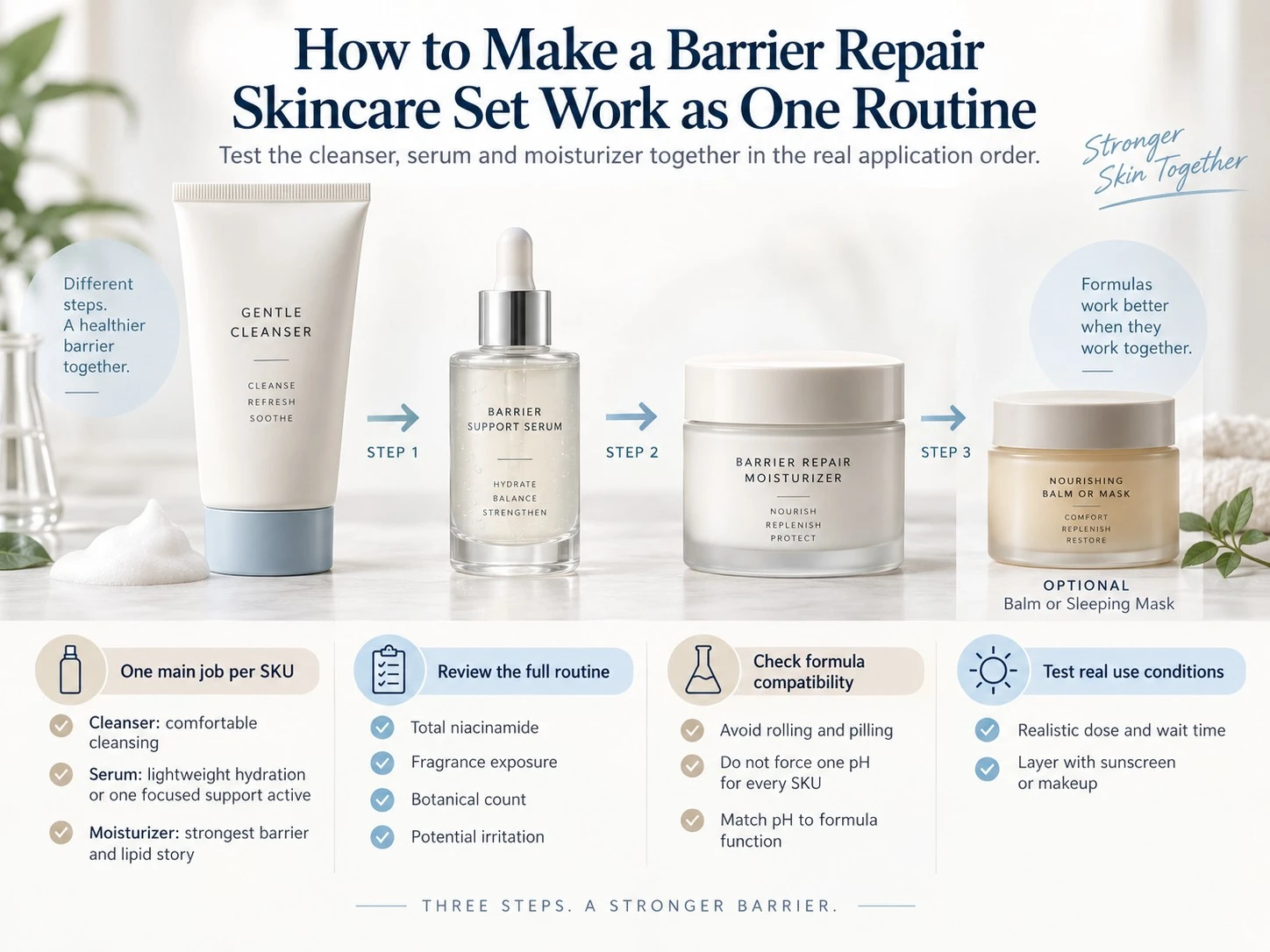
Test the products together in the intended order, not only as separate laboratory samples. The cleanser’s after-feel affects how the serum and moisturizer are perceived, while incompatible polymer systems or excessive solids can create rolling and pilling when layers are combined.
Assign one main job to each SKU:
- Let the cleanser focus on effective, comfortable cleansing.
- Let the serum provide lightweight hydration or one focused supporting active story.
- Let the moisturizer carry the strongest moisture-barrier, emollient and lipid narrative.
- Let any optional balm or sleeping mask create a clearly richer use occasion rather than repeating the daily cream.
Review total niacinamide level, fragrance exposure, botanical count and potential irritation across the complete routine. Repeating the same highlighted ingredient can help visual merchandising, but it should not create unnecessary active load, cost or tack. A coordinated set can share a claim theme without using identical ingredient decks.
The target pH of each formula must fit its surfactant system, preservative strategy, active stability and skin-use context. Do not impose one pH number on the entire set merely for marketing consistency. Confirm the sequence with realistic doses, waiting times and the sunscreen or makeup customers are likely to apply afterward.
Set a Defensible Cosmetic Claims Boundary
Write the intended claims before formula approval. In the United States, moisturizing, skin-softening and appearance-focused claims can fit cosmetic positioning, while claims that a product treats or prevents disease or affects the body’s structure or function can cause it to be regulated as a drug.[5]
Potential cosmetic directions may include “helps support the skin’s moisture barrier,” “helps reduce moisture loss,” “provides lasting hydration,” “helps relieve the feeling of dryness” or “leaves skin feeling smoother and more comfortable,” when the exact finished product has appropriate support. Review the wording in context for every destination market.
Avoid unqualified promises such as “heals a damaged barrier,” “treats eczema,” “repairs dermatitis,” “regenerates skin cells” or “accelerates wound healing” on an ordinary cosmetic. Product names, diagrams, before-and-after images, influencer scripts and website copy contribute to the overall intended-use message; the risk is not limited to the carton text.
Do not use ingredient evidence as automatic proof of the set. A paper about one panthenol formulation or a supplier study on a ceramide complex does not substantiate every cleanser, serum and moisturizer containing that ingredient. Map each claim to the exact finished SKU and test method.
Choose Packaging That Protects the Formulas
Select packaging after the formula direction and usage pattern are clear. A low-viscosity serum needs controlled dispensing without leakage; a lipid-rich cream needs a pump or passage that can prime and evacuate reliably; a cleanser closure must tolerate repeated exposure to water and handling.
Airless pumps can reduce repeated air exposure and provide controlled dosing, but they require viscosity, priming and evacuation checks. Tubes can work well for cleansers and creams and may offer efficient product recovery. Jars support rich textures and easy access but require a realistic hygiene, preservation and formula-protection assessment. Droppers suit some fluid serums but expose the product to repeated opening and user handling.
Visual consistency does not require identical containers. Use color, typography, decoration and closure details to create a family appearance while selecting the best dispensing system for each formula. Run packaging compatibility testing with production-intent components to assess leakage, dispensing, odor or color change, component interaction, decoration and transport behavior.
Build the Testing and Claim-Support Plan
Every formula needs a risk-based safety and quality plan. In the United States, the manufacturer or distributor is responsible for ensuring cosmetic safety, and there is no single prescribed test list that applies to every cosmetic.[6] The plan should reflect the formula, packaging, instructions, user profile and destination market.
A barrier-support set may require:
- Stability testing under relevant storage conditions.
- Microbiological quality testing and preservative-efficacy testing for water-containing products where appropriate.
- Packaging compatibility using the final formula and production-intent component.
- Safety and tolerability assessment appropriate to the target user and claim.
- Routine-level checks for sting, tack, pilling, residue and cumulative sensory load.
- Fill, dispensing, leakage, transport and decoration checks.
- Claim testing matched to the exact words, time points and directions for use.
Hydration claims may use corneometry or another validated hydration method. Moisture-barrier or water-loss claims may use transepidermal water loss measurements when the protocol and interpretation fit the wording. Consumer-perception studies can support subjective outcomes such as comfort, softness and product feel, but they should not be used to imply an instrumental or medical result.
Test the hero moisturizer most deeply, then decide what independent evidence is needed for the cleanser, serum and complete regimen. The cosmetic claim testing guide can help separate instrumental, clinical and consumer methods before a protocol is commissioned.
Common Barrier Repair Set Development Mistakes
- Starting with a trendy ingredient list: Ceramides, panthenol and niacinamide do not define the customer, texture, claim or price point.
- Putting the same active system in every SKU: Repetition can add cost, tack and formulation constraints without improving the routine.
- Making the serum the only meaningful product: The cleanser and especially the moisturizer still need clear performance roles.
- Using “sulfate-free” as the complete mildness brief: The finished surfactant system, concentration and use experience matter more than one excluded ingredient.
- Choosing a rich cream for every market: An occlusive winter texture may be rejected by customers in humid climates or under makeup.
- Approving products one by one: Individually elegant formulas can pill, feel heavy or create excessive fragrance when layered.
- Using medical language for ordinary cosmetics: Disease-treatment and structure/function claims can change regulatory classification.
- Relying on supplier ingredient data for final claims: Finished-product wording needs finished-product-relevant support.
- Selecting matching packaging before compatibility work: Visual consistency cannot compensate for leakage, poor priming or formula-component interaction.
Develop a Private Label Barrier-Support Set with ZICAIL
ZICAIL can help brands translate a barrier-support concept into a coordinated cleanser, serum and moisturizer range, with optional products added only when they strengthen the market proposition. Development can cover stock, modified or custom formulas, texture selection, samples, packaging compatibility, testing and claim planning.
Prepare a brief with the destination market, target customer, climate, preferred product count, ingredient references, excluded ingredients, fragrance direction, texture targets, packaging preferences, intended claims, price range and launch quantity. ZICAIL can then assess feasibility SKU by SKU and identify which product should carry the strongest barrier-support story.


