
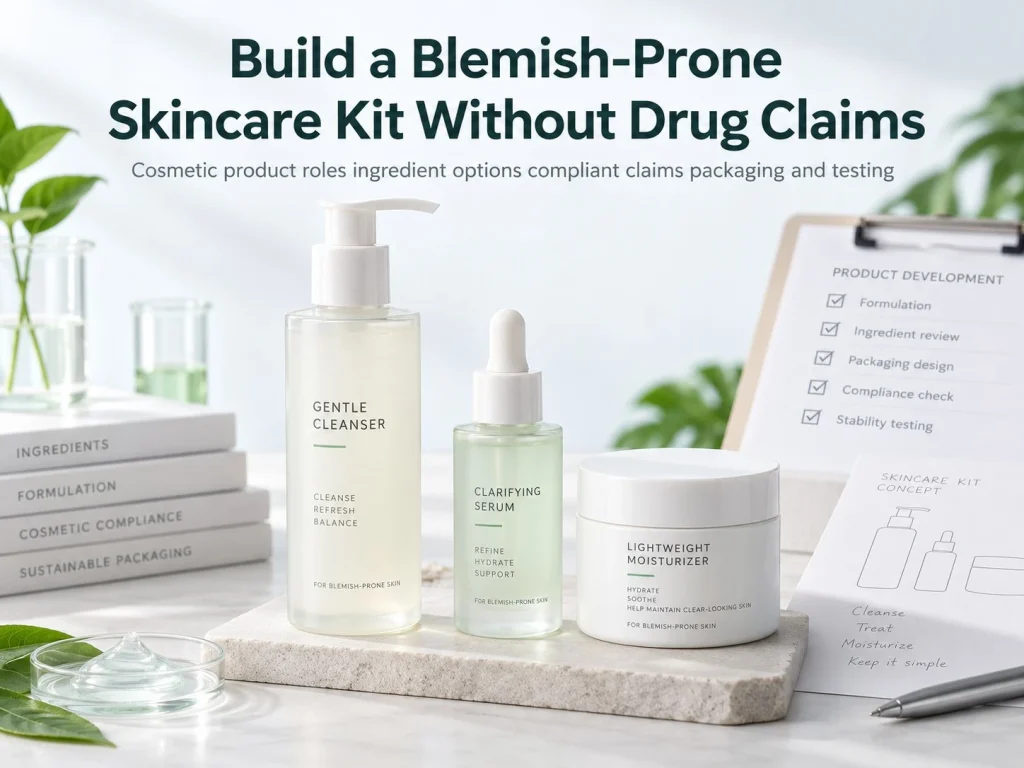

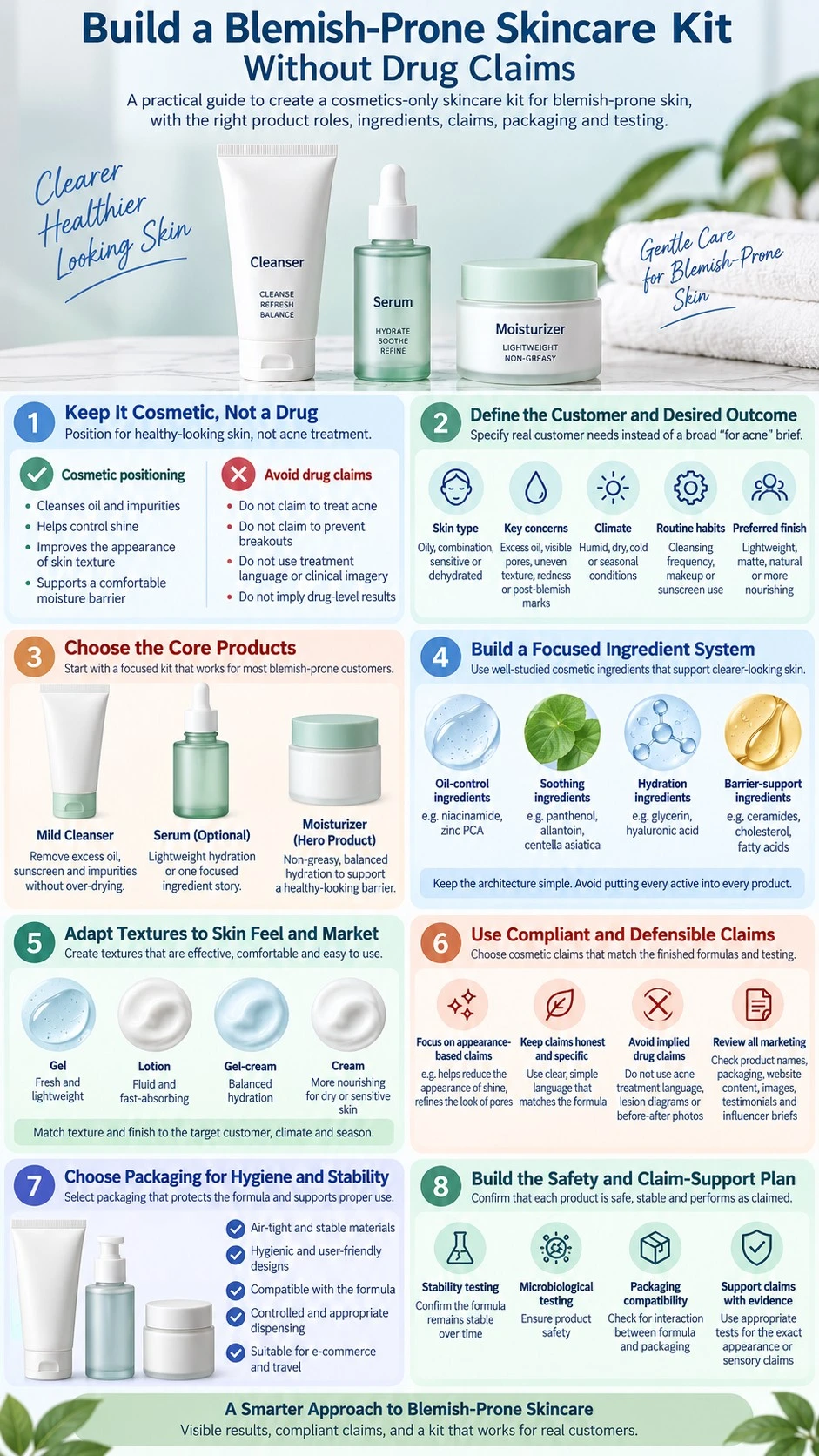
“Blemish-prone” can describe a target customer without turning every product into an acne treatment. A cosmetic kit can cleanse away surface oil and impurities, provide lightweight hydration, improve the appearance of texture and shine, and support a comfortable moisture barrier. It should not promise to treat acne, prevent pimples or deliver the effects of an OTC acne drug.
The brand therefore has to control the whole product concept. Formula ingredients matter, but intended use is also communicated through the product name, directions, images, before-and-after content, testimonials, website and sales training. The safest workflow begins with classification and claims, then moves to product selection and formulation.
Separate Cosmetic Positioning from Acne Treatment
In the United States, intended use determines whether a product is a cosmetic, a drug or both. Intended use can be established through label claims, advertising, online content, consumer perception and the circumstances surrounding distribution.[1] A cleanser marketed only to remove oil and impurities may be a cosmetic; a cleanser marketed to treat acne is a drug-cosmetic and must meet the applicable drug and cosmetic requirements.
OTC Monograph M006 identifies active ingredients, permitted concentrations, indications, warnings and labeling conditions for compliant topical acne drug products.[2] A brand that wants claims such as “treats acne,” “prevents new acne pimples” or “clears acne blemishes” should treat that as a separate regulatory project. Removing a Drug Facts panel while keeping the treatment message does not turn the product back into an ordinary cosmetic.
Ingredient presence alone does not answer the classification question. Salicylic acid, sulfur and other materials can appear in different regulatory contexts, but formula level, intended use, claims, labeling and market-specific rules all matter. Do not ask a manufacturer to create an “acne treatment without drug claims.” Decide whether the product is genuinely cosmetic or whether the commercial goal requires the OTC drug route.
The word “blemish” also needs context. “For blemish-prone skin” is a target-audience description, while “eliminates blemishes” communicates a product result. Even cosmetic-sounding words can create a drug message when paired with lesion diagrams, treatment timelines, clinical imagery or testimonials about clearing acne.
Define the Cosmetic Customer and Outcome
Replace a broad “for acne” brief with cosmetic characteristics the formulator can act on. Blemish-prone customers may have oily skin, dehydrated skin, sensitivity, visible redness, uneven-looking texture or irritation from an aggressive routine. One kit should not attempt to solve every version.
A useful brief should define:
- Skin-feel profile: Very oily, combination, oily but dehydrated, or sensitive-feeling.
- Primary cosmetic outcome: A clean after-feel, less visible shine, lightweight hydration, smoother-looking texture or reduced appearance of redness.
- Climate and use context: Humid daytime use, dry indoor environments, makeup layering, active-heavy routines or travel.
- Sensory limits: Fragrance-free or restrained scent, low tack, fast absorption and no heavy residue.
- Commercial position: Entry, masstige, professional-inspired or premium, with a target price for each product and the complete kit.
- Excluded territory: Acne treatment, breakout prevention, antibacterial activity, comedolysis, lesion reduction and other drug-oriented promises.
This customer definition gives the manufacturer a usable development target without diagnosing acne. It also prevents “oil control” from becoming an excuse for an overly stripping cleanser or an underbuilt moisturizer.
Choose the Core Products in the Kit
Most startup kits need two or three products. A mild cleanser and lightweight moisturizer form the functional core; add a serum only when it creates a distinct cosmetic benefit or commercial step.
| Product | Cosmetic role | Suitable direction | Avoid assigning it |
|---|---|---|---|
| Mild cleanser | Remove makeup residue, sunscreen, surface oil and daily impurities | Low-foam gel, cream-gel or cleansing lotion with a mild surfactant system | Acne treatment, antibacterial action or aggressive “deep pore detox” claims |
| Lightweight serum | Provide hydration, reduce the appearance of shine or support smoother-looking texture | Watery serum, fluid gel or light emulsion with one focused ingredient story | Acting as a disguised medicated spot treatment |
| Non-greasy moisturizer | Maintain hydration and comfort without an unnecessarily heavy finish | Gel-cream, fluid lotion or light cream selected for climate and skin feel | Promising that moisturization prevents acne or stops breakouts |
Gentle cleansing remains important for people with acne-prone skin, while harsh scrubbing, astringents and other irritating practices can worsen discomfort.[3] Mildness depends on the complete surfactant system and finished formula, not one “sulfate-free” statement. Brands can use a structured process for selecting cleanser surfactants before approving foam level and after-feel.
The serum is optional. If it merely repeats the moisturizer’s humectants and marketing story, omit it. A toner, clay mask or hydrocolloid-style patch creates additional claim, safety, packaging and classification questions and should be added only after its distinct role is approved.
Build a Focused Ingredient System
Choose ingredients by cosmetic function and finished-formula behavior. Do not assemble an “anti-acne” ingredient checklist and then try to neutralize the claims later.
| Ingredient direction | Cosmetic role in the kit | Suitable product | Development cautions |
|---|---|---|---|
| Glycerin, betaine, hyaluronic acid or other humectants | Lightweight hydration and improved skin feel | Serum and moisturizer | Balance hydration with tack, pilling and climate conditions |
| Niacinamide | Hydration support, barrier-support positioning and appearance-focused oil or texture story where substantiated | Serum or moisturizer | Select a formula-appropriate level; excessive loading can weaken sensory quality or tolerability |
| Panthenol, beta-glucan, allantoin, bisabolol or selected oat materials | Comfort and soothing-feel support | Serum or moisturizer | Avoid turning “soothing” into treatment of inflamed acne or dermatitis |
| Squalane, light esters, silicones or selected emollients | Slip, softness and moisture retention without an overly rich finish | Moisturizer or light emulsion serum | Evaluate the finished blend rather than labeling individual oils as universally comedogenic |
| Clay, silica, starches or oil-absorbing powders | Reduce surface shine or create a matte after-feel | Mask, cleanser or selected leave-on formula | Check dryness, residue, shade effects and inhalation or application considerations where relevant |
| Exfoliating acids | Smoother-looking texture or surface exfoliation in a cosmetic context | Toner, serum or cleanser after regulatory review | Ingredient, concentration, pH, directions, warnings and claims can change both tolerability and regulatory analysis |
Niacinamide can support a blemish-prone cosmetic concept without requiring an acne-treatment claim. Its role should be described through the exact finished product and evidence rather than broad ingredient promises. Brands can review niacinamide’s skincare uses before deciding whether it should lead the serum story.
Do not build a blacklist of supposedly “pore-clogging” ingredients from social media charts. Comedogenicity depends on the finished formula, dose, use pattern and test method; historical ingredient models do not reliably predict every person’s experience with a complete product. A claim about the finished product needs support relevant to that product.
Adapt the Textures to Skin Feel and Market
Match the kit’s sensory profile to oil level, sensitivity, climate and layering habits. “Blemish-prone” does not automatically mean oil-free, alcohol-heavy or matte at every step.
| Market profile | Cleanser direction | Serum direction | Moisturizer direction | Main sensory risk |
|---|---|---|---|---|
| Humid climate and oily skin feel | Quick-rinsing low-foam gel | Watery, low-tack serum | Fluid lotion or gel-cream | Sticky layers, visible shine and pilling under sunscreen |
| Oily but dehydrated skin feel | Mild gel or cream-gel | Humectant-focused fluid serum | Light lotion with balanced emollients | Over-cleansing followed by rebound discomfort and tightness |
| Sensitive-feeling audience | Restrained low-sensory cleanser | Simple serum or omit the step | Fragrance-free or low-fragrance comfort-focused gel-cream | Sting from acids, fragrance or excessive active load |
| Cooler or drier market | Gentle cream-gel cleanser | Hydrating serum | Light cream with stronger moisture retention | A kit that controls shine but leaves skin uncomfortable |
| Premium minimalist concept | Elegant low-foam cleanser | One differentiated serum | Refined lotion or cream with a non-greasy finish | Paying for extra SKUs that repeat the same benefit |
Texture decisions should be made alongside pack type and target price. A market-led moisturizer texture framework can help brands choose between gel, lotion and cream without assuming that every blemish-prone customer wants the lightest possible product.
Choose Cosmetic Claims That Match the Finished Products
Cosmetic claims should describe cleansing, appearance, sensory effects or moisturization without promising acne treatment or prevention. There is no FDA list of pre-approved cosmetic claims, and disease-treatment or structure/function claims can cause a product to be regulated as a drug.[4]
| Lower-risk cosmetic direction when substantiated | Drug-oriented or high-risk direction to avoid for a cosmetics-only kit | Why the distinction matters |
|---|---|---|
| Removes excess surface oil and impurities | Treats oily acne | The cosmetic claim describes cleansing; the second connects the product to treatment of a disease condition |
| Leaves skin looking less shiny | Controls the cause of acne | Appearance-based shine language does not promise a biological acne effect |
| Helps pores look less visible | Unclogs pores to prevent breakouts | “Unclogs” plus prevention communicates an acne-treatment mechanism |
| Improves the appearance of uneven texture | Clears acne bumps and pimples | The first concerns appearance; the second promises lesion treatment |
| Provides lightweight, non-greasy hydration | Prevents moisturizer-related breakouts | Hydration and finish are cosmetic; prevention is a drug claim |
| Helps reduce the appearance of redness | Reduces acne inflammation | Visible appearance differs from treating inflammation associated with acne |
| Suitable for blemish-prone skin | Eliminates blemishes | Audience suitability does not equal a treatment result |
These examples are directions, not guaranteed safe phrases in every context. “Clarifying,” “purifying,” “detoxifying” and “correcting” can also become risky when surrounding copy explains them as treating acne. Review the product name, front label, directions, iconography, ingredient callouts and campaign together.
“Non-comedogenic” is not a promise that no user will ever develop a clogged pore or blemish. Testing approaches and claim language vary, so the protocol should fit the finished product, intended use and destination market.[5] ZICAIL’s guide to non-comedogenic skincare claims can help brands define the term before selecting a test.
Select Packaging for Hygiene and Controlled Use
Choose packaging that supports realistic dosing, formula protection and clean use. Pumps and airless systems can provide controlled dispensing for serums and moisturizers, but viscosity, priming and evacuation must be verified. Tubes can work well for cleansers and gel-creams, while droppers expose the formula and applicator to repeated opening and handling.
Avoid selecting a jar only because it looks premium. A jar may suit some creams, but the preservation system, repeated user contact, opening frequency and included applicator require review. Likewise, a highly fluid serum in a wide-neck package can create overdosing and messy use.
Visual consistency can come from color, typography and decoration without forcing every formula into the same component. Run packaging compatibility testing with production-intent components to assess leakage, dispensing, formula interaction, decoration and transport behavior.
Build the Safety and Claim-Support Plan
The manufacturer or distributor is responsible for ensuring that a cosmetic is safe under labeled or customary conditions of use, and no single FDA-prescribed test list applies to every cosmetic.[6] Build a risk-based plan for each formula and for the complete routine.
The plan may include:
- Formula stability under relevant storage conditions.
- Microbiological quality and preservative-efficacy testing for water-containing products where appropriate.
- Packaging compatibility with the final component.
- Safety and tolerability assessment matched to the target user and directions.
- Routine-level evaluation for tightness, sting, dryness, tack, pilling and residue.
- Instrumental or consumer testing matched to the exact appearance and sensory claims.
- A finished-product protocol when using “non-comedogenic” or a similar suitability claim.
Consumer perception can support statements such as “skin feels clean without feeling stripped” or “the moisturizer feels lightweight.” Instrumental sebum measurements may support a defined surface-oil or shine claim. Standardized photography or expert grading may support appearance claims when the protocol, time point and wording align.
Do not convert an improvement in appearance into an acne-treatment claim. Advertising must be assessed for both express and implied messages, and the evidence should be relevant to the marketed product and claim.[7] Use a cosmetic claim testing plan before approving the final wording.
Review the Kit’s Complete Market Presentatio
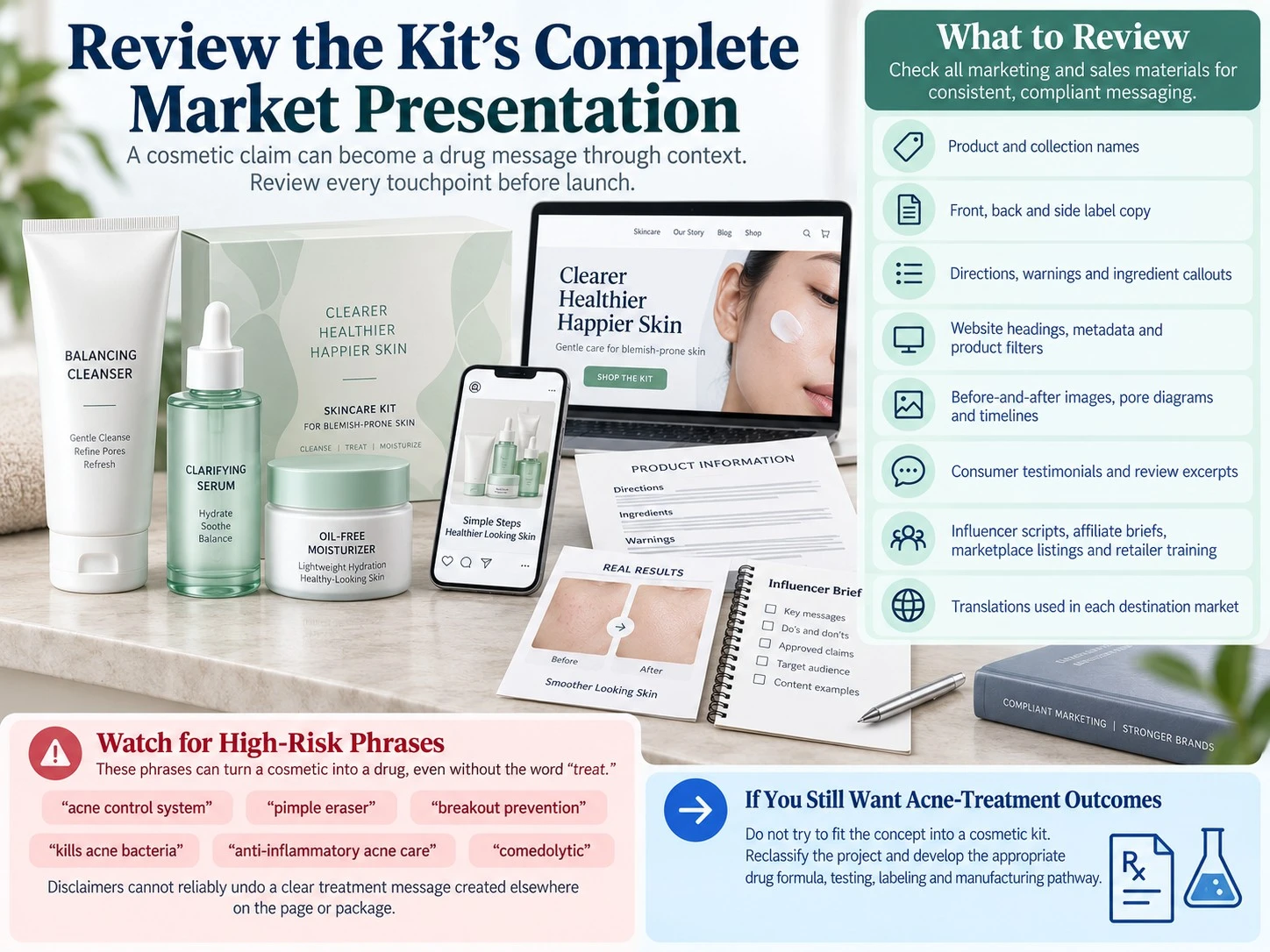
Run one final classification review after the formulas and marketing assets are assembled. A cosmetic claim can become a drug message through context even when no individual sentence says “treats acne.”
Review:
- Product and collection names.
- Front, back and side label copy.
- Directions, warnings and ingredient callouts.
- Website headings, metadata and product filters.
- Before-and-after images, pore diagrams and timelines.
- Consumer testimonials and review excerpts selected by the brand.
- Influencer scripts, affiliate briefs, marketplace listings and retailer training.
- Translations used in each destination market.
Watch for phrases such as “acne control system,” “pimple eraser,” “breakout prevention,” “kills acne bacteria,” “anti-inflammatory acne care” or “comedolytic.” Disclaimers cannot reliably undo a clear treatment message created elsewhere on the page or package.
If the commercial team still wants acne-treatment outcomes after this review, stop trying to fit the concept into a cosmetic kit. Reclassify the project and develop the applicable drug formula, testing, labeling and manufacturing pathway.
Common Blemish-Prone Kit Development Mistakes
- Starting with acne-actives instead of classification: The intended use must be decided before ingredient and claim selection.
- Using “blemish” as a substitute for “acne” everywhere: Context can still communicate treatment or prevention.
- Making every product oil-stripping: Blemish-prone customers can also experience dehydration, sensitivity and barrier discomfort.
- Treating ingredient presence as legal permission: An INCI name does not authorize every claim associated with that ingredient.
- Using social-media comedogenicity lists as formulation rules: Finished-product behavior cannot be predicted from a simple ingredient blacklist.
- Calling a product non-comedogenic without a defined basis: The claim should be tied to an appropriate finished-product assessment.
- Approving package copy but ignoring digital marketing: Websites, testimonials, images and influencer scripts contribute to intended use.
- Testing ingredients instead of finished formulas: Supplier evidence does not automatically substantiate the marketed cleanser, serum or moisturizer.
- Adding too many steps: Extra toners, masks and spot products increase claim, irritation, inventory and compatibility risks.
Develop a Cosmetic Blemish-Prone Skincare Kit with ZICAIL
ZICAIL can help brands translate a blemish-prone cosmetic concept into a coordinated cleanser, serum and moisturizer kit without making acne-treatment positioning the default. Development can cover stock, modified or custom formulas, texture selection, samples, packaging compatibility, safety testing and cosmetic claim planning.
Prepare a brief with the destination market, intended cosmetic use, excluded drug claims, target customer, climate, preferred product count, ingredient references, texture goals, packaging direction, proposed claims, price range and launch quantity. ZICAIL can then assess feasibility SKU by SKU and identify which wording or product concepts require additional regulatory review before production.


