
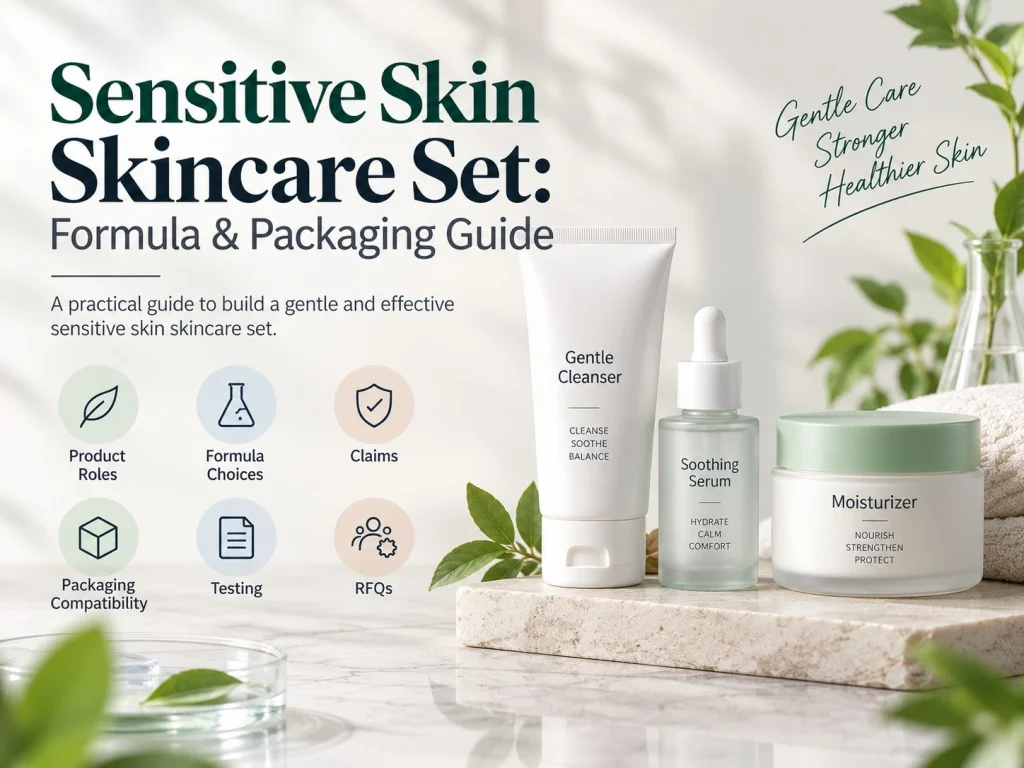


“Sensitive skin” is commercially attractive because it speaks to customers who report stinging, burning, itching, tightness or discomfort from products and environmental triggers. It is also a difficult development brief. The term does not identify one cause, one skin type or one universally acceptable ingredient list.
For a private label brand, the task is to reduce avoidable sensory load while preserving cleansing, moisturization, microbial protection and a pleasant user experience. This checklist turns that positioning into decisions a manufacturer can sample, test and quote.
Define the Sensitive Skin Customer Before Choosing Formulas
Sensitive skin has been defined as unpleasant sensations—such as stinging, burning, pain, itching and tingling—in response to stimuli that normally should not cause those sensations; visible signs may or may not be present.[1] This definition is useful for positioning, but it does not tell a formulator which cleanser, preservative or cream texture every customer will tolerate. Published guidance also recognizes that mechanisms and management are not completely settled.[2]
Turn the broad label into a specific development target:
- Primary experience: Tightness after cleansing, sting from layered products, dryness-related discomfort, weather reactivity or a preference for low-sensory formulas.
- Skin and routine profile: Dry, combination, oily but dehydrated, mature, makeup-wearing or already using retinoids and exfoliants.
- Known exclusions: Fragrance direction, essential oils, colorants or named materials the brand has a commercial or market-specific reason to exclude.
- Destination market: Country, sales channel, label language, restricted ingredients, cosmetic classification and responsible-party requirements.
- Climate and season: Humid, hot, dry, cold or highly seasonal conditions that influence foam, richness, residue and pack choice.
- Price and positioning: Entry, masstige, professional-inspired or premium, with a target cost and retail price for each SKU.
Do not use a sensitive-skin audience label as a substitute for diagnosis. Marketing teams often use “sensitized” for a temporary reactive state, while sensitive skin may describe a recurring tendency; neither label proves the cause of a customer’s symptoms. Persistent rash, swelling or a diagnosed condition belongs outside an ordinary cosmetic promise. ZICAIL’s guide to sensitive versus sensitized skin can help a brand keep the audience definition clear.
Choose the Core Products and Give Each One a Clear Role
Most startup sets should contain two or three products. A mild cleanser and moisturizer form the functional core. A serum is useful only when it adds a distinct lightweight layer, ingredient story or price point.
| Product | Primary job | Suitable direction | Do not make it responsible for |
|---|---|---|---|
| Mild cleanser | Remove sunscreen, makeup residue, surface oil and daily soil without an excessively tight after-feel | Low-foam gel, cream-gel, cleansing lotion or another mild system suited to the market | The set’s main long-term barrier or moisturization claim |
| Optional serum | Add lightweight hydration or a focused comfort-support story | Watery serum, fluid gel or light emulsion with controlled tack and active load | Carrying every trending soothing active in one formula |
| Moisturizer | Deliver the main hydration, emollience and moisture-retention experience | Gel-cream, lotion or cream selected for climate, skin feel and price | Being universally rich, occlusive or suitable for every skin profile |
Cleanser mildness depends on the complete surfactant system, concentration, formula interactions, dose and rinse behavior. “Sulfate-free” is an exclusion claim, not proof that the finished product is gentle. Use a structured method for choosing cleanser surfactants and evaluate the after-feel at the intended dose.
The moisturizer normally deserves hero status because it remains on the skin and can combine humectants, emollients and occlusive materials. The serum should not duplicate that story in a thinner base. Add another format only when customer behavior and channel strategy justify a separate use occasion.
Use a Formula Checklist Instead of an Ingredient Blacklist
A strong sensitive skin brief controls formula complexity and exposure without labeling every unfamiliar material as harsh. Natural extracts can contain fragrant or sensitizing constituents, while synthetic ingredients can perform essential functions with consistent specifications. Evaluate purpose, level, purity, interactions and finished-product behavior.
| Formula decision | What to specify | What to verify in samples |
|---|---|---|
| Cleansing system | Desired foam, soil removal, rinse speed and after-feel; surfactant family and total system selected by the formulator | No excessive tightness, residue or eye-area migration under intended use |
| Humectant system | Focused blend such as glycerin, betaine, hyaluronic acid, panthenol or suitable polyols | Hydration without excessive tack, sting or pilling in the routine |
| Emollient and occlusive system | Slip, softness and moisture retention suited to climate and customer profile | Comfortable finish without unwanted heaviness, greasiness or poor makeup layering |
| Comfort-support ingredients | A restrained selection such as panthenol, beta-glucan, allantoin, bisabolol, ectoin, oat-derived materials or niacinamide where suitable | Formula stability, color and odor, sensory quality, supplier specifications and claim relevance |
| Barrier-support lipids | Ceramides, cholesterol, fatty acids or other lipid systems when they fit the concept | Correct incorporation, stability and a finished-product story that does not rely on ingredient presence alone |
| Exfoliants and high-sensory actives | Omit, reduce or tightly define according to the audience and positioning | Stinging, cumulative irritation potential, pH constraints and whether the active conflicts with the set’s main promise |
Avoid a race to the shortest INCI list. Water-based products still need effective preservation, while texture modifiers, chelators, antioxidants or pH adjusters may improve stability and safety. “Minimalist” should mean that each material has a job, not that the formula is underbuilt.
Review cumulative exposure across the set. A level that works in one SKU can become an unnecessary sensory burden when the same fragrance, botanical blend, niacinamide system or exfoliant appears in three products used together. Shared hero ingredients can support range identity, but product roles should determine where they are used.
Review Fragrance, Preservation and pH as Formula Systems
Fragrances and preservatives are among the ingredient groups associated with cosmetic contact reactions, but this does not mean every preservative is unsuitable or every fragrance-free product is reaction-proof.[3] Treat these choices as risk-managed formula systems.
For a sensitive skin position, a fragrance-free direction is often easier to explain and validate than adding perfume or essential oils. “Unscented” is not necessarily equivalent because scent-masking ingredients may still be present. The ingredient declaration and supplier documentation should match the exact wording; see the distinction between fragrance-free and unscented skincare. Fragrance components can also be declared under collective terminology in the United States, which makes clear brand documentation especially useful.[4]
Do not solve fragrance risk by adding several aromatic botanical extracts. Plant origin does not remove sensitization or odor-variation questions. If a botanical is essential to the concept, define its technical purpose, specification, allergen information, use level and effect on color, odor and preservation.
Preservative-free should not be the default goal for a water-containing multiuse cosmetic. Select the preservation system from water activity, pH, raw-material bioburden, packaging, manufacturing controls and expected consumer use. A pump may reduce direct finger contact, but it does not make preservation unnecessary.
Set pH product by product. A cleanser’s target must suit its surfactants, preservation and after-feel; a serum or moisturizer must also fit active stability, emulsion structure and the preservative system. Do not force one pH across the set for visual consistency. Brands developing the wash step can use the private label cleanser pH guide as a starting framework, then confirm the actual formula.
Match the Packaging to Each Formula and Use Pattern
Packaging should protect the formula, deliver a repeatable amount and remain practical for the target customer. It should not be chosen from appearance alone or forced into one identical family of containers.
| Product and texture | Practical formats to evaluate | Sensitive-skin-set advantages | Validation priorities |
|---|---|---|---|
| Low- to medium-viscosity cleanser | Pump bottle, tube or foamer designed for the formula | Controlled dose and convenient wet-environment handling | Leakage, water ingress around closure, pump output, foamer compatibility and label durability |
| Fluid serum | Airless pump, treatment pump or controlled dropper | Repeatable dispensing; some systems limit repeated opening and applicator handling | Priming, dose, evacuation, leakage, formula pickup, closure integrity and viscosity window |
| Gel-cream or lotion | Airless pump, standard pump or tube | Controlled application and reduced direct bulk contact compared with an open jar | Pump force, channel size, sputtering, evacuation, paneling and formula-component interaction |
| Rich cream or balm | Wide-path pump, tube or jar | Access to high-viscosity product; jar may be practical for formulas that cannot pump reliably | User contact, applicator design, preservation, product recovery, closure torque and heat behavior |
Airless packaging is an option, not an automatic quality grade. Some systems handle fluid emulsions well; others struggle with high viscosity, particulates, entrained air or unsuitable filling conditions. A jar can work, but repeated opening and contact belong in the preservation and use-risk assessment.
Use color, typography and finish to create a coordinated set while giving each formula the correct dispensing path. Review the complete component system—not just the bottle body. ZICAIL’s skincare packaging guide provides a broader selection framework.
Never approve a component from an empty-pack sample alone. Run packaging compatibility testing with the final or production-representative formula and production-intent components.
Test the Formula, Package and Routine Before Release
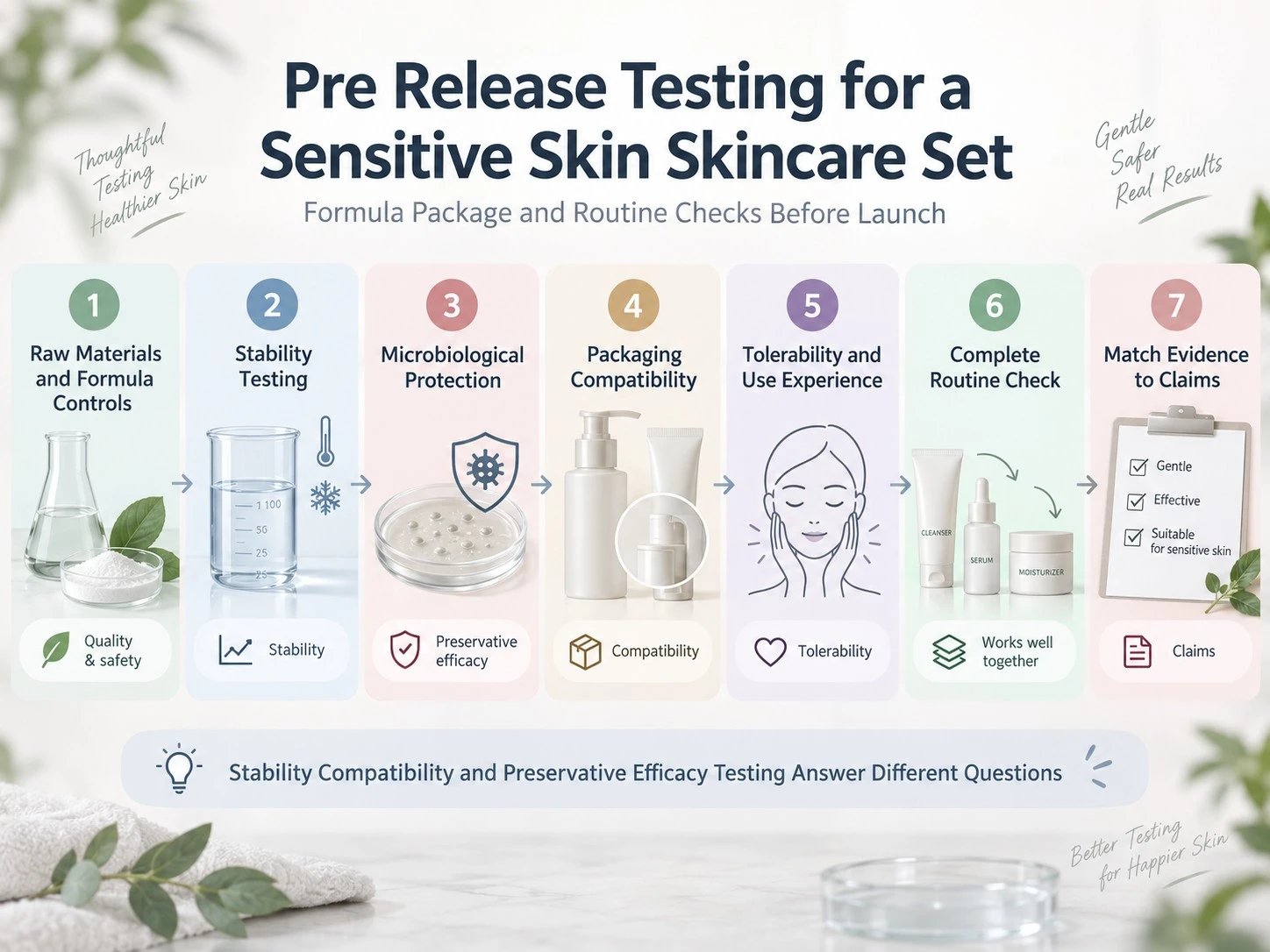
Testing should follow the actual formula, pack, market, claims and directions rather than a generic certificate checklist. For U.S. cosmetics, the responsible person must maintain records supporting adequate safety substantiation.[5] The resulting test plan should be risk-based, not copied unchanged across every SKU.
Use a gated release sequence:
- Confirm raw materials and formula controls. Review specifications, supplier documentation, restrictions, impurities or allergens where relevant, manufacturing instructions and finished-product specifications.
- Establish stability. Monitor physical appearance, odor, color, viscosity, pH and other formula-specific attributes under justified conditions and time points.
- Verify microbiological protection. Set finished-product microbiological criteria and evaluate preservative efficacy for applicable formulas. ISO 11930 provides a reference method for assessing the antimicrobial protection of cosmetic formulations.[6]
- Run packaging compatibility. Use production-intent components to assess leakage, deformation, discoloration, corrosion, cracking, label or decoration failure, dispensing and formula change.
- Evaluate tolerability and use experience. Select a qualified protocol matched to the target population, body site, directions and proposed claims; “dermatologically tested” is incomplete unless the method and conclusion are defined.
- Check the complete routine. Use realistic doses and order to assess tightness, sting, residue, tack, pilling, pump usability and cumulative sensory load.
- Match evidence to claims. Use instrumental, expert, clinical or consumer methods according to the exact endpoint, wording and time point.
Stability, compatibility and preservative-efficacy testing answer different questions; one passing result cannot substitute for the others. The stability, compatibility and challenge testing guide helps brands assign each test its correct release job.
Set Sensitive Skin Claims and Evidence Requirements
Write provisional claims before approving the formula and packaging. This lets the development team identify which wording needs tolerability, instrumental or consumer support before artwork is locked.
Potential cosmetic directions, when appropriately substantiated, include:
- Cleanses without leaving skin feeling stripped.
- Provides lightweight or lasting hydration.
- Helps skin feel calmer, softer or more comfortable.
- Supports the skin’s moisture barrier.
- Suitable for sensitive skin.
- Fragrance-free, when the formula and documentation support the term.
Avoid promises to treat eczema, rosacea, dermatitis, allergic reactions or inflammation in an ordinary cosmetic set. In the United States, disease-treatment or structure/function claims can cause a product to be regulated as a drug, even when the formula is presented as skincare.[7] Product names, diagrams, testimonials, influencer scripts and retail copy all contribute to the intended-use message.
“Hypoallergenic” is not a guarantee that no reaction will occur, and U.S. federal standards do not define the term through a mandatory test for cosmetic use.[8] If the brand wants the claim, document the formulation rationale, excluded materials, finished-product safety assessment and relevant tolerability evidence. Do not use the word as a replacement for a real substantiation file.
Ingredient studies do not automatically prove a finished serum or set claim. Map each statement to the exact SKU, method, population, directions and result. Use the cosmetic claim testing methods guide to separate instrumental endpoints from expert grading and consumer perception.
Prepare a Manufacturer RFQ That Can Be Quoted
A useful request for quotation gives the manufacturer decision-ready inputs instead of asking for a generic “best sensitive skin formula.” Include:
- Destination country, launch channel and target launch date.
- Two- or three-product architecture and the hero SKU.
- Customer profile, climate, routine and sensory concerns.
- Stock, modified-stock or custom-formula preference.
- Target texture, foam, absorption, finish, color and fragrance-free direction.
- Required ingredient stories and technically justified exclusions.
- Proposed front-label, product-page and campaign claims.
- Preferred pack formats, fill sizes, decoration and secondary packaging.
- Testing, documentation and market-compliance requirements.
- Target unit cost, retail price, forecast quantity and acceptable MOQ range.
- Reference products, with a note explaining which attributes—not the full formula—the brand wants to emulate.
State priorities and tradeoffs. For example, a premium airless pack, a custom ceramide system, low launch quantity and aggressive unit cost may not all fit the same brief. A complete private label skincare RFQ gives the manufacturer a better basis for feasibility, samples and quotations.
Common Sensitive Skin Set Development Mistakes
- Treating sensitive skin as one diagnosis: The positioning must not imply that a cosmetic set treats eczema, rosacea, allergy or dermatitis.
- Building a universal ingredient blacklist: Formula function, concentration, interactions and finished-product evidence matter more than fear-based exclusions.
- Assuming natural means gentle: Essential oils and botanical extracts still require safety, allergen, odor, color and stability review.
- Chasing preservative-free claims: Weak microbial protection is not a sensitive-skin benefit.
- Putting every soothing active into every SKU: Cumulative load can raise cost, tack, instability and sting risk without giving each product a clear role.
- Calling sulfate-free a mildness test: The complete cleanser and its use conditions determine cleansing experience.
- Choosing identical packs for visual consistency: A foaming cleanser, fluid serum and rich cream do not share the same dispensing needs.
- Treating airless as automatically compatible: Priming, dose, evacuation, viscosity and filling behavior still need validation.
- Testing each product but not the routine: Layering can reveal pilling, residue, tightness or cumulative sensory issues.
- Using hypoallergenic as a guarantee: The term does not eliminate individual reactions or the need for substantiation.
Develop a Sensitive Skin Skincare Set with ZICAIL
ZICAIL can discuss a coordinated sensitive-skin cleanser, serum and moisturizer project using stock, modified or custom formula routes, with product roles, textures, packaging compatibility, testing and cosmetic claims considered together.
Prepare the destination market, target customer, SKU count, formula route, fragrance direction, preferred textures, ingredient references, exclusions, pack formats, fill sizes, claims, price range and launch quantity. Then submit the brief through ZICAIL’s private label skincare page so feasibility and sample priorities can be reviewed product by product.


