

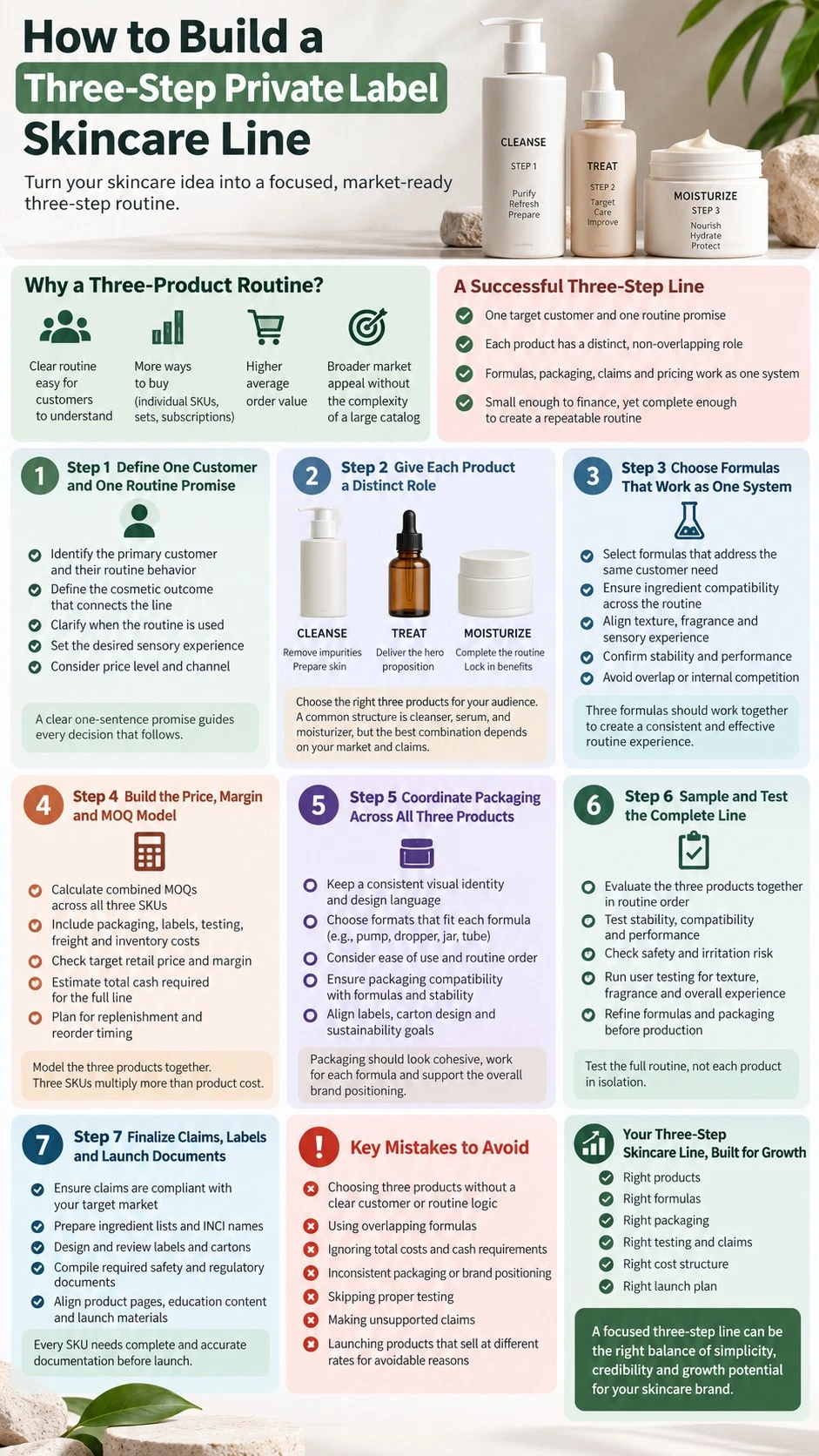
A three-step private label skincare line is not simply three attractive formulas with matching labels. It is a coordinated product system in which the customer, product roles, prices, packaging, claims, and replenishment logic support one another. Building that system before ordering inventory reduces the risk of launching three products that compete for attention or sell at different rates for avoidable reasons.
The process below assumes a cosmetic line rather than an over-the-counter drug line. If a U.S. launch includes sunscreen or acne-treatment claims, the classification and compliance path changes and should be scoped separately.
Why Build a Three-Product Skincare Routine?
Three products can give a startup enough range to demonstrate a routine without creating the inventory exposure of a broad catalog. Customers can understand what each item does, buy one entry product, or purchase the complete set. The brand also gains several order-value and merchandising options: individual SKUs, a full routine, trial kits, subscriptions, or replenishment offers.
The number alone does not create a strong line. Three products work when each has a clear role and all three address the same audience. A cleanser for oily teenage skin, a luxury firming serum, and a rich fragrance-led night cream may each be saleable, but together they do not communicate one coherent reason to buy the set.
Before committing, compare the inventory and cash requirements in the three-product skincare line cost guide. Three SKUs multiply more than product cost: each can introduce its own components, labels, cartons, samples, tests, production minimums, and reorder timing.
Step 1: Define One Customer and One Routine Promise
Start with a one-sentence range promise that identifies the user, routine, and cosmetic outcome. “A simple fragrance-free hydration routine for dry, sensitive-feeling skin” is more useful to a manufacturer than “clean skincare for everyone.” It guides formula selection, texture, fragrance, packaging, claims, price, and the order in which products are used.
The promise should answer five questions:
- Who is the primary customer? Specify the relevant routine behavior, concern, climate, channel, and product familiarity rather than relying only on age or gender.
- What cosmetic outcome connects the line? Examples include cleansing without a tight after-feel, improving the look of dullness, supporting a hydrated appearance, or maintaining a comfortable skin feel.
- When will the routine be used? Morning, evening, travel, professional treatment follow-up, and humid-climate routines create different formula and packaging needs.
- What must the experience feel like? Define foam, slip, absorption, finish, fragrance direction, and the time customers are likely to spend on the routine.
- What price position must the set support? A mass-market three-piece routine and a premium spa set need different formula, component, decoration, and margin choices.
Turn those decisions into one range brief before selecting formulas. A skincare product brief should identify nonnegotiable requirements, acceptable tradeoffs, target markets, benchmark products, packaging direction, cost targets, and claims boundaries. One shared brief prevents the three products from being developed as unrelated projects.
Step 2: Give Each Product a Distinct Role
For a broad facial skincare startup, cleanser-serum-moisturizer is often the easiest three-step structure to explain. The cleanser opens the routine, the serum carries the most specific proposition, and the moisturizer completes the experience. This is a commercial design rule rather than a claim that every consumer medically needs three products.
| Product position | Primary customer job | Formula questions | Commercial role |
|---|---|---|---|
| Step 1: Cleanser | Remove makeup, sunscreen, oil, and daily residue with an acceptable after-feel | Gel, cream, foam, balm, or oil; rinse profile; eye-area positioning; fragrance; skin feel after rinsing | Accessible entry product and frequent-use routine anchor |
| Step 2: Serum or treatment cosmetic | Deliver the line’s most specific cosmetic benefit and memorable texture | Benefit direction; active system; pH; color and odor stability; layering; dropper, pump, or airless pack | Hero-story product and potential value driver |
| Step 3: Moisturizer | Complete the routine with hydration, comfort, and the intended finish | Gel, lotion, or cream; finish; occlusivity; pilling; daytime and nighttime fit; jar, tube, or pump | Routine-completion product and replenishment anchor |
Do not give all three products the same broad description. If every label says “hydrates, brightens, smooths, and restores,” customers cannot see why they need the set. Keep the range promise consistent but assign the strongest product-level claim and sensory expectation to the SKU that can support it best.
When Should You Change the Cleanser-Serum-Moisturizer Structure?
Replace one position only when customer behavior or the channel creates a stronger routine. A spa brand may choose cleanser, treatment mask, and moisturizer. A makeup-removal line may use cleansing balm, water-based cleanser, and moisturizer. A body-care brand may prefer wash, targeted treatment, and body cream. A travel line may prioritize compact, leak-resistant formats over a conventional serum step.
Avoid replacing a core product merely because another category looks trendy. The alternative should make the routine easier to understand, strengthen the brand’s expertise, and have a credible replenishment role.
Step 3: Choose Formulas That Work as One System
Select formulas in routine order and evaluate how they behave together. The cleanser should leave a finish that does not undermine the next step. The serum should spread and absorb without excessive tack. The moisturizer should layer over the serum without rolling, pilling, separating, or creating an unwanted shine. Fragrance, color, viscosity, and sensory intensity should feel related even when the formats differ.
The three products do not need identical hero ingredients. Repeating one ingredient across every SKU can simplify storytelling, but it can also become decorative if the rinse-off product, serum, and cream use it in ways that do not support meaningful claims. A better system may use complementary formula roles under one benefit direction.
Decide whether each SKU will use a stock, semi-custom, or custom formula. A stock route can reduce development complexity when suitable bases already meet the brief. Custom work is more defensible when the customer promise depends on a texture, ingredient system, packaging interaction, or performance target that available formulas cannot provide. Use the stock versus custom formula guide to evaluate ownership, differentiation, testing, and transfer terms before approving the route.
Mixing routes is possible. A startup might choose established cleanser and moisturizer bases while investing more development effort in the hero serum. The range should still have one coordinated approval schedule so the hero product does not delay every other launch decision unexpectedly.
Step 4: Build the Price, Margin, and MOQ Model
Budget the line as three linked inventory positions, not as one unit-cost average. Record the MOQ, finished-unit cost, packaging, decoration, testing, freight, duties, warehousing, sampling, expected selling price, wholesale price, promotion allowance, and contribution margin for every SKU and for the set.
A simple model should answer:
- Can the individual products meet the required margin at their planned prices?
- Does the set still meet its margin target after a bundle discount?
- How much cash is committed if all three products must be reordered together?
- What happens if the cleanser sells twice as fast as the serum?
- Which components have higher minimums than the filled-product MOQ?
- Can cartons, pumps, bottles, or decoration be shared without weakening usability?
Typical ZICAIL project MOQs may fall around 1,000–3,000 units per SKU, depending on formula, packaging, decoration, and project requirements. Three SKUs can therefore represent three separate minimum commitments rather than one combined quantity. The private label skincare MOQ guide explains why formula and packaging minimums may not align.
Use a downside case, not only a target-sales case. Model slower sell-through, uneven SKU demand, damaged packaging, samples, returns, and the time between paying deposits and receiving customer revenue. A three-product line is viable only if the business can finance the complete order and still fund launch activity and reorders.
Step 5: Coordinate Packaging Across All Three Products
The line should look related without forcing every formula into the same container. Start with the product’s technical needs—viscosity, oxygen or light sensitivity, dispensing dose, evaporation risk, user hygiene, and shipping conditions—then create visual consistency through shape families, colors, labels, finishes, typography, and secondary packaging.
Shared components can reduce complexity, but only when they fit the formulas and usage. A pump family may work across a serum and lotion, while the cleanser may need a tube or higher-output pump. Using one bottle merely for visual uniformity can cause poor dispensing, excessive residual product, leakage, or an awkward customer experience.
Confirm component availability, decoration minimums, lead times, fill volumes, artwork areas, label materials, and carton dimensions before locking the design. Formula and package should be evaluated together through packaging compatibility testing, because a stable bulk formula can still interact with a pump, gasket, liner, tube, coating, or decoration.
Plan the set packaging after the individual packs are stable. A rigid gift box can raise cost and freight volume; a folding carton, sleeve, pouch, or shipper insert may be more practical for a first launch. The set must also protect each product during fulfillment rather than serve only as a presentation device.
Step 6: Sample and Test the Complete Line
Review each sample on its own and in the intended order. Use a written scorecard for appearance, odor, dispensing, spread, absorption, rinse behavior, after-feel, layering, pilling, package usability, and alignment with the approved brief. Test the routine under realistic use conditions instead of evaluating each sample only on the back of a hand.
Keep feedback specific and controlled. “Reduce the serum’s tack after one minute” gives the laboratory a clearer target than “make it more luxurious.” Track the sample version, requested change, reason, approver, and approval date for every SKU. A late change to fragrance, color, active system, viscosity, or package can affect evidence and timing.
Formula approval is not the same as commercial release. Companies marketing cosmetics are responsible for ensuring safety, and there is no single universal test list for every cosmetic. Existing ingredient or similar-formula data may be relevant, while additional scientifically sound testing may be needed to fill gaps for the finished product.[1] The responsible person must also ensure and maintain records supporting adequate safety substantiation for U.S. cosmetics, subject to the applicable MoCRA framework.[2]
Create a SKU-level matrix covering stability, microbiological quality, preservative efficacy when relevant, packaging compatibility, specifications, and claim-support work. The exact plan depends on formula type, package, intended use, claims, and markets. Use the skincare product testing guide to distinguish the tests and documents a launch may need.
Step 7: Finalize Claims, Labels, and Launch Documents
Build a separate label and claims file for each product, plus a range-level checklist. In the United States, required cosmetic label information includes elements such as product identity, net quantity, business information, ingredient declaration, and any necessary warnings or directions, with detailed placement and presentation rules applying to the package.[3] Final artwork should therefore be reviewed as regulated labeling, not only as visual design.
Keep claims cosmetic, truthful, and supportable. Claims that a product treats or prevents disease or affects the structure or function of the body can cause it to be regulated as a drug in the United States, even when the product also affects appearance.[4] Advertising evidence should also match the specific formula, benefit, use conditions, and target audience rather than relying on research about a fashionable ingredient that does not substantiate the finished-product claim.[5]
For each SKU, assemble the approved formula and ingredient list, finished-product specification, test records, packaging specification, artwork version, directions, warnings, claims support, batch and traceability information, and market-specific compliance documents. Confirm which party prepares, reviews, owns, and updates each item.
Under MoCRA, a responsible person generally must list each marketed cosmetic product with FDA, including its ingredients, and update the listing annually, subject to applicable exemptions and requirements. Facility registration and product listing are not FDA approval and should not be marketed as certificates of product approval.[6] A three-product routine normally requires product-level information for all three SKUs rather than one generic “set” file.
Do not schedule the launch around the first optimistic production date. Create one critical path that includes formula approval, component arrival, compatibility work, test milestones, artwork approval, production, quality release, freight, photography, website preparation, and fulfillment setup. Regular ZICAIL samples often take about 7–10 working days, while standard bulk production is commonly about 25–30 working days after required approvals; exact timing depends on the project and does not include every development, testing, component, or transit stage.
Common Three-Step Skincare Line Mistakes
- Choosing three bestsellers instead of one routine: individually popular products may target different customers, price points, or usage patterns.
- Making every SKU a hero: three competing messages make the line harder to explain and divide the marketing budget.
- Ignoring combined inventory exposure: founders sometimes calculate one MOQ but commit to three formulas, three packs, and several component minimums.
- Using one package family without technical review: visual consistency cannot compensate for poor dispensing or formula-package interaction.
- Approving formulas separately: products that feel acceptable alone may pill, layer poorly, or create an inconsistent sensory sequence.
- Writing claims after testing: the evidence plan should follow the intended claim before commercial artwork is approved.
- Launching before the set economics work: a bundle can increase order value but still lose margin after discounts, inserts, assembly, and fulfillment costs.
- Adding a fourth product to solve an unclear concept: more SKUs cannot repair a weak audience definition or overlapping product roles.
Plan a Three-Step Private Label Line with ZICAIL
ZICAIL can discuss stock, semi-custom, or custom options for a coordinated three-product skincare project, together with packaging direction, MOQ, sampling, testing, and production scope. Prepare your target customer, market, three proposed product roles, formula preferences, packaging references, target prices, forecast, claims direction, and launch window. Send that range brief to begin a feasibility and quotation discussion.


