


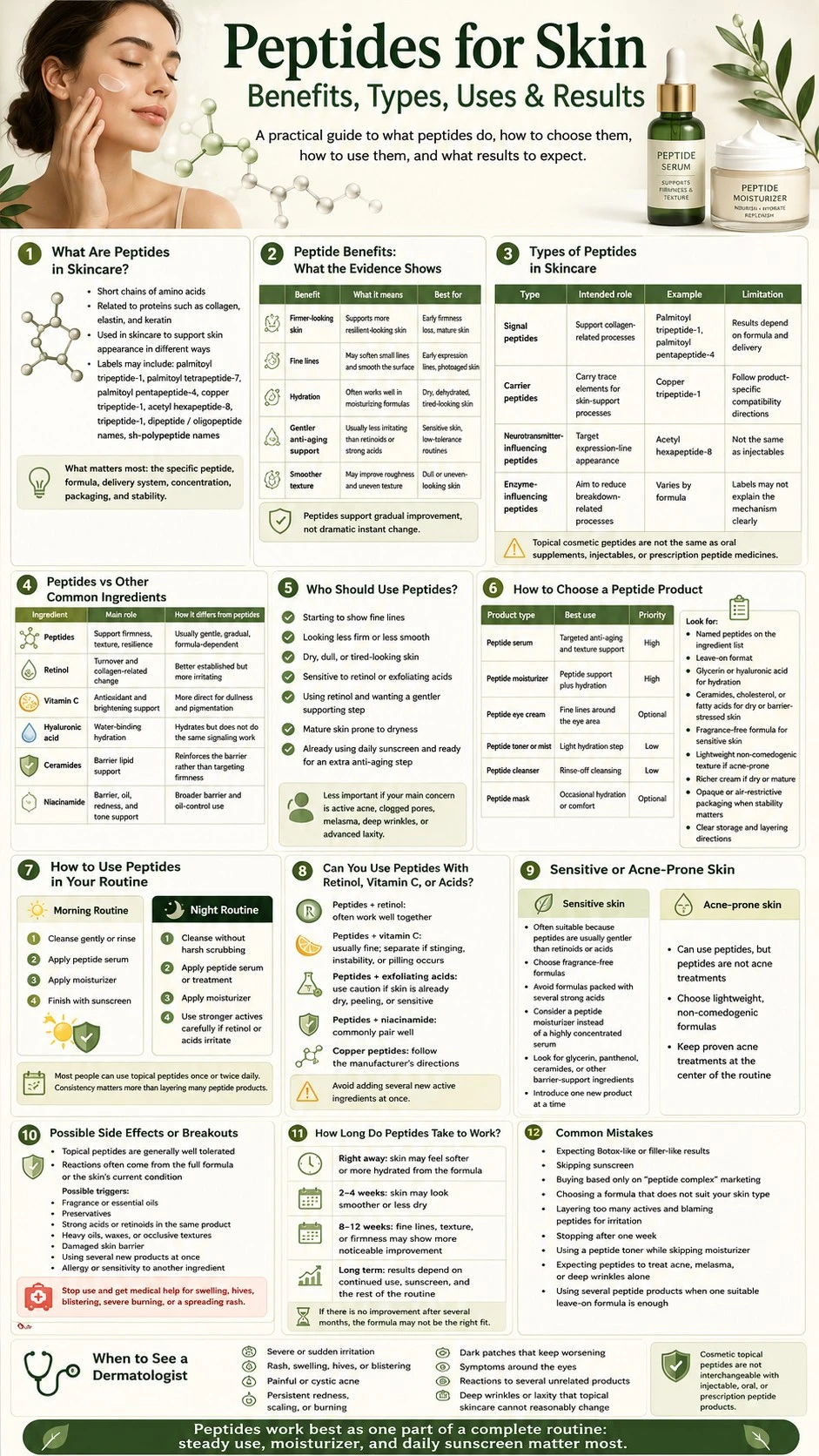
What Are Peptides in Skincare?
Peptides are chains of amino acids shorter than full proteins. Amino acids join to form peptides, and longer chains help form proteins such as collagen, elastin, and keratin.
In skincare, peptides are designed to interact with the skin in different ways. Some are used to support collagen-related processes, some carry trace elements, and others are intended to influence enzymes or the appearance of expression lines.[3]
You may see peptide ingredients listed as:
- Palmitoyl tripeptide-1.
- Palmitoyl tetrapeptide-7.
- Palmitoyl pentapeptide-4.
- Copper tripeptide-1.
- Acetyl hexapeptide-8.
- Tripeptide-1.
- Dipeptide or oligopeptide names.
- Sh-polypeptide or other biomimetic peptide names.
You do not need to memorize these names. What matters more is the specific peptide, the delivery system, the concentration, the packaging, and the rest of the formula. Peptides can be difficult to stabilize and deliver through the skin, so the word “peptide” on a label does not guarantee strong results.[1][4]
Peptide Benefits for Skin: What the Evidence Shows
Topical peptides can support hydration, smoother texture, firmer-looking skin, and the appearance of fine lines. Results vary because different peptides, concentrations, delivery systems, and finished formulas do not work the same way.[3][6]
The evidence is promising but not equally strong for every claim. Many studies are small or test specific formulas, and current evidence is stronger for hydration and gradual improvements in skin appearance than for major changes in elasticity, skin density, or deep wrinkles.[5]
| Potential Benefit | What It Means | Who May Benefit Most |
|---|---|---|
| Supports firmer-looking skin | May help skin look more resilient with consistent use | Early firmness loss and mature skin |
| Improves the look of fine lines | May soften small lines and improve surface smoothness | Early expression lines and photoaged skin |
| Supports hydration | Often works in formulas with humectants and moisturizers | Dry, dehydrated, or tired-looking skin |
| Supports a gentler anti-aging routine | Usually causes less irritation than retinoids or strong acids | Sensitive skin and users who cannot tolerate stronger actives |
| Supports smoother texture | May improve the look of roughness and uneven surface texture | Dull or uneven-looking skin |
A well-formulated peptide product can support gradual improvements in skin quality, but it will not replace retinoids, sunscreen, injectable treatments, or medical care.[2]
Types of Peptides in Skincare
Peptides are often grouped by their intended mechanism. These categories are useful for understanding labels, but they do not prove that every finished product will deliver the same result.
| Peptide Type | Intended Role | Common Examples | Important Limitation |
|---|---|---|---|
| Signal peptides | Support collagen-related processes and firmer-looking skin | Palmitoyl tripeptide-1, palmitoyl pentapeptide-4 | Results depend on delivery and the finished formula |
| Carrier peptides | Carry trace elements used in skin-support processes | Copper tripeptide-1 | Copper peptide formulas may have product-specific compatibility directions |
| Neurotransmitter-influencing peptides | Aim to soften the appearance of expression lines | Acetyl hexapeptide-8 | They do not work like injectable neuromodulators |
| Enzyme-influencing peptides | Aim to reduce processes linked to collagen or elastin breakdown | Varies by formula | Consumer labels may not clearly explain the mechanism |
Acetyl hexapeptide-8 is often marketed as “Botox-like,” but the comparison is misleading. It may support the appearance of wrinkle depth, hydration, and elasticity, but there is limited evidence that topical use reaches the neuromuscular targets affected by injectable treatments.[7]
Topical cosmetic peptides are not the same as oral supplements, injectable peptides, or prescription peptide medicines. They differ in delivery, dosage, evidence, and safety requirements.
Peptides vs Retinol, Vitamin C, Hyaluronic Acid, and Ceramides
Peptides are not direct substitutes for every popular active. Each ingredient has a different primary role.
| Ingredient | Main Role | Best For | How It Differs From Peptides |
|---|---|---|---|
| Peptides | Supports firmness, texture, and skin resilience | Fine lines, early aging, sensitive routines | Usually gentle, gradual, and formula-dependent |
| Retinol | Supports cell turnover and collagen-related changes | Wrinkles, texture, acne-prone concerns | Better established but more likely to irritate |
| Vitamin C | Antioxidant and brightening support | Dullness, uneven tone, sun damage appearance | Targets oxidation and pigmentation more directly |
| Hyaluronic acid | Water-binding hydration | Dehydrated and tight-feeling skin | Hydrates but does not serve the same signaling role |
| Ceramides | Barrier lipid support | Dry, sensitive, barrier-stressed skin | Reinforces the lipid barrier rather than targeting firmness |
| Niacinamide | Barrier, oil, redness, and tone support | Oily, sensitive, uneven-looking skin | Has broader barrier and oil-control uses |
Who Should Use Peptides?
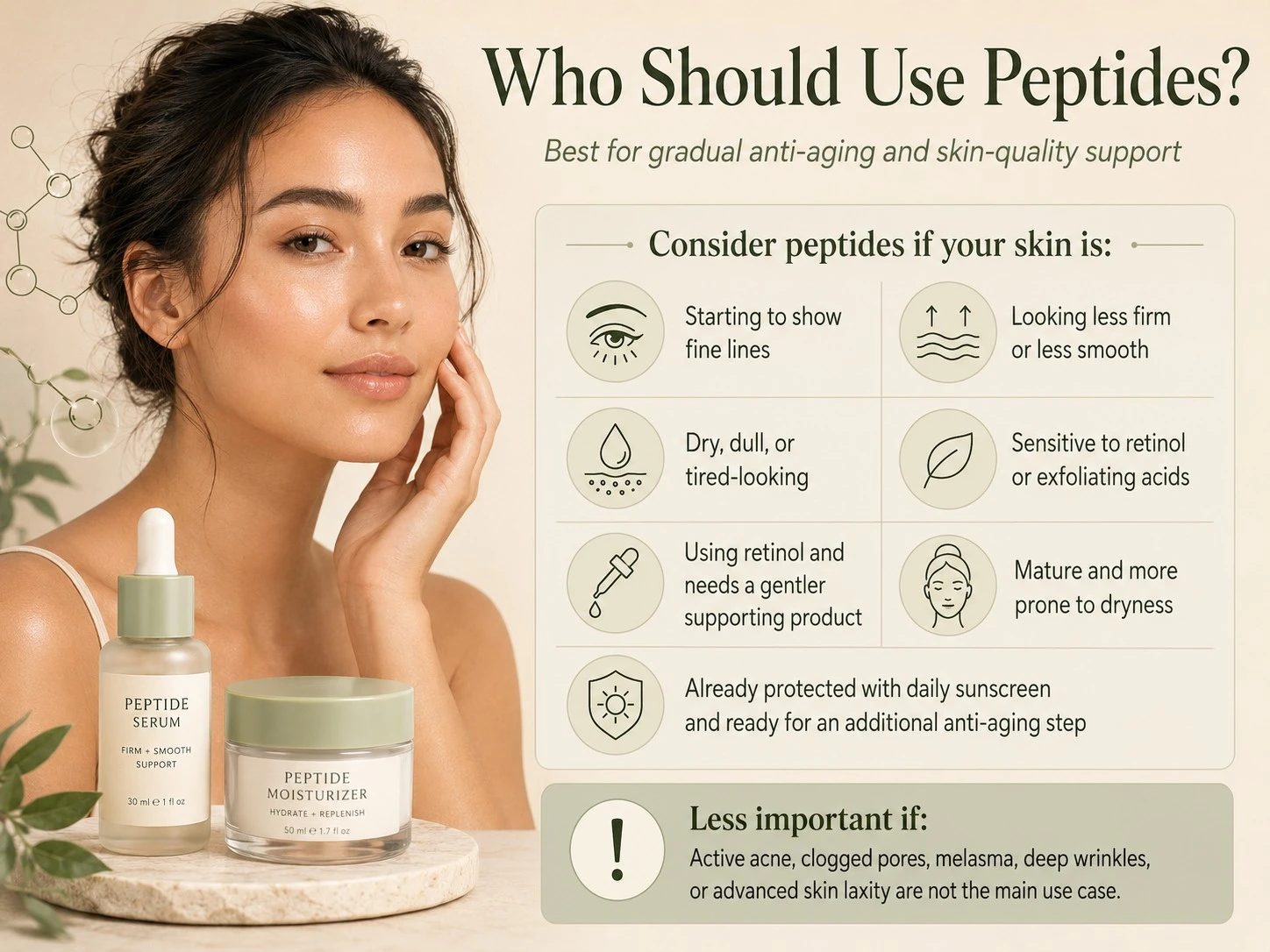
Peptides are most useful for people who want gradual anti-aging or skin-quality support without making the routine more aggressive.
Consider peptides if your skin is:
- Starting to show fine lines.
- Looking less firm or less smooth.
- Dry, dull, or tired-looking.
- Sensitive to retinol or exfoliating acids.
- Using retinol and needs a gentler supporting product.
- Mature and more prone to dryness.
- Already protected with daily sunscreen and ready for an additional anti-aging step.
Peptides are less important if your main concern is active acne, clogged pores, melasma, deep wrinkles, or advanced skin laxity. They can support those routines, but they should not be the main treatment.
How to Choose a Peptide Product
For most people, a leave-on peptide serum or moisturizer is the best first choice. Rinse-off cleansers and short-contact masks give peptides less time on the skin.
| Product Type | Best Use | Priority |
|---|---|---|
| Peptide serum | Targeted anti-aging and texture support | High |
| Peptide moisturizer | Peptide support plus hydration and barrier comfort | High, especially for dry or sensitive skin |
| Peptide eye cream | Fine lines around the eye area | Optional if a face product is already eye-safe |
| Peptide toner or mist | Light hydration step | Low |
| Peptide cleanser | Rinse-off cleansing | Low because contact time is short |
| Peptide mask | Occasional hydration or comfort | Optional |
When choosing a peptide product, look for:
- Named peptides on the ingredient list instead of a vague marketing claim alone.
- A leave-on format that suits your routine.
- Glycerin or hyaluronic acid if hydration is a priority.
- Ceramides, cholesterol, or fatty acids if your skin is dry or barrier-stressed.
- A fragrance-free formula if your skin is sensitive.
- A lightweight, non-comedogenic texture if you are acne-prone.
- A richer cream if your skin is dry or mature.
- Air-restrictive or opaque packaging when the formula is sensitive to light or air.
- Clear storage, layering, and compatibility directions from the manufacturer.
Peptide skincare can be expensive, but a higher price does not prove better performance. Formulation quality matters because peptide stability, penetration, and delivery remain major product-development challenges.[1][4]
How to Use Peptides in Your Skincare Routine
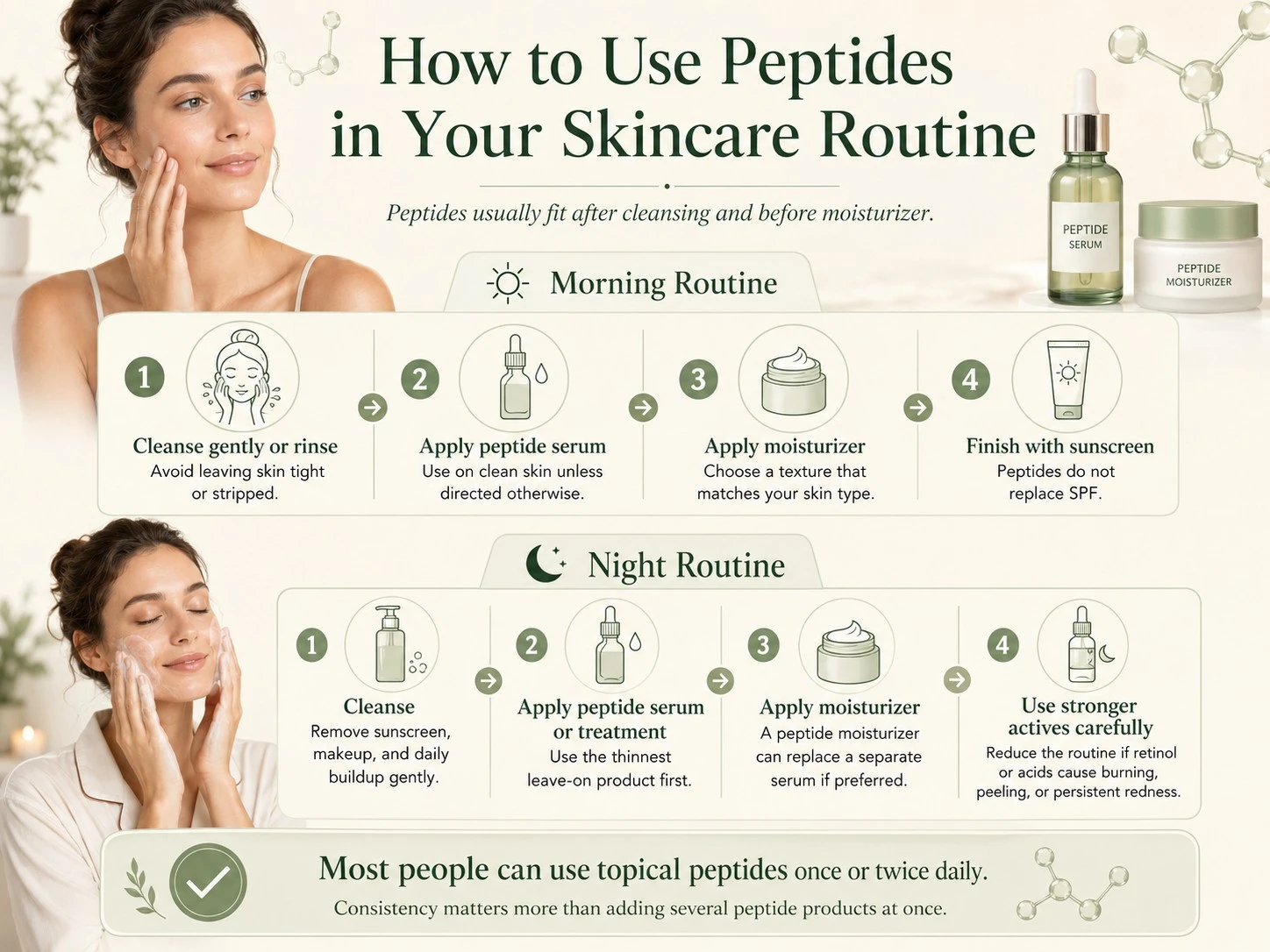
Peptides usually fit after cleansing and before moisturizer. Follow the product directions when a formula combines peptides with stronger actives.
Morning routine:
- Cleanse gently or rinse: avoid leaving the skin tight or stripped.
- Apply peptide serum: use it on clean skin unless the product directs otherwise.
- Apply moisturizer: choose a texture that matches your skin type.
- Finish with sunscreen: peptides do not prevent UV damage or replace SPF.
Night routine:
- Cleanse: remove sunscreen, makeup, and daily buildup without harsh scrubbing.
- Apply peptide serum or treatment: use the thinnest leave-on product first unless directed otherwise.
- Apply moisturizer: a peptide moisturizer can replace a separate serum if you prefer fewer steps.
- Use stronger actives carefully: reduce the routine if retinol or acids cause burning, peeling, or persistent redness.
Most people can use topical peptides once or twice daily. Consistency matters more than adding several peptide products at once. For the full order of other products, see our skincare routine order guide.
Can You Use Peptides With Retinol, Vitamin C, or Acids?
Peptides can often be used with retinol, vitamin C, niacinamide, and exfoliating acids. The main concern is the total irritation load and the directions for the specific formula.
- Peptides and retinol: often work well in the same routine, especially when the peptide product also moisturizes.
- Peptides and vitamin C: can usually coexist, but separate them if layering causes stinging, instability, or pilling.
- Peptides and exfoliating acids: use caution if the skin is already dry, peeling, or sensitive.
- Peptides and niacinamide: commonly pair well in hydrating and barrier-support formulas.
- Copper peptides: follow the manufacturer’s directions because compatibility advice can differ by formula.
A simple routine may use vitamin C in the morning, retinol or acids at night, and peptides at whichever time causes the least irritation. Do not add several new active ingredients at once.
Are Peptides Good for Sensitive or Acne-Prone Skin?
Peptides are often suitable for sensitive skin because they are usually less irritating than retinoids or exfoliating acids. The finished formula still matters.
For sensitive skin:
- Choose fragrance-free products.
- Avoid formulas that combine peptides with several strong acids.
- Consider a peptide moisturizer instead of a highly concentrated treatment serum.
- Look for glycerin, panthenol, ceramides, or other barrier-support ingredients.
- Introduce one product at a time.
Acne-prone skin can also use peptides, but peptides are not acne treatments. Choose a lightweight, non-comedogenic product and keep proven acne treatments at the center of your acne-prone skincare routine.
Can Peptides Cause Side Effects or Breakouts?
Topical peptides are generally well tolerated. If a peptide product burns, stings, itches, or causes breakouts, another part of the formula or the skin’s current condition may be responsible.
Possible triggers include:
- Fragrance or essential oils.
- Preservatives.
- Strong acids or retinoids in the same product.
- Heavy oils, waxes, or occlusive textures.
- A damaged skin barrier.
- Using several new products at once.
- An allergy or sensitivity to another ingredient.
Stop using the product if irritation persists. Get medical help for swelling, hives, blistering, severe burning, or a spreading rash. Reactive skin should patch test new skincare products before full-face use.
How Long Do Peptides Take to Work?
Peptide results are gradual and depend on the formula, the concern being treated, and consistent use.
- Right away: moisturizing ingredients in the formula may make skin feel softer or more hydrated.
- After 2–4 weeks: skin may look smoother or less dry if the product suits your routine.
- After 8–12 weeks: fine lines, texture, or firmness may show more noticeable improvement.
- Long term: results depend on continued use, sunscreen, and the rest of the routine.
These are practical review points, not guaranteed deadlines. If a product causes no improvement after several months, it may not contain the right peptide, delivery system, or supporting formula for your concern.
Common Mistakes When Using Peptides
- Expecting peptides to work like Botox or fillers.
- Using peptides while skipping sunscreen.
- Buying a product based only on the phrase “peptide complex.”
- Choosing a formula that does not suit your skin type.
- Layering too many actives and blaming peptides for irritation.
- Stopping after one week because the result is not dramatic.
- Using a peptide toner while skipping moisturizer.
- Expecting peptides to treat acne, melasma, or deep wrinkles alone.
- Using several peptide products when one suitable leave-on formula is enough.
A good peptide routine should feel steady, not aggressive. If the skin keeps stinging, peeling, or breaking out, simplify the routine and reassess the full formula.
When to See a Dermatologist
Peptide skincare supports cosmetic skin goals but does not treat persistent or severe skin disease.
See a dermatologist if you have:
- Severe or sudden irritation.
- Rash, swelling, hives, or blistering.
- Painful or cystic acne.
- Persistent redness, scaling, or burning.
- Dark patches that keep worsening.
- Skin symptoms around the eyes.
- Reactions to several unrelated products.
- Deep wrinkles or laxity that topical skincare cannot reasonably change.
Injectable peptides, oral supplements, prescription peptide medicines, and topical cosmetic peptides are not interchangeable. Do not use unapproved injectable or wellness peptides based on claims made for a cosmetic serum.
Final Thoughts
Peptides are useful for people who want gentle, gradual support for fine lines, firmness, texture, hydration, and overall skin quality. They are most valuable in a well-formulated leave-on product used consistently with moisturizer and sunscreen.
Choose a product that names its peptides, fits your skin type, and avoids your triggers. Keep expectations realistic: peptides can improve the look of skin, but they do not replace retinol, sunscreen, injectables, or medical treatment.
FAQs About Peptides for Skin
Are peptides good for your skin?
Yes. Well-formulated peptides can support smoother, firmer-looking, better-hydrated skin. They are most useful for early fine lines, dryness, dullness, and skin that does not tolerate stronger actives well.
Do peptides really work for wrinkles?
Peptides may gradually improve the appearance of fine lines and surface texture, but results vary by peptide and formula. They are more realistic for early lines and overall skin quality than deep wrinkles or sagging.
Are peptides better than retinol?
No. Retinol has stronger evidence for wrinkles, texture, and acne-related concerns, but it also causes more irritation. Peptides are generally gentler, with slower and more subtle results.
Can I use peptides with retinol or vitamin C?
Yes. Peptides can usually be used with retinol or vitamin C. Separate the products if layering causes burning, redness, pilling, or conflicts with the manufacturer’s directions. Copper peptide formulas may have more specific compatibility instructions.
Are peptides good for sensitive or acne-prone skin?
Peptides often suit sensitive or acne-prone skin because they are generally gentle and do not directly exfoliate the skin. Choose a fragrance-free, lightweight, non-comedogenic formula. Breakouts are more likely to come from the product base than from peptides themselves.
How long do peptides take to show results?
Hydration and comfort may improve within days, while fine lines, texture, and firmness often need at least 8–12 weeks of consistent use. Results depend on the peptide, formula, skin condition, and the rest of the routine.
Sources
[1] Cleveland Clinic. Peptides for Skin Care: Are They Worth It?
[2] American Academy of Dermatology. Caring for Your Skin in Menopause.
[3] Pintea A, et al. Peptides: Emerging Candidates for the Prevention and Treatment of Skin Aging
[4] Badilli U, et al. Current Approaches in Cosmeceuticals: Peptides, Biotics and Essential Oils
[5] Nukaly HY, et al. Oral and Topical Peptides for Skin Aging: A Systematic Review and Meta-Analysis of Randomized Controlled Trials
[6] Chan LKW, et al. Cosmeceuticals in Photoaging: A Review
[7] Zdrada-Nowak J, et al. Acetyl Hexapeptide-8 in Cosmeceuticals: A Review of Skin Permeability and Wrinkle-Reducing Efficacy


