


Why Skincare Startup Costs Vary So Much
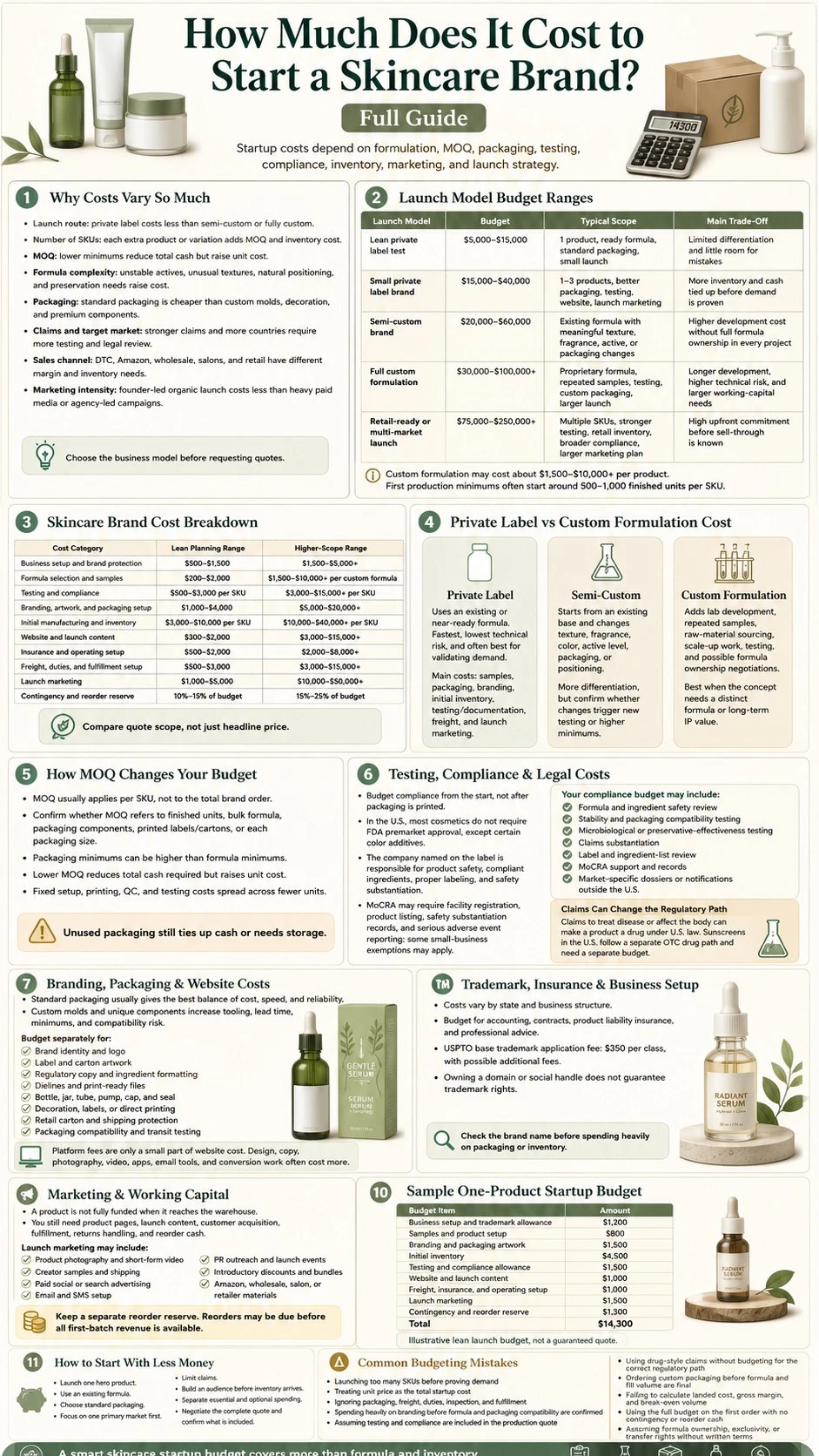
Two founders can launch similar-looking moisturizers and spend very different amounts. The main cost drivers are not only the ingredients inside the bottle, but also how the product is developed, packaged, tested, manufactured, and sold.
- Launch route: a ready private label formula costs less than semi-custom development or a formula created from scratch.
- Number of SKUs: every cleanser, serum, moisturizer, size, shade, or packaging variation can create another MOQ and another inventory commitment.
- MOQ: a lower minimum reduces total cash required but often raises the cost per unit.
- Formula complexity: unstable actives, unusual textures, encapsulated ingredients, natural positioning, or difficult preservation systems can increase development and testing.
- Packaging: standard bottles and jars are cheaper than custom molds, decorated components, unusual pumps, or premium secondary boxes.
- Claims and target market: stronger claims or entry into multiple countries can require more testing, documentation, and legal review.
- Sales channel: a direct-to-consumer launch needs different inventory, content, margin, and logistics than Amazon, wholesale, salons, or major retail.
- Marketing intensity: organic founder-led content costs less in cash than a launch built around paid media, agencies, events, and large influencer seeding.
Start by choosing the business model before requesting quotes. Our step-by-step guide to starting a skincare brand explains the full route from product concept to launch.
Skincare Brand Cost Breakdown
The table below is a planning framework for a small online-first skincare launch. The ranges are intentionally broad because supplier country, product type, order size, packaging, and compliance scope can change the budget substantially.
| Cost Category | Lean Planning Range | Higher-Scope Range | What It May Include |
|---|---|---|---|
| Business setup and brand protection | $500–$1,500 | $1,500–$5,000+ | Business registration, contracts, trademark filing, professional advice |
| Formula selection and samples | $200–$2,000 | $1,500–$10,000+ per custom formula | Stock samples, benchmark products, formulation, revisions, fragrance work |
| Testing and compliance | $500–$3,000 per SKU | $3,000–$15,000+ per SKU | Stability, compatibility, microbiology, claims support, safety review, market documents |
| Branding, artwork, and packaging setup | $1,000–$4,000 | $5,000–$20,000+ | Logo, label design, dielines, cartons, component samples, printing setup, custom tooling |
| Initial manufacturing and inventory | $3,000–$10,000 per SKU | $10,000–$40,000+ per SKU | Bulk formula, filling, components, labels, cartons, assembly, quality control |
| Website and launch content | $300–$2,000 | $3,000–$15,000+ | Store platform, theme, product pages, photography, video, copy, email setup |
| Insurance and operating setup | $500–$2,000 | $2,000–$8,000+ | Product liability insurance, accounting, software, contracts, storage setup |
| Freight, duties, and fulfillment setup | $500–$3,000 | $3,000–$15,000+ | International freight, customs, inspection, domestic transport, 3PL onboarding |
| Launch marketing | $1,000–$5,000 | $10,000–$50,000+ | Samples, creators, paid ads, PR, launch offers, events, retail materials |
| Contingency and reorder reserve | 10%–15% of budget | 15%–25% of budget | Delays, damaged components, revisions, extra freight, reorder deposits |
Do not add the lowest number from every row and treat it as a guaranteed total. Some manufacturers include testing, artwork support, or packaging assembly in their quote, while others separate every service. Compare the scope of each quote, not only the headline price.
Private Label vs Custom Formulation Cost
Private Label Skincare
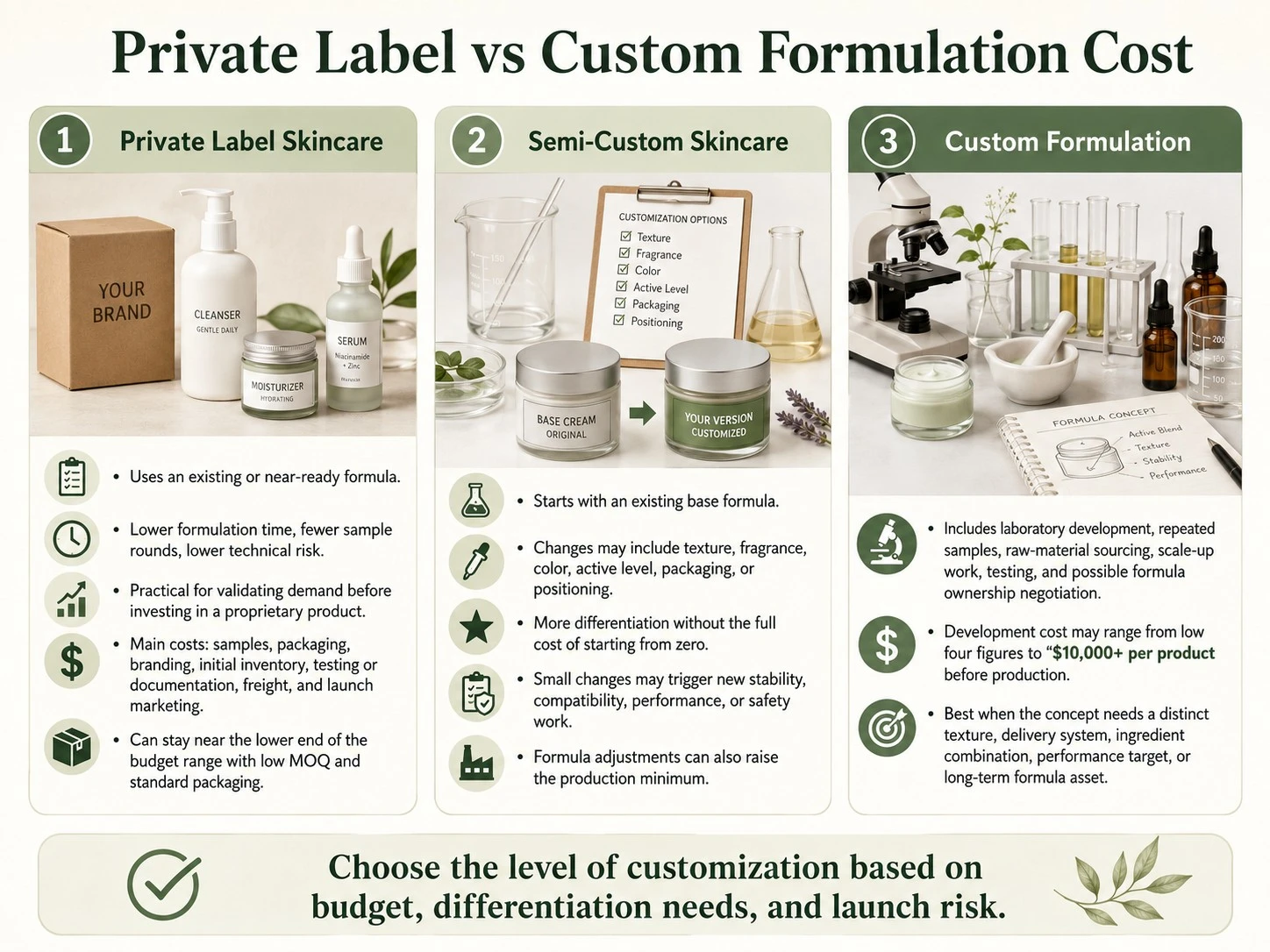
Private label usually uses an existing or near-ready formula. It reduces formulation time, sample rounds, and technical risk, making it the most practical route for a founder who wants to validate demand before investing in a proprietary product.
The main costs are samples, packaging, branding, initial inventory, testing or documentation not already included, freight, and launch marketing. A one-product private label launch can sometimes stay near the lower end of the budget range when the manufacturer offers a low MOQ and standard packaging.
Semi-Custom Skincare
Semi-custom development begins with an existing base but changes selected features such as texture, fragrance, color, active level, packaging, or positioning. It can create more differentiation without the full cost of starting from zero.
Confirm which changes trigger new stability, compatibility, performance, or safety work. A small formula adjustment can be inexpensive, but it can also create a new testing path or change the production minimum.
Custom Formulation
Custom formulation adds laboratory development, repeated samples, raw-material sourcing, scale-up work, testing, and possible formula ownership negotiations. Development can range from low four figures to $10,000 or more per product before the production order begins.[2]
Custom is most justified when the product concept needs a distinct texture, delivery system, ingredient combination, performance target, or long-term formula asset. See our skincare formulation guide before deciding how much customization the first launch really needs.
How MOQ Changes Your Budget
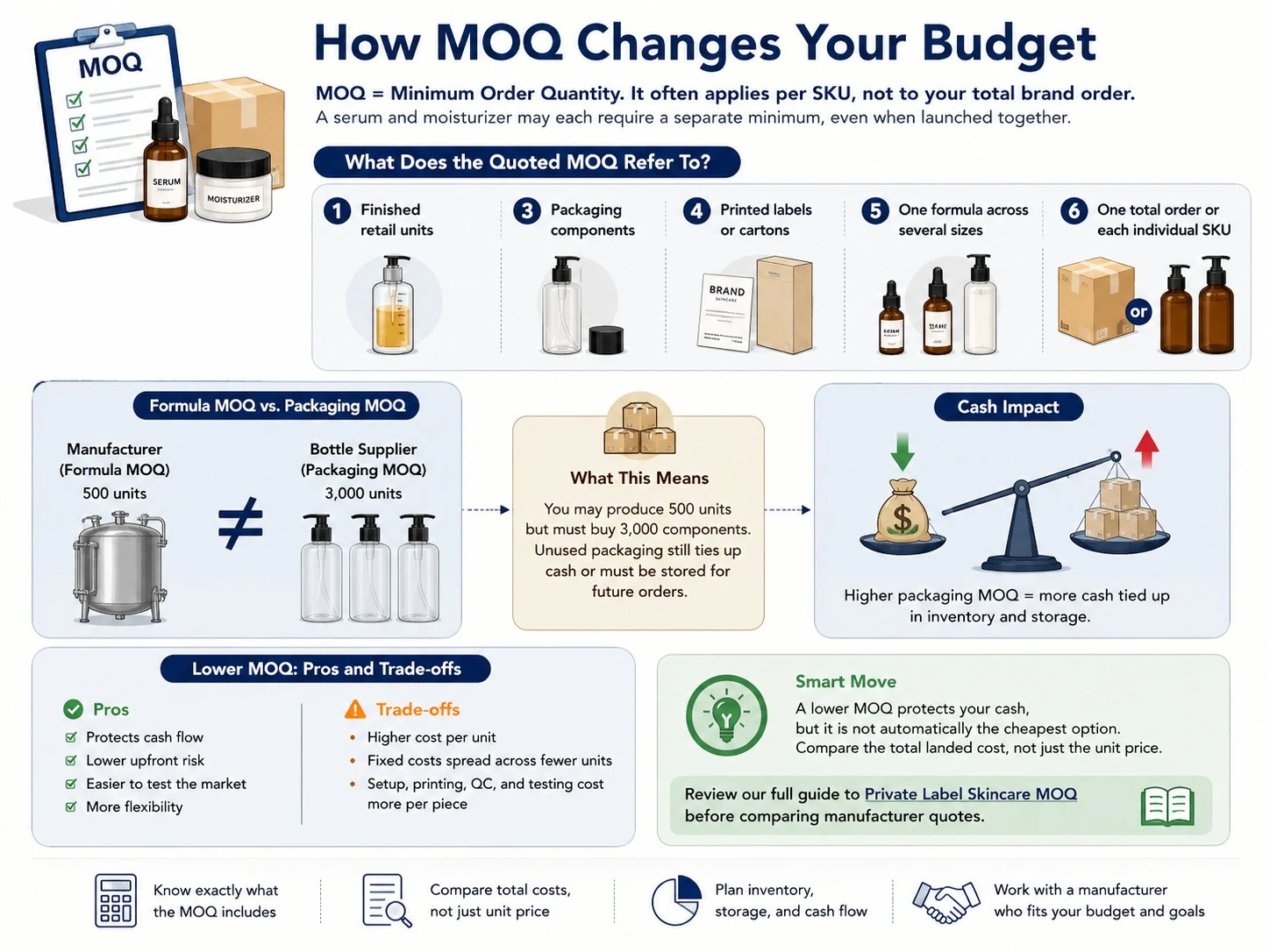
MOQ means minimum order quantity. In skincare manufacturing, it often applies per SKU rather than to the total brand order. A serum and moisturizer may each require a separate minimum, even when they launch together.
You should confirm whether the quoted MOQ refers to:
- Finished retail units.
- Bulk formula measured in kilograms or liters.
- Packaging components.
- Printed labels or cartons.
- One formula across several packaging sizes.
- One total order or each individual SKU.
Packaging minimums can be higher than the formula minimum. For example, a manufacturer may agree to produce 500 units while the decorated bottle supplier requires 3,000 components. The unused packaging still ties up cash or must be stored for future orders.
A lower MOQ protects cash, but it is not automatically the cheapest option. Fixed setup, printing, quality control, and testing costs are spread across fewer units. Review our full guide to private label skincare MOQ before comparing manufacturer quotes.
Testing, Compliance, and Legal Costs
Compliance should be budgeted from the beginning, not added after the packaging is printed. In the United States, most cosmetics and cosmetic ingredients do not require FDA premarket approval, except for certain color additives. The company whose name appears on the label is still responsible for product safety, compliant ingredients, proper labeling, and records supporting adequate safety substantiation.[4]
MoCRA also established requirements that can include facility registration, product listing, safety substantiation records, and serious adverse event reporting. Required facilities renew registration every two years, and responsible persons update product listings annually, although certain small-business exemptions may apply.[5]
Your compliance budget may include:
- Formula and ingredient safety review.
- Stability and packaging compatibility testing.
- Microbiological or preservative-effectiveness testing.
- Claims substantiation.
- Label and ingredient-list review.
- MoCRA support and record preparation.
- A U.S. agent or responsible-person support where applicable.
- Market-specific product dossiers or notifications outside the United States.
Cosmetic labels must include required information and must not be false or misleading. Incorrect placement, missing information, or unsupported claims can make a product misbranded.[6]
Claims Can Change the Regulatory Path
A product marketed to cleanse, moisturize, or improve appearance may remain a cosmetic, while claims to treat disease or affect the structure or function of the body can make it a drug under U.S. law.[7]
This matters for products positioned around acne treatment, eczema treatment, hair growth, antiperspirant effects, or sun protection. Sunscreens are regulated as nonprescription drugs in the United States and require a different testing, labeling, and compliance path.[8] A sunscreen-led launch should therefore use a separate budget; see our guide to the cost of launching a sunscreen brand.
Branding, Packaging, and Website Costs
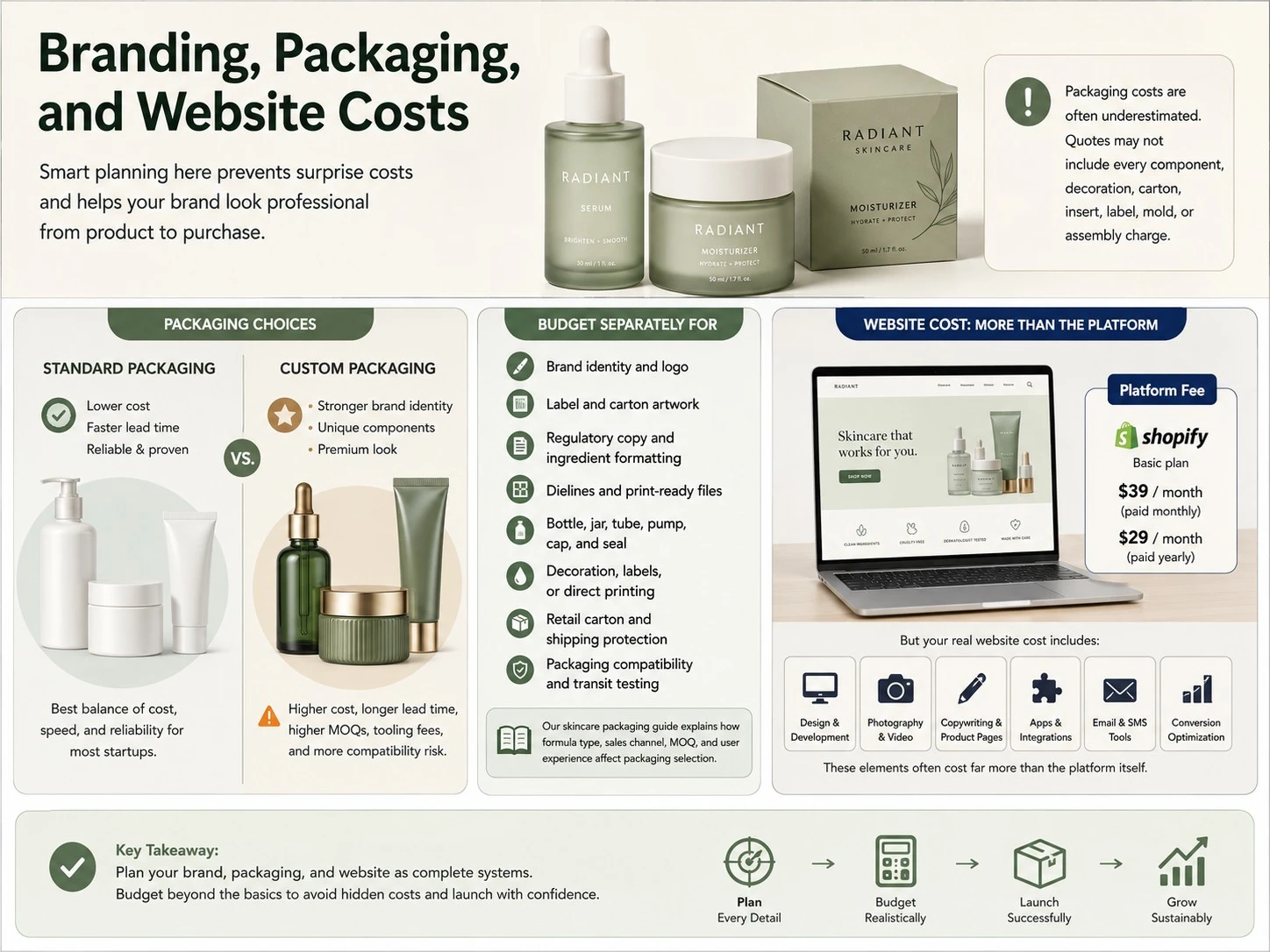
Packaging is one of the easiest costs to underestimate because the product quote may not include every component, decoration method, carton, insert, label, mold, or assembly charge.
Standard packaging usually gives a startup the best balance of cost, speed, and reliability. Custom molds and unique components can strengthen brand identity, but they add tooling fees, longer lead times, higher component minimums, and more compatibility risk.
Budget separately for:
- Brand identity and logo.
- Label and carton artwork.
- Regulatory copy and ingredient formatting.
- Dielines and print-ready files.
- Bottle, jar, tube, pump, cap, and seal.
- Decoration, labels, or direct printing.
- Retail carton and shipping protection.
- Packaging compatibility and transit testing.
Our skincare packaging guide explains how formula type, sales channel, MOQ, and user experience affect packaging selection.
An e-commerce platform fee is only a small part of website cost. Shopify’s Basic plan is currently listed at $39 per month when paid monthly, or $29 per month when paid yearly, but design, photography, copy, apps, email tools, and conversion work can cost much more than the platform itself.[9]
Trademark, Insurance, and Business Setup
Business registration costs vary by state and legal structure. Founders may also need accounting, contracts, product liability insurance, and professional advice on formula ownership, manufacturing terms, claims, and market responsibilities.
The current USPTO base trademark application fee is $350 per class of goods or services, with possible additional fees depending on the application.[10] Attorney fees, clearance searches, office-action responses, and international protection are separate.
Do not assume that owning a domain, social handle, or company registration gives you trademark rights in every market. Check the brand name before spending heavily on packaging or inventory.
Marketing and Working Capital

A product is not fully funded when it reaches the warehouse. The brand still needs product pages, launch content, customer acquisition, fulfillment, returns handling, and enough cash to reorder.
Launch marketing may include:
- Product photography and short-form video.
- Creator samples and shipping.
- Paid social or search advertising.
- Email and SMS setup.
- PR outreach and launch events.
- Introductory discounts and bundles.
- Amazon, wholesale, salon, or retailer materials.
Working capital is especially important because manufacturers often require a deposit before production and the balance before shipment. If the first batch sells well, the reorder may be due before all customer revenue is available for reuse.
Keep a separate reorder reserve rather than spending the entire budget on the first production run and launch campaign.
A Sample One-Product Startup Budget
The example below shows how a $14,300 planning budget could be allocated for a small private label launch. It is an illustration, not a guaranteed quote.
| Budget Item | Illustrative Amount | Planning Note |
|---|---|---|
| Business setup and trademark allowance | $1,200 | Basic setup and one-class filing allowance; professional fees can increase this |
| Samples and product setup | $800 | Stock-formula samples, small revisions, packaging samples |
| Branding and packaging artwork | $1,500 | Logo refinement, label, carton, production files |
| Initial inventory | $4,500 | One SKU using standard packaging and a manageable MOQ |
| Testing and compliance allowance | $1,500 | Depends heavily on included manufacturer documentation and claims |
| Website and launch content | $1,000 | Template-based store, product copy, basic photography or content |
| Freight, insurance, and operating setup | $1,000 | Shipping, customs or domestic freight, basic insurance and software |
| Launch marketing | $1,500 | Samples, creators, small paid test, email launch |
| Contingency and reorder reserve | $1,300 | Protects against revisions, freight changes, and early reorder needs |
| Total | $14,300 | Illustrative lean launch budget |
A lower total is possible when the founder handles design and content, uses a very low MOQ, launches through preorders, or chooses a simple stock formula. A higher total is likely when packaging is premium, the formula is customized, the product needs more testing, or the launch depends on paid customer acquisition.
How to Start a Skincare Brand With Less Money
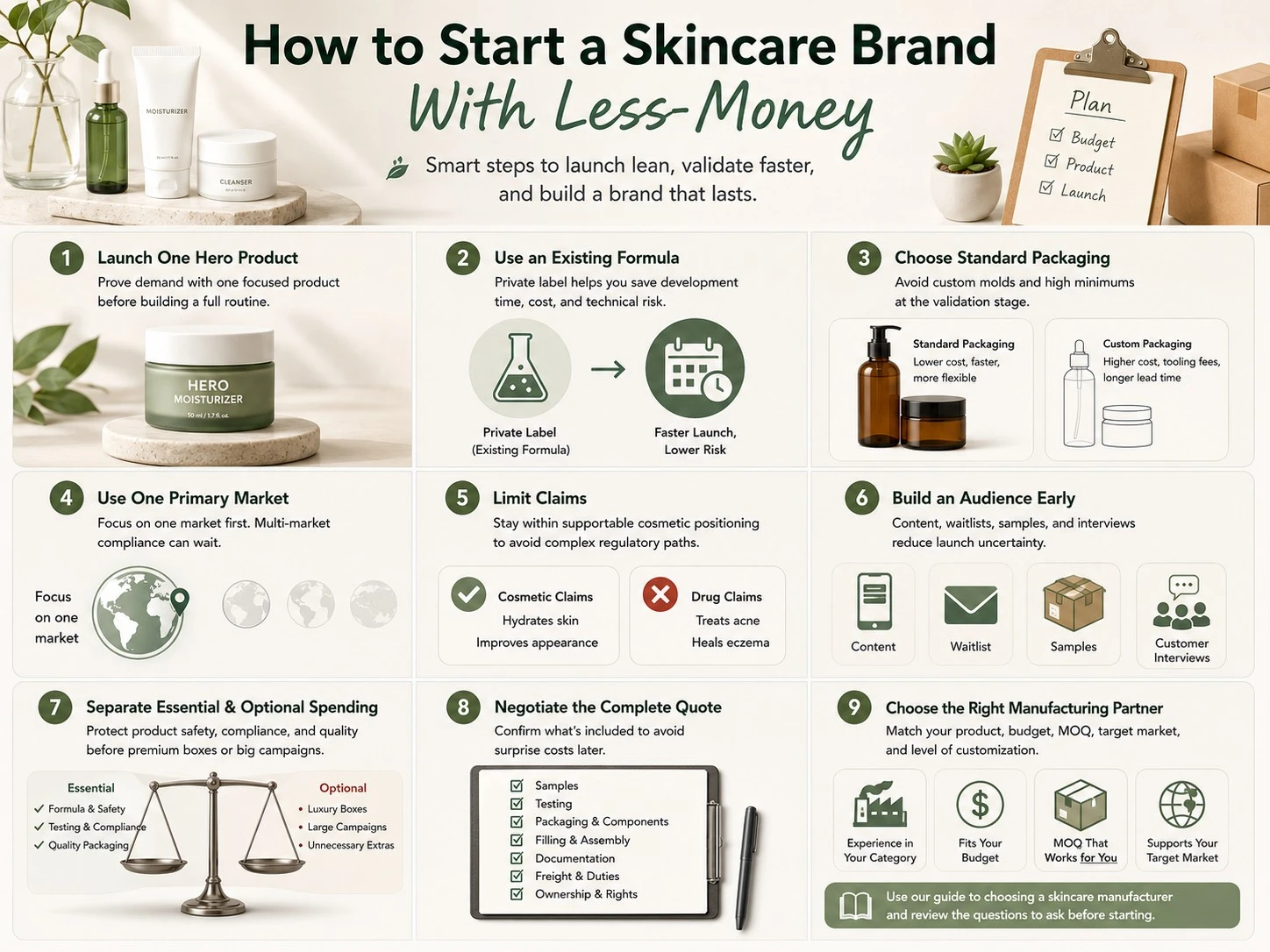
- Launch one hero product: prove demand before building a full routine.
- Use an existing formula: private label reduces development time and technical risk.
- Choose standard packaging: avoid custom molds and high component minimums at the validation stage.
- Use one primary market: multi-market compliance and packaging versions can wait until demand is clearer.
- Limit claims: stay within supportable cosmetic positioning rather than creating a more complex regulatory path.
- Build an audience before inventory arrives: content, waitlists, samples, and customer interviews can reduce launch uncertainty.
- Separate essential and optional spending: protect product safety, compliance, and quality before premium boxes or large campaigns.
- Negotiate the complete quote: confirm what is included in samples, testing, packaging, filling, documentation, freight, and ownership.
A suitable manufacturing partner should match your product category, budget, MOQ, target market, and level of customization. Use our guide to choosing a skincare manufacturer and review the questions to ask before starting.
Common Budgeting Mistakes
- Launching too many SKUs before proving demand.
- Treating the manufacturer’s unit price as the total startup cost.
- Ignoring packaging, freight, duties, inspection, and fulfillment.
- Spending heavily on branding before formula and packaging compatibility are confirmed.
- Assuming all testing and compliance work is included in the production quote.
- Using drug-style claims without budgeting for the correct regulatory path.
- Ordering custom packaging before the final formula and fill volume are approved.
- Failing to calculate landed cost, gross margin, and break-even volume.
- Using the full budget on the first order with no contingency or reorder cash.
- Assuming formula ownership, exclusivity, or transfer rights without written terms.
Ready to Plan Your Skincare Brand Budget?
The cost of starting a skincare brand depends on more than the price per unit. Formula route, MOQ, packaging, testing, compliance, freight, marketing, and reorder capital all affect the real budget. Starting with fewer products and a clearly defined development path can reduce unnecessary cost and inventory risk.
ZICAIL Beauty can help you compare private label, semi-custom, and custom formulation options based on your product goals, target market, order quantity, packaging direction, and available budget.
Share the products you want to develop, your estimated quantity, target market, and budget range. Our team can review the project requirements and recommend a more practical starting path.


