
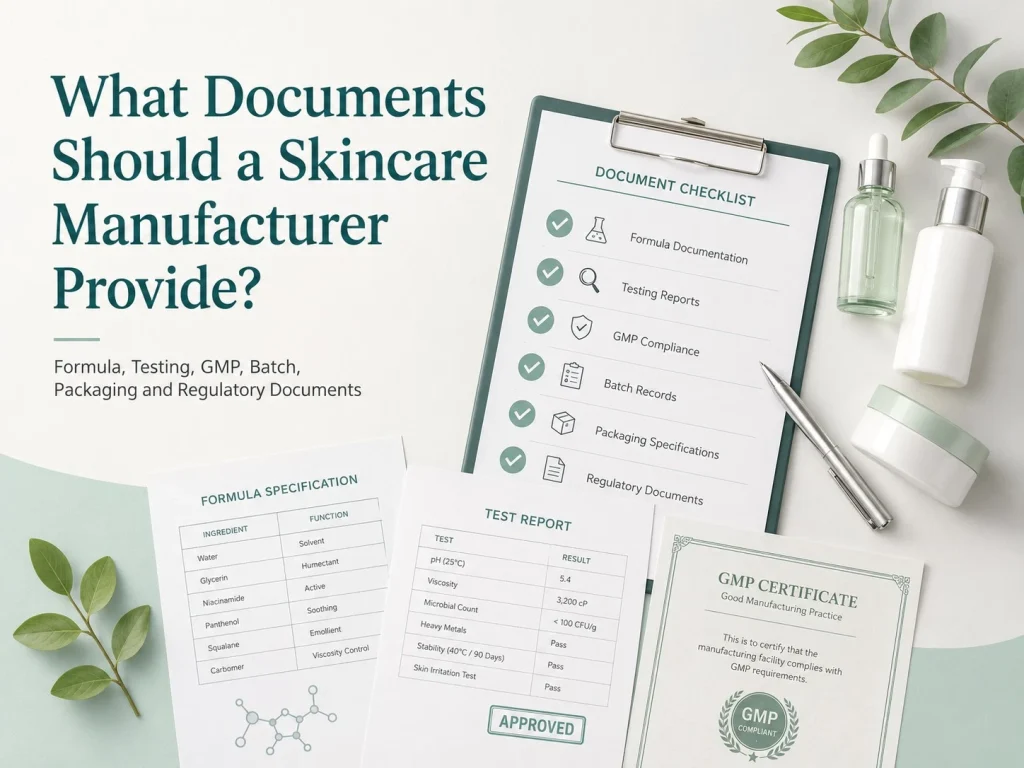

A quotation and an ingredient list are not a complete manufacturer handover. Once a skincare product moves toward commercial production, the brand may need information from formulation, quality control, testing, packaging, regulatory, and production teams—often months or years after the first sample was approved.
The difficult part is knowing what to request. Asking for every file the factory owns creates unnecessary document volume and can conflict with legitimate supplier confidentiality. Asking for too little can leave the brand unable to complete a safety assessment, investigate a failed batch, support a claim, or transfer production later.
A better approach is to separate documents into three groups: documents the brand should receive, documents the manufacturer should be able to support when required, and internal records that may remain controlled by the manufacturer unless the contract or regulatory role requires disclosure.
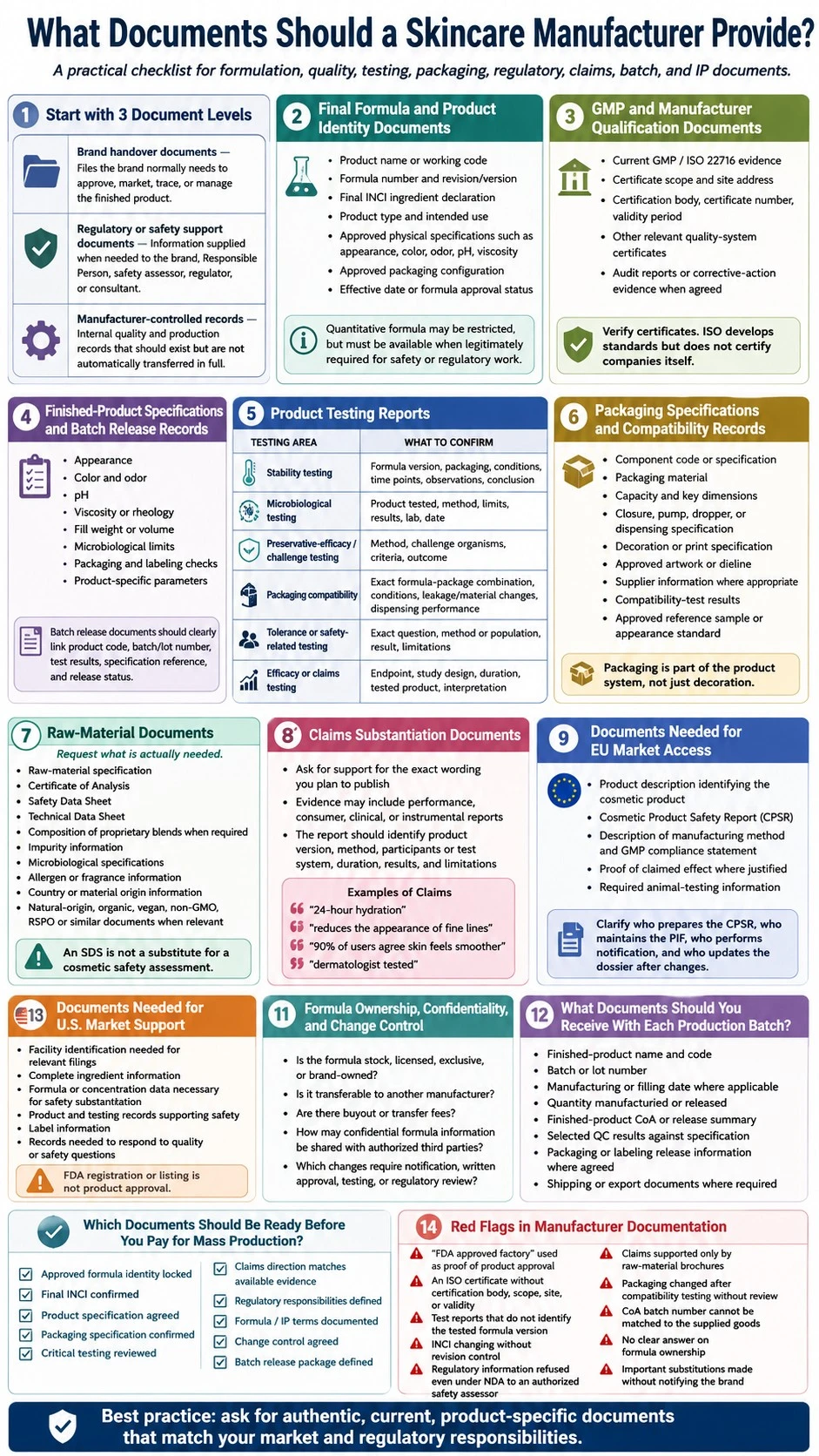
Start by Separating Manufacturer Documents Into Three Levels
| Document Level | What It Means | Examples |
|---|---|---|
| Brand handover documents | Files the brand normally needs to approve, market, trace, or manage the finished product | Final INCI, approved product specification, relevant test reports, packaging specification, batch identification, claims evidence |
| Regulatory or safety support documents | Information that may need to be supplied to the brand, Responsible Person, safety assessor, regulator, or authorized consultant when required | Quantitative formula, raw-material safety information, manufacturing-method information, toxicological data, supporting certificates |
| Manufacturer-controlled records | Internal quality and production records that should exist and be controlled but are not automatically transferred in full to every client | Detailed batch manufacturing records, supplier qualification files, internal SOPs, full raw-material supplier dossiers, deviation investigations |
This distinction prevents two opposite mistakes: accepting a vague “everything is compliant” statement, or demanding every confidential factory record without first establishing why it is needed.
1. Final Formula and Product Identity Documents
The first requirement is being able to identify exactly which product was approved. A commercial formula should not exist only as “the third sample we liked.”
The product documentation should normally establish:
- product name or working code;
- formula number and revision/version;
- final ingredient declaration using appropriate INCI nomenclature;
- product type and intended use;
- approved physical specifications such as appearance, color, odor, pH, viscosity, or other relevant parameters;
- approved packaging configuration;
- effective date or formula-approval status.
The quantitative formula is more sensitive. Whether the brand receives the full percentages depends on formula ownership, confidentiality terms, regulatory responsibilities, and the information required by the destination market or safety assessor.
For example, an EU Responsible Person must maintain a Product Information File containing a Cosmetic Product Safety Report and other required information, so the safety assessment must have access to sufficiently detailed formula and raw-material data even if the manufacturer does not distribute the quantitative formula broadly within the brand organization.[1]
Canada provides another example of why a simple consumer-facing INCI list may be insufficient for regulatory work: its Cosmetic Notification requires ingredient concentrations or prescribed concentration ranges, together with product and manufacturing information.[7]
2. GMP and Manufacturer Qualification Documents
Before relying on product-specific reports, establish that the factory itself operates under an appropriate quality system.
ISO 22716 provides internationally recognized cosmetic GMP guidance covering production, control, storage, and shipment.[2] For EU cosmetics, manufacture must comply with good manufacturing practice, and compliance is presumed when manufacturing follows the relevant harmonized standards.[1]
Useful supplier-qualification evidence can include:
- current GMP or ISO 22716 certification where the manufacturer uses third-party certification;
- certificate scope and manufacturing-site address;
- issuing certification body;
- certificate number and validity period;
- other quality-system certificates relevant to the factory or project;
- factory audit reports or corrective-action evidence when agreed during supplier qualification.
Verify the certificate rather than accepting a logo in a sales presentation. ISO develops standards but does not certify companies or issue ISO certification itself; certification is performed by external certification bodies.[8]
If supplier qualification is still at an earlier stage, Questions to Ask a Skincare Manufacturer Before You Start covers the commercial and operational questions that should accompany document review.
3. Finished-Product Specifications and Batch Release Records
A formula tells you what should be manufactured. A finished-product specification tells you how the manufacturer decides whether an actual batch is acceptable.
Depending on the product, the specification may establish limits or acceptance criteria for:
- appearance;
- color and odor;
- pH;
- viscosity or other rheological properties;
- fill weight or volume;
- microbiological limits;
- packaging and labeling checks;
- other product-specific parameters.
For commercial batches, brands should also agree in advance what batch-release documentation they will receive. A Certificate of Analysis (CoA) or equivalent release document may summarize selected test results against approved specifications, but there is no single universal cosmetic CoA format that automatically proves every aspect of product compliance.
The batch documentation should be traceable to the actual goods supplied. Confirm that product code, batch or lot number, manufacturing identity, relevant test results, specification references, and release status can be connected without ambiguity.
4. Product Testing Reports
A statement such as “all tests passed” is not as useful as knowing what was tested, which formula version was tested, which packaging was used, what method was followed, and what the result actually showed.
The required testing package depends on formula type, intended use, packaging, target market, and claims. It can include:
| Document | What the Brand Should Confirm |
|---|---|
| Stability testing report | Formula version, packaging, storage conditions, time points, parameters evaluated, acceptance criteria, observations, and conclusion |
| Microbiological testing | Product tested, method, limits, results, laboratory identity, and test date |
| Preservative-efficacy or challenge testing | Final relevant formula, test method, organism challenge, acceptance criteria, and outcome when such testing is appropriate |
| Packaging compatibility report | Exact formula/package combination, storage conditions, leakage or material changes, dispensing performance, and formula observations |
| Tolerance or safety-related testing | Exact claim or safety question addressed, study population or method, tested formula, result, and limitations |
| Efficacy or claims testing | Exact endpoint, study design, duration, participants, product tested, data interpretation, and wording the result can reasonably support |
Testing should remain linked to the approved commercial formula. If the manufacturer materially changes the preservative system, active level, packaging, or another relevant variable after testing, ask which previous reports remain applicable and which need review or repetition.
The broader decision about which tests a product actually needs is covered in Skincare Product Testing Guide: What Brands Need.
5. Packaging Specifications and Compatibility Records
Packaging documentation should identify the commercial component clearly enough that an approved package cannot silently be replaced by a visually similar but technically different one.
Useful records can include:
- component code or specification;
- packaging material;
- capacity and key dimensions;
- closure, pump, dropper, or dispensing specification;
- decoration or print specification;
- approved artwork or dieline;
- supplier information where contractually appropriate;
- compatibility-test results;
- approved reference sample or appearance standard.
This information becomes particularly important when the formula is sensitive to light, oxygen, evaporation, component materials, or dispensing conditions. Packaging is part of the product system, not a decoration added after formula approval.
For the earlier selection decisions behind these documents, use Skincare Packaging Guide: How Brands Choose Packaging.
6. Raw-Material Documents: What Should a Brand Actually Request?
Brands sometimes request the CoA, SDS, Technical Data Sheet, origin statement, allergen information, and specification for every raw material in the formula. That can be necessary in some projects, but it should not become an automatic document-collection exercise.
The manufacturer should maintain appropriate raw-material qualification and technical records within its quality system. The brand, Responsible Person, safety assessor, or regulatory consultant should receive the information necessary to perform the regulatory and safety task for which it is required.
Depending on the ingredient and claim, this may include:
- raw-material specification;
- Certificate of Analysis;
- Safety Data Sheet;
- Technical Data Sheet;
- composition of proprietary blends when required for safety assessment;
- impurity information;
- microbiological specifications;
- allergen or fragrance information;
- country or material origin information;
- natural-origin, organic, vegan, non-GMO, RSPO, or other documentation when the product makes a corresponding claim.
An SDS is not a substitute for a cosmetic safety assessment, and a supplier marketing sheet is not proof that the finished product delivers the same benefit as the raw material.
7. Claims Substantiation Documents
Claims evidence should be treated as part of the product dossier, not separated from manufacturing documentation once the brand begins making objective performance claims.
In the EU, cosmetic claims must be supported by adequate and verifiable evidence, and evidence based on an ingredient cannot simply be transferred to the finished product without adequate support.[6]
For claims such as:
- “24-hour hydration”;
- “reduces the appearance of fine lines”;
- “90% of users agree skin feels smoother”;
- “dermatologist tested”;
- “suitable for sensitive skin”;
- “clinically proven”;
ask for the report that supports the actual wording you intend to publish. The document should identify the tested product and version, methodology, participants or test system, duration, endpoint, results, and relevant limitations.
Skincare Product Claims: Types, Evidence & Compliance explains how to match evidence strength to claim wording before artwork is finalized.
8. Documents Needed for EU Market Access
One of the most important distinctions for brands is that the manufacturer does not automatically replace the EU Responsible Person. The Responsible Person must ensure the required safety assessment is completed and maintain the Product Information File.[1]
The EU PIF includes:
- a description identifying the cosmetic product;
- the Cosmetic Product Safety Report;
- a description of the manufacturing method and a statement of GMP compliance;
- proof of the claimed effect where justified by the product or claim;
- specified information relating to animal testing.[1]
The manufacturer may provide much of the underlying technical information needed to assemble these documents, but the brand should not assume that receiving a folder called “PIF” automatically transfers or satisfies every Responsible Person obligation.
Before launch, establish clearly who prepares the CPSR, who maintains the PIF, who performs the notification, where confidential formula data is sent, and who updates the dossier if the formula or packaging changes.
9. Documents Needed for U.S. Market Support
Under MoCRA, cosmetic facilities that are subject to registration requirements must register and renew their registration biennially, while the Responsible Person must list marketed cosmetic products and update listings as required.[3][4]
The Responsible Person must also ensure and maintain records supporting adequate safety substantiation for the cosmetic product. U.S. rules do not prescribe one universal testing regimen for every cosmetic, so the evidence package must be appropriate to the specific product and available safety information.[3][5]
For a contract-manufactured product, the brand may therefore need the manufacturer to support:
- facility identification required for relevant filings;
- complete ingredient information;
- formula or concentration data necessary for safety substantiation;
- product and testing records supporting safety;
- label information;
- records needed to respond to product-quality or safety questions.
Be cautious with anyone selling an “FDA certificate” as evidence that a cosmetic factory or product has been approved. FDA explicitly states that cosmetic facility registration and product listing are not approval programs, and FDA does not issue certificates for those registrations or listings.[4]
10. Formula Ownership, Confidentiality, and Change-Control Documents
Technical documents do not answer one of the biggest commercial questions: who owns the formula?
The manufacturing agreement or a separate IP agreement should clarify whether the formula is:
- a manufacturer’s stock formula;
- licensed to the brand;
- exclusive within a defined market or category;
- owned outright by the brand;
- transferable to another manufacturer;
- subject to additional buyout or transfer fees.
The agreement should also establish how confidential formula information can be shared with a safety assessor, Responsible Person, testing laboratory, regulator, or other authorized third party.
Equally important is change control. The manufacturer should not silently replace a raw material, supplier, preservative system, packaging component, fragrance, or another material variable when the change could affect safety, claims, stability, regulatory status, or product performance.
Define which changes require notification, which require written brand approval, and which trigger testing or regulatory review.
What Documents Should You Receive With Each Production Batch?
Most of the development dossier does not need to be reissued with every shipment. Batch-specific documentation has a different purpose: traceability and release of the actual goods being supplied.
Depending on your quality agreement, the batch package may include:
- finished-product name and code;
- batch or lot number;
- manufacturing or filling date where applicable;
- quantity manufactured or released;
- finished-product CoA or release summary;
- selected QC results against specification;
- packaging or labeling release information where agreed;
- shipping or export documents where required.
You do not necessarily need the complete internal batch manufacturing record with every shipment. You do need a system that allows a supplied batch to be traced back to the manufacturer’s controlled production and quality records when an investigation is necessary.
Which Documents Should Be Ready Before You Pay for Mass Production?
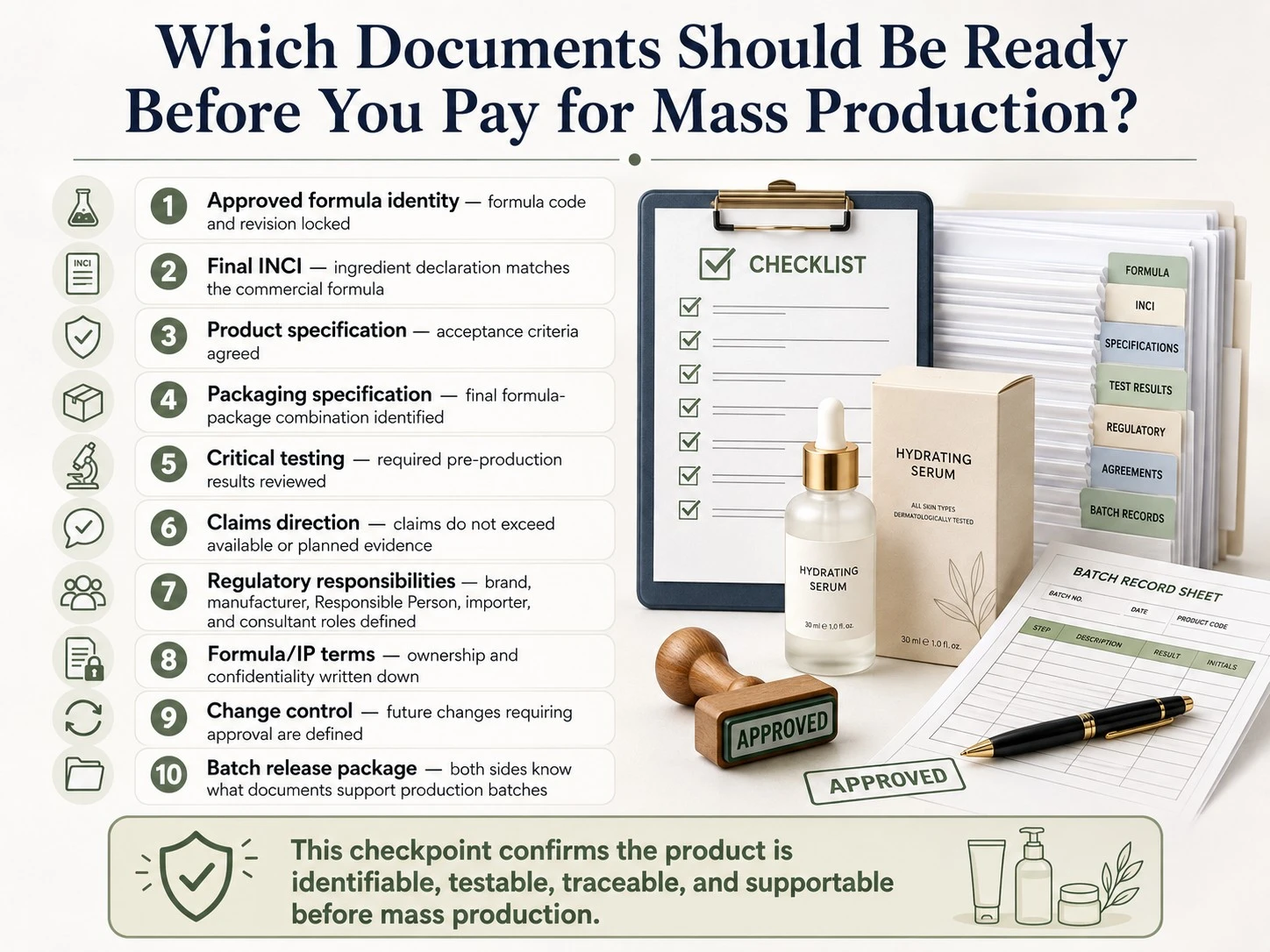
Before committing to the production order, confirm that the project has moved beyond informal sample approval.
- Approved formula identity: formula code and revision are locked.
- Final INCI: ingredient declaration reflects the commercial formula.
- Product specification: acceptance criteria are agreed.
- Packaging specification: the final formula-package combination is identified.
- Critical testing: required pre-production results are reviewed, with longer-term studies continuing where appropriate.
- Claims direction: intended claims do not exceed available or planned evidence.
- Regulatory responsibilities: brand, manufacturer, Responsible Person, importer, and consultant roles are defined for the target markets.
- Formula/IP terms: ownership and confidentiality are written down.
- Change control: the manufacturer knows which future changes require approval.
- Batch release package: both sides know what documentation will accompany or support production batches.
This checkpoint is more useful than asking for an arbitrary number of certificates. It confirms that the product you are about to manufacture is technically identifiable, testable, traceable, and supportable in its intended market.
Red Flags in Manufacturer Documentation
- An “FDA approved factory” or paid FDA registration certificate is presented as product approval. Cosmetic registration and listing do not mean FDA approval.[4]
- An “ISO certificate” cannot identify the external certification body, scope, site, or validity. ISO itself does not certify companies.[8]
- Test reports cannot identify which formula version was tested.
- The INCI changes between sampling, testing, artwork, and production without documented revision control.
- The factory refuses to provide regulatory information even under an NDA to an authorized safety assessor.
- Claims are supported only with raw-material supplier brochures.
- A packaging change is proposed after compatibility testing without assessing whether the previous evidence still applies.
- A CoA is supplied but its batch number cannot be matched to the received goods.
- The manufacturer cannot explain who owns the formula.
- Important ingredient or supplier substitutions can be made without notifying the brand.
Final Thoughts
The right manufacturer document package is not the thickest folder. It is the set of controlled records that lets a brand answer five questions: What exactly are we selling? Was it manufactured and released correctly? Is the product adequately supported for safety and claims? Can we meet the rules of our target market? Can we trace and manage future changes?
A final INCI list, specification, GMP evidence, relevant testing reports, packaging records, claims evidence, regulatory-support information, batch traceability, and clear IP/change-control terms form a much stronger foundation than collecting certificates without understanding their purpose.
If your brand is developing a product with ZICAIL, prepare the target markets, product brief, claims, packaging direction, expected documentation package, formula-ownership requirements, and any third-party safety or regulatory contacts at the start of the project. These requirements can then be incorporated into custom skincare formulation, testing, regulatory preparation, and production handover instead of being reconstructed after manufacturing is complete.


