


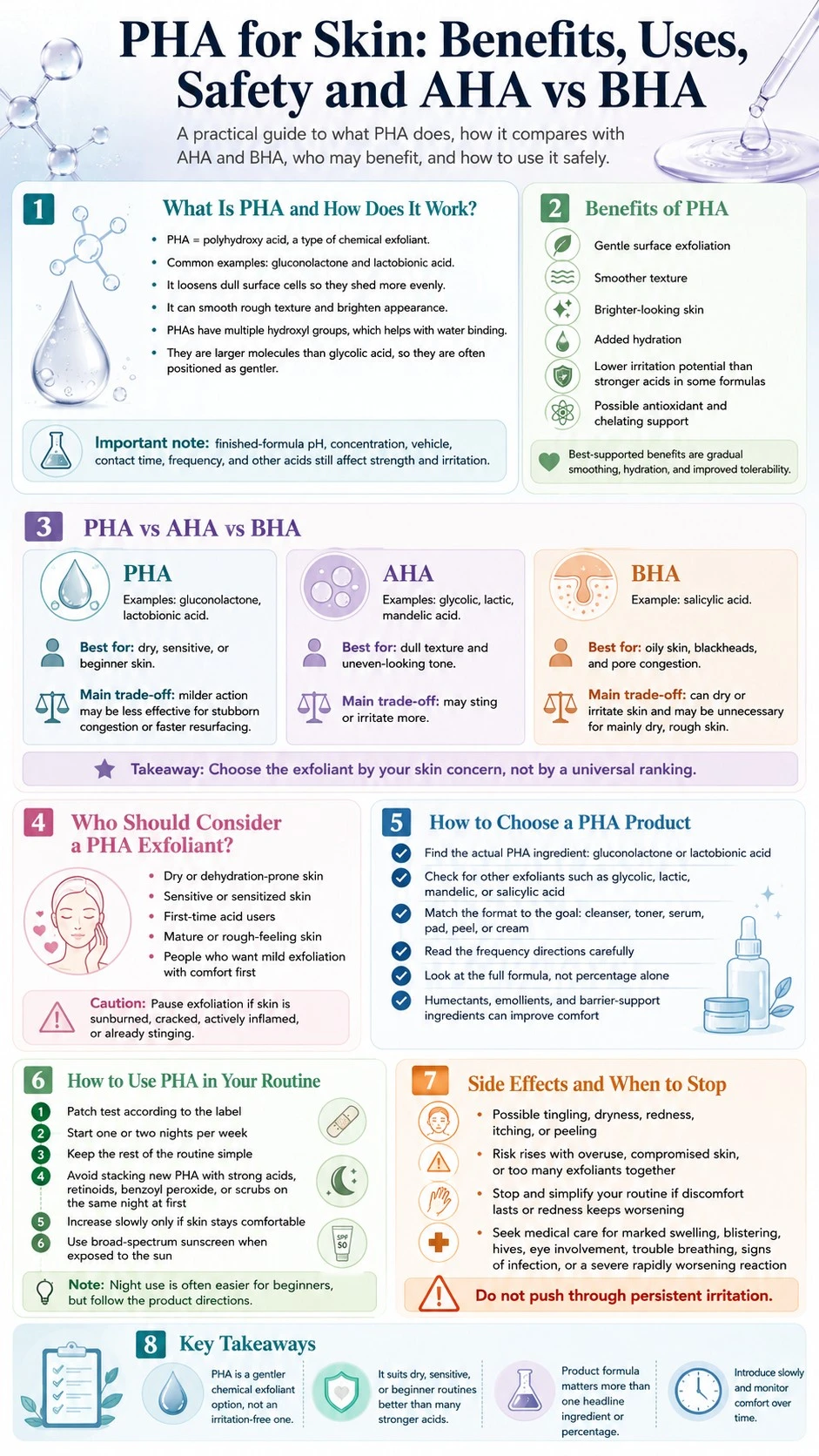
PHA has become shorthand for “the gentle acid,” but that label hides important differences between products. A PHA toner made only for mild surface smoothing is not equivalent to a peel that combines PHA with glycolic or salicylic acid.
This guide explains where PHA fits among skincare active ingredients, what the evidence supports, and how to tell whether a PHA product matches your skin and routine.
What Is PHA and How Does It Work?
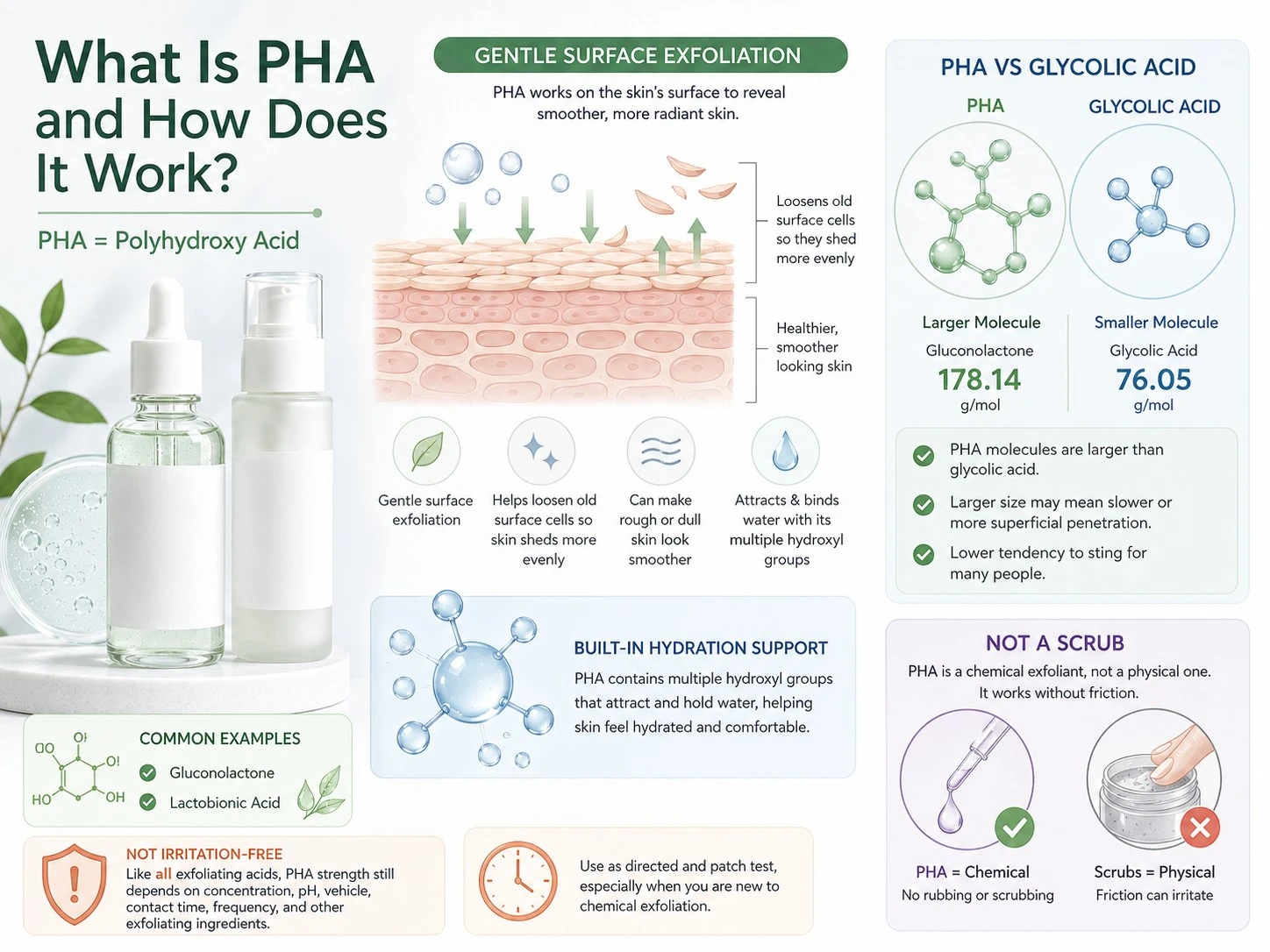
PHA stands for polyhydroxy acid. PHAs belong to the broader hydroxy-acid family used in chemical exfoliation. They help reduce the cohesion of old cells at the skin surface so those cells shed more evenly, which can make rough or dull skin look smoother.[1]
Gluconolactone is the clearest example. Lactobionic acid is also routinely marketed as a PHA, although technical literature may classify it more specifically as a bionic acid. That distinction matters to chemists, but shoppers will usually find both under the PHA label.[1]
PHAs contain multiple hydroxyl groups, which helps explain their water-binding behavior. They are also larger molecules than glycolic acid. Gluconolactone has a molecular weight of 178.14 g/mol.[2] Glycolic acid, by comparison, is 76.05 g/mol.[3] Larger size is commonly used to explain slower or more superficial penetration and a lower tendency to sting.
That is a useful comparison, not a guarantee. The finished product’s concentration, pH, vehicle, contact time, frequency, and other exfoliating ingredients all affect how it behaves. “Contains PHA” therefore does not mean “cannot irritate.” It also does not reveal how strong two different products will be.
Unlike a scrub, PHA does not rely on friction to lift surface cells. The guide to chemical vs physical exfoliation explains when that difference matters.
What Are the Benefits of PHA for Skin?
PHA’s clearest benefits are mild surface exfoliation and added hydration. Claims about treating acne, erasing pigmentation, or producing major anti-aging changes require more caution because the available evidence often involves specific ingredients or finished formulas rather than PHA products as a category.
| Potential benefit | Practical meaning | Evidence boundary |
|---|---|---|
| Smoother texture | Helps loosen compacted surface cells that can make skin feel rough | Results depend on formula strength and consistent use |
| Brighter appearance | More even surface shedding can reduce a dull look | It does not remove every cause of discoloration |
| Better hydration | Multiple hydroxyl groups support water binding | An exfoliant does not replace moisturizer when skin is dry |
| Lower irritation potential | Larger molecules and moisturizing properties may improve tolerability compared with smaller AHAs | Sensitive skin can still react to the full formula |
| Antioxidant and chelating activity | Laboratory research suggests that some PHAs can interact with free radicals and metals | This does not make PHA a substitute for sunscreen or proven treatment |
Reviews support the water-binding and antioxidant properties of lactobionic acid and related hydroxy acids.[4] A moisturizer containing 10% lactobionic acid also showed satisfactory tolerability under one specific 24-hour test condition, but that result does not establish a universal concentration or safety rule for PHA products.[5]
Overall, PHA has a stronger case for gradual smoothing, hydration, and improved tolerability than for treating acne, pigmentation, or photoaging.
PHA vs AHA vs BHA: Which Exfoliant Fits Your Skin?
PHA is not inherently better than AHA or BHA. It solves a different priority: gaining mild surface exfoliation while keeping irritation relatively low.[1]
| Exfoliant | Common examples | Often suits | Main trade-off |
|---|---|---|---|
| PHA | Gluconolactone, lactobionic acid | Dry, sensitive, or easily irritated skin; beginners | Gentler action may be less useful for stubborn congestion or faster resurfacing |
| AHA | Glycolic, lactic, mandelic acid | Dull texture, uneven-looking tone, visible surface roughness | Smaller or stronger acids may sting and irritate more |
| BHA | Salicylic acid | Oily skin, blackheads, and pore congestion | Can dry or irritate skin and may not be necessary for a mainly dry, rough surface |
Choose by the problem you are trying to solve. PHA is a sensible starting point when comfort and hydration come first. AHA may fit resilient skin seeking more noticeable surface renewal. BHA may be more targeted when oil and clogged pores are the main concern. The broader AHA vs BHA comparison covers those two categories in more detail.
A blended product changes the decision. A “PHA toner” that also contains glycolic acid or salicylic acid may behave more like a multi-acid exfoliant. Read the complete ingredient list and directions instead of assigning the whole product the gentleness of its mildest acid.
Who Should Consider a PHA Exfoliant?
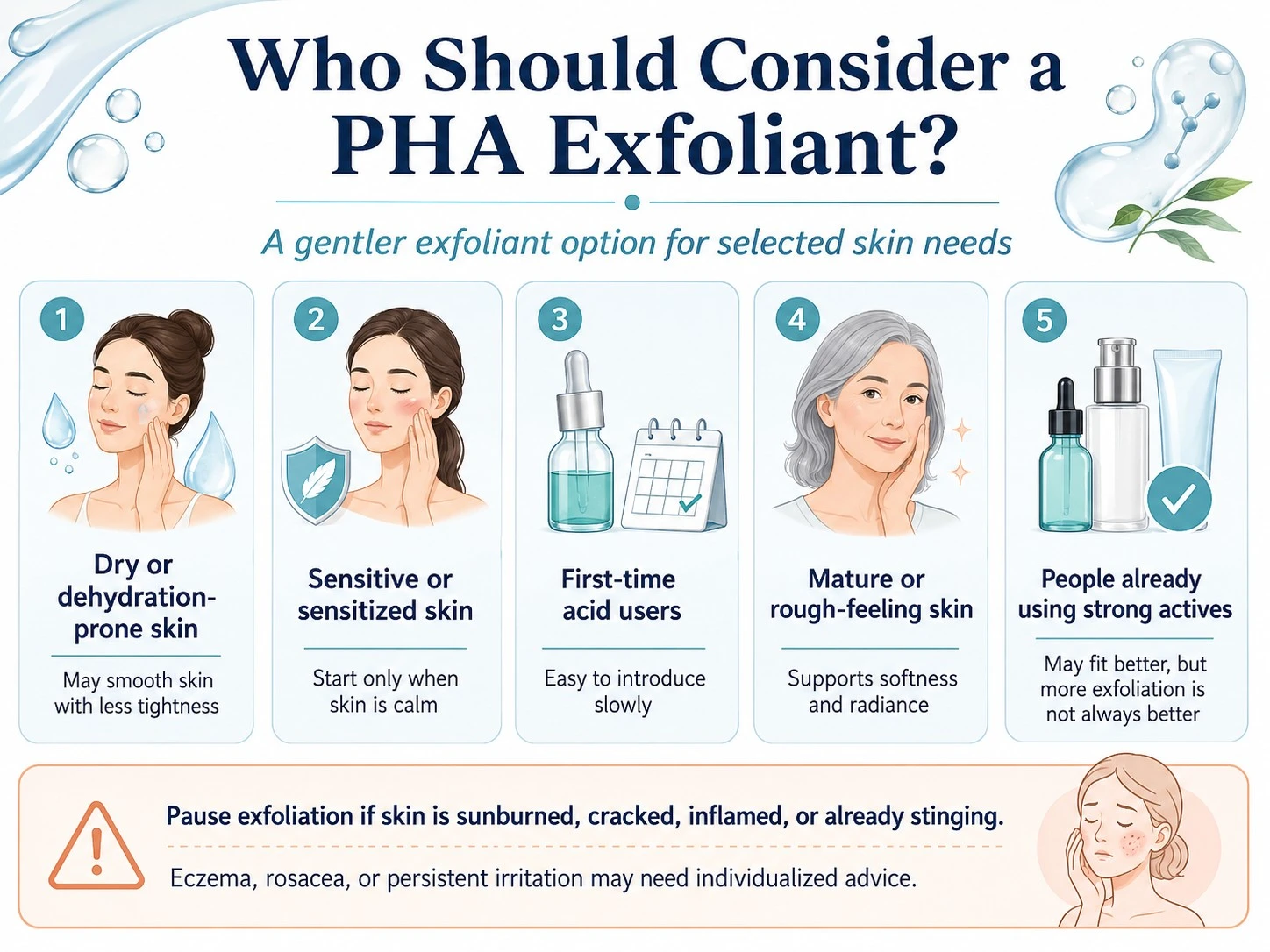
PHA may be worth considering when conventional exfoliants feel too drying or intense. It is not a requirement for every routine.
- Dry or dehydration-prone skin: a moisturizing PHA formula may smooth without the same tight feel caused by a poorly tolerated acid.
- Sensitive or sensitized skin: PHA may offer a lower-intensity option, but begin only when the skin is calm and the barrier is intact.
- First-time acid users: slower introduction makes it easier to judge whether exfoliation is actually helping.
- Mature or rough-feeling skin: mild surface renewal can improve softness and radiance without making aggressive peeling the goal.
- People already using strong actives: PHA may be easier to schedule, but adding another exfoliant is not always better.
Skip exfoliation temporarily if skin is sunburned, cracked, actively inflamed, or already stinging with bland products. A simple routine for sensitive skin is a better starting point until comfort returns. Persistent eczema, rosacea, or another diagnosed skin condition deserves individualized advice rather than the assumption that “gentle acid” means risk-free.
How to Choose a PHA Skincare Product
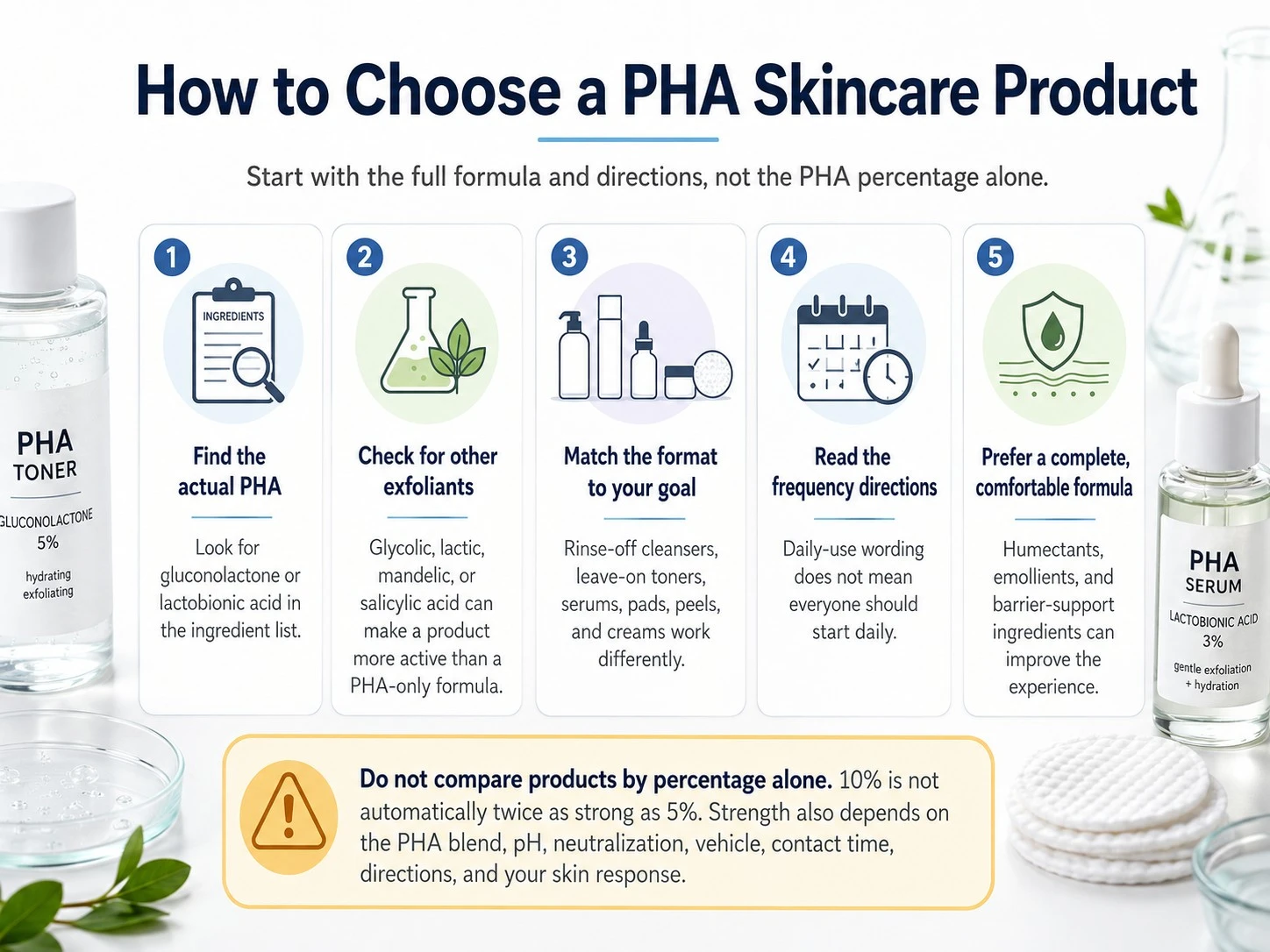
Start with the full formula and directions, not the PHA percentage alone.
- Find the actual PHA. Look for gluconolactone or lactobionic acid in the ingredient list. “PHA complex” on the front label may not disclose which ingredient or how much is present.
- Check for other exfoliants. Glycolic, lactic, mandelic, or salicylic acid can make the product more active than a PHA-only formula.
- Match the format to your goal. A rinse-off cleanser gives shorter contact than a leave-on toner, serum, pad, or peel. A moisturizing cream may prioritize hydration over visible peeling.
- Read the frequency directions. Daily-use wording does not mean every person should begin daily. Stronger blends and exfoliating pads may need wider spacing.
- Prefer a complete, comfortable formula. Humectants, emollients, and barrier-support ingredients can improve the experience, but they cannot cancel an overly aggressive acid system.
Do not compare two products as if 10% is always twice as strong as 5%. Percentage says nothing about the exact PHA blend, pH, neutralization, vehicle, or contact time. If the percentage is not disclosed, the directions and your skin’s response are still more useful than guessing from ingredient-list position.
How to Use PHA in Your Skincare Routine
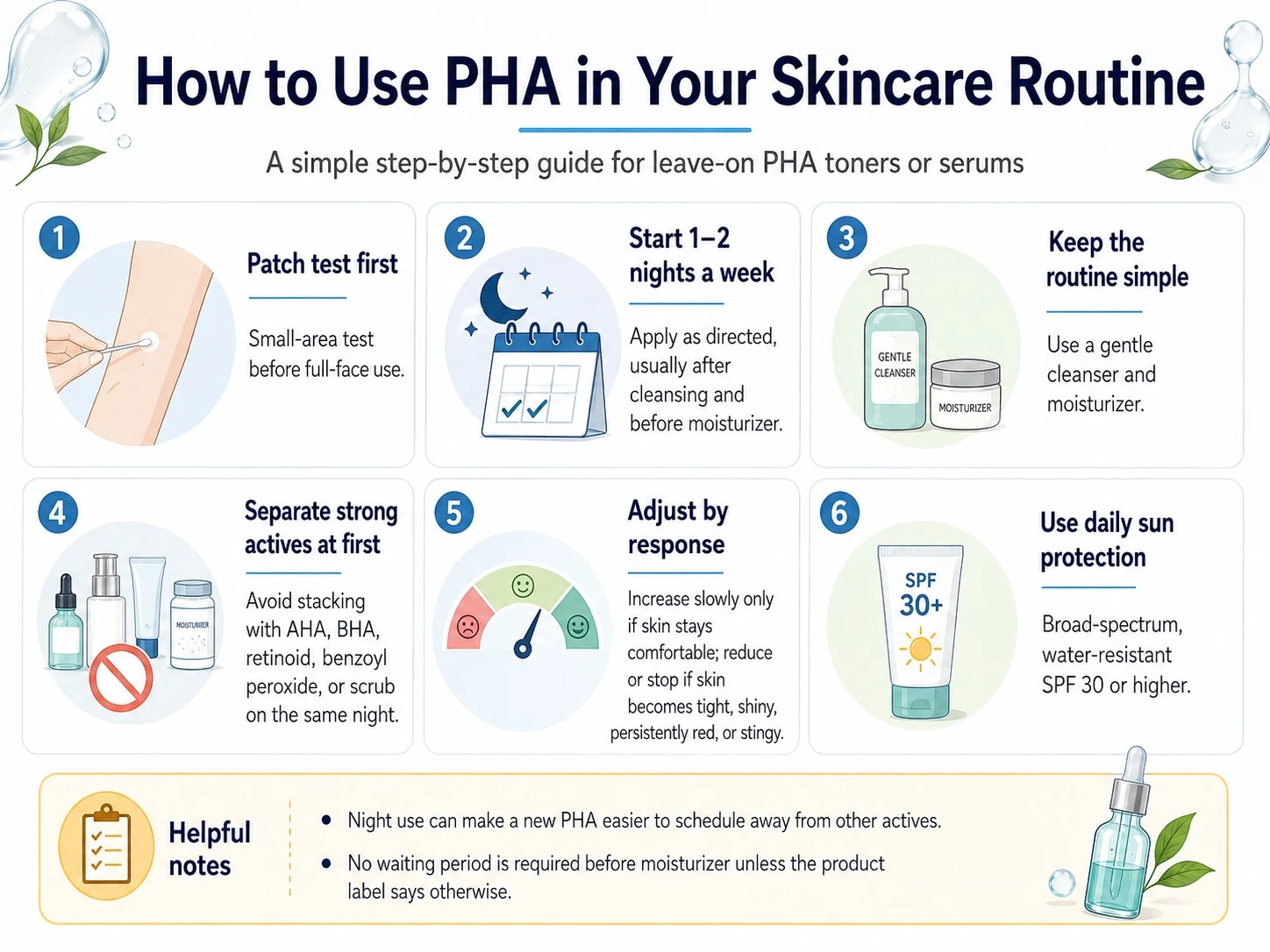
For a leave-on toner or serum, use a controlled introduction rather than adding PHA to every routine at once.
- Patch test according to the label. A small-area test cannot guarantee future tolerance, but it may reveal an immediate reaction before full-face use.
- Begin one or two nights a week. Apply the product at the step directed by its label, usually after cleansing and before moisturizer for a thin leave-on exfoliant.
- Keep the rest of the routine simple. Use a gentle cleanser and moisturizer so any change is easier to trace to the new product.
- Separate strong actives at first. Avoid stacking a new PHA product with a separate AHA, BHA, retinoid, benzoyl peroxide, or scrub on the same night. This is an irritation-control strategy, not proof that every combination is chemically incompatible. The guide to mixing skincare ingredients can help simplify the schedule.
- Adjust by response, not ambition. If skin stays comfortable for several weeks and the label permits, increase slowly. If it becomes tight, shiny, persistently red, or stingy, reduce frequency or stop. More detailed frequency guidance is available in how often to exfoliate your face.
- Protect skin from the sun. A small gluconolactone study did not show the same UV response associated with traditional AHAs, but that is not a reason to skip sunscreen.[6] The U.S. sun-sensitivity warning applies specifically to AHA cosmetics and should not be presented as a PHA-specific rule.[7] Use a broad-spectrum, water-resistant SPF 30 or higher when exposed and follow correct application and reapplication guidance.[8]
Morning use is possible when the label allows it, but night use can make a new acid easier to schedule away from other actives. There is no required waiting period between a PHA leave-on and moisturizer unless the product directions specify one.
PHA Side Effects and When to Stop
PHA can cause tingling, dryness, redness, itching, or peeling. Risk rises when it is used too often, applied to compromised skin, or layered with several exfoliants.
Stop the product and simplify the routine if discomfort lasts, redness keeps worsening, or ordinary moisturizer begins to sting. The guide to over-exfoliated skin explains common signs and recovery steps.
Seek medical care for marked swelling, blistering, hives, eye involvement, trouble breathing, signs of infection, or a severe or rapidly worsening reaction. Do not keep applying PHA to “push through” persistent irritation; visible peeling is not required for exfoliation to work.
Final Thoughts
PHA is a useful option for gradual surface smoothing when hydration and tolerability matter more than aggressive resurfacing. Gluconolactone and lactobionic acid are the names most likely to appear on a label, but the finished formula determines how gentle the product actually feels. Choose one exfoliant, start slowly, moisturize, and treat comfort as part of the result rather than a barrier to faster progress.
FAQs About PHA for Skin
Is PHA the same as gluconolactone?
No. PHA is a category of hydroxy acids, while gluconolactone is one ingredient in that category. Lactobionic acid is another common label name, although technical sources may classify it more specifically as a bionic acid.
Can PHA cause purging?
PHA may change surface-cell shedding, but new breakouts are not automatically “purging.” They can reflect irritation, another ingredient, or the skin concern’s normal course. Breakouts in unusual areas, itching, burning, or steady worsening are reasons to stop and reassess.
Can you use PHA with niacinamide?
Many finished products combine or schedule these ingredients successfully. If they are in separate products, introduce one at a time. People with easily irritated skin can use niacinamide in one routine and PHA in another until tolerance is clear.
Is PHA safe during pregnancy?
Do not assume that an entire product is pregnancy-compatible because its featured ingredient is PHA. Check the complete formula and ask your obstetric clinician about leave-on exfoliants, multi-acid products, or professional peels during pregnancy or breastfeeding.
Can you use PHA after a facial or cosmetic procedure?
Only when the treating professional says the skin is ready. Procedures differ in depth and recovery time, and applying an acid to healing or barrier-damaged skin can cause avoidable irritation.
Sources
[1] Green BA, Yu RJ, Van Scott EJ. Clinical and cosmeceutical uses of hydroxyacids
[2] National Center for Biotechnology Information. delta-Gluconolactone
[3] National Center for Biotechnology Information. Glycolic Acid
[4] Algiert-Zielińska B, Mucha P, Rotsztejn H. Lactic and lactobionic acids as typically moisturizing compounds
[5] Savić S, et al. A 10% Lactobionic acid-containing moisturizer reduces skin surface pH without irritation—An in vivo/in vitro study
[6] Bernstein EF, et al. The polyhydroxy acid gluconolactone protects against ultraviolet radiation in an in vitro model of cutaneous photoaging
[7] U.S. Food and Drug Administration. Guidance for Industry: Labeling for Cosmetics Containing Alpha Hydroxy Acids
[8] American Academy of Dermatology. How to decode a sunscreen label


