

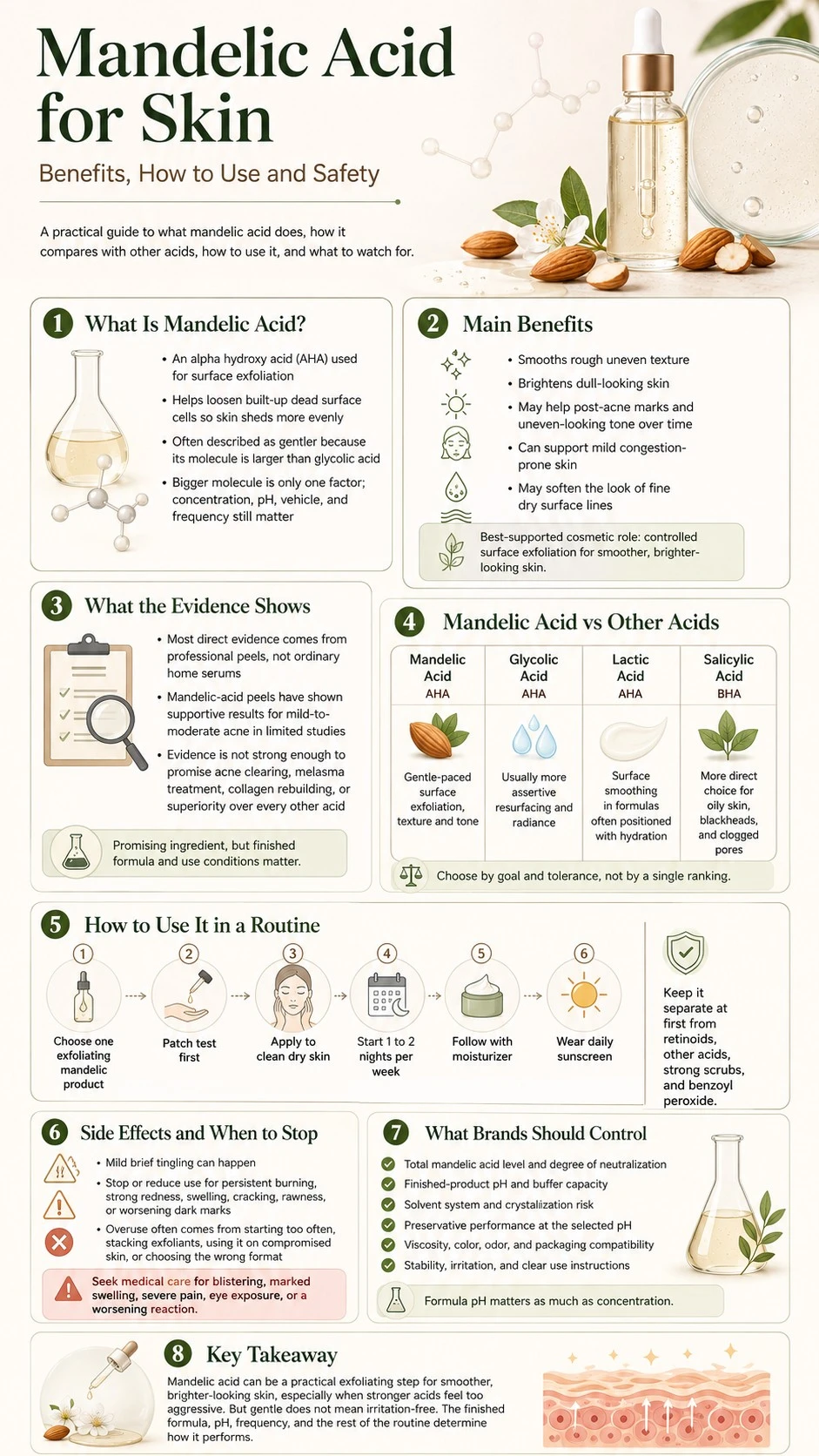
Mandelic acid is often positioned as the AHA for beginners, sensitive skin, acne, and dark marks. That description is useful only up to a point. It tells you the ingredient category, but not how a particular toner, serum, or peel will behave.
A good decision depends on the finished formula and your main goal. Mandelic acid can be a practical surface exfoliant, but it is not automatically the best acid for clogged pores, a treatment for acne, or a guaranteed pigment corrector.
What Is Mandelic Acid and How Does It Work?
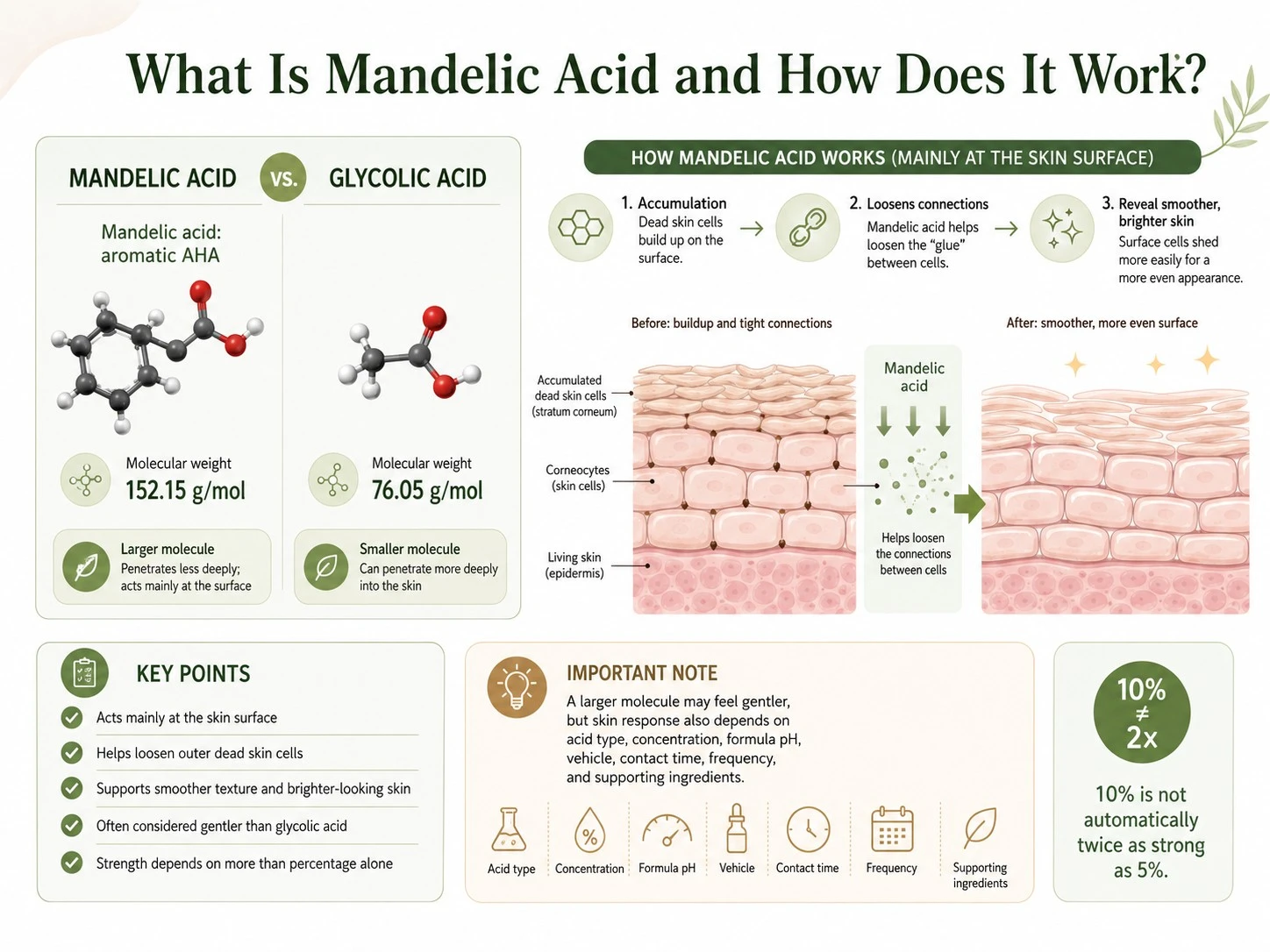
Mandelic acid is an aromatic AHA with a molecular weight of 152.15 g/mol.[1] Glycolic acid, by comparison, is 76.05 g/mol.[2] Like other AHAs, mandelic acid acts mainly at the skin surface, helping loosen the connections among accumulated outer cells so they shed more evenly. The visible result can be smoother texture and a brighter, more even appearance.
Its larger molecule is frequently used to explain why mandelic acid is considered gentler than glycolic acid. That is a reasonable formulation clue, not a complete prediction. Skin response also depends on acid type, concentration, formula pH, vehicle, contact time, frequency, and supporting ingredients.[3]
This is also why a 10% mandelic acid product is not necessarily twice as strong as a 5% product. Percentage alone cannot describe exfoliating intensity, and the number does not make products from different brands directly comparable.
If you are deciding between a scrub and an acid, the broader distinction is explained in chemical vs physical exfoliation.
What Are the Benefits of Mandelic Acid for Skin?
Mandelic acid’s clearest role is controlled surface exfoliation. Other benefits are plausible or supported in professional-peel research, but they should not be presented as equally certain for every home-use formula.
| Skin goal | Realistic role of mandelic acid | Important limit |
|---|---|---|
| Rough or uneven texture | Helps remove accumulated surface cells for a smoother feel | It does not repair depressed acne scars or structural texture changes |
| Dull-looking skin | Can improve surface light reflection as shedding becomes more even | “Glow” is a cosmetic appearance change, not proof of healthier skin |
| Post-acne marks and uneven tone | May support gradual fading by increasing surface turnover | It does not remove the cause of ongoing discoloration, and irritation can deepen marks |
| Mild congestion or acne-prone skin | Exfoliation may help reduce surface buildup; professional peels have limited supportive evidence | A cosmetic serum is not an acne treatment, and mandelic acid is not as directly pore-focused as salicylic acid |
| Fine, dry surface lines | Smoother surface texture may make fine lines look softer | Mandelic-specific evidence for wrinkle remodeling is limited |
For discoloration, first identify whether you are dealing with post-acne marks, melasma-like patches, or another form of hyperpigmentation. Exfoliation can support a routine, but persistent or changing pigmentation may need professional assessment.
Mandelic acid is often promoted for sensitive skin and deeper skin tones. A less aggressive formula may reduce irritation that can trigger post-inflammatory darkening, but no exfoliating acid is risk-free. Conservative frequency and barrier condition matter more than the “gentle” label.
What Does the Evidence Actually Show?
The most relevant direct clinical evidence involves professional-strength peels, not ordinary leave-on serums. In a randomized trial of 50 people with mild-to-moderate facial acne, six 45% mandelic acid peels and six 30% salicylic acid peels produced similar overall improvement; mandelic acid caused fewer reported adverse effects in that study.[4]
That result cannot be transferred directly to a 5% or 10% home product. The concentration, procedure, contact conditions, population, and outcome all differ. A systematic review of randomized chemical-peel trials also found that evidence for acne peels was limited and too heterogeneous to establish clear superiority among commonly used agents.[5]
The fair conclusion is that mandelic acid is a credible exfoliating ingredient with promising peel data for acne-related concerns. Evidence is not strong enough to promise that every mandelic serum will clear acne, fade melasma, rebuild collagen, or outperform glycolic, lactic, or salicylic acid.
Mandelic Acid vs Glycolic, Lactic, and Salicylic Acid
Choose an acid by the job you need it to do and the formula you can tolerate—not by a universal ranking.
| Acid | Category | Often chosen for | Main decision point |
|---|---|---|---|
| Mandelic acid | AHA | Gentle-paced surface exfoliation, uneven texture, and tone | Useful when glycolic feels too aggressive, but still capable of irritation |
| Glycolic acid | AHA | Stronger-feeling texture and radiance routines | Smaller molecule and often more assertive; may be too much for reactive skin |
| Lactic acid | AHA | Surface smoothing in formulas designed with hydration in mind | Formula can feel more conditioning, but concentration and pH still control intensity |
| Salicylic acid | BHA in skincare terminology | Oily skin, blackheads, and pore congestion | Oil-soluble and usually the more direct choice when clogged pores are the main concern |
Compare the detailed use cases in the guides to glycolic acid, lactic acid, and salicylic acid. You do not need all four. One well-chosen exfoliant is usually easier to evaluate than an acid rotation with several overlapping products.
How to Use Mandelic Acid in a Skincare Routine
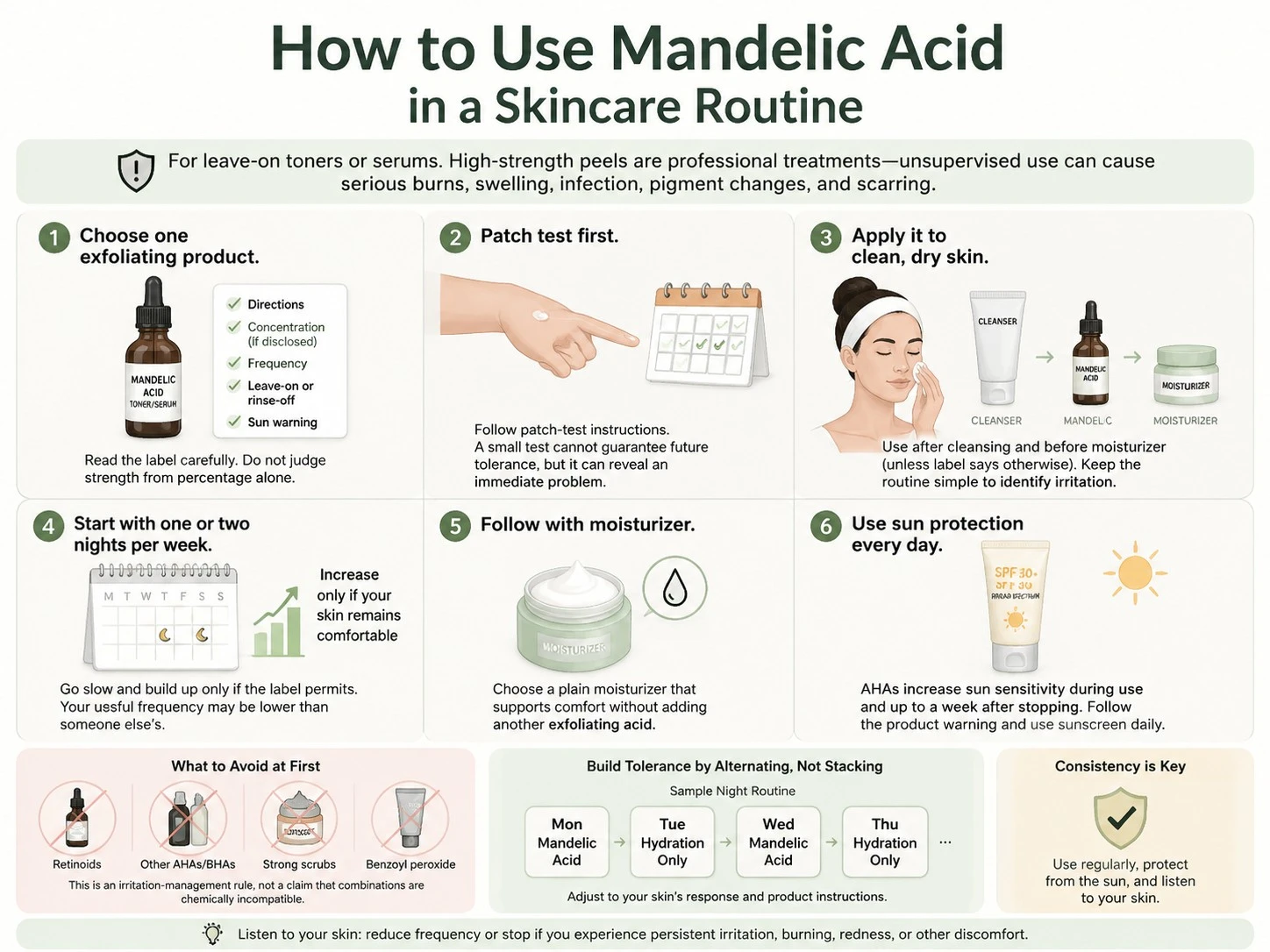
Use this sequence for a leave-on mandelic acid toner or serum. High-strength chemical peels are a different category: unsupervised use can cause serious burns, swelling, infection, pigment changes, and scarring.[6]
- Choose one exfoliating product. Read the directions, concentration if disclosed, frequency, rinse-off or leave-on status, and sun warning. Do not judge strength from percentage alone.
- Patch test first. Follow the brand’s patch-test instructions. A small test cannot guarantee future tolerance, but it can reveal an immediate problem before full-face use.
- Apply it to clean, dry skin. Unless the label says otherwise, use mandelic acid after cleansing and before moisturizer. Keeping the routine simple makes irritation easier to identify.
- Start with one or two nights per week. Increase only if the label permits and your skin remains comfortable. Your useful frequency may be lower than someone else’s; this face-exfoliation frequency guide explains the main tolerance signals.
- Follow with moisturizer. Choose a plain moisturizer that supports comfort without adding another exfoliating acid.
- Use sun protection every day. AHAs can increase sensitivity to ultraviolet exposure during use and for up to a week after stopping, so follow the product warning and maintain a consistent sunscreen routine.[3]
At first, separate mandelic acid from retinoids, other AHAs or BHAs, strong scrubs, and benzoyl peroxide. This is mainly an irritation-management rule, not a claim that every combination is chemically incompatible. Once tolerance is clear, alternating products on different nights is easier to assess than stacking them. The guide to mixing skincare ingredients can help you simplify overlapping actives.
Side Effects, Irritation, and When to Stop
Mild, brief tingling can occur, but pain is not a sign that an acid is working better. Reduce frequency or stop if you develop persistent burning, pronounced redness, swelling, cracking, rawness, or worsening dark marks.
Common problems usually come from one of four situations:
- Starting too often: Daily use is not a required goal.
- Stacking exfoliants: Several acids, retinoids, scrubs, or acne treatments can create cumulative irritation.
- Applying to compromised skin: Sunburned, freshly shaved, picked, inflamed, or already over-exfoliated skin is less tolerant.
- Using an unsuitable format: A professional-strength peel carries different risks from a routine cosmetic serum.
If your skin becomes tight, shiny, unusually reactive, or persistently flaky, pause exfoliation and use a minimal routine. The guide to over-exfoliated skin explains how to recognize a barrier problem. Seek medical care for blistering, marked swelling, eye exposure, severe pain, or a reaction that continues to worsen.
Acne that is painful, scarring, widespread, or persistent should not be managed by repeatedly increasing acid strength. Mandelic acid may support the cosmetic routine, but it does not replace evidence-based acne care.
What Brands Should Control in a Mandelic Acid Formula
For product developers, “10% mandelic acid” is not a complete brief. The finished formula needs a target pH and acceptable range, a defined assay or raw-material basis, and a test method that makes batch results comparable.
Important controls include:
- total mandelic acid concentration and degree of neutralization;
- finished-product pH and buffer capacity;
- solvent system, crystallization risk, and clarity over shelf life;
- preservative performance at the selected pH;
- viscosity, color, odor, and packaging compatibility;
- irritation, use-frequency, and consumer-instruction substantiation;
- stability of the finished formula rather than the acid raw material alone.
The product format should match the claim. A daily toner, beginner serum, rinse-off treatment, and professional peel should not share the same use instructions merely because they contain the same ingredient. The U.S. AHA guidance cites concentration and pH conditions specifically for glycolic and lactic acid; those numbers should not be copied as a mandelic acid safety guarantee.[3]
A controlled cosmetic stability testing program should track pH, appearance, assay where appropriate, microbiological quality, and package interaction. Claims such as “gentle,” “for sensitive skin,” or “helps acne” need evidence from the finished formula and intended use—not from mandelic acid’s reputation alone.
Final Thoughts
Mandelic acid is a useful AHA when the goal is gradual surface smoothing and a more even-looking tone. Its larger molecule can inform a gentler formulation strategy, but the finished product—not the ingredient nickname—determines performance and irritation.
Start slowly, avoid unnecessary active stacking, and judge the result by sustained comfort and improvement. For brands, control pH, free-acid conditions, stability, directions, and claim evidence as one connected system.
FAQs About Mandelic Acid
Does Mandelic Acid Cause Purging?
Mandelic acid does not have to cause “purging.” Breakouts that appear after starting it may reflect irritation, another ingredient in the formula, or acne’s normal course. New lesions in unusual areas, itching, burning, or steady worsening are reasons to stop treating the reaction as a normal adjustment.
Can You Use Mandelic Acid With Niacinamide?
Yes, many routines can contain both. They do not need to be separated because one “cancels” the other. The real issue is finished-formula tolerance: use them in the same routine only if the products layer comfortably, or separate morning and evening use if your skin is reactive.
Can You Use Mandelic Acid in the Morning?
Follow the product directions. Morning use is possible for some formulas, but evening application is often simpler because it reduces active stacking. It does not remove the need for broad-spectrum sunscreen and sun-protective behavior during AHA use.
Is Mandelic Acid Safe if You Have an Almond Allergy?
The name alone does not tell you whether the finished product contains almond-derived proteins, almond oil, fragrance, or other potential allergens. Manufacturing routes and complete formulas vary. If you have a severe almond allergy or a history of topical reactions, ask the manufacturer for product-specific allergen information and consult your clinician before use.
How Long Does Mandelic Acid Take to Work?
Surface smoothness may change before stubborn discoloration or congestion. There is no reliable universal timeline because concentration, pH, vehicle, frequency, starting condition, and the rest of the routine differ. Look for gradual change over several weeks rather than increasing use after a few applications.
Sources
[1] National Center for Biotechnology Information. Mandelic Acid
[2] National Center for Biotechnology Information. Glycolic Acid
[3] U.S. Food and Drug Administration. Guidance for Industry: Labeling for Cosmetics Containing Alpha Hydroxy Acids
[4] S. Dayal et al. Comparative Study of Efficacy and Safety of 45% Mandelic Acid Versus 30% Salicylic Acid Peels in Mild-to-Moderate Acne Vulgaris
[5] X. Chen et al. Chemical Peels for Acne Vulgaris: A Systematic Review of Randomised Controlled Trials
[6] U.S. Food and Drug Administration. FDA Warns Against Purchasing or Using Chemical Peel Skin Products Without Professional Supervision


