
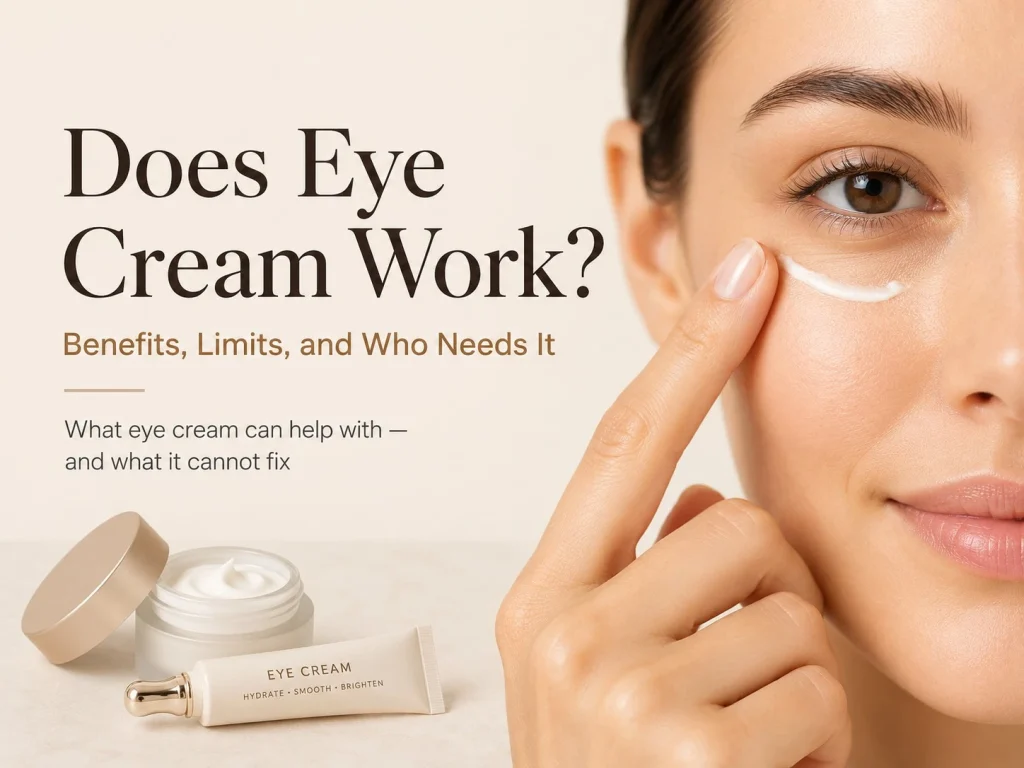


The debate around eye cream combines two different questions: whether a formula is comfortable near the eyes and whether it meaningfully targets a concern. A gentle cream can moisturize well without changing dark circles, while a stronger treatment may target fine lines but be too irritating to use consistently.
Research supports the potential of ingredients such as retinoids, vitamin C, peptides, ceramides, hyaluronic acid, caffeine, and niacinamide for specific eye-area concerns. However, direct trials of complete eye-cream formulas remain limited, and differences in formula, concentration, study design, and sample size make one product difficult to predict from an ingredient name alone.[1]
What Eye Cream Can Realistically Improve
Start with the visible problem, then ask what is causing it. “Dark circles,” for example, can mean brown pigment, visible blue-purple vessels through thin skin, or a shadow cast by a hollow tear trough. Those are different targets, so a cream that helps one may do little for another.[2]
| Main concern | Formula features that may help | Realistic result | Important limit |
|---|---|---|---|
| Dryness and fine dehydration lines | Humectants such as glycerin or hyaluronic acid, plus emollients and barrier-supporting lipids such as ceramides | Better hydration can make the surface feel smoother and temporarily make shallow dry lines less visible | Hydration does not rebuild lost volume or permanently remove structural wrinkles |
| Early fine lines and rough texture | A well-tolerated retinoid, niacinamide, vitamin C, peptides, or a combination supported by the finished formula | Consistent use may produce gradual, modest improvement in texture and the appearance of fine lines | Ingredient evidence does not prove that every eye cream contains an effective concentration or delivery system.[1] |
| Mild morning puffiness | Caffeine, a lightweight moisturizing base, or a cool compress used separately | Caffeine or cooling may temporarily reduce the look of fluid-related swelling | A cream cannot remove prominent fat pads, marked skin laxity, or inherited eye bags.[3] |
| Brown or uneven-looking darkness caused by pigment | Niacinamide, vitamin C, other appropriate brightening ingredients, and daily sun protection | A suitable formula may gradually reduce excess surface pigmentation and improve brightness | It will not correct every cause of darkness, and irritation can make discoloration look worse.[1] |
| Blue-purple darkness or tear-trough shadow | Hydration may improve surface light reflection; caffeine may temporarily affect vascular-looking darkness | The area may look slightly smoother or less tired for a limited time | Thin translucent skin, visible vessels, bone structure, and hollowing respond poorly to a brightening cream.[2] |
This is why “brightening,” “depuffing,” and “anti-aging” should not be treated as interchangeable claims. If the main issue is temporary dryness, a plain moisturizer may outperform an active eye cream that causes irritation. If the darkness is mostly a shadow, buying successively stronger brighteners is unlikely to solve the mismatch.
Eye Cream vs Face Moisturizer: Which Do You Need?
Eye creams and face moisturizers often use the same ingredient families: water-binding humectants, smoothing emollients, water-loss-reducing occlusives, antioxidants, and optional treatment ingredients. Some eye creams use a richer or less mobile texture, package an active at a tolerable level, or omit ingredients that commonly bother the eye area. Those are formula choices, not guarantees attached to the category name.
Use your regular face moisturizer around the orbital area when its directions do not exclude that use, it stays out of your eyes, and it keeps the skin comfortable without bumps, burning, or watering. The guide to what moisturizer does explains why hydration alone can make fine dry lines look softer without changing deeper wrinkles.
A separate eye cream is more likely to earn its place when:
- Your face moisturizer migrates or stings: A smaller amount or a different texture designed for the eye area may stay in place more comfortably.
- The eye area needs more or less richness than the rest of your face: Dry under-eyes may prefer a creamier layer, while a very rich facial cream may feel heavy under concealer.
- You want one targeted ingredient only around the eyes: An eye-area retinoid, for example, may let you treat that region without applying the same product over the full face. It still needs to be introduced cautiously.
- You value easier makeup layering: A thin, fast-settling eye formula can reduce slipping or creasing, although this is a texture benefit rather than proof of better long-term treatment.
Skip the extra product when your current moisturizer already does the job and you have no distinct eye-area concern. A minimalist skincare routine is not incomplete because it lacks eye cream. Sunscreen, gentle cleansing, and adequate moisturizing generally deserve priority over adding a specialized jar.[4]
How to Choose Eye Cream Without Relying on Marketing

- Choose one main job. Start with dryness, fine lines, temporary puffiness, or pigment—not a promise to “erase all signs of fatigue.” No single topical formula corrects every cause of an aged or dark under-eye area.
- Read the complete label. Check the directions, warnings, active ingredients, fragrance, and whether the product permits use on the upper eyelid or only around the orbital area. The guide to reading a skincare ingredient list helps separate a highlighted ingredient from the full formula.
- Use active ingredients deliberately. If you choose retinol or another retinoid, follow the product directions, begin conservatively, and avoid duplicating it with another irritating eye-area treatment. The complete retinol guide covers tolerance, interactions, and broader safety considerations.
- Favor tolerance over intensity. Fragrance, essential oils, strong acids, or a high active load may be unnecessary near easily irritated eyes. If fragrance is a concern, check the difference between fragrance-free and unscented skincare.
- Do not use price as an efficacy score. Anti-aging products can deliver modest results across different price ranges, and a higher price does not prove better clinical evidence.[4]
Give one well-tolerated product a fair, label-consistent trial instead of changing several parts of the routine at once. Hydration and cosmetic smoothing may be noticeable quickly, while changes related to uneven pigment or fine lines require consistent use and should remain modest. Stop if irritation is building; discomfort is not evidence that an eye cream is becoming more effective.
How to Apply Eye Cream Safely
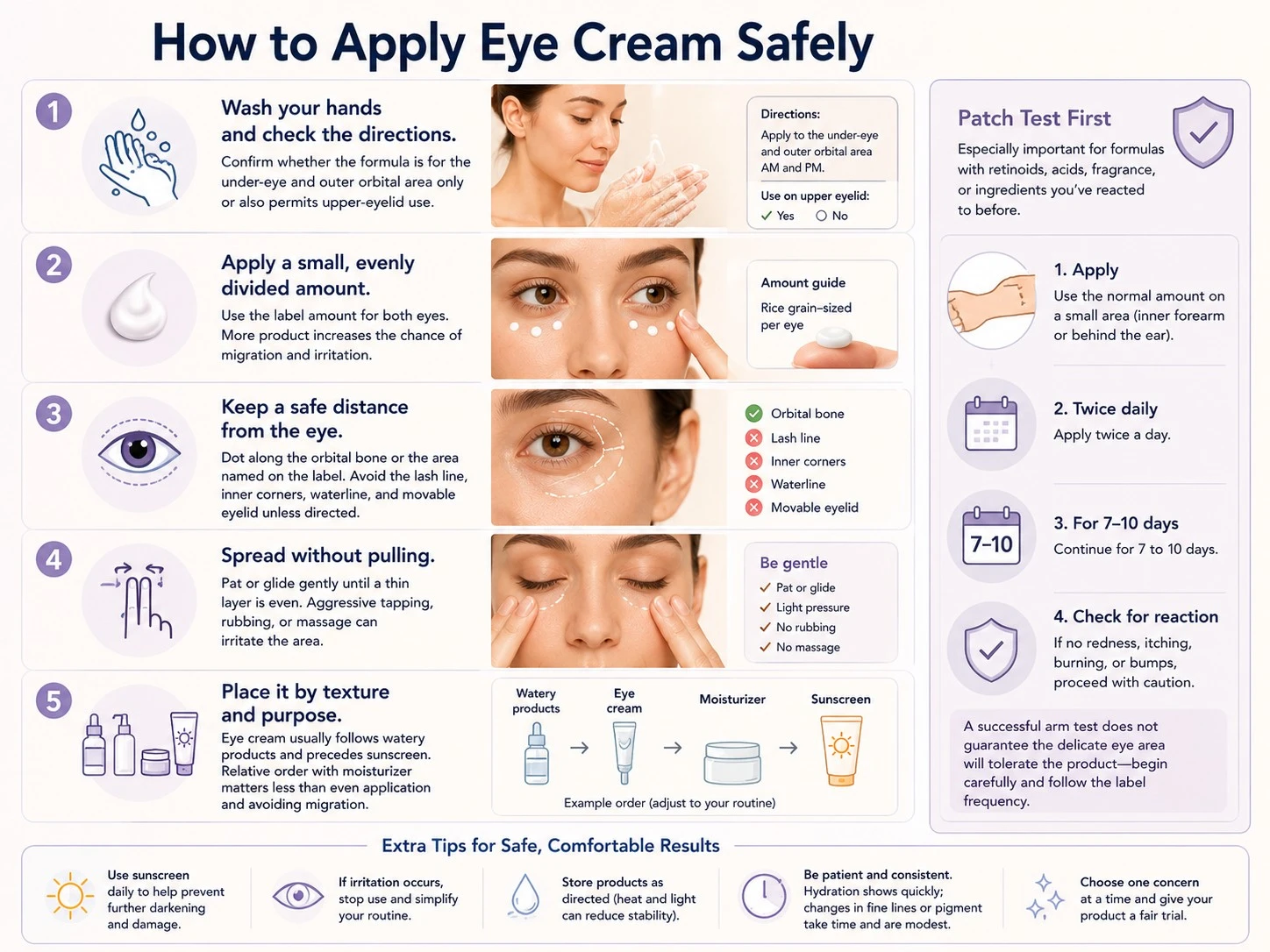
- Wash your hands and check the directions. Confirm whether the formula is intended only for the under-eye and outer orbital area or also permits upper-eyelid use.
- Apply a small, evenly divided amount. Use the label amount for both eyes. More product raises the chance of migration and irritation without proving a stronger result.
- Keep a safe distance from the eye. Dot the product along the orbital bone or the area named on the label. Avoid the lash line, inner corners, waterline, and movable eyelid unless the directions explicitly permit them.
- Spread without pulling. Pat or glide gently until a thin layer is even. Aggressive tapping, rubbing, or massage is unnecessary and can irritate the area.
- Place it by texture and purpose. Eye cream generally follows watery products and precedes sunscreen; relative order with face moisturizer matters less than even application and avoiding product migration. The full skincare routine order can help when several leave-on products are involved.
Patch test a new formula before regular use, especially when it contains retinoids, acids, fragrance, or other ingredients that have irritated you before. The standard skincare patch test uses the normal amount on a small area twice daily for seven to 10 days.[5] A successful arm test cannot guarantee that the more sensitive eye area will tolerate the product, so begin carefully and follow the label frequency.
When Eye Cream Is Not the Right Answer
Eye cream cannot correct every change that appears around the eyes. Changing formulas repeatedly is unlikely to help when the main driver sits deeper than the skin surface.
- Fixed hollows and tear-trough shadows: Topical hydration may soften surface texture, but it does not replace lost volume or change facial bone structure.
- Prominent or permanent bags: Caffeine and cooling may help temporary fluid puffiness, but fat pads, significant laxity, and structural bags generally require a different evaluation.[3]
- Darkness driven by allergies or rubbing: The trigger matters more than adding another brightener. Persistent itching, watery eyes, or seasonal symptoms may need appropriate medical care.
- Ongoing eyelid rash or inflammation: Stop optional cosmetics instead of layering eye cream over burning, scaling, swelling, or broken skin. Do not use eye cosmetics during an eye infection or while the surrounding skin is inflamed.[6]
- Sudden or one-sided change: New swelling or darkening under one eye, especially with pain, discharge, marked redness, headache, fever, or vision changes, is not a routine cosmetic concern.[2]
If an eye product causes irritation, stop using it immediately; persistent irritation should be medically evaluated.[6] Protecting the area from sun exposure also matters because UV damage contributes to uneven pigment and visible skin aging. Use sunglasses and a broad-spectrum product from a reliable sunscreen routine that you can apply safely around the eyes, following its label.[2]
FAQs About Eye Cream
What age should you start using eye cream?
There is no required age. Use one when a specific concern and suitable formula justify it—not because you reach a particular birthday. Younger users with simple dryness may need only moisturizer, while someone choosing a targeted active should base the decision on skin needs, tolerance, and product directions.
Should you keep eye cream in the refrigerator?
Only if the storage directions allow it. A cool product or applicator may feel soothing and temporarily reduce the look of mild puffiness, but refrigeration does not make the active ingredients stronger. Do not freeze the product or store it outside the temperature range specified by the manufacturer.
Sources
[1] Hamie H, Yoon R, Torbeck D, et al. A review of the efficacy of popular eye cream ingredients
[2] Cleveland Clinic. Dark Circles Under the Eyes: Causes & Treatment
[3] Cleveland Clinic. Dark Circles or Bags Under Your Eyes? How To Get Rid of Them
[4] American Academy of Dermatology Association. How to select anti-aging skin care products
[5] American Academy of Dermatology Association. How to test skin care products
[6] U.S. Food and Drug Administration. Cosmetics Safety Q&A: Eye Cosmetic Safety


