


“Moisturizer” names a product category, not one fixed mechanism or texture. The balance of water-binding, skin-softening, and water-loss-reducing ingredients determines whether a formula feels like a fluid, lotion, gel cream, rich cream, or ointment—and which benefits it can realistically provide.
This distinction also sets useful limits: an ordinary moisturizer can improve dryness, roughness, and comfort, but it is not automatically an acne treatment, anti-aging treatment, or substitute for sunscreen.
How Moisturizer Changes the Outer Skin Layer
The main target of an ordinary moisturizer is the stratum corneum, the outermost part of the epidermis. This layer is made of flattened cells surrounded by lipids and water-binding substances. When it loses too much water or its surface becomes disrupted, skin can feel tight, rough, flaky, itchy, or more reactive.
Moisturizer changes this surface environment rather than simply “soaking into” the skin. It can bind water within the stratum corneum, smooth gaps around shedding cells, and form a partial surface seal that slows transepidermal water loss—the passive movement of water through skin into the air.[1]
Some formulas also contain ceramides, fatty acids, cholesterol, or other ingredients intended to support the lipid structure of the skin barrier. However, an ingredient name alone does not prove that every finished product restores the barrier to the same degree. Concentration, ingredient combination, delivery system, application pattern, and the starting condition of the skin all matter; controlled studies have found that moisturizer effects can differ by composition.[5]
This explains why two products both labeled “moisturizer” can perform very differently. One may give a short burst of hydration and a light finish, while another may reduce dryness for longer but feel heavier.
The Main Benefits of Using Moisturizer
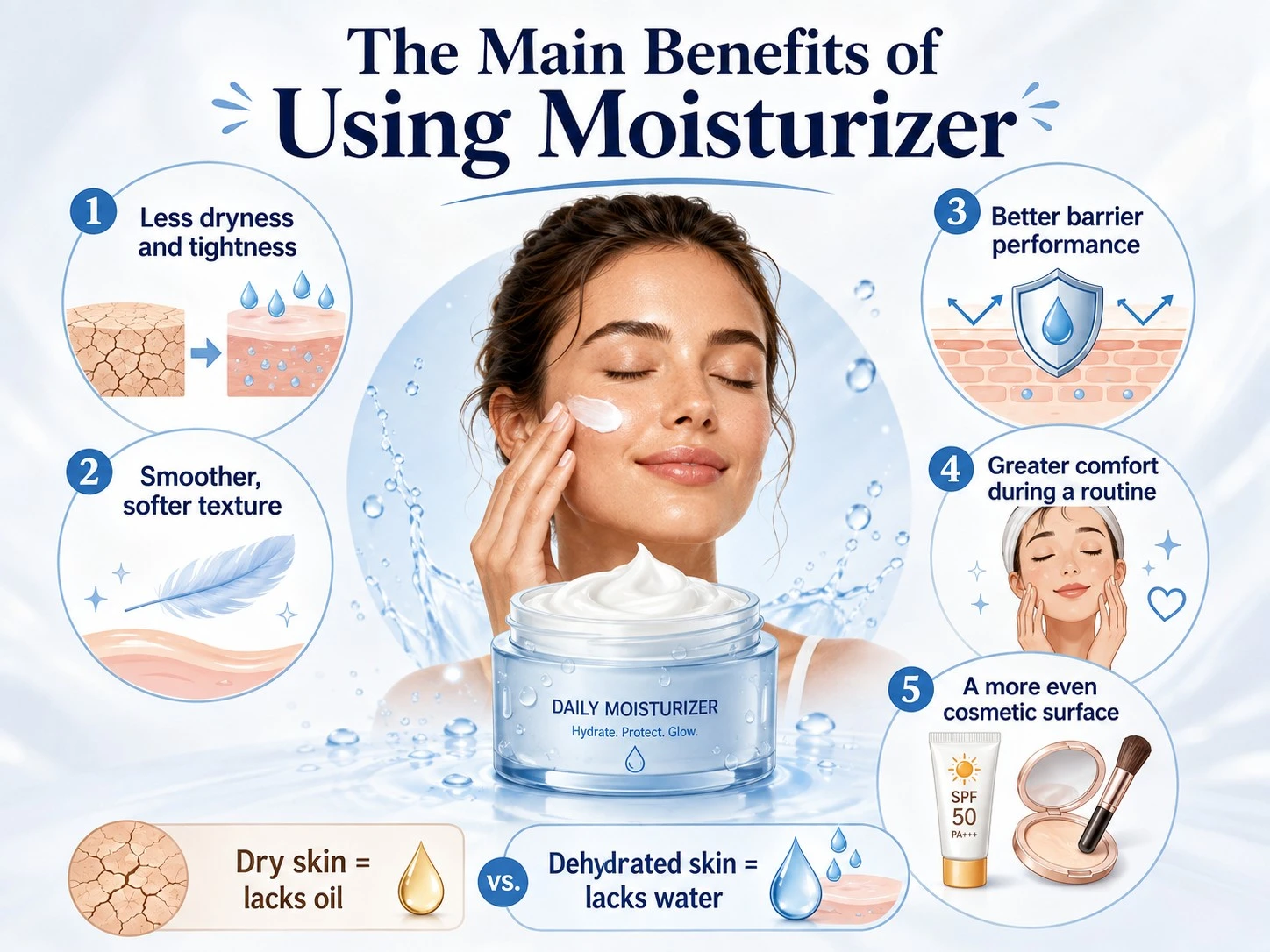
A suitable moisturizer can provide several connected benefits. These are strongest when the formula matches the skin’s current needs and is used consistently.
- Less dryness and tightness: Increasing water content and slowing water loss can reduce the uncomfortable pulled or tight feeling that follows cleansing, cold weather, low humidity, or drying treatments.
- Smoother, softer texture: Emollient and hydrating effects make rough flakes less prominent and help the surface feel more even. Hydrated skin may also make fine dehydration lines look temporarily less obvious, but an ordinary moisturizer does not permanently remove structural wrinkles.
- Better barrier performance: Reducing excessive water loss and supporting surface lipids can help dry or stressed skin maintain a more functional outer layer. Benefits vary by formula, and “barrier repair” should not be treated as a guarantee based on one highlighted ingredient.[2]
- Greater comfort during a routine: A well-tolerated moisturizer can reduce dryness caused by frequent cleansing, low humidity, or active products. It is often used alongside acne treatments because ingredients such as benzoyl peroxide and topical retinoids can dry or irritate skin.[4]
- A more even cosmetic surface: When dry flakes and rough patches are reduced, sunscreen and makeup may spread more evenly. This is a cosmetic benefit, not proof that moisturizer increases the protection or treatment strength of products applied over it.
Dryness and dehydration are related but not identical. Dry skin lacks enough protective oil and has difficulty retaining moisture, while dehydrated skin lacks water and can occur even when the face looks oily. The guide to dehydrated vs dry skin can help clarify which response you are trying to manage.
How Humectants, Emollients, and Occlusives Work
The familiar ingredient groups describe functions rather than rigid product categories. A single ingredient can perform more than one job, and most moisturizers combine several. For a deeper ingredient comparison, see humectants vs emollients vs occlusives.
| Ingredient function | What it does | Common examples | What the reader may notice |
|---|---|---|---|
| Humectant | Attracts and binds water in the outer skin layer | Glycerin, hyaluronic acid, urea, panthenol | More hydrated, flexible skin; some formulas may feel tacky |
| Emollient | Smooths and softens by filling spaces around dry surface cells | Squalane, fatty alcohols, esters, plant oils, dimethicone | Less roughness and a softer after-feel |
| Occlusive | Forms a water-resistant film that slows evaporation | Petrolatum, mineral oil, waxes, dimethicone | Longer-lasting moisture retention; richer formulas may feel heavier |
These mechanisms work best as a system. A humectant-heavy gel can increase hydration but may not give very dry skin enough protection from evaporation. A highly occlusive ointment can hold water effectively but may feel unnecessarily greasy on an oily face. Combining the roles lets a formulator balance hydration, softness, wear time, and sensory finish.[1]
An ingredient guide can explain the role of a material such as glycerin, but the complete formula is a better predictor of how a moisturizer will feel and perform.
What Moisturizer Cannot Do
Moisturizer has a useful but limited job. Keeping those limits clear prevents disappointment and unsafe substitutions.
- It does not replace sunscreen. A moisturizer provides UV protection only when it is labeled and applied as a broad-spectrum sunscreen with an adequate SPF. Otherwise, apply sunscreen as a separate morning step.
- It does not permanently erase wrinkles. Better hydration can soften the temporary appearance of fine dry lines, while long-term wrinkle treatment and UV prevention involve different mechanisms.
- It does not treat every cause of redness, itching, or flaking. Persistent or severe symptoms can come from eczema, psoriasis, contact dermatitis, infection, medication effects, or other conditions that need proper evaluation.
- It cannot make an irritating routine harmless. A moisturizer may improve tolerance, but it does not justify over-cleansing, frequent exfoliation, or continuing a product that causes ongoing burning, swelling, or rash.
- It is not guaranteed to be non-comedogenic or hypoallergenic. Texture, ingredients, amount, and individual response still matter.
Stop using a moisturizer that repeatedly causes burning, marked redness, swelling, hives, or an itchy rash. Seek medical care for severe reactions, eye involvement, blistering, signs of infection, or symptoms that persist despite simplifying the routine.
How to Choose a Moisturizer That Fits Your Skin
Choose from your skin’s response, climate, and routine rather than assuming one texture is universally best. The full guide to choosing a moisturizer for your skin type covers the decision in more detail.
- Dry, flaky, or tight skin: Start with a cream containing a mix of humectant, emollient, and occlusive functions. An ointment can be useful for very dry localized areas, especially overnight.
- Oily or acne-prone skin: A fluid, lotion, or gel cream may provide enough hydration with less residue. Look for a product labeled non-comedogenic, then judge it by actual tolerance rather than assuming oil-free means irritation-free. Oily skin can still benefit from moisturizer, particularly when acne treatments cause dryness.[4]
- Combination skin: Use a moderate texture over the whole face or adjust the amount by area. Multiple moisturizers are optional, not a requirement.
- Sensitive or easily irritated skin: Favor a simple, fragrance-free formula and patch test when practical. A short ingredient list is not automatically gentler, but fewer unnecessary extras can make troubleshooting easier.
- Hot, humid conditions: Lighter textures may feel more wearable. In cold, dry, windy, or heated indoor environments, a cream with stronger water-loss protection may be more comfortable.
If the choice is mainly about texture, compare gel vs cream moisturizer. If shine makes you want to skip the step entirely, this guide explains whether oily skin needs moisturizer.
How to Apply Moisturizer for Better Results
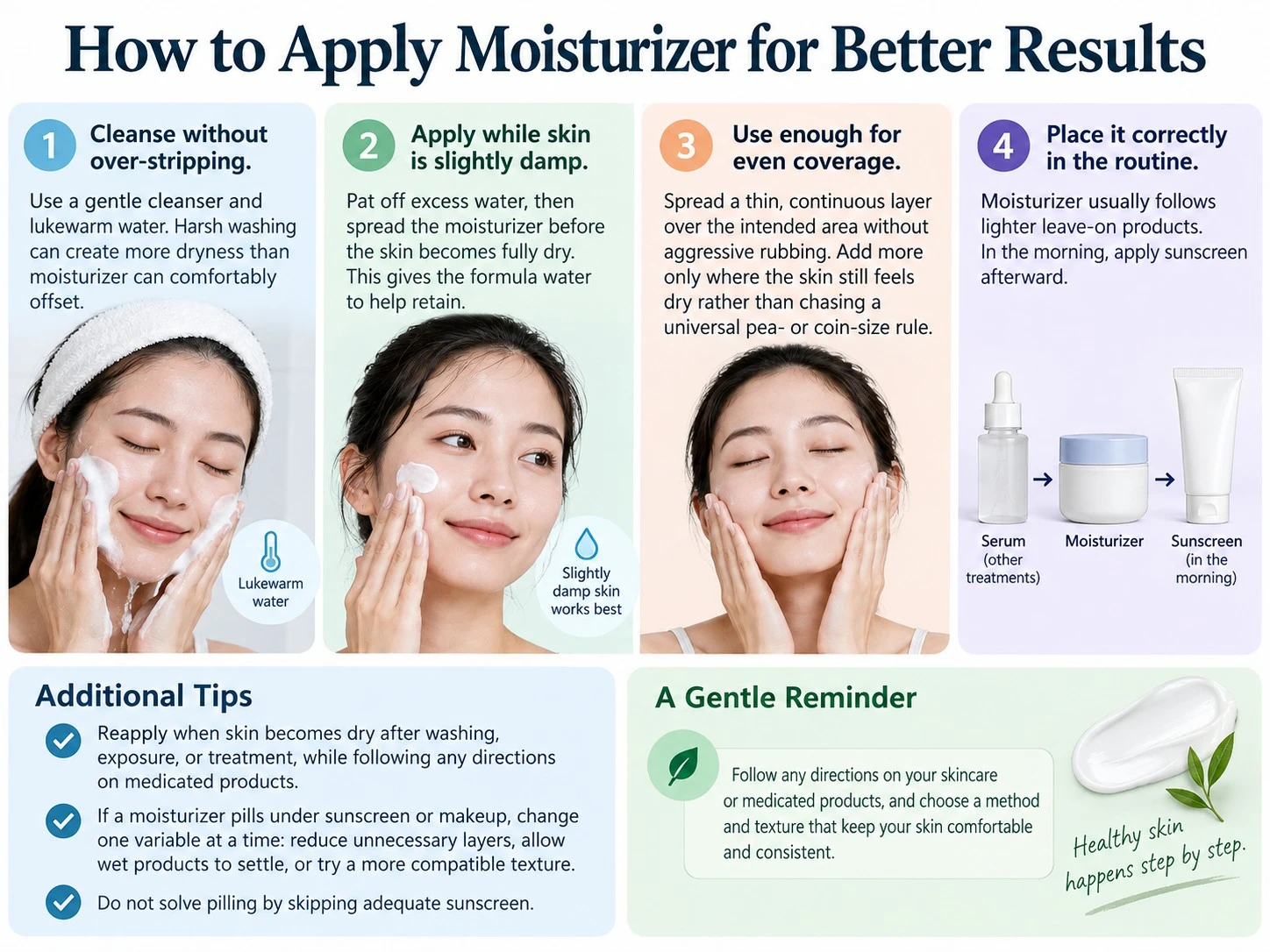
- Cleanse without over-stripping. Use a gentle cleanser and lukewarm water. Harsh washing can create more dryness than moisturizer can comfortably offset.
- Apply while skin is slightly damp. In a basic routine, pat off excess water, then spread the moisturizer before the skin becomes fully dry. This gives the formula water to help retain. If a medication or treatment label directs you to apply it to dry skin, follow that instruction. Creams and ointments are generally more effective than lotions for very dry skin.[3]
- Use enough for even coverage. Spread a thin, continuous layer over the intended area without aggressive rubbing. Add more only where the skin still feels dry rather than chasing a universal pea- or coin-size rule.
- Place it correctly in the routine. Moisturizer usually follows lighter leave-on products. The comparison of serum vs moisturizer explains their different jobs. In the morning, apply sunscreen afterward; see sunscreen or moisturizer first for the complete order.
Reapply when skin becomes dry after washing, exposure, or treatment, while following any directions on medicated products. If a moisturizer pills under sunscreen or makeup, change one variable at a time: reduce unnecessary layers, allow wet products to settle, or try a more compatible texture. Do not solve pilling by skipping adequate sunscreen.
FAQs About Moisturizer
Can your skin become dependent on moisturizer?
Moisturizer does not make skin physiologically “lazy.” If dryness returns after you stop, the underlying climate, cleansing habits, treatment, or skin condition may still be present. Adjust frequency to how your skin responds rather than stopping solely to prevent dependence.
Is face oil the same as moisturizer?
Face oil mainly provides emollient and sometimes occlusive effects. It can soften skin and slow water loss, but it may not contain water or strong humectants. Some people can use oil alone, while others get better results from a balanced moisturizer or from applying oil over one.
Can you use body moisturizer on your face?
Sometimes, if the formula is tolerated and suitable for facial use. Body products may be richer, more fragranced, or less cosmetically elegant on the face. Avoid the eye area unless the label permits it, and switch if the product causes stinging, congestion, or rash.
Sources
[1] Purnamawati S, Indrastuti N, Danarti R, Saefudin T. The Role of Moisturizers in Addressing Various Kinds of Dermatitis: A Review
[2] DermNet. Emollients and Moisturizers (Moisturisers)
[3] American Academy of Dermatology Association. Dermatologists’ Top Tips for Relieving Dry Skin
[4] American Academy of Dermatology Association. Moisturizer: Why You May Need It If You Have Acne
[5] Buraczewska I, Berne B, Lindberg M, Törmä H, Lodén M. Changes in Skin Barrier Function Following Long-Term Treatment With Moisturizers, a Randomized Controlled Trial


