


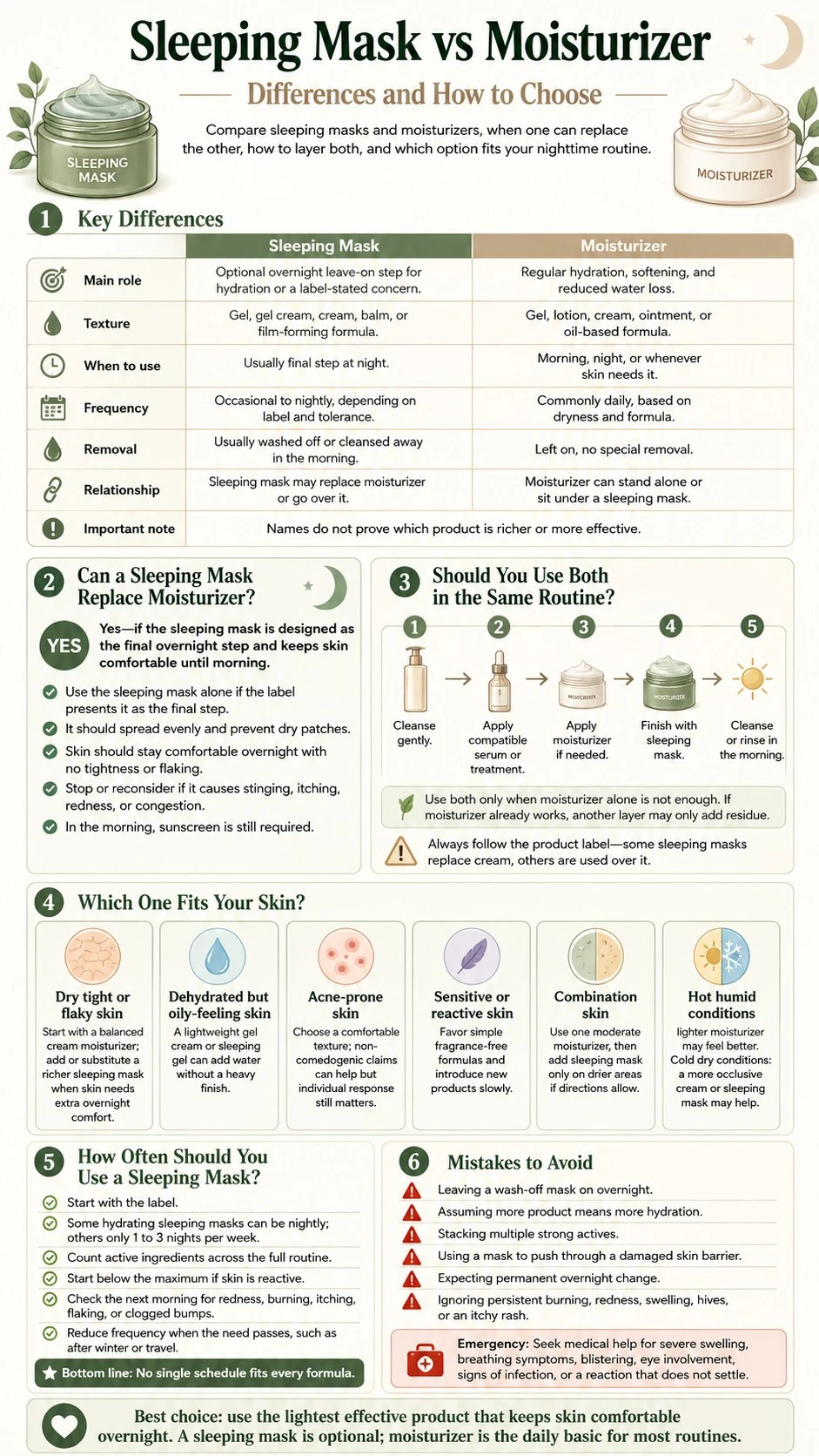
Sleeping masks are often marketed as an intensive nighttime step, while moisturizers are presented as everyday essentials. In practice, both may contain water-binding humectants, skin-smoothing emollients, and water-loss-reducing occlusives. You do not need to buy two products that perform the same job, but a well-chosen sleeping mask can add comfort when your usual moisturizer is not enough.
Sleeping Mask vs Moisturizer: Key Differences
A moisturizer is defined mainly by what it does for the outer skin layer. It can be a gel, lotion, cream, oil, or ointment. If you want the underlying mechanism, this guide explains what moisturizer does.
A sleeping mask, also called an overnight mask or sleeping pack, is defined more by how it is used: it stays on while you sleep and is normally rinsed or cleansed away in the morning. It may differ from a moisturizer in texture, finish, active ingredients, or use schedule.
| Feature | Sleeping mask | Moisturizer |
|---|---|---|
| Main role | Optional overnight leave-on step for hydration or another label-stated concern | Regular hydration, softening, and reduction of water loss |
| Typical texture | Gel, gel cream, cream, balm, or film-forming formula | Fluid, gel, lotion, cream, ointment, or oil-based formula |
| When to use | Usually the final step at night | Morning, night, or whenever skin needs it |
| Frequency | From occasional to nightly, depending on the label, ingredients, and tolerance | Commonly daily; frequency depends on dryness and formula |
| Removal | Usually washed off during the next morning cleanse | Normally left on; no special removal step |
| Relationship to other products | May replace nighttime moisturizer or sit over it | Can stand alone or sit beneath a sleeping mask |
| What the name does not prove | That it is richer, more occlusive, or more effective than moisturizer | That it is lighter, simpler, or less active than a sleeping mask |
The ingredient balance explains more than the front label. Humectants such as glycerin bind water, emollients smooth the surface, and occlusives form a film that slows evaporation.[2] Most moisturizing formulas combine these roles, so compare the complete ingredient list, texture, directions, and after-feel instead of one “hero” ingredient.[5] The guide to humectants, emollients, and occlusives compares these functions more closely.
Can a Sleeping Mask Replace Moisturizer?
Yes, a sleeping mask can replace moisturizer at night when it is designed as the final leave-on step and keeps your skin comfortable until morning. It does not have to sit over a cream simply because the package calls it a mask.
Try the sleeping mask by itself if:
- its directions present it as the final step rather than an add-on over moisturizer;
- your skin feels comfortable after application and does not become tight or flaky overnight;
- the product spreads evenly without needing a second layer to prevent dry patches; and
- it does not cause persistent stinging, itching, redness, or new congestion.
Keep your moisturizer underneath—or use it instead—if the sleeping mask feels too light, mainly functions as an active treatment, or leaves dry areas uncomfortable. A richer product is not automatically better. The guide to choosing a moisturizer for your skin type can help if neither product feels balanced.
Replacing nighttime moisturizer does not mean replacing the rest of a basic routine. The American Academy of Dermatology describes facial masks as optional additions rather than substitutes for cleansing, moisturizing, sun protection, or medical treatment.[1] In the morning, use broad-spectrum sunscreen as directed regardless of what you wore overnight.
Should You Use Both in the Same Routine?
Using both is optional. Layering makes sense when moisturizer handles everyday hydration but a sleeping mask adds comfort during dry weather, travel, or another temporary change. If moisturizer alone works, another layer may add residue without a noticeable benefit.
When the label supports layering, use this order:
- Cleanse gently. Remove makeup, sunscreen, and cleanser residue, then pat off excess water.
- Apply lighter leave-on products. Use any compatible serum or treatment according to its own directions.
- Apply moisturizer if needed. Spread a thin, even layer rather than trying to create a thick base.
- Finish with the sleeping mask. Apply the label-directed amount as the final step and leave it on for the stated time.
- Cleanse or rinse in the morning. Follow the mask directions, then continue with the rest of your morning routine.
This sequence does not override the package. Some sleeping masks replace cream; others direct use over moisturizer. A complete skincare routine order is useful when prescription products or several optional layers are involved.
Do not assume that “sealing in” every treatment is helpful. An extra layer may increase irritation in some routines. With prescription medication, follow its instructions or ask the prescriber before adding an occlusive layer.
Which One Fits Your Skin?

Choose by the result you need and the feel your skin tolerates, not by treating sleeping masks as an automatic upgrade.
- Dry, tight, or flaky skin: Start with a balanced cream moisturizer. Add or substitute a richer sleeping mask when cold air, indoor heating, or another temporary stress leaves skin uncomfortable. Persistent dryness usually calls for a better daily formula, not just an occasional extra product.
- Dehydrated but oily-feeling skin: A lightweight gel cream or sleeping gel may add water without a heavy finish. Oily skin can still need moisturizer, especially when cleansers or acne treatments are drying; this guide explains why oily skin may still need moisturizer.
- Acne-prone skin: Look for a comfortable texture and consider a non-comedogenic claim, but treat the claim as a useful screening cue rather than a guarantee. Individual response still matters. The meaning and limits of non-comedogenic skincare are explained separately.
- Sensitive or reactive skin: Favor a simple, fragrance-free formula and do not introduce a sleeping mask alongside several new actives. Unsuitable ingredients or frequency can cause irritation, dryness, or breakouts.[1] Cosmetics can also cause allergic contact dermatitis in some people.[4]
- Combination skin: Apply one moderate moisturizer everywhere, then place a sleeping mask only on the areas that remain dry if the product directions allow localized use.
- Hot or humid conditions: A heavy final layer may feel sticky or trap unwanted heat. A lighter moisturizer may be easier to wear. In cold, dry conditions, a more occlusive cream or sleeping mask may feel better.
Texture labels can still narrow the search, but they are not performance grades. Comparing gel and cream moisturizers can help you choose a finish before deciding whether a separate mask is necessary.
How Often Should You Use a Sleeping Mask?
Start with the label. Some hydrating sleeping masks are designed for nightly use, while others recommend one to three nights per week. No category-wide schedule fits every formula.
Adjust frequency with these checks:
- Count active ingredients across the full routine. A sleeping mask containing exfoliating acids, retinoid-like ingredients, or another potentially irritating active is not merely an extra layer of moisture.
- Start below the maximum when your skin is reactive. Test the product first and increase only if the label permits and your skin remains comfortable.
- Watch the following morning, not just the application feel. New flaking, persistent redness, burning, itching, swelling, or clusters of clogged bumps suggest that the product or schedule does not suit you.
- Reduce frequency when the need passes. A mask that helps during winter or travel does not have to remain in the routine every night.
The guide to how often to use a face mask explains how formula type and existing actives change a safe schedule. Dermatologists advise following the stated wear time and avoiding redundant actives because longer or more frequent use can increase irritation.[1]
Mistakes to Avoid
- Leaving a wash-off mask on overnight: Clay, peel-off, rinse-off acid, and other short-contact masks are not sleeping masks. FDA guidance notes that an ingredient may be appropriate in a product that is rinsed off but not in one left on for hours; use the product only as directed.[3]
- Assuming more product means more hydration: A thick coat can transfer to bedding, pill, or feel suffocating. Use the amount on the label or enough for a thin, continuous layer.
- Stacking multiple strong actives: A mask that repeats the acid, retinoid, or exfoliant already in your routine may create dryness and irritation rather than faster results.[1]
- Using a mask to push through a damaged barrier: Extra occlusion cannot make an irritating routine harmless. If skin is burning, sore, or unusually flaky, simplify the routine and address the cause; the guide to a damaged skin barrier explains the warning signs.
- Expecting permanent overnight change: Hydration can make skin look smoother or plumper temporarily, but a cosmetic sleeping mask does not permanently erase wrinkles, cure acne or eczema, “detox” skin, or undo UV damage overnight.
- Ignoring a reaction because the product feels intensive: Wash the product off and stop using it if you develop persistent burning, marked redness, swelling, hives, or an itchy rash. Seek medical help for severe swelling, breathing symptoms, blistering, eye involvement, signs of infection, or a reaction that does not settle.
FAQs About Sleeping Masks and Moisturizers
Is a sleeping mask the same as a night cream?
The categories overlap, but the names are not enough to prove that two products are identical. Both can be leave-on moisturizing formulas used at night. A sleeping mask may have directions for occasional use, a more film-forming finish, or additional active ingredients, while a night cream is commonly positioned as a regular nighttime moisturizer. Compare the formula, directions, and result on your skin rather than relying on the front label.
Can you use a sleeping mask during the day?
Only if the directions allow it and the texture works under daytime products. A sleeping mask may feel heavy, pill under makeup, or create too much shine, but some lightweight formulas can function like moisturizers. It never replaces broad-spectrum sunscreen unless it is specifically labeled and used as a sunscreen.
Sources
[1] American Academy of Dermatology Association. Do Facial Masks Work, and Should I Add One to My Skin Care Routine?
[2] DermNet. Emollients and Moisturizers (Moisturisers)
[3] U.S. Food and Drug Administration. Summary of Cosmetics Labeling Requirements
[4] U.S. Food and Drug Administration. Allergens in Cosmetics
[5] Purnamawati S, Indrastuti N, Danarti R, Saefudin T. The Role of Moisturizers in Addressing Various Kinds of Dermatitis: A Review


