
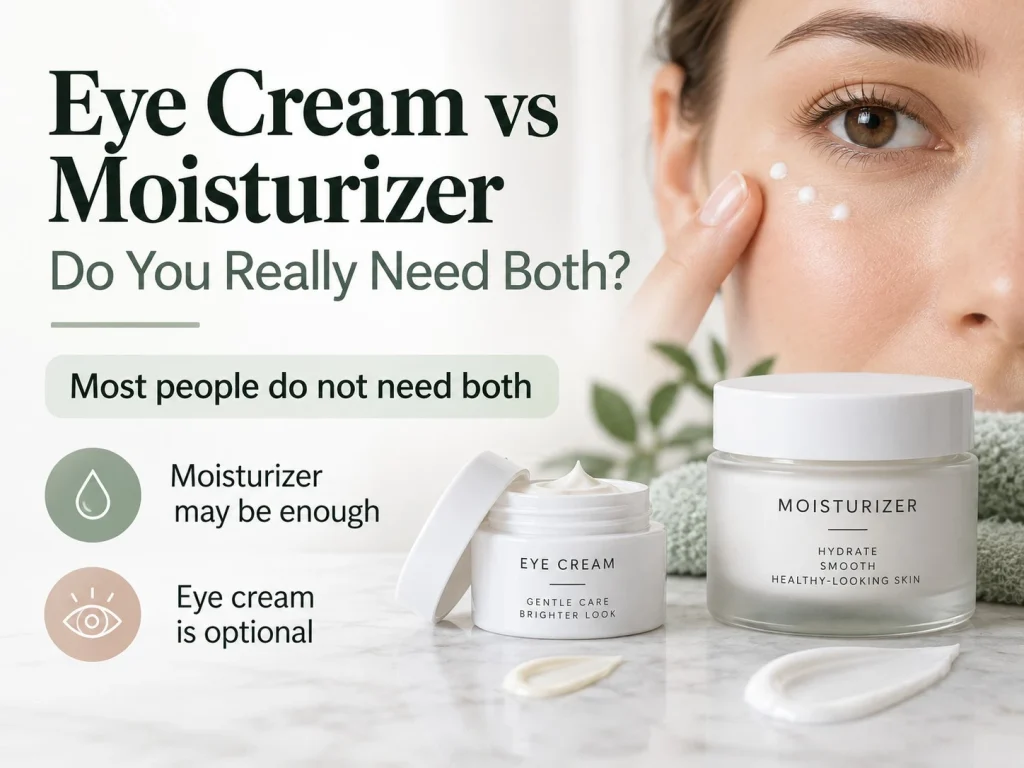

Eye cream and face moisturizer are both leave-on emulsions designed to condition and hydrate skin. Their ingredient lists can overlap heavily, so the category name alone does not tell you whether one formula will outperform the other around your eyes.
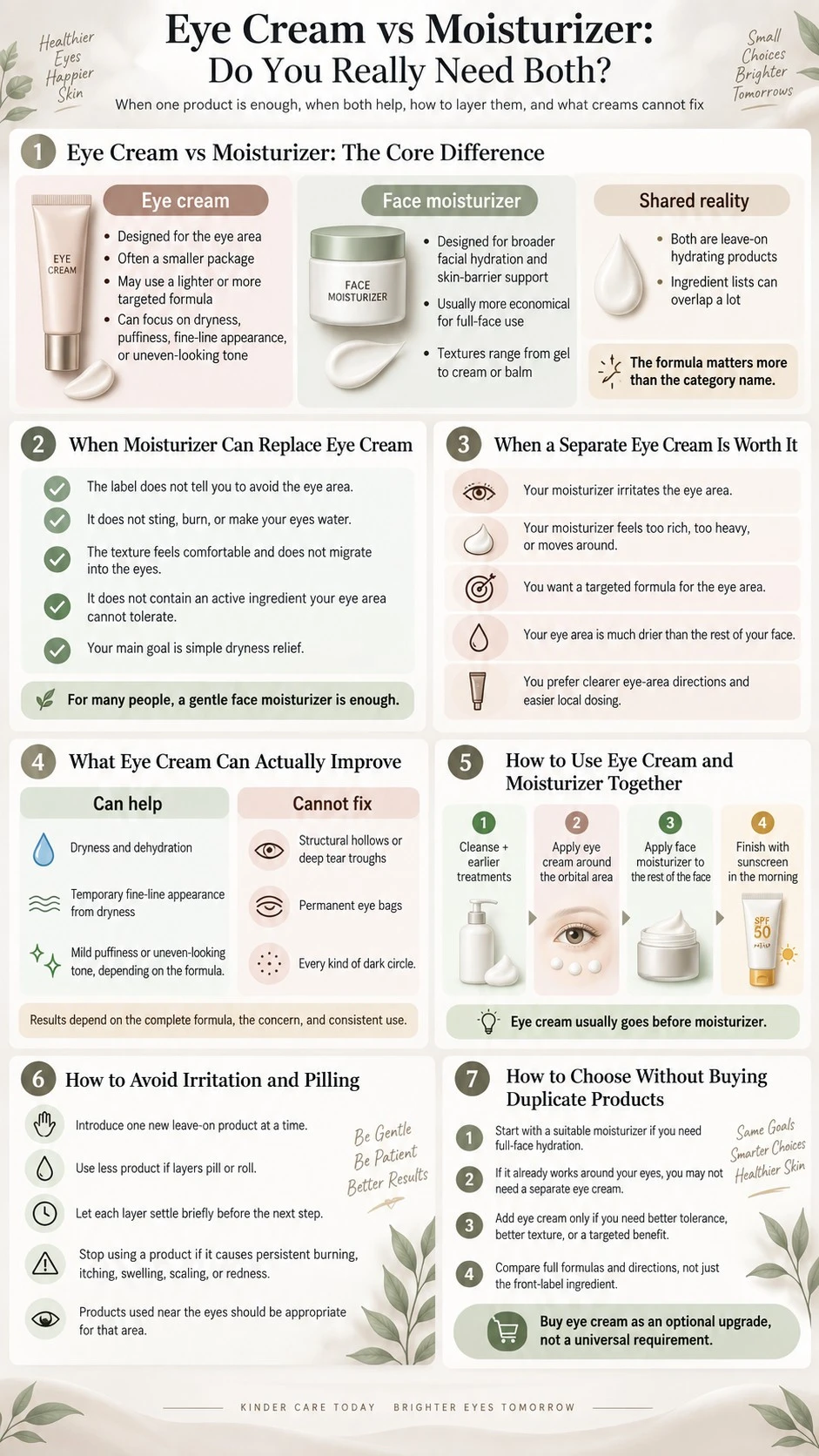
The useful distinction is scope. Moisturizer is made for broader facial use and supports hydration and the skin barrier. Eye cream is packaged and directed for a smaller, more sensitive area and may use a different texture or targeted ingredients. That can make an eye cream worthwhile, but it does not make two separate products necessary for everyone.
What Is the Difference Between Eye Cream and Moisturizer?
Most moisturizers combine humectants that help hold water, emollients that soften rough skin, and occlusive ingredients that reduce water loss. Their main role is to improve hydration and support the outer skin barrier.[1] Eye creams can use the same types of ingredients, then adjust the texture, active ingredients, and use directions for the eye area.
| Comparison point | Eye cream | Face moisturizer |
|---|---|---|
| Main job | Hydrates or targets a concern around the eyes | Hydrates and supports the skin barrier across the face |
| Intended area | Periorbital area, according to the product label | Face and sometimes neck; eye-area use depends on the label and formula |
| Typical texture | Often lightweight, cushioning, or designed to stay in a small area | Ranges from gel to lotion, cream, balm, or ointment |
| Common ingredients | Glycerin, hyaluronic acid, ceramides, peptides, caffeine, niacinamide, antioxidants, or retinoids | Glycerin, hyaluronic acid, ceramides, oils, silicones, petrolatum, niacinamide, and other barrier-supporting ingredients |
| Targeted claims | Dryness, temporary puffiness, fine-line appearance, or uneven-looking tone | Dryness, roughness, barrier support, and overall skin comfort |
| Value per use | Usually a smaller package and higher cost per unit | Usually more economical for full-face hydration |
| Can it replace the other? | Not practical as a full-face moisturizer for most people | May replace a basic hydrating eye cream if it is gentle and suitable around the eyes |
| Best fit | A specific eye-area need or poor tolerance of face moisturizer near the eyes | The first purchase for a simple, hydration-focused routine |
The formula matters more than the product name. Evidence supports the potential of several ingredients used in eye creams, but trials specifically comparing complete eye-cream formulas with ordinary facial moisturizers remain limited.[2] This is why the answer depends on the two actual products, not simply “eye cream” versus “moisturizer.” For more detail on the evidence boundary, see whether eye cream works.
When Can Moisturizer Replace Eye Cream?
A face moisturizer can often replace a basic eye cream when it meets all of these conditions:
- The label does not tell you to avoid the eye area.
- The formula does not sting, burn, make your eyes water, or cause persistent redness.
- The texture hydrates without feeling uncomfortably greasy or migrating into the eyes.
- It does not contain an active ingredient that your eye area cannot tolerate.
- Your goal is mainly dryness relief rather than a targeted cosmetic concern.
This option is especially practical for a minimalist routine or a limited budget. You are using one product to perform the same hydration job across two nearby areas instead of buying a second formula with similar ingredients.
“Around the eyes” does not mean on the eyeball, lash line, or mobile eyelid unless the product specifically directs that use. If you are uncertain about a particular formula, the fuller guide to using face moisturizer under the eyes explains the placement and tolerance checks.
When Is a Separate Eye Cream Worth It?
A separate eye cream becomes more useful when it solves a problem your face moisturizer does not.
- Your moisturizer irritates the eye area. A simpler fragrance-free eye formula may be easier to tolerate, although “eye cream” is not a guarantee against irritation.
- Your moisturizer is too rich or too mobile. A different texture may sit better under concealer or be less likely to travel toward the eyes.
- You want a carefully targeted active. Some eye creams contain caffeine, niacinamide, peptides, antioxidants, or a retinoid in a formula intended for localized use.
- Your eye area is much drier than the rest of your face. A separate cream lets you add richness locally without coating an oily or acne-prone face in the same texture.
- You prefer separate application directions. A small product with clear eye-area instructions can make cautious dosing easier.
Eye-area skin is thin and sits close to the eye, so active ingredients require more caution there than they might on less sensitive facial areas.[3] Follow the eye cream label rather than assuming that an active face cream and a similarly named eye product are interchangeable.
What Can Eye Cream Actually Improve?
An eye cream can improve dryness and temporarily make dehydration lines look softer by increasing water content at the skin surface. Specific formulas may also produce modest changes in the appearance of fine lines, uneven tone, or puffiness. Ingredient-level research is promising, but results vary with the formula, concern, concentration, study design, and consistent use.[2]
Eye cream has clearer limits. It cannot permanently remove a deep tear trough, reposition protruding fat, or correct every cause of under-eye darkness. Dark circles can reflect pigmentation, visible blood vessels, thin skin, shadowing, allergies, dermatitis, anatomy, or several factors at once.[3] The guide to dark circles under the eyes can help you distinguish what topical skincare can reasonably change.
If a concern is structural, sudden, one-sided, painful, swollen, or accompanied by vision changes, buying a stronger eye cream is not the right next step. Seek medical assessment.
How to Use Eye Cream and Moisturizer Together

If you choose to use both products, this order keeps the routine simple:
- Cleanse and apply earlier treatments. Use toner, essence, serum, or prescribed treatment in the order and area directed by its label.
- Apply eye cream. Use a small amount around the orbital area and press or tap gently instead of rubbing. Keep it out of the eye unless the label explicitly says otherwise.
- Apply face moisturizer. Smooth it over the rest of the face. You do not need to place a second heavy layer directly over the eye cream unless your skin needs it and both products remain comfortable.
- Finish the morning routine with sunscreen. Sunscreen remains the final skincare step before makeup.
Eye cream usually goes before moisturizer because it is applied to a small target area and often has a lighter texture. The order can change if the eye product is thicker, the label gives different instructions, or a clinician has prescribed an eye-area treatment. See eye cream before or after moisturizer for the full set of order exceptions.
How to Avoid Irritation, Pilling, and Heavy Layering
Introduce one new leave-on product at a time. Adding an eye cream, retinoid, exfoliating acid, and richer moisturizer together makes it difficult to identify the cause of a reaction.
Use less product if layers roll into flakes or pills. Pilling is often a formula-compatibility or quantity problem, not proof that the products are failing to absorb. Let each layer spread and settle before continuing, but there is no universal waiting time that suits every formula.
Stop using a product if it causes persistent burning, itching, swelling, scaling, repeated watering, or eye redness. Cosmetics near the eyes should be used carefully, kept clean, and limited to products intended for that area; persistent irritation warrants medical advice.[4] Do not continue simply because the packaging calls the product gentle or ophthalmologist-tested.
How to Choose Without Buying Duplicate Products
Start with the job, then compare formulas.
- If you need full-face hydration, prioritize a suitable moisturizer.
- If that moisturizer is comfortable around the eyes, test whether it already meets your hydration goal.
- If one eye-area concern remains, look for an eye cream designed for that concern rather than another generic hydrating cream.
- Compare the complete ingredient lists and directions, not only the highlighted ingredient on the front label.
- Avoid paying for two products that contain similar base ingredients and perform the same basic hydration job unless the textures serve different areas well.
A separate eye cream is a reasonable preference even when it is not strictly necessary. The useful test is whether it adds better tolerance, application, or a targeted benefit—not whether a skincare routine diagram includes an eye-cream step.
FAQs About Eye Cream and Moisturizer
Can I use face moisturizer as eye cream?
Yes, if the product is gentle, the label does not exclude the eye area, and it does not cause stinging, watering, redness, or uncomfortable heaviness. Keep it out of the eyes and away from the lash line unless directed otherwise.
Is eye cream just moisturizer in a smaller jar?
Sometimes the formulas are very similar, but not always. An eye cream may change the texture, ingredient levels, targeted actives, packaging, and use directions for the periorbital area. Compare the actual formulas before deciding that they are duplicates.
Should eye cream go before or after moisturizer?
Eye cream usually goes before face moisturizer. Apply it after lighter serums or treatments and before moisturizer, then finish the morning routine with sunscreen. Follow different label or prescription instructions when provided.[5]
Can eye cream get rid of dark circles?
It may improve darkness caused partly by dryness or surface pigmentation, depending on the formula. It cannot correct every cause, especially shadows from hollows, visible vessels, allergies, or inherited anatomy.
What age should you start using eye cream?
There is no required starting age. Use an eye cream when you have a specific need that your moisturizer does not meet. Preventive sun protection and a tolerable moisturizer are more useful foundations than buying an eye cream because you reached a certain birthday.
Sources
[1] Harwood A, et al. Moisturizers
[2] Hamie H, et al. A review of the efficacy of popular eye cream ingredients
[3] Pilkington SJ, et al. The Tricky Tear Trough: A Review of Topical Cosmeceuticals for Periorbital Skin Rejuvenation
[4] U.S. Food and Drug Administration. Cosmetics Safety Q&A: Eye Cosmetic Safety
[5] American Academy of Dermatology. Should I apply my skin care products in a certain order?


