


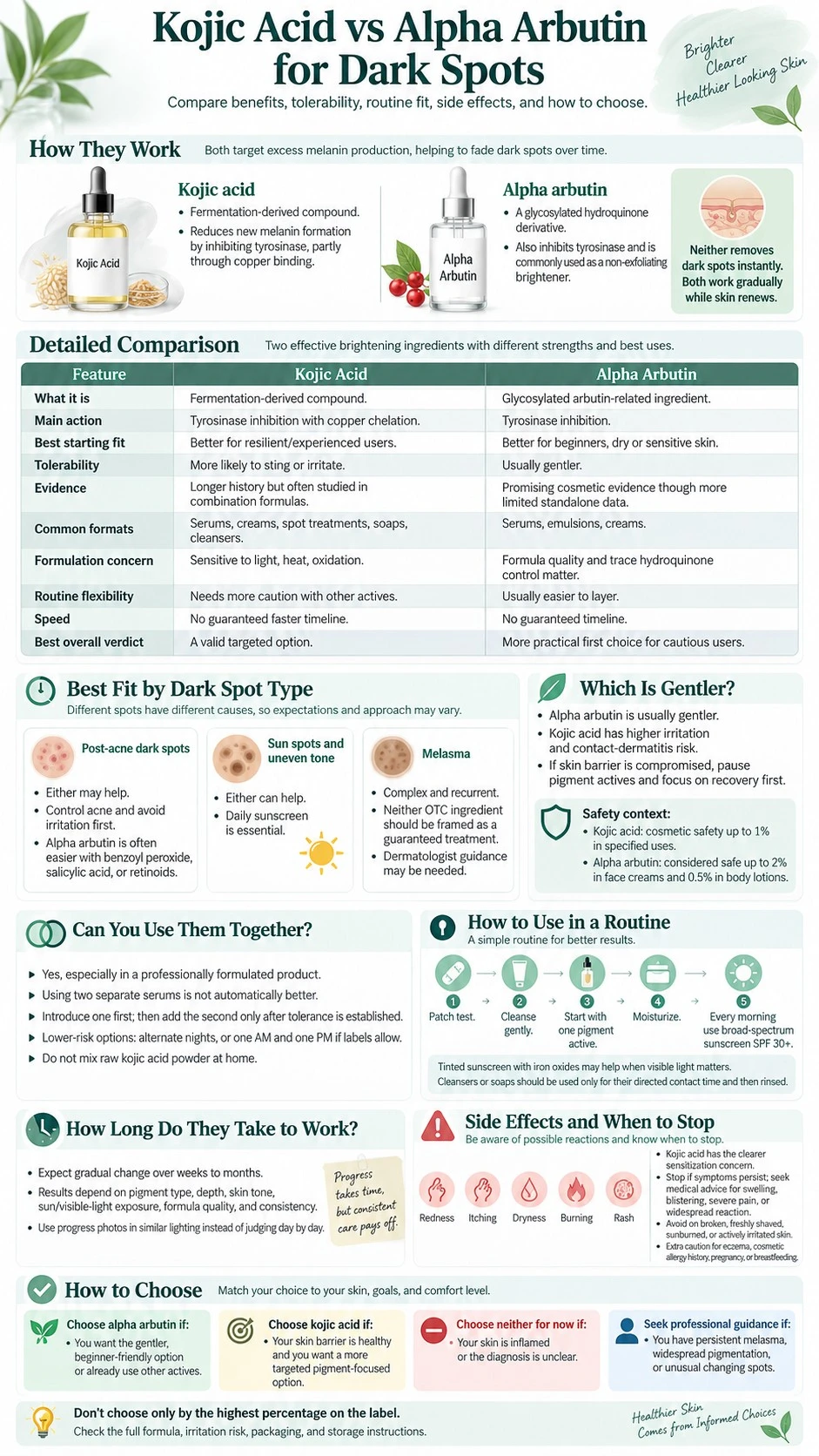
Kojic acid and alpha arbutin often appear in the same dark-spot conversation because both interfere with tyrosinase, an enzyme involved in melanin production. That shared target does not make them interchangeable. Their chemistry, tolerability, formulation needs, and strength of evidence differ.
The practical answer is that alpha arbutin is usually the safer starting point for a cautious routine, while kojic acid can be a reasonable targeted option for skin that tolerates it. Your result will depend at least as much on the cause and depth of the pigmentation, the complete formula, consistent sun protection, and whether the product causes inflammation.
How Do Kojic Acid and Alpha Arbutin Work?
Kojic acid is a fermentation-derived compound that suppresses tyrosinase activity partly by binding copper at the enzyme’s active site. This can slow the formation of new melanin. Reviews describe its use in products for uneven pigmentation, but clinical evidence frequently involves formulas that combine kojic acid with other brightening agents.[1]
Alpha arbutin is a glycosylated hydroquinone derivative. It also inhibits tyrosinase, but it is a distinct cosmetic ingredient rather than prescription hydroquinone. Alpha arbutin is commonly positioned as a non-exfoliating brightener, which helps explain why many people find it easier to use in a multi-step routine.
Neither ingredient erases existing pigment immediately. Both aim to reduce ongoing excess pigment production while normal skin renewal gradually makes discoloration less visible. They are most relevant to flat areas of excess pigment, not indented or raised scars. If the mark followed acne, first determine whether you are dealing with acne scars or dark spots.
Kojic Acid vs Alpha Arbutin: Detailed Comparison
| Comparison point | Kojic acid | Alpha arbutin |
|---|---|---|
| What it is | A compound produced through fermentation by certain fungi | A synthetic or biosynthetic glycosylated derivative related to arbutin |
| Main action | Inhibits tyrosinase, including through copper chelation | Inhibits tyrosinase and reduces new melanin formation |
| Best starting fit | Experienced users with normal or resilient skin who want a targeted pigment product | Beginners, dry or sensitive skin, and routines that already contain other actives |
| Tolerability | More likely to sting, dry, or trigger irritant or allergic contact dermatitis | Usually gentler, although redness, itching, dryness, or irritation can still occur |
| Evidence | Longer history in pigmentation products, but many studies use combination formulas | Promising cosmetic evidence, but standalone clinical evidence is limited and many studies use combinations |
| Common product formats | Serums, creams, spot treatments, soaps, and cleansers | Mostly serums, emulsions, and creams |
| Formulation concern | Can be sensitive to light, heat, and oxidation; derivatives are not identical to kojic acid | Formula quality, pH, stability, and control of unavoidable hydroquinone traces matter |
| Routine flexibility | Requires more caution beside exfoliating acids, retinoids, or other irritating products | Often easier to layer, although more products do not automatically produce better results |
| Speed | No dependable universal timeline; formula and tolerance affect consistency | No dependable universal timeline; gentleness may make consistent use easier |
| Best overall verdict | A valid targeted option, not an objectively stronger winner | The more practical first choice for most cautious users |
The table describes typical decision factors, not a head-to-head efficacy ranking. Published reviews support both as tyrosinase inhibitors, yet direct, high-quality comparisons of standalone kojic acid and standalone alpha arbutin are lacking. Irritation also matters because inflammation can worsen hyperpigmentation, especially in deeper skin tones.[2]
Which Ingredient Is Better for Different Dark Spots?
Post-acne dark spots
Either ingredient may help with flat brown marks left after a breakout, but controlling the acne and preventing irritation come first. Alpha arbutin is often the easier choice if you already use benzoyl peroxide, salicylic acid, or a retinoid. Kojic acid may still fit, but adding it to an already aggressive routine can create more inflammation than benefit.
Sun spots and uneven tone
Both can support a more even-looking tone, provided daily sun protection is part of the plan. A spot that is new, changing in color or shape, bleeding, or unlike your other marks should be assessed by a dermatologist rather than treated as ordinary pigmentation.
Melasma
Melasma is complex, recurrent, and influenced by ultraviolet light, visible light, hormones, and heat. Kojic acid and arbutin appear in melasma research, often inside combination formulas, but an over-the-counter serum should not be presented as a guaranteed melasma treatment. A dermatologist can help distinguish melasma from other pigmentation and build a safer multimodal plan.
Is Alpha Arbutin Gentler Than Kojic Acid?
Usually, yes. Kojic acid has a recognized potential to cause irritation and contact dermatitis, and reviews advise caution because irritation itself can deepen post-inflammatory pigmentation.[2] Alpha arbutin is generally selected when tolerability is the priority, but “gentler” does not mean reaction-proof.
Choose alpha arbutin first if your skin is dry, reactive, recovering from over-exfoliation, or already using another strong active. If your skin barrier is currently compromised, pause pigment actives and focus on recovery before testing either one.
For context, European safety assessments concluded that kojic acid is safe as a skin-lightening agent in cosmetic products at concentrations up to 1%, while noting extra concern when it is used with peeling agents on a weakened barrier.[3] A separate assessment concluded that alpha arbutin is safe up to 2% in face creams and 0.5% in body lotions, with hydroquinone kept to unavoidable trace levels.[4] These are safety conclusions for specified uses, not proof that a higher percentage works better or a universal dosing instruction.
Can You Use Kojic Acid and Alpha Arbutin Together?
Yes, they can appear together in a professionally formulated product. That does not prove the combination is necessary or superior for your skin. A finished formula has been designed around ingredient compatibility, stability, delivery, and preservation; layering two unrelated serums has not.
If you want to use separate products, introduce one first and establish tolerance before adding the other. The lower-risk options are to use them on alternate nights or use one in the morning and one at night, provided the labels allow it. Stop adding actives if you develop persistent stinging, redness, scaling, or itching.
Do not mix raw kojic acid powder into a serum, cream, or soap at home. Concentration, pH, dissolution, stability, contamination control, and even distribution cannot be judged reliably by appearance.
How to Use Kojic Acid or Alpha Arbutin in a Routine
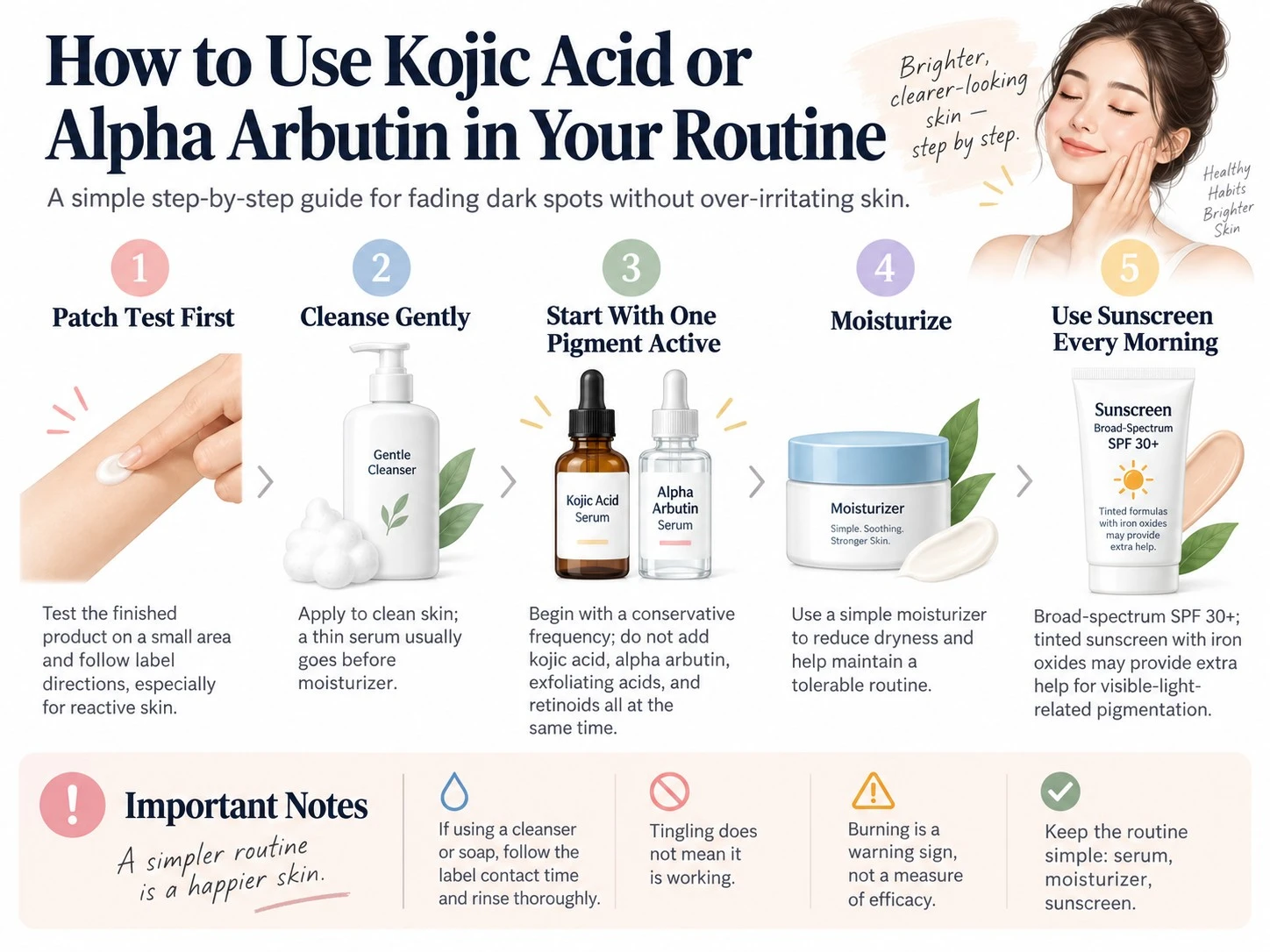
- Patch test the finished product. Follow its directions and test a small area before broader facial use, especially if you have reactive skin.
- Cleanse gently. Apply the product to clean skin at the step indicated on its label; a thin serum generally goes before moisturizer.
- Start with one pigment active. Use a conservative frequency at first instead of adding kojic acid, alpha arbutin, exfoliating acids, and retinoids at the same time.
- Moisturize. A simple moisturizer can reduce dryness and help you maintain a tolerable routine.
- Protect skin every morning. Use a broad-spectrum sunscreen with SPF 30 or higher. For pigmentation affected by visible light, a tinted sunscreen containing iron oxides may offer useful additional protection.[5]
If the product is a cleanser or soap, follow its specified contact time and rinse thoroughly. Do not assume a tingling sensation means it is working. Burning is a warning sign, not an efficacy measure. See the complete skincare routine order if you need help placing a serum, moisturizer, and sunscreen.
How Long Do Kojic Acid and Alpha Arbutin Take to Work?
Expect gradual change over weeks to months, not overnight fading. The pace depends on the cause, how deep the pigment sits, your baseline skin tone, sun and visible-light exposure, the complete formula, and how consistently you can use it without irritation.
Take photos in similar lighting rather than judging the mirror every day. If the marks are becoming darker, spreading, or not responding after sustained label-directed use, reconsider the diagnosis and routine with a dermatologist. Do not respond by continually increasing the amount or stacking more aggressive actives.
Side Effects and When to Stop
Possible reactions to either ingredient include redness, itching, dryness, burning, or a rash. Kojic acid has the clearer sensitization and contact-dermatitis concern. Stop using the product and simplify your routine if symptoms persist; seek medical advice for swelling, blistering, severe pain, or a widespread reaction.
Avoid applying either active to broken, freshly shaved, sunburned, or actively irritated skin. People with eczema or a history of cosmetic allergy should be especially cautious. During pregnancy or breastfeeding, evidence specific to these ingredients is limited, so ask your obstetrician or dermatologist before starting them rather than relying on a generic “pregnancy-safe” list.
How to Choose Between Kojic Acid and Alpha Arbutin
Use this decision rule:
- Choose alpha arbutin if sensitivity, dryness, beginner-friendliness, or compatibility with an existing active routine is your main concern.
- Choose kojic acid if you want a targeted pigment ingredient, your barrier is healthy, and you are prepared to introduce it slowly.
- Choose neither for now if your skin is inflamed, your diagnosis is uncertain, or the spot is changing or symptomatic.
- Choose professional guidance for persistent melasma, widespread pigmentation, or marks that do not behave like ordinary post-acne or sun-related discoloration.
Do not choose solely by the largest percentage on the front label. Check the full skincare ingredient list for exfoliating acids, retinoids, fragrance, and other ingredients that change the formula’s irritation profile. Packaging and storage instructions also matter, particularly for formulas containing kojic acid.
FAQs About Kojic Acid and Alpha Arbutin
Is kojic acid stronger than alpha arbutin?
Not in a way that can be applied to every product or every person. Kojic acid is often treated as the more intensive option, but direct evidence does not establish that it universally fades spots faster. Formula design, the type of pigmentation, tolerance, and consistent use matter more than a simple strength label.
Which is better for sensitive skin?
Alpha arbutin is usually the more practical first choice for sensitive or dry skin. Patch test it anyway, begin gradually, and stop if it causes persistent irritation.
Can kojic acid and alpha arbutin be used every day?
Possibly, if the finished product’s directions allow daily use and your skin tolerates it. Do not force daily use through burning, redness, or peeling. Kojic acid products may require a slower start than alpha arbutin products.
Can I use kojic acid and alpha arbutin with vitamin C or retinol?
Compatibility depends on the complete products and your tolerance. Alpha arbutin is often easier to combine. With kojic acid, adding retinol or exfoliating acids may increase irritation, so separate applications or alternate days and introduce only one change at a time.
Are kojic acid and alpha arbutin safe during pregnancy?
Pregnancy-specific human safety data are limited, and alpha arbutin’s relationship to hydroquinone makes casual assumptions unhelpful. Ask your obstetrician or dermatologist about the exact product before starting either ingredient during pregnancy or breastfeeding.
Sources
[1] Saeedi M, et al. Kojic acid applications in cosmetic and pharmaceutical preparations
[2] Davis EC, Callender VD. Postinflammatory Hyperpigmentation: A Review of the Epidemiology, Clinical Features, and Treatment Options in Skin of Color
[3] Scientific Committee on Consumer Safety. Kojic acid
[4] Scientific Committee on Consumer Safety. Safety of alpha-arbutin and beta-arbutin in cosmetic products
[5] American Academy of Dermatology. How to fade dark spots in darker skin tones


