

“Stock” and “custom” describe how a formula is sourced, not whether a product is automatically good or bad. A stock formula is an existing formulation offered by a manufacturer, while a custom formula is developed or substantially revised against a brand-specific brief. This choice is also different from choosing a manufacturing relationship: private label, OEM, and ODM can involve different degrees of formulation input depending on the supplier and contract.
The practical question for a startup is not which route sounds more premium. It is which route can deliver the intended customer experience, evidence, economics, and launch timing without adding complexity that the business is not ready to manage.
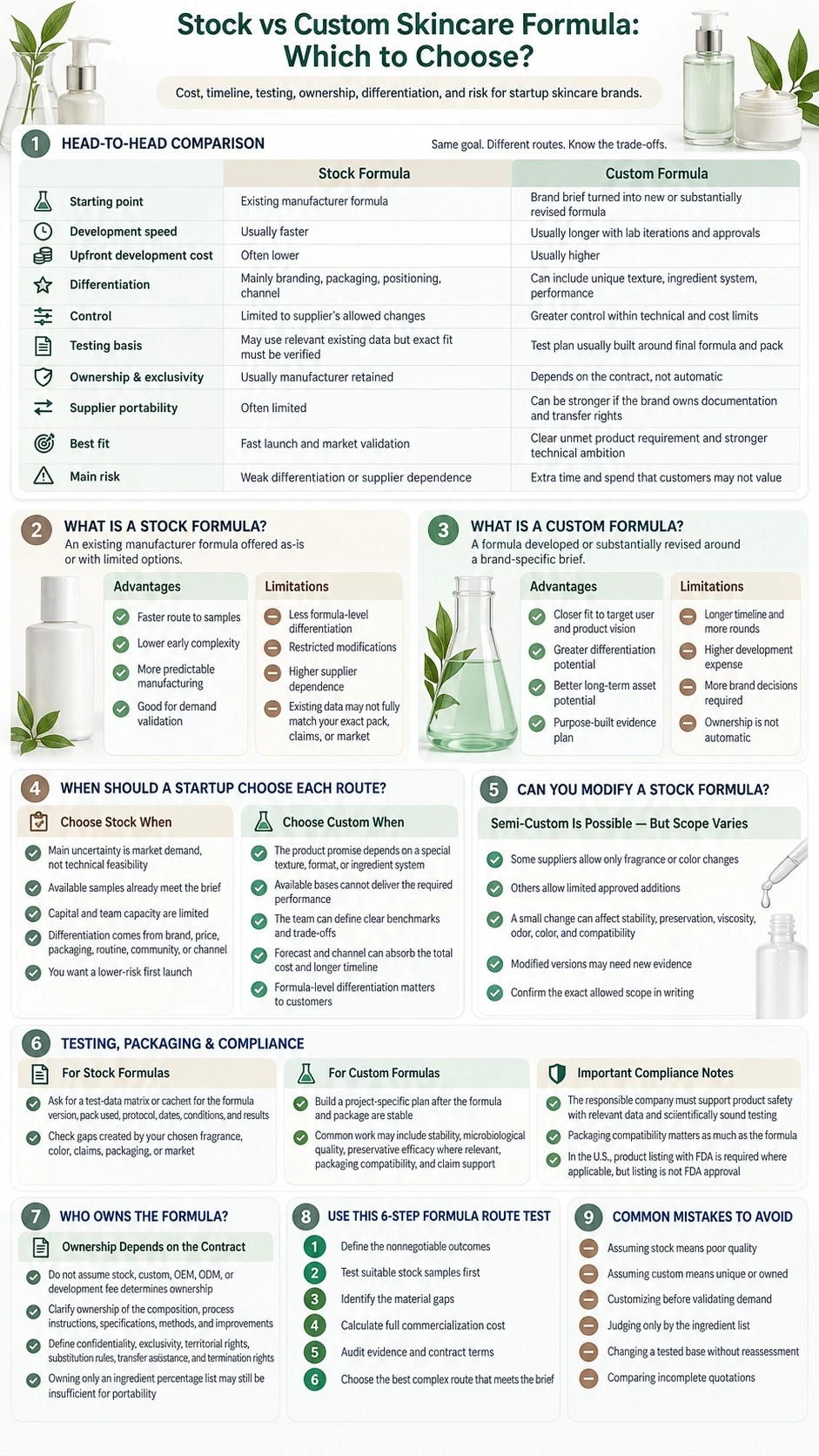
Stock Formula vs Custom Formula: Key Differences
The terms are used differently across suppliers, so founders should compare the actual scope in writing. The table below shows the typical commercial distinction rather than a universal legal definition.
| Decision factor | Stock formula | Custom formula |
|---|---|---|
| Starting point | An existing manufacturer formula selected from a library or sample range | A brand brief translated into a new or substantially revised formula |
| Development speed | Usually faster because the base formula already exists | Usually longer because laboratory iterations, approvals, and project-specific evaluation are required |
| Upfront development cost | Often lower, although sampling, packaging, testing, design, and production costs still apply | Usually higher because formulation work and additional validation must be funded |
| Differentiation | Primarily created through positioning, packaging, service, channel, routine, and brand execution | Can include distinctive ingredients, ratios, texture, delivery system, or product experience |
| Control | Limited to the supplier’s permitted choices and change policy | Greater control within safety, stability, sourcing, regulatory, processing, and cost constraints |
| Testing basis | Existing data may be relevant, but applicability to the exact formula, pack, claims, and market must be confirmed | A project-specific test plan normally follows formula and packaging decisions |
| Ownership and exclusivity | The manufacturer commonly retains the formula and may supply it to other brands | Ownership or exclusivity is not automatic; it depends on the written agreement |
| Supplier portability | Often limited because another manufacturer may not have access to the same formula | Can be stronger if the brand owns sufficient formula documentation and transfer rights |
| Best fit | Market validation, fast launches, simpler briefs, and brands differentiated beyond the formula | Clear unmet product requirements, defensible formulation concepts, and teams able to support development |
| Main risk | Weak differentiation or dependence on one supplier’s formula library | Spending time and capital on complexity that customers may not value |
A startup comparing quotations should also read private label versus custom skincare as a separate sourcing decision. A manufacturer may offer both stock and custom options, and the commercial label used in a proposal does not replace a line-by-line scope review.
What Is a Stock Skincare Formula?
A stock formula is an existing formulation that a manufacturer has already developed for use by one or more customers. It may be sold as-is or offered with a controlled menu of choices, such as fragrance, color, package, fill size, or a narrow set of marketing ingredients. Some suppliers call this private label, white label, ready-made, house formula, or catalog formulation.
Because the base already exists, the manufacturer may have historical stability, microbiological, processing, or compatibility information. That can shorten development work, but “pretested” should never be treated as a blanket guarantee. The brand still needs to confirm which version was tested, in which package, for what duration, under what conditions, and whether the available evidence supports the intended market and claims.
Stock formulas are often manufacturer-owned. The same or a similar base may therefore appear under multiple brands, sometimes with different packaging and positioning. This is not inherently a problem. Many customers buy a complete proposition—not an ingredient list alone—and strong branding, merchandising, education, service, and distribution can create meaningful differentiation.
Advantages of a Stock Formula
- Faster route to sampling: the laboratory begins with an established base rather than an open-ended development brief.
- Lower early complexity: fewer formulation decisions can help a small team focus on packaging, claims, compliance, inventory, and launch execution.
- More predictable manufacturing: an established formula may already have a known process and raw-material supply pattern.
- Useful for demand validation: the brand can learn whether the positioning, price, channel, and customer problem are commercially viable before funding deeper R&D.
Limitations of a Stock Formula
- Less formula-level differentiation: competitors may have access to the same or a comparable base.
- Restricted modifications: changing one ingredient can affect preservation, viscosity, color, odor, stability, claims, or process behavior.
- Supplier dependence: moving production may require reformulation if the brand does not own or cannot access the formula.
- Evidence gaps: historical test data may not cover the chosen package, fragrance variant, claims, use instructions, or target market.
What Is a Custom Skincare Formula?
A custom formula is developed to meet a defined product brief. The brief may specify the target user, product format, texture, skin feel, hero ingredients, excluded materials, packaging, target cost, claims direction, benchmark products, markets, and performance criteria. The laboratory then balances those goals with safety, stability, preservation, processing, sourcing, and regulatory constraints.
Custom does not mean the chemist can combine any requested ingredients at any concentration. Some concepts are incompatible, unstable, difficult to preserve, unsuitable for the package, unsupported by evidence, or commercially unrealistic. A strong skincare product brief ranks requirements so the formulator knows what is essential and where compromise is acceptable.
Development normally involves sample rounds, feedback, formula approval, testing, packaging checks, production preparation, and scale-up. The exact path depends on product risk and market requirements. Custom development therefore needs more than a creative concept; it needs disciplined decisions and enough budget to validate the finished product.
Advantages of a Custom Formula
- Closer product fit: the formula can be designed around a specific texture, use occasion, ingredient philosophy, or performance target.
- Greater differentiation potential: formula architecture and sensory experience can support a proposition that is harder to reproduce through packaging alone.
- Stronger long-term asset potential: negotiated ownership, exclusivity, documentation, and transfer rights may make the formulation more valuable to the brand.
- Purpose-built evidence: the test and claims plan can be designed around the final formula, package, directions, and intended market.
Limitations of a Custom Formula
- More time and iteration: sample feedback, technical tradeoffs, and validation can extend the path to production.
- Higher development exposure: R&D, specialized raw materials, testing, pilot work, and packaging changes can increase prelaunch spending.
- More founder decisions: unclear feedback or frequently changing requirements can create unnecessary rounds and delays.
- No automatic ownership: paying a development fee does not by itself prove that the brand owns the formula or can transfer it elsewhere.
When Should a Startup Choose a Stock Formula?
A stock formula is often the rational choice when the main business uncertainty is market demand rather than technical feasibility. If the startup still needs to prove its audience, price point, acquisition channel, or repeat-purchase potential, reducing formulation complexity can preserve capital for the commercial questions that determine survival.
Stock also works when the available formula already meets the brief. There is little strategic value in funding a custom project only to recreate a familiar cleanser, moisturizer, or body lotion with differences customers cannot notice or value. The founder should assess samples against explicit acceptance criteria rather than assume that custom is automatically superior.
This route is especially suitable when differentiation comes from a tightly edited routine, accessible price, distinctive packaging, founder authority, customer community, retail placement, or content. For a typical ZICAIL project, minimum order quantity may fall around 1,000–3,000 units per SKU, with regular samples often taking about 7–10 working days and standard bulk production about 25–30 working days after approvals. Exact timing and quantity still depend on formula, packaging, components, testing, and project scope.
When Is Custom Formulation Worth the Investment?
Custom formulation is justified when the product-level difference is both important to customers and difficult to obtain from available bases. Examples may include a specific finish for a defined skin type, an unusual product format, a demanding compatibility requirement, a carefully constrained ingredient policy, or a measurable performance goal backed by an appropriate test plan.
The business should also be ready to make precise decisions. A founder who cannot define the target user, benchmark, sensory standard, acceptable tradeoffs, target cost, claims boundary, packaging direction, or approval process is likely to pay for avoidable iterations. Reviewing skincare samples with a consistent scorecard makes feedback more actionable than comments such as “make it feel more premium.”
Finally, custom work is more defensible when the forecast and channel can absorb its total economics. That calculation should include development, samples, testing, packaging engineering, artwork, regulatory work, production, freight, duties, warehousing, marketing, and working capital. The formula fee alone does not reveal the true investment.
Can You Modify a Stock Formula?
Often, yes—but the meaning of “modified” varies. A supplier may permit only fragrance and color choices, may offer a menu of approved additions, or may treat any change to the base as a new custom project. Terms such as semi-custom, customized stock, and light customization have no universal scope, so the proposal should identify exactly what can change.
Even a small edit can create technical consequences. Adding an extract may change color or odor; changing a surfactant can affect foam and viscosity; changing fragrance can affect compatibility; and altering water activity or the preservative environment can affect microbiological risk. Existing evidence may no longer apply to the revised version.
Semi-custom is most useful when the base already satisfies the essential brief and the requested modification has a clear commercial purpose. It is less useful when repeated small edits gradually turn a proven formula into an under-tested custom product while the founder still expects stock-formula speed and cost.
How Do Testing, Packaging, and Compliance Differ?
The responsible company must have adequate support for product safety. The U.S. Food and Drug Administration does not prescribe one universal set of tests for every cosmetic; it states that companies and individuals marketing cosmetics are responsible for ensuring product safety, and relevant existing data may be used alongside additional scientifically sound testing where appropriate.[1]
For a stock formula, ask for a test-data matrix: exact formula version, batch identity, test type, protocol, dates, results, package used, storage conditions, and any limits on reliance. Then identify gaps created by the brand’s chosen package, fragrance, color, directions, claims, or market. A skincare product testing plan should reflect the finished configuration, not just the existence of a report with a similar product name.
For a custom formula, the team typically defines a project-specific program after the formula and package are sufficiently stable. This may include stability, microbiological quality, preservative efficacy when relevant, packaging compatibility, and claim-support work appropriate to the product. FDA also notes that determining a cosmetic’s shelf life is the manufacturer’s responsibility.[2]
Packaging deserves equal attention in both routes. A formula that is stable in a laboratory container may interact differently with a pump, tube, jar, liner, gasket, or decoration. Leakage, paneling, swelling, discoloration, clogging, evaporation, corrosion, or dispensing changes can undermine an otherwise acceptable formula, which is why packaging compatibility testing should be planned before final commercialization.
In the United States, the responsible person must list each marketed cosmetic product with FDA, including its ingredients, and update listings annually, subject to applicable requirements and exemptions. FDA registration and listing do not constitute product approval.[3] FDA also allows one listing submission to cover certain products with identical formulas or formulas differing only in colors, fragrances, flavors, or quantity, but the submission still needs accurate product and ingredient information.[4]
Who Owns the Formula?
Formula ownership should be answered by the contract, not by assumptions about the words stock, custom, OEM, ODM, or development fee. A stock formula is commonly retained by the manufacturer. A custom formula may be owned by the manufacturer, assigned to the brand, licensed exclusively for a market or channel, or governed through another negotiated arrangement.
Before paying for development, clarify who owns the formula composition, manufacturing instructions, specifications, methods, and resulting improvements. Also define confidentiality, exclusivity, geographic or channel limits, access to records, raw-material substitutions, approval rights, reformulation triggers, transfer assistance, termination rights, and what happens if a key material becomes unavailable.
A brand that expects future portability should review skincare formula ownership before development begins. Owning an ingredient percentage list may still be insufficient if the business lacks the process parameters, specifications, methods, and rights required to reproduce the product reliably.
Use This Six-Step Formula Route Test
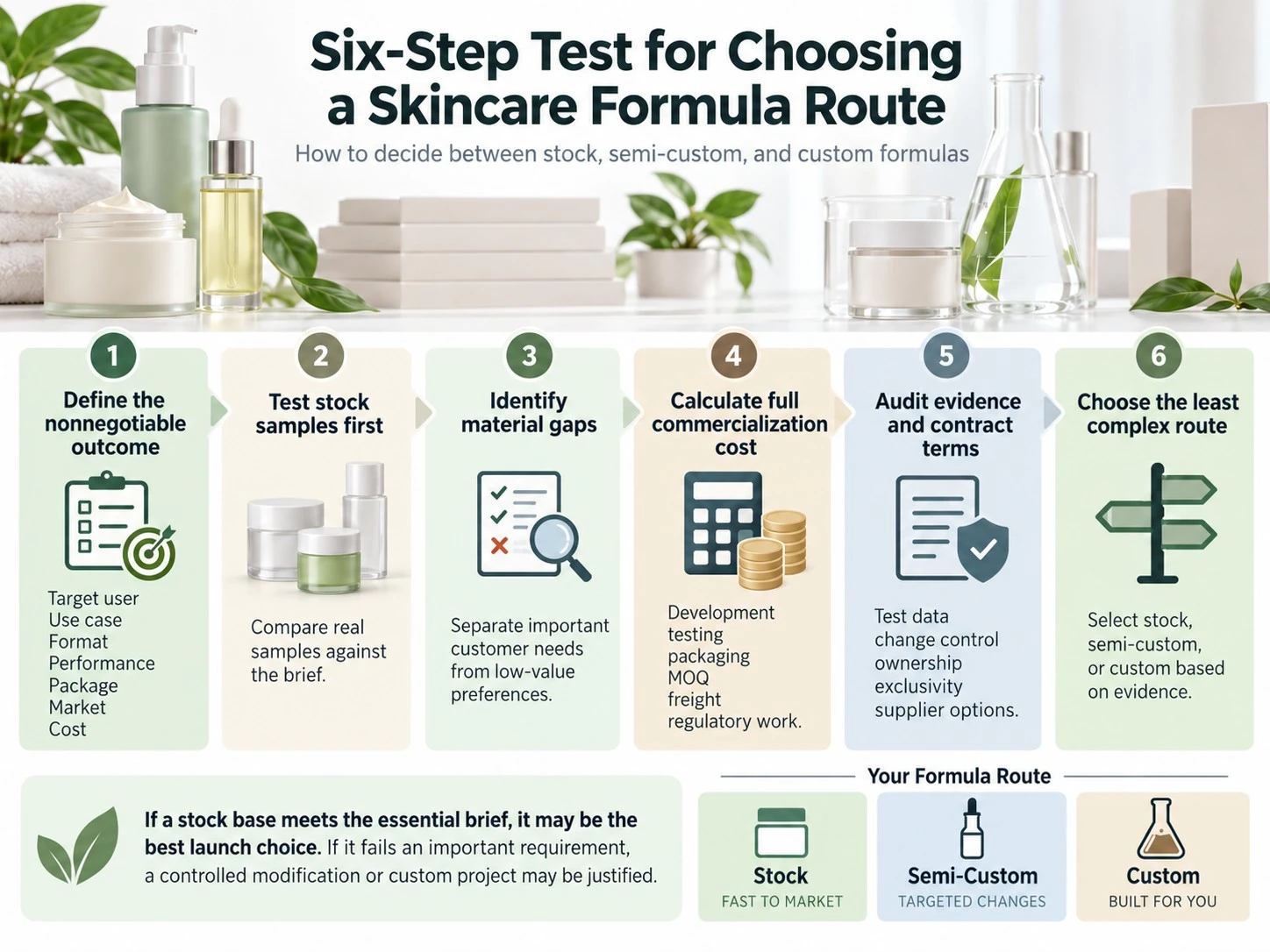
- Define the nonnegotiable outcome: write the target user, use case, format, sensory result, performance goal, package, market, target cost, and claims boundary.
- Test suitable stock samples first: compare existing options with the brief using a consistent scorecard, not brand-story assumptions.
- Identify the material gaps: separate customer-relevant shortcomings from preferences that add cost but little purchasing value.
- Calculate full commercialization cost: compare development, testing, packaging, MOQ, unit cost, freight, regulatory work, inventory exposure, and launch delay.
- Audit evidence and contract terms: verify applicable test data, change control, ownership, exclusivity, documentation access, and future supplier options.
- Select the least complex route that meets the brief: choose stock, semi-custom, or custom based on evidence, then document approval criteria before the next round.
This process prevents a false binary. If a stock base passes the essential brief, it may be the best launch choice. If it fails a commercially important requirement, a controlled modification or custom project has a clearer business case.
Which Formula-Route Mistakes Should Startups Avoid?
- Assuming stock means poor quality: quality depends on formula design, raw materials, manufacturing controls, testing, packaging, storage, and execution—not whether the starting point was already developed.
- Assuming custom means unique or owned: another brand may use similar ingredients or concepts, and rights depend on the agreement.
- Customizing before validating demand: complex R&D does not solve weak positioning, poor distribution, or an uncompetitive acquisition model.
- Choosing from the ingredient list alone: percentages, interactions, processing, preservation, package, and sensory performance matter more than a decorative list of fashionable materials.
- Changing a tested base without reassessment: a small marketing-driven addition can affect stability, appearance, preservation, compatibility, and evidence.
- Comparing incomplete quotations: one price may include samples, testing, packaging support, or documentation that another excludes.
Compare Stock and Custom Formula Options with ZICAIL
ZICAIL can review your product brief against available stock bases, feasible customization, MOQ, packaging direction, testing needs, and production scope. Send the target product, market, benchmark, texture, ingredients, exclusions, packaging concept, target cost, forecast, and preferred launch window. The team can then identify which route is commercially realistic and what information is still needed before quotation or sampling.


