

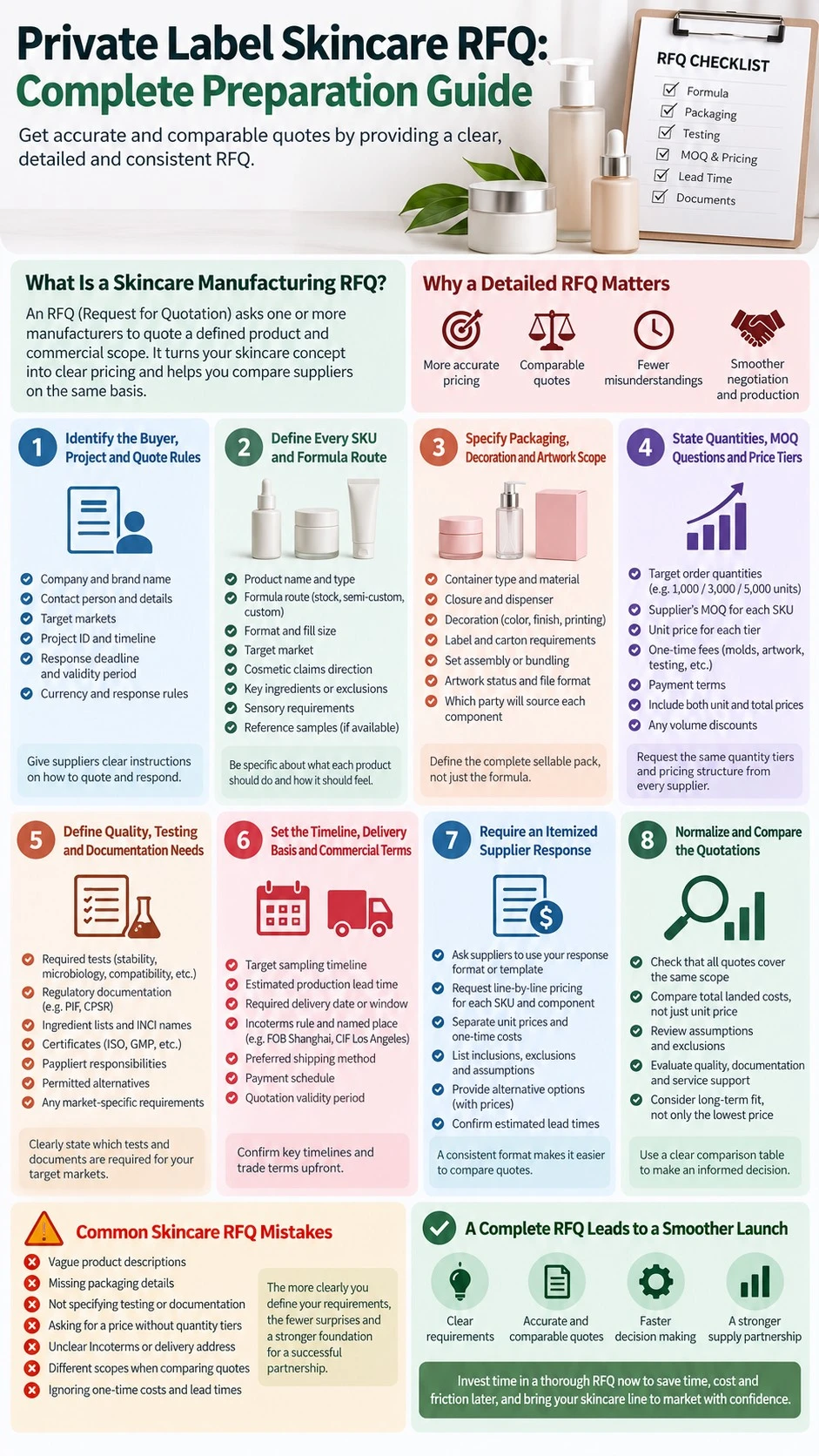
An RFQ, or request for quotation, turns a skincare concept into a controlled pricing request. A weak inquiry asks, “What is your price for a premium serum?” A useful RFQ defines what is being priced, at which quantity, with which packaging and evidence, delivered where, under which assumptions.
That discipline matters because two quotations with the same unit price may include very different work. One may include primary packaging, filling, compatibility work, and cartons; another may cover bulk product in a standard bottle only. Unless the scope is normalized, the apparent price comparison can be misleading.
What Is a Skincare Manufacturing RFQ?
A skincare manufacturing RFQ is a document that asks one or more suppliers to quote a defined product and commercial scope. It normally follows early concept work and precedes final negotiation, sampling commitments, a manufacturing agreement, and a purchase order.
It is different from three adjacent documents:
- Product brief: explains the target customer, product concept, texture, ingredients, exclusions, packaging direction, claims, and performance expectations.
- Request for proposal: asks suppliers to recommend a broader technical or commercial solution when the project approach is still open.
- Purchase order: authorizes a specific purchase after scope, pricing, terms, and approvals have been agreed.
The RFQ can attach the product brief rather than duplicate it. If the brief is not ready, prepare the skincare product brief first. The RFQ should then translate that concept into pricing fields, supplier responsibilities, and decision deadlines.
An RFQ is ready when the buyer can distinguish confirmed requirements from preferences and open questions. Unknowns are acceptable; hidden assumptions are not.
Step 1: Identify the Buyer, Project, and Quote Rules
Start with a one-page control section so the supplier knows who is requesting the quotation, what decision is being made, and how to respond. Include the buyer’s legal business name, brand name, country, contact person, role, email, phone or messaging contact, website if available, and intended sales markets.
Add a project identifier and version number, such as RFQ-SERUM-001 Rev A. State the RFQ issue date, clarification-question deadline, response deadline, expected shortlist date, preferred communication method, and the period for which the supplier should keep the quotation valid.
Also define the response rules:
- use the supplied SKU names and item numbers;
- quote in the requested currency;
- complete every field or mark it not applicable;
- identify every assumption, exclusion, substitute, and dependency;
- separate confirmed pricing from estimates;
- do not replace the requested specification without showing the alternative as a separate option.
These controls prevent a revised email, spreadsheet, and messaging thread from becoming three conflicting versions of the project.
Step 2: Define Every SKU and Formula Route
Give each SKU its own specification row. State the product type, intended routine role, formula route, fill quantity, texture, fragrance direction, color, hero-ingredient direction, excluded materials, target customer, intended markets, and cosmetic claims direction. Attach benchmark notes or samples when they communicate sensory expectations better than adjectives.
Identify whether the supplier should quote:
- an existing stock formula with no formula change;
- a stock formula with defined options such as fragrance or color;
- a semi-custom modification;
- a new custom formula;
- bulk manufacture from a buyer-owned formula;
- filling and packing only.
Do not use private label, white label, OEM, ODM, and custom as if they define one universal scope. Ask the supplier to describe its proposed route, formula ownership, exclusivity, permitted modifications, development work, sample rounds, change-control terms, and whether the formula can be transferred. The stock versus custom formula guide explains why ownership and development fees must be confirmed separately.
If a requirement is flexible, show the acceptable range. “Lightweight gel-cream, fragrance-free preferred, low fragrance considered as an alternate” is easier to quote than “luxurious moisturizer.” If a requirement is mandatory, label it must-have rather than allowing the supplier to infer its priority.
Step 3: Specify Packaging, Decoration, and Artwork Scope
Packaging can materially change the unit price, MOQ, lead time, testing scope, freight volume, and filling process. Define the complete sellable pack rather than naming only the bottle or jar.
For each SKU, list:
- primary container material, format, capacity, color, and finish;
- closure, pump, dropper, cap, liner, gasket, wiper, or applicator;
- decoration method, colors, print area, coating, frosting, metallization, or label;
- carton, insert, leaflet, seal, shrink wrap, batch-code area, and set packaging;
- requested unit configuration, such as bottle plus pump plus carton;
- artwork status and required label languages;
- who supplies each component and whether buyer-supplied packaging is allowed;
- stock component and custom component alternatives.
Attach drawings, dimensions, reference images, component links, or physical samples where available. Mark reference images as visual direction unless exact construction is required; a picture alone does not define material, tolerance, closure performance, or decoration quality.
Ask which packaging assumptions are included in the quotation and whether tooling, molds, plates, screens, color matching, preproduction samples, freight to the filler, assembly, wastage, and compatibility work are separate. Formula and packaging should also be assessed together through packaging compatibility testing before commercial release.
Step 4: State Quantities, MOQ Questions, and Price Tiers
Request quantities by SKU, not only as a total line volume. A factory may have one minimum for bulk formula, another for filling, and different minimums for bottles, pumps, labels, cartons, or decoration. Ask the supplier to identify the limiting MOQ rather than returning one unexplained number.
Give three demand views when available:
- first production quantity by SKU;
- requested comparison tiers, such as 1,000, 3,000, and 5,000 units;
- estimated annual volume and likely reorder pattern.
Use quantity tiers that reflect plausible purchases. Requesting a price for 100,000 units when the funded launch is 1,000 units creates a headline price that is irrelevant to the first order.
Ask whether mixed SKUs, shared packaging, split deliveries, or staggered production can satisfy any minimum. Confirm the overrun and underrun tolerance, component surplus ownership, storage fees, obsolete-material treatment, and how unused custom packaging will be handled.
The private label skincare MOQ guide provides the background; the RFQ should convert those variables into supplier-specific answers.
Step 5: Define Quality, Testing, and Documentation Needs
Do not write “all required tests and documents” without naming the market, product, package, claims, and expected deliverables. Test scope is product-specific, and U.S. law does not prescribe one universal test list for every cosmetic. Companies marketing cosmetics remain responsible for product safety, and scientifically sound additional testing may be needed where available data leave gaps.[1]
For each SKU, ask the supplier to state whether its price includes or excludes:
- stability and shelf-life support;
- microbiological quality testing;
- preservative efficacy or challenge testing when relevant;
- formula-package compatibility and dispensing checks;
- finished-product specifications and release testing;
- claim-support testing or consumer studies;
- retained samples and batch records;
- third-party laboratory fees and report ownership.
Under the U.S. MoCRA framework, the responsible person must ensure and maintain records supporting adequate safety substantiation, subject to applicable provisions and exemptions.[2] The RFQ should therefore ask what safety, ingredient, formula, and finished-product information will be available, when it will be supplied, and whether the buyer may retain it for compliance records.
Request only documents that serve the project and target market. Relevant examples may include an ingredient list, formula or product specification, certificate of analysis, safety data sheet where applicable, test reports, batch records, packaging specifications, manufacturing-system evidence, and market-support information. Ask who issues each document and whether it applies to the exact formula and production site. ISO 22716 provides cosmetic GMP guidelines covering production, control, storage, and shipment, but citing the standard is not a substitute for confirming the supplier’s actual scope and evidence.[3]
Use the manufacturer document guide and finished-product specification guide to build a document schedule that fits the product instead of attaching a generic certificate wish list.
Step 6: Set the Timeline, Delivery Basis, and Commercial Terms
Provide the required launch date and work backward. Ask for separate estimates for technical review, formula samples, revised samples, packaging samples, tooling, component production, testing, bulk manufacture, filling, quality release, and shipment readiness. A single “lead time” can hide which clock starts after formula approval, deposit, artwork approval, or packaging arrival.
State the requested currency, payment structure, deposit timing, balance trigger, quotation validity, tax treatment, and whether bank fees are included. Ask how raw-material, packaging, exchange-rate, or freight changes can affect the price before production.
For cross-border purchases, request an Incoterms® 2020 rule and name the exact place or port. Incoterms define important buyer and seller responsibilities for tasks, costs, and risks in delivery, but the three-letter rule alone is incomplete without the named location.[4] “FOB,” “EXW,” or “DDP” without a place, included services, and shipment assumptions does not create a reliable landed-cost comparison.
Also state the destination country, delivery address or port, preferred transport mode, pallet or carton requirements, and whether the supplier should quote freight as a separate option. Keep product price and optional freight visible as separate fields even when requesting a delivered quotation.
Step 7: Require an Itemized Supplier Response
Do not invite every supplier to answer in its own format. Provide a response schedule that can be returned as a spreadsheet or table, with one row per SKU and separate rows for one-time charges and optional services.
| RFQ response field | What the supplier should state | Why it matters |
|---|---|---|
| Proposed product scope | Exact formula route, fill size, package, decoration, carton, and included services | Confirms what the quoted unit actually contains |
| MOQ and quantity tiers | MOQ driver and unit price at every requested tier | Separates real launch pricing from hypothetical scale pricing |
| Recurring unit price | Currency, price per sellable unit, scrap allowance, and included assembly | Creates a consistent price denominator |
| One-time charges | Development, samples, testing, tooling, plates, color matching, setup, and registration support | Prevents low unit prices from hiding upfront costs |
| Samples | Sample type, quantity, cost, shipping, included revisions, and timing | Defines the path to approval |
| Testing and documents | Included work, excluded work, issuer, report owner, and delivery stage | Connects price with usable evidence |
| Lead-time assumptions | Start trigger and duration for each major stage | Shows which approvals or components control the schedule |
| Commercial terms | Currency, payment terms, quotation validity, tax treatment, and price-adjustment conditions | Reveals cash-flow and price risk |
| Delivery basis | Incoterms® 2020 rule, named place, packing basis, freight option, and shipment assumptions | Makes logistics scope comparable |
| Deviations and alternatives | Every exception, substitute, dependency, and optional upgrade | Prevents silent specification changes |
Ask the supplier to identify whether each figure is firm, budgetary, or subject to sample and component confirmation. Require a total estimated first-order cash commitment as well as the unit price, but keep the calculation transparent so the buyer can adjust quantities or optional services.
Step 8: Normalize and Compare the Quotations
Compare only like-for-like scopes. First, create a compliance check showing whether each supplier meets every must-have requirement. Then normalize the financial comparison to the same quantity, sellable-unit definition, currency, delivery basis, and included services.
Calculate at least four views:
- recurring product cost at the funded order quantity;
- one-time development and setup charges;
- estimated landed cost under the same logistics assumptions;
- total initial cash requirement, including deposits and buyer-paid components.
Use the skincare cost and margin guide to test whether the normalized cost supports retail, wholesale, discounts, fulfillment, marketing, and target margin.
Do not score price before resolving material exclusions. A cheaper quote may omit testing, cartons, decoration, freight, or documents that another supplier includes. Send one clarification round to all shortlisted suppliers, record revisions by RFQ version, and ask each supplier to confirm the final exception list.
Price should remain one decision field alongside formula fit, sample quality, communication, documentation, capacity, quality controls, timing, payment exposure, and change-management terms. The RFQ creates comparability; it does not replace supplier due diligence or the manufacturing agreement.
Common Skincare RFQ Mistakes
- Asking for the “best price” without a fixed scope: the supplier must guess the formula, package, quantity, testing, and delivery basis.
- Sending different requirements to different factories: responses cannot be compared when the input changes by supplier.
- Quoting only one quantity: the buyer cannot see which minimum drives cost or how pricing changes at realistic scale.
- Comparing unit price without the sellable-unit definition: bulk, filled bottle, decorated pack, and cartoned retail unit are different pricing bases.
- Combining one-time and recurring costs: development or tooling fees become difficult to identify and amortize.
- Leaving packaging until later: components can change filling feasibility, MOQ, testing, lead time, and freight.
- Requesting unnamed “certificates”: a document may apply to a different formula, site, date, or scope.
- Using an Incoterms abbreviation without a named place: the quoted logistics responsibility remains ambiguous.
- Treating the quotation as a contract: the final agreement must still control specifications, quality, change approval, ownership, confidentiality, remedies, and termination.
Prepare a Skincare RFQ for ZICAIL
ZICAIL can review an RFQ for stock, semi-custom, custom-formula, or filling-and-packaging skincare projects and identify the information needed before quotation. Prepare your SKU list, formula route, target markets, packaging direction, quantity tiers, testing and document needs, claims direction, destination, and launch window. Send the same controlled scope you intend to compare so the response can state included work, assumptions, exclusions, and next steps clearly.


