
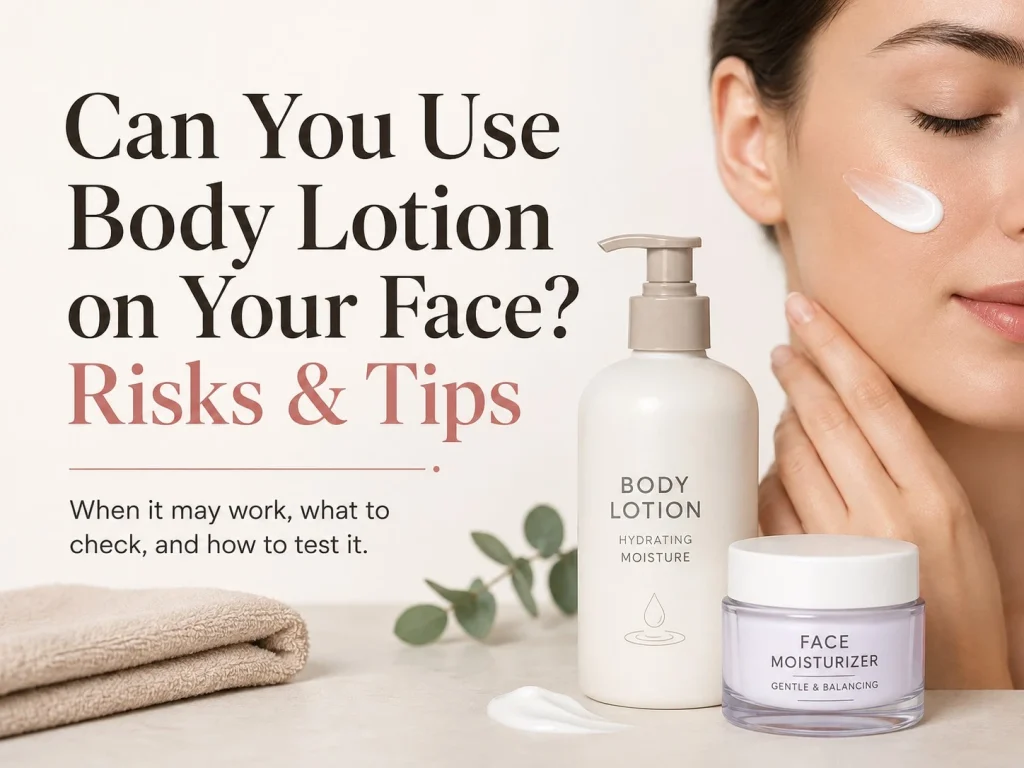


Body lotion and face moisturizer do the same basic job: help the outer skin layer hold water. But the labels do not describe fixed recipes. One body lotion may be light and fragrance-free; another may be heavily scented, occlusive, or made to exfoliate rough areas.
Judge the directions, complete formula, and your skin’s response—not the front label alone.
When Body Lotion May Work on Your Face
Using body lotion on the face is more reasonable when several of the following are true:
- The label includes the face. Some moisturizers are intentionally sold for both face and body. Follow any limits around the eyes, broken skin, age, or frequency.
- The formula is plain and fragrance-free. A basic moisturizing lotion without perfume, essential oils, shimmer, self-tanner, cooling agents, or treatment actives creates fewer obvious conflicts with a simple facial routine.
- Your skin is dry and not easily congested. Normal or dry facial skin may tolerate a body lotion better than skin that frequently develops closed comedones, inflamed acne, or folliculitis.
- You need a temporary substitute. One thin application after cleansing is different from making an unfamiliar product a permanent twice-daily step.
- It works under the rest of your routine. The lotion should not sting, stay greasy for hours, pill under sunscreen, or make makeup difficult to apply.
Moisturizers range from light gels and lotions to richer creams and ointments, and the right texture depends partly on skin type and the degree of dryness.[1] Compare lotion vs cream if weight is your main concern, or see what moisturizer does for the shared humectant, emollient, and occlusive mechanisms.
When a Face Moisturizer Is the Better Choice
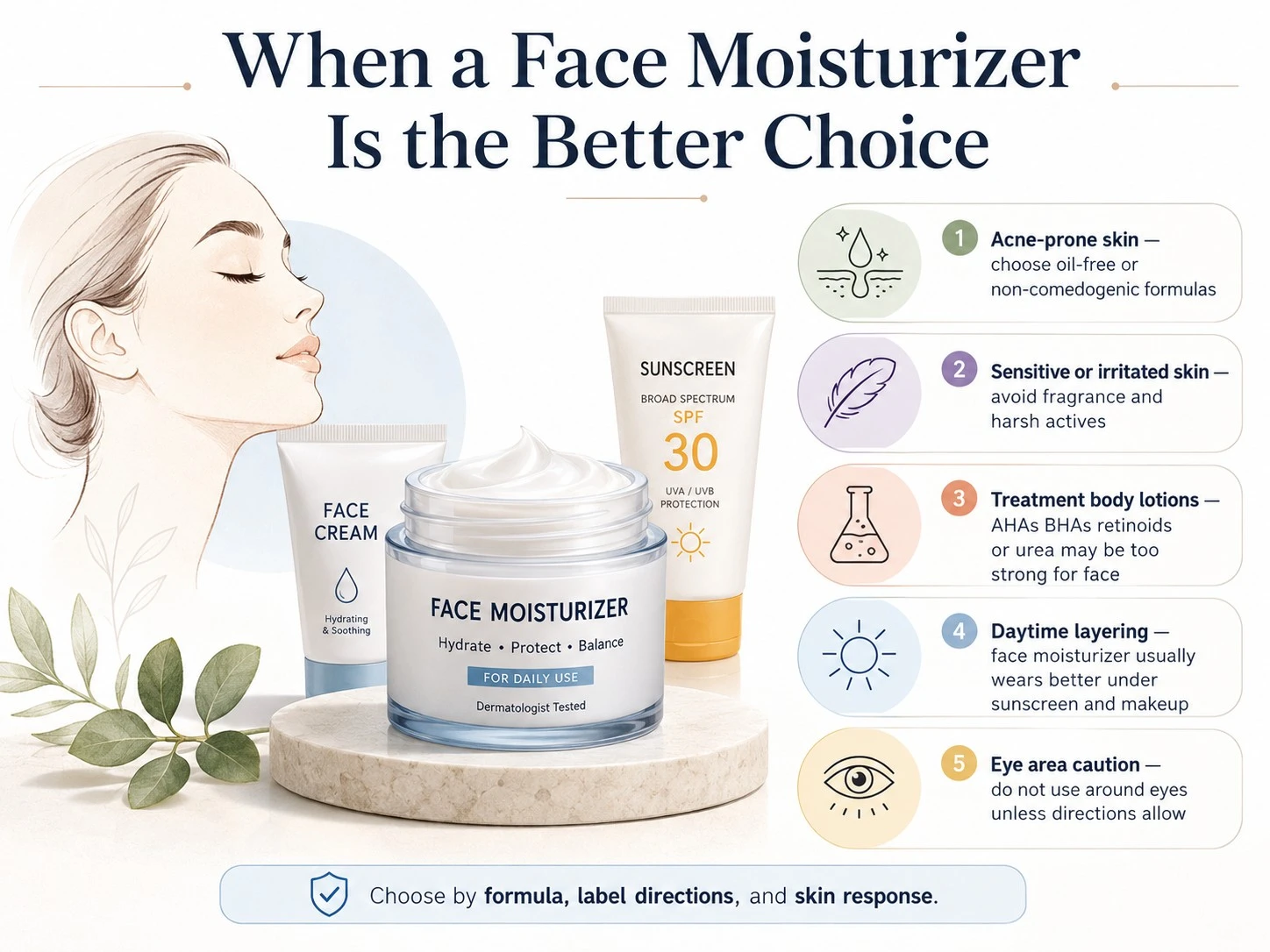
A dedicated facial moisturizer is usually the easier long-term choice when your face has needs that the body product does not address.
- You are acne-prone or clog easily. Occlusive emollients can aggravate acne, perioral dermatitis, or folliculitis in some people.[2] Look for facial products labeled oil-free, non-comedogenic, or “won’t clog pores”; these descriptions indicate that a product is less likely to cause acne, although no label predicts every person’s response.[4] The guide to what non-comedogenic means explains that limitation.
- Your skin is sensitive or actively irritated. Fragrance, preservatives, vehicles, and treatment ingredients can trigger irritation or contact allergy. Avoid experimenting on sunburned, cut, swollen, or already-burning skin.
- The body lotion is a treatment product. Lotions for rough bumps, body acne, firming, self-tanning, or “renewal” may contain AHAs, BHAs, retinoids, urea, fragrance, color, or other ingredients that change how the product should be used. Do not assume a moisturizing base makes those actives suitable for your face.
- You need reliable daytime layering. A facial moisturizer may be easier to wear under sunscreen and makeup because its finish was designed for that use. Plain body lotion does not replace sunscreen.
- You plan to use it around the eyes. Eyelid skin is easily irritated. Keep body lotion off the eyelids, lash line, and inner corners unless the product directions specifically permit that area.
If the main problem is choosing a facial texture rather than finding an emergency substitute, use the guide to choosing a moisturizer for your skin type.
What to Check Before Putting Body Lotion on Your Face
Read the back label and ingredient list before judging the product by thickness or scent. “Unscented” is not the same as fragrance-free and can still involve ingredients used to mask odor; the distinction is covered in fragrance-free vs unscented skincare.[3]
| Product clue | What it means for facial use |
|---|---|
| Labeled for face and body | The strongest practical sign that the manufacturer intends both uses; still follow area and frequency directions |
| Fragrance-free | A more cautious starting point for sensitive or eczema-prone skin than fragranced or merely unscented lotion |
| Oil-free, non-comedogenic, or won’t clog pores | Useful for acne-prone skin, but not a guarantee that the finished product will suit every user |
| Exfoliating acids, retinoids, or high-strength urea | Treat as an active product rather than an ordinary moisturizer; facial suitability and frequency depend on the label |
| Cooling, warming, self-tanning, shimmer, or strong fragrance effects | Usually a poor facial substitute unless the directions explicitly include the face |
| Very rich or waxy finish | May help very dry areas but can feel heavy, interfere with layering, or aggravate congestion in susceptible skin |
Do not try to classify every individual ingredient as universally “good” or “bad.” Concentration, ingredient combinations, product testing, amount applied, skin condition, and the rest of the routine all affect the result.
How to Test Body Lotion Before Using It on Your Face
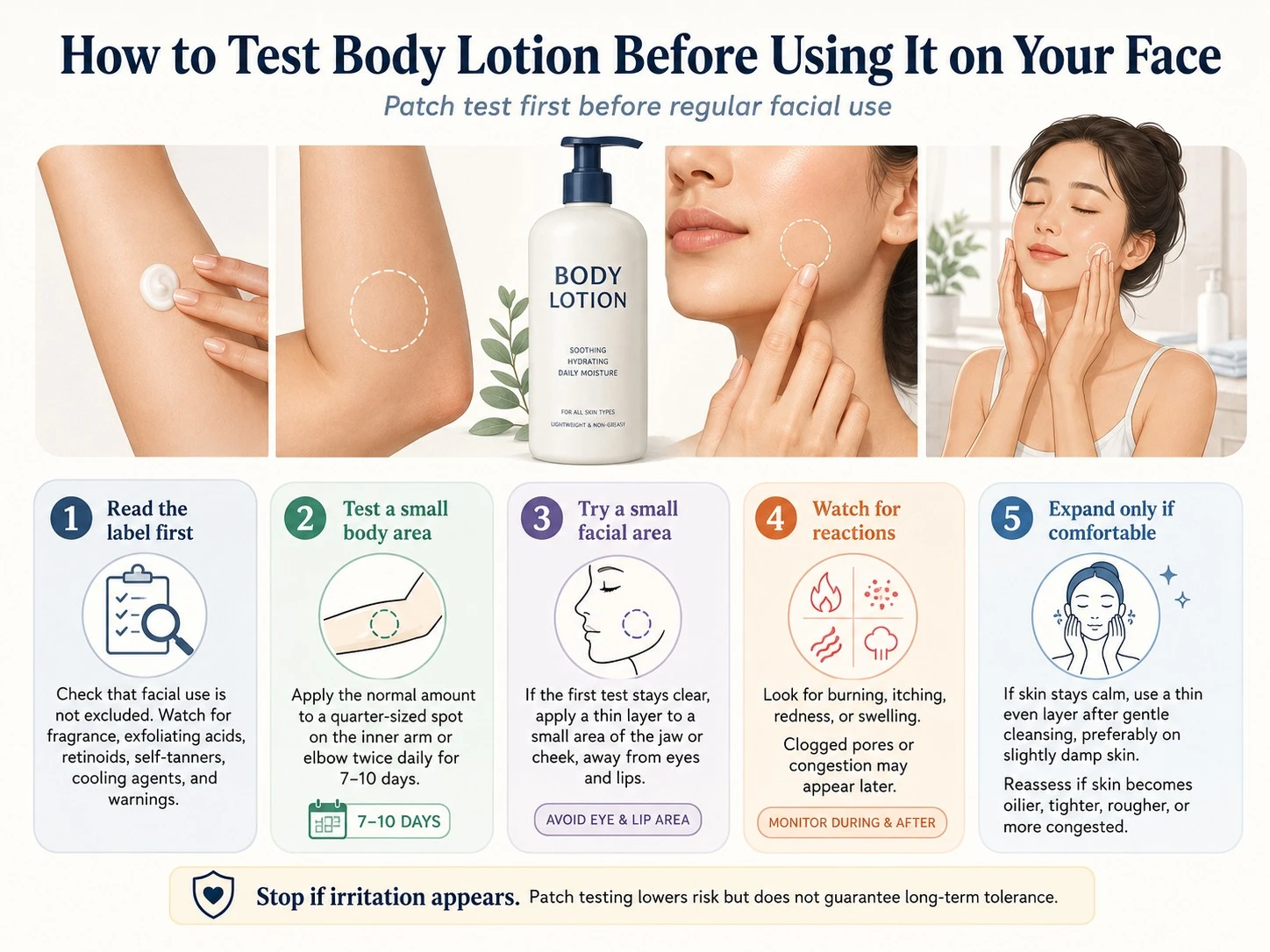
If you want to use the lotion regularly, test it rather than starting with a full-face application. The complete guide to patch testing skincare products covers the method and its limits.
- Read the directions first. Confirm that the label does not exclude facial use, and identify fragrance, exfoliating acids, retinoids, self-tanning agents, cooling ingredients, or warnings that change the decision.
- Test for irritation on a small area. Apply the normal amount to a quarter-sized spot on the underside of the arm or bend of the elbow twice daily for seven to 10 days, leaving it on for the usual length of time.[3]
- Try a small facial area. If the first test stays clear, use a thin layer along a small area of the jaw or cheek, away from the eyes and lips. Do not introduce other new products at the same time.
- Check both immediate and delayed responses. Burning, itching, redness, or swelling suggests irritation or allergy. New congestion may take longer to appear, so an irritation test cannot prove that the lotion will remain acne-friendly.
- Expand only if the skin stays comfortable. Apply a thin, even layer after gentle cleansing, preferably while the skin is slightly damp. Reassess if the face becomes oilier, tighter, rougher, or more congested over the following days.
What to Do If Body Lotion Causes a Reaction
Stop applying the lotion if it repeatedly stings, burns, itches, or produces redness, swelling, hives, or a spreading rash. Gently wash it off and simplify the routine rather than covering the reaction with more new products. Suspected reactions to fragrances, preservatives, or other moisturizer components may require professional patch testing when the cause is unclear.[2]
If the main change is gradually increasing bumps or blackheads, stop the body lotion and return to a previously tolerated routine. Do not scrub or add several acne treatments at once; that makes irritation and the original trigger harder to identify. The guide to clogged pores explains how congestion differs from an itchy or swollen contact reaction.
Seek medical care for severe swelling, breathing difficulty, eye involvement, blistering, signs of infection, or a reaction that does not improve after the product is stopped. Persistent facial dryness, burning, or rash can have causes that require more than changing moisturizers.
FAQs About Using Body Lotion on Your Face
Can you use body lotion on your face just once?
A one-time thin application may be reasonable when the lotion is plain and fragrance-free, contains no unsuitable body-treatment actives, and your skin is not already irritated. A first use can still cause irritation or allergy, so wash it off if it burns or itches and avoid the eye area.
Can you use body lotion on your face every day?
You can if the product is intended or suitable for facial use and remains comfortable without causing congestion. Daily use is not automatically unsafe, but repeated irritation, heaviness, pilling, or breakouts means the product is a poor facial match even if it moisturizes the body well.
Can you leave body lotion on your face overnight?
Yes, if the formula is suitable and tolerated. Overnight duration is not the main issue; fragrance, active ingredients, occlusiveness, and individual response matter more. Do not leave it on simply to “push through” burning or itching.
Can you use body lotion on a very dry face?
Possibly, but a lotion may not be rich enough for persistent facial dryness. A fragrance-free cream or ointment can retain more water than a lotion, while acne-prone areas may need a lighter texture.[1] Choose by the area and response rather than assuming one product must cover the entire face.
Is hand cream safe to use on your face?
Not automatically. Hand creams are often richer and may contain fragrance, barrier ingredients, or specialty actives intended for frequent washing and rough hand skin. Apply the same label, formula, eye-area, and testing checks you would use for body lotion.
Sources
[1] American Academy of Dermatology Association. How to Pick the Right Moisturizer for Your Skin
[2] DermNet. Emollients and Moisturizers (Moisturisers)
[3] American Academy of Dermatology Association. How to Test Skin Care Products
[4] American Academy of Dermatology Association. Moisturizer: Why You May Need It If You Have Acne


