


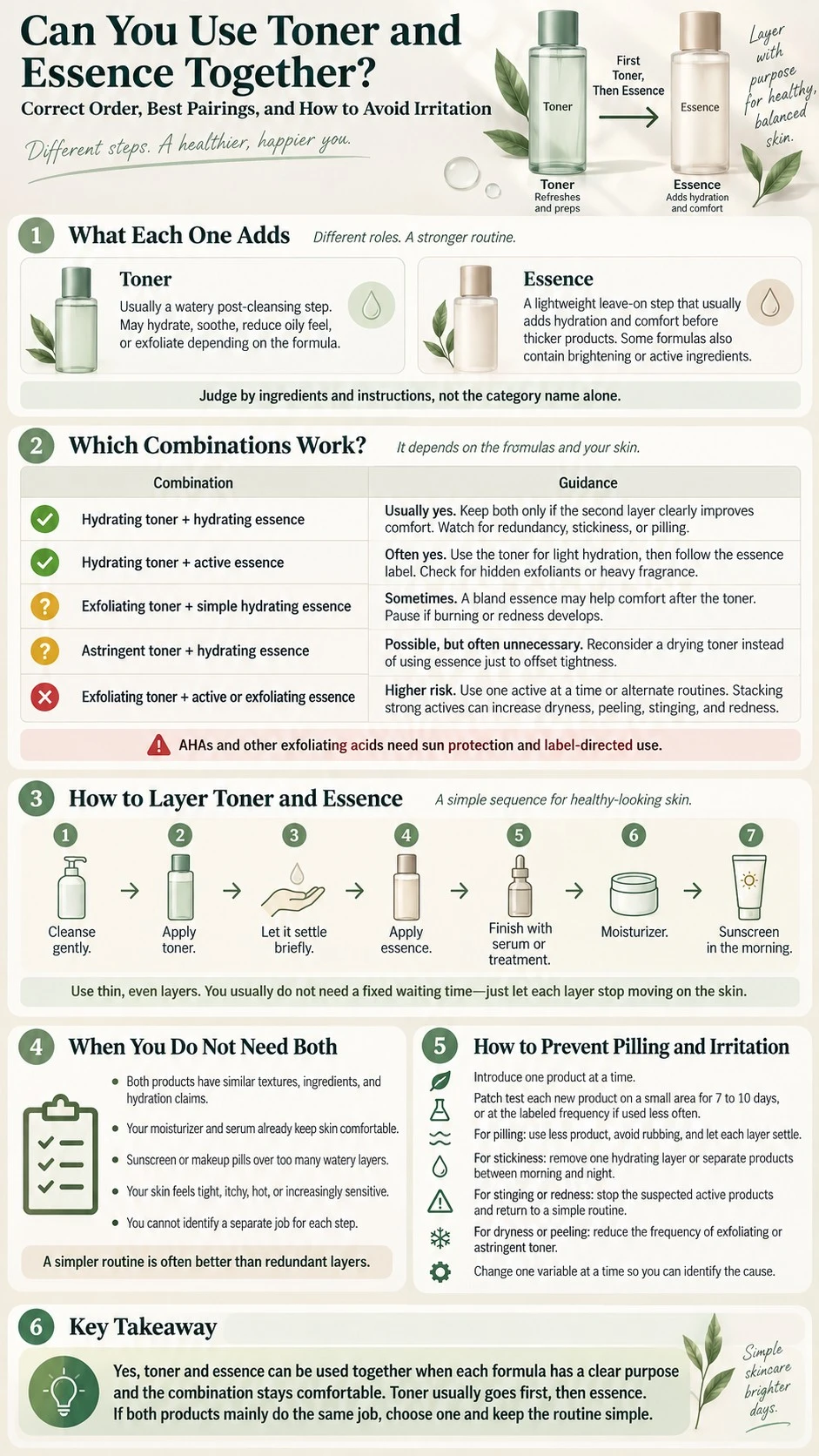
Toner and essence can fit into the same routine, but neither product is automatically necessary. The useful question is not simply whether the two categories are compatible. It is whether these two formulas add different benefits without creating unnecessary layers or doubling up on irritating ingredients.
For most conventional leave-on products, the sequence is cleanser → toner → essence → serum or treatment → moisturizer → sunscreen in the morning. That order is a starting point; product directions and the active ingredients still control how often the products should be combined.
What Toner and Essence Each Add to a Routine
Toner is usually a watery product applied after cleansing. Depending on the formula, it may hydrate, soothe, reduce an oily feel, or exfoliate. A toner with glycerin and panthenol is fundamentally different from one built around glycolic acid, lactic acid, or salicylic acid.
Essence is also a lightweight leave-on product, usually used to add hydration and comfort before thicker products. Some essences are simple humectant formulas, while others include brightening, exfoliating, ferment-derived, or retinoid-type ingredients. The category name does not reliably reveal how active or gentle a formula will be.
This overlap explains why toner and essence can feel interchangeable. If both are watery, hydrating products with similar ingredients, layering them may create more tackiness without solving a new problem. If one product exfoliates and the other provides uncomplicated hydration, using both may make more sense. For a broader breakdown of category roles, see the toner, essence, and serum comparison.
Which Toner and Essence Combinations Work?
Compatibility depends more on the complete formulas than on the product names. Use the table as a screening guide, then follow both labels and adjust according to how your skin responds.
| Toner and essence pairing | Can they be used together? | Best approach | Main caution |
|---|---|---|---|
| Hydrating toner + hydrating essence | Usually, if both feel comfortable | Use thin layers; keep both only if the second layer noticeably improves comfort | Similar formulas may be redundant or cause stickiness and pilling |
| Hydrating toner + active essence | Often, when the active essence is already tolerated | Let the toner provide light hydration, then use the essence according to its label | Check whether the toner contains hidden exfoliating or strongly fragranced ingredients |
| Exfoliating toner + simple hydrating essence | Sometimes, if the toner schedule is appropriate and the essence is bland | Apply the exfoliating toner as directed, follow with the essence if it does not sting, then moisturize | Irritated skin does not need more layers; pause the exfoliant if burning or redness develops |
| Astringent toner + hydrating essence | Possible, but often unnecessary | Reconsider the drying toner rather than using essence only to offset tightness | A high-alcohol or strongly astringent formula may leave dry or sensitive skin less comfortable |
| Exfoliating toner + active or exfoliating essence | Higher-risk combination | Use one active at a time or alternate routines unless the labels clearly support combination use | Stacking acids or other strong actives can increase dryness, stinging, peeling, and redness |
An AHA toner deserves active-product precautions even when it looks like water. AHAs exfoliate the skin, and their effect depends on factors including acid type, concentration, pH, and the rest of the formula. Follow label directions and use sun protection because AHAs can increase sun sensitivity.[2] If you are unsure which type you own, compare the formula against the guide to hydrating toner vs exfoliating toner.
Prescription directions and Drug Facts labels take priority over a general layering rule. If either product is intended to treat acne or another condition, do not increase its frequency merely because it is called a toner or essence.
How to Layer Toner and Essence

Use this sequence for ordinary leave-on toner and essence products when neither label gives different instructions:
- Cleanse gently. Rinse away cleanser and pat off excess water. Do not scrub the face to prepare it for the next steps.
- Apply toner. Use the labeled amount in clean hands or on a soft cotton pad. Spread a thin, even layer without repeated rubbing.
- Let the toner settle. Wait until the product is evenly distributed and no longer moving around the skin. A fixed waiting time is usually unnecessary.
- Apply essence. Press or smooth a small amount over the intended area. Add only enough for an even layer rather than leaving the face dripping wet.
- Finish the routine. Apply any separate serum or treatment as directed, then moisturizer. In the morning, finish with sunscreen.
The thinner-to-thicker rule is useful when both products are ordinary cosmetics, but the label is more important than texture. A rinse-off toner, prescription treatment, biphasic product, or unusually rich essence may require a different method. The guide to using toner provides more detail on amount, application tools, and frequency, while the complete skincare routine order covers steps outside this pairing.
You do not need to wait for toner to become completely dry. If the next layer drags, foams, or rolls into flakes, use less product and give the first film a little more time to settle. A brief practical pause is enough; there is no universal minute count that improves every formula.
When You Do Not Need Both
Using toner and essence together is optional. A simple routine built around cleansing, moisturizing, sun protection, and any needed treatment can be effective, while adding many products can increase cost and irritation.[3]
Choose only one product when:
- both formulas have nearly identical textures, ingredients, and hydration claims;
- your moisturizer and serum already keep the skin comfortable;
- sunscreen or makeup pills over multiple watery layers;
- your skin feels tight, itchy, hot, or increasingly sensitive after application; or
- you cannot identify a separate reason for keeping each step.
If you want lightweight hydration, compare the two products on feel, ingredients, packaging, and price, then keep the one you use consistently. If you want exfoliation or another targeted effect, keep the formula that addresses that goal and remove redundant layers around it. The question do you really need toner can help with the first decision; the guide to choosing a facial essence can help with the second.
How to Prevent Pilling and Irritation
Introduce toner and essence one at a time. Patch test each new product before applying it widely: use the normal amount on a small area twice daily for seven to ten days, or at the labeled frequency if the product is used less often. Stop and wash the product off if a reaction develops.[4]
Once both products are individually tolerated, reduce common layering problems with these checks:
- For pilling: use less of each product, avoid rubbing after a film begins to set, and allow one layer to settle before adding the next.
- For stickiness: remove one hydrating layer or reserve one product for morning and the other for night.
- For stinging or redness: stop the suspected active products and return to a simple, familiar routine until the skin feels comfortable.
- For dryness or peeling: reduce the frequency of exfoliating or astringent toner; do not try to correct over-exfoliation simply by adding more essence.
- For an unclear reaction: change one variable at a time so you can identify whether the toner, essence, or their combination is responsible.
Persistent or severe burning, swelling, blistering, hives, or a spreading rash needs medical advice rather than another layering adjustment. Ask a dermatologist or other qualified clinician before combining cosmetics with prescription treatments when the instructions are unclear.
FAQs About Using Toner and Essence Together
Which comes first, toner or essence?
Toner usually comes first, followed by essence, because toner is commonly the thinner post-cleansing step.[1] Follow a product-specific or prescription direction if it gives a different sequence.
Can you use toner and essence together every day?
Simple hydrating formulas may suit daily use when both labels permit it and the skin remains comfortable. An exfoliating, retinoid-type, medicated, or otherwise active formula may need a slower schedule. Daily use is not a goal in itself.
How long should you wait between toner and essence?
There is no universal waiting time. Apply essence when the toner is evenly distributed and has stopped moving around the skin. Wait a little longer only if immediate layering causes dragging, foaming, or pilling.
Can you mix toner and essence before applying them?
Layer them separately unless the manufacturers explicitly say the formulas can be mixed. Separate application preserves the intended amount and makes it easier to identify which product causes irritation, pilling, or discomfort.
Sources
[1] InStyle. What’s the Difference Between Toner vs. Essence, Anyway?
[2] U.S. Food and Drug Administration. Alpha Hydroxy Acids
[3] American Academy of Dermatology Association. Skin Care on a Budget
[4] American Academy of Dermatology Association. How to Test Skin Care Products


