


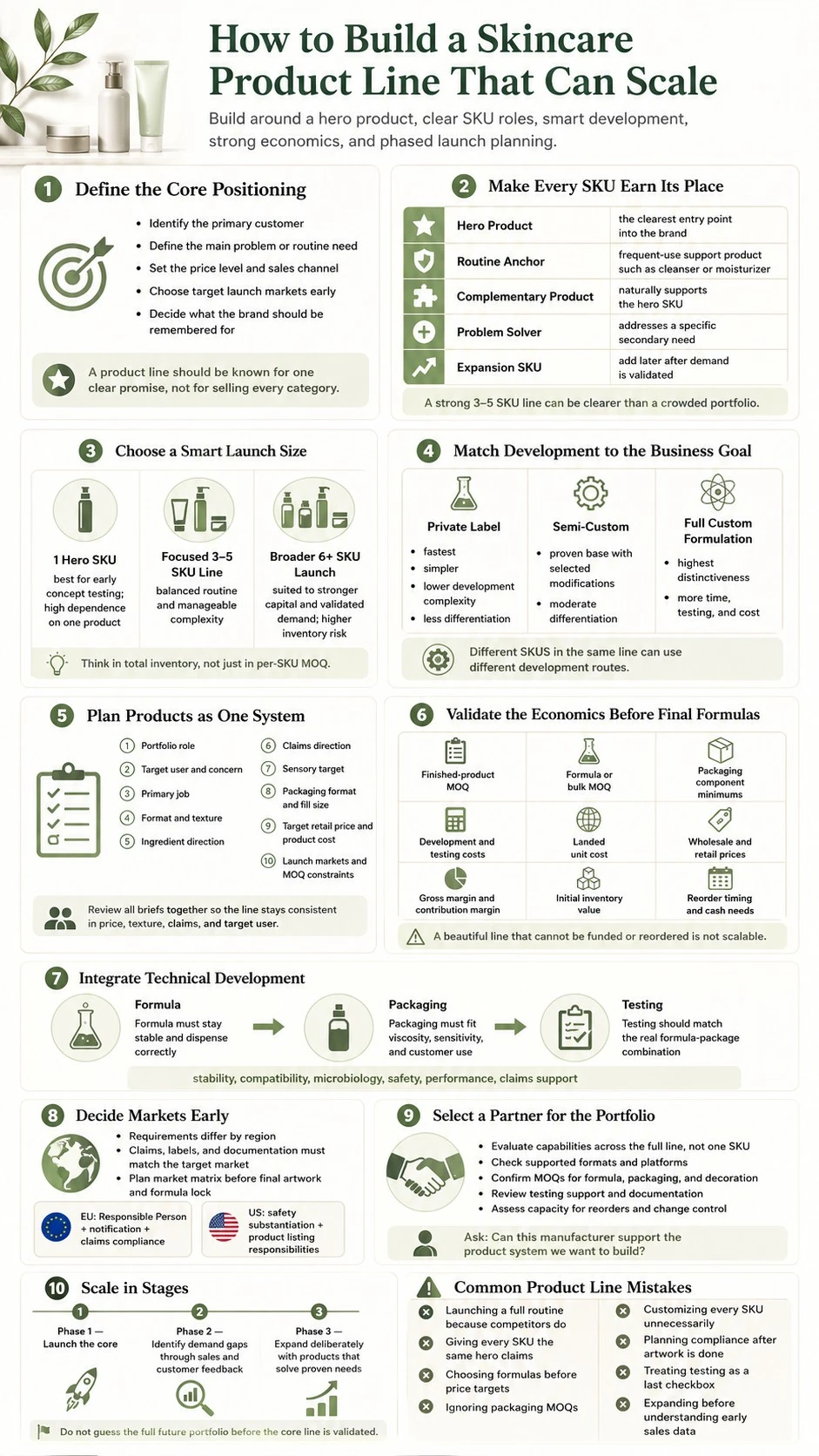
One of the most expensive mistakes in skincare product development is treating a product line like a shopping list: cleanser, toner, serum, cream, mask, eye cream, face oil, and sunscreen simply because competitors sell them. A strong product line is not defined by how many SKUs it contains. It is defined by how clearly the products work together commercially and functionally.
That means product strategy has to come before formula selection. The customer, brand promise, price level, sales channel, target market, product roles, manufacturing route, packaging system, claims, testing, and inventory economics should reinforce one another. If those decisions are made independently, even individually good products can become an expensive and confusing portfolio.
If you are still at the broader company-planning stage rather than product architecture, begin with How to Start a Skincare Brand: Step-by-Step Launch Guide.
Start With What the Product Line Should Be Known For
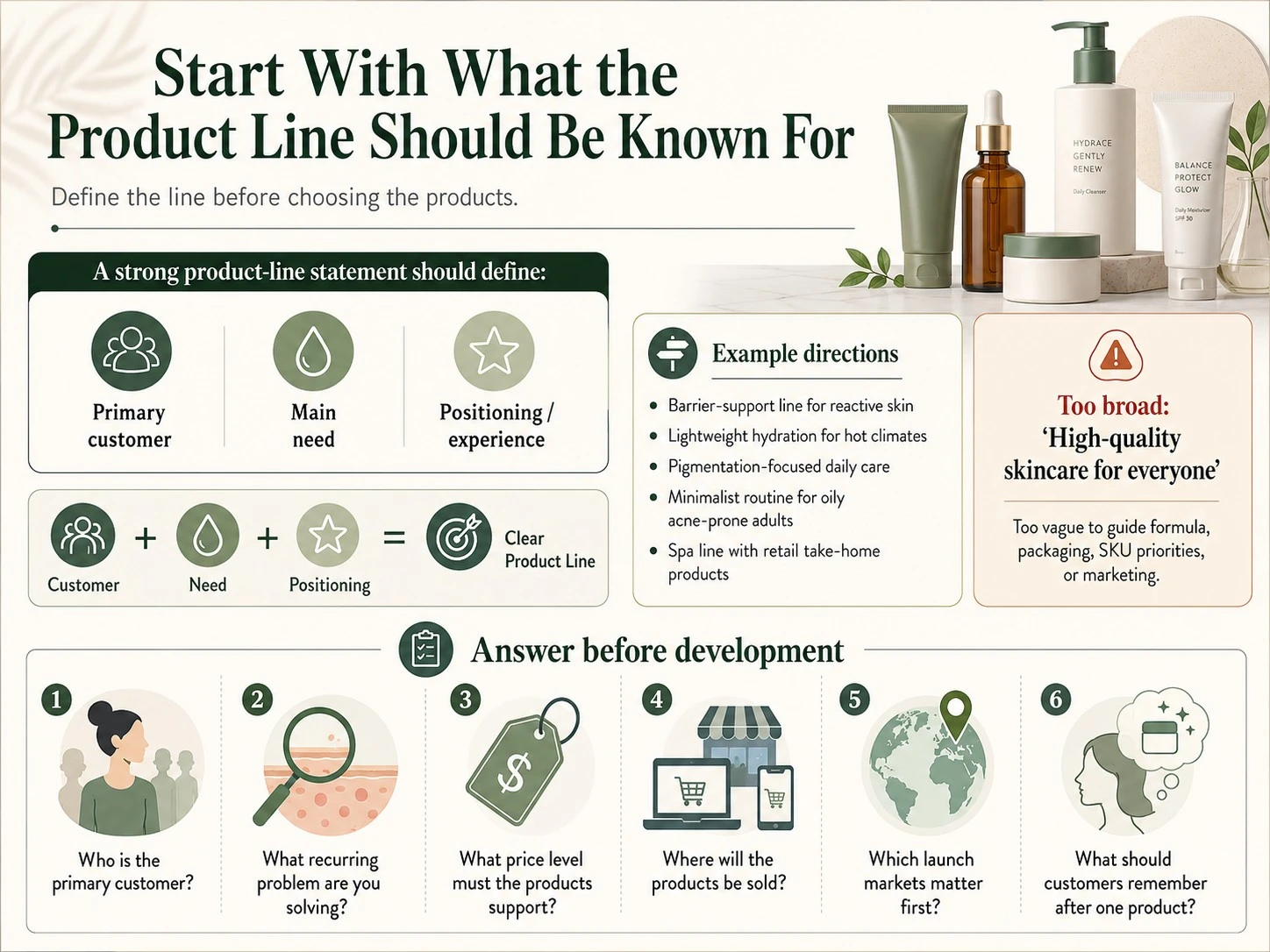
Before deciding what products to manufacture, define the line in one sentence. A useful product-line statement identifies the customer, the main need, and the type of experience or positioning you want to own.
For example:
- a simple barrier-support line for reactive skin;
- a lightweight hydration system for hot and humid climates;
- a premium pigmentation-focused line built around daily treatment and sun protection;
- a minimalist routine for oily and acne-prone adults;
- a spa-oriented professional line with retail take-home products.
A statement such as “high-quality skincare for everyone” is too broad to guide product development. It does not tell the formulator which textures matter, the packaging team which formats fit, the buyer which SKUs deserve priority, or the marketing team what the customer should remember.
Before development begins, answer these questions:
- Who is the primary customer?
- What recurring problem or routine need are you solving?
- What price level must the finished products support?
- Where will the products be sold? DTC, marketplace, retailer, distributor, clinic, spa, salon, or another channel?
- Which countries or regions are launch markets?
- What should customers associate with the brand after using one product?
Give Every SKU a Clear Role
The next step is product architecture. Instead of asking “Which five products should we launch?”, ask “What job does each SKU perform in the portfolio?”
| Product Role | Main Question | Possible Example | Why It Exists |
|---|---|---|---|
| Hero product | What should the brand become known for? | Peptide serum, barrier cream, acne serum | Creates the clearest entry point into the brand |
| Routine anchor | What product supports frequent or daily use? | Cleanser or moisturizer | Makes the range easier to use as a routine |
| Complementary product | What naturally follows or supports the hero SKU? | Moisturizer supporting a treatment serum | Creates logical cross-selling without duplicating the same function |
| Problem solver | What specific secondary need deserves its own solution? | Spot treatment, exfoliant, eye product | Extends the line without weakening the core positioning |
| Expansion SKU | What should be added only after demand is clearer? | Mask, mist, face oil, specialty treatment | Allows portfolio growth after the core line has been validated |
Not every launch needs all five roles. A hero product plus two or three strong supporting products can communicate a clearer idea than eight products competing for attention.
The hero product is especially important because it gives the rest of the portfolio a reference point. If your strongest proposition is a barrier serum, the next question is not “What is the next trending ingredient?” It is “Which additional product makes the barrier-focused customer experience more complete?”
How Many Products Should You Launch?
There is no universal correct SKU count. The right launch size depends on capital, channel, manufacturer MOQs, packaging requirements, marketing capacity, and how much product education your customer needs.
| Launch Structure | Best Fit | Main Advantage | Main Risk |
|---|---|---|---|
| One hero SKU | Early-stage founder testing one strong concept | Concentrates inventory, development, and marketing resources | The brand depends heavily on one product and has limited cross-selling |
| Focused 3–5 SKU line | Brands that want a clear routine or concern-based system | Provides enough breadth for a coherent customer journey without excessive complexity | Each additional SKU still adds MOQ, testing, packaging, and inventory requirements |
| Broader 6+ SKU launch | Established brands, distributors, retailers, or projects with validated demand and stronger capital | Offers more assortment depth from launch | Higher inventory exposure and more development variables before real customer data exists |
The important issue is not whether three or five products is theoretically ideal. It is whether every SKU has enough strategic value to justify its own formula, packaging, artwork, MOQ, testing, documentation, inventory, forecast, and marketing workload.
This creates what is useful to think of as an SKU multiplication effect. If five finished products each require a 1,000-unit production MOQ, the launch begins with 5,000 finished units—not 1,000—before separate packaging-component minimums, testers, samples, replacement stock, or shipping requirements are considered.
Choose the Right Product Development Route
Once the initial range is defined, decide how much of the line actually needs to be developed from scratch. Private label, semi-custom development, and full custom formulation solve different business problems.
| Development Route | What Is Already Established | Best When | Main Tradeoff |
|---|---|---|---|
| Private label | Existing formula and production platform | Speed, lower development complexity, or early market validation matters most | Less formula differentiation |
| Semi-custom | Existing base or proven formulation platform with selected modifications | You need moderate differentiation without starting every formula from zero | Customization limits depend on the manufacturer and base formula |
| Full custom formulation | Product brief and technical direction | Texture, delivery system, ingredient combination, claims direction, or performance must be distinctive | More development, testing, time, and cost |
A product line does not have to use one development route for every SKU. A brand may justify custom development for its hero serum while using proven formulation platforms for simpler supporting products. The decision should be based on where differentiation actually creates customer value.
For a deeper comparison, see Private Label vs Custom Skincare: Which Is Better.
Write Product Briefs as One Portfolio, Not Separate Projects
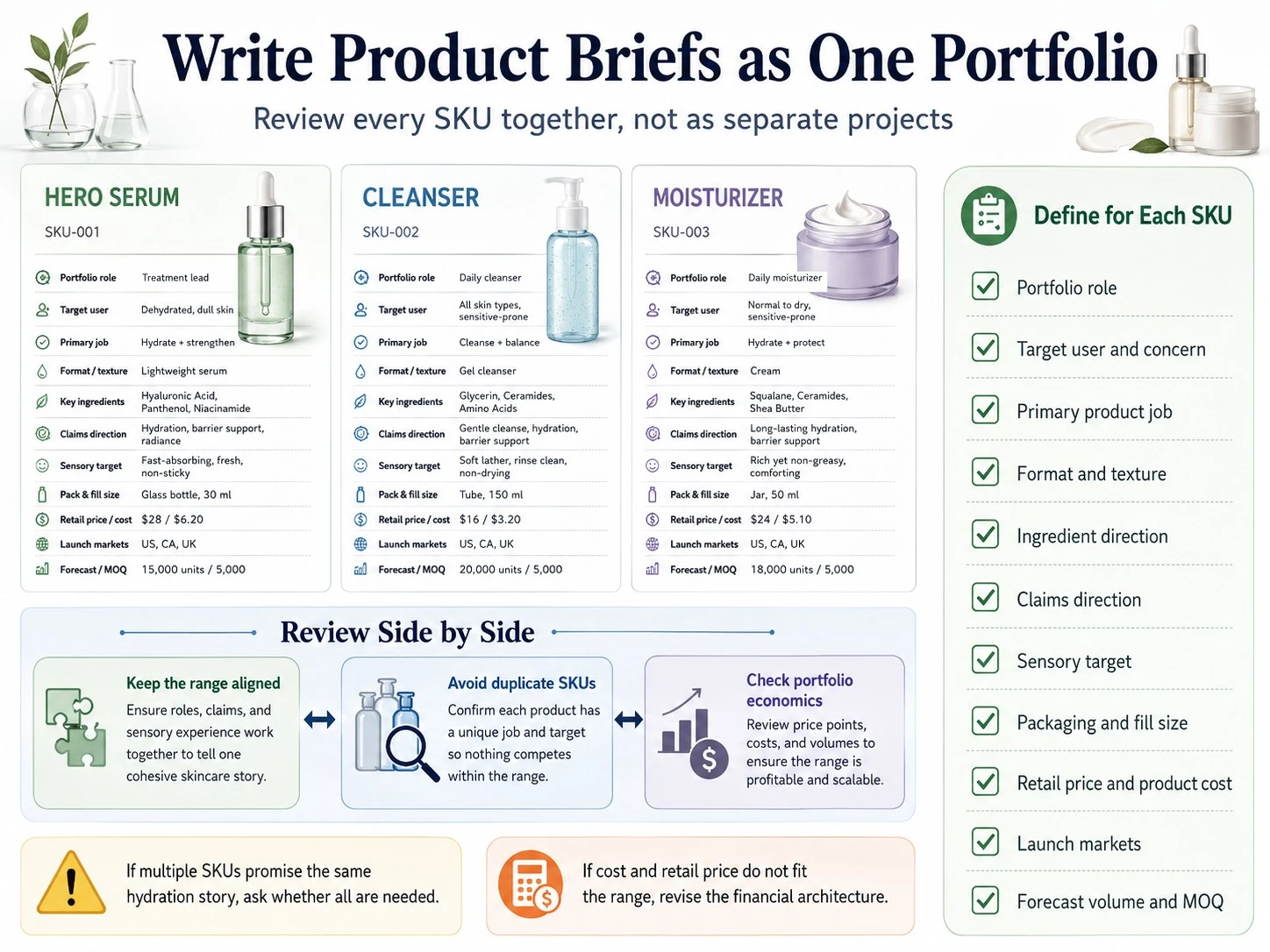
Each SKU still needs its own product brief, but the briefs should be reviewed together. Otherwise, products can drift into different price levels, textures, claim styles, fragrance directions, or target users even though they are supposed to belong to the same range.
For each product, define at least:
- portfolio role — hero, anchor, complement, problem solver, or expansion product;
- target user and concern;
- primary product job;
- format and texture;
- ingredient direction;
- claims direction;
- sensory target — absorption, slip, finish, fragrance, residue, richness;
- packaging format and fill size;
- target retail price and acceptable product cost;
- launch markets;
- forecast volume and MOQ constraints.
Then review the briefs side by side. If three products all promise hydration using the same hero ingredients and similar textures, ask whether customers really need three separate SKUs. If the cleanser costs almost as much to manufacture as the hero treatment but must retail for much less, the financial architecture may also need revision.
When the formulation direction itself is still unclear, use the framework in our Skincare Formulation Guide: How Brands Develop Products.
Build the Financial Architecture Before You Lock the Formulas
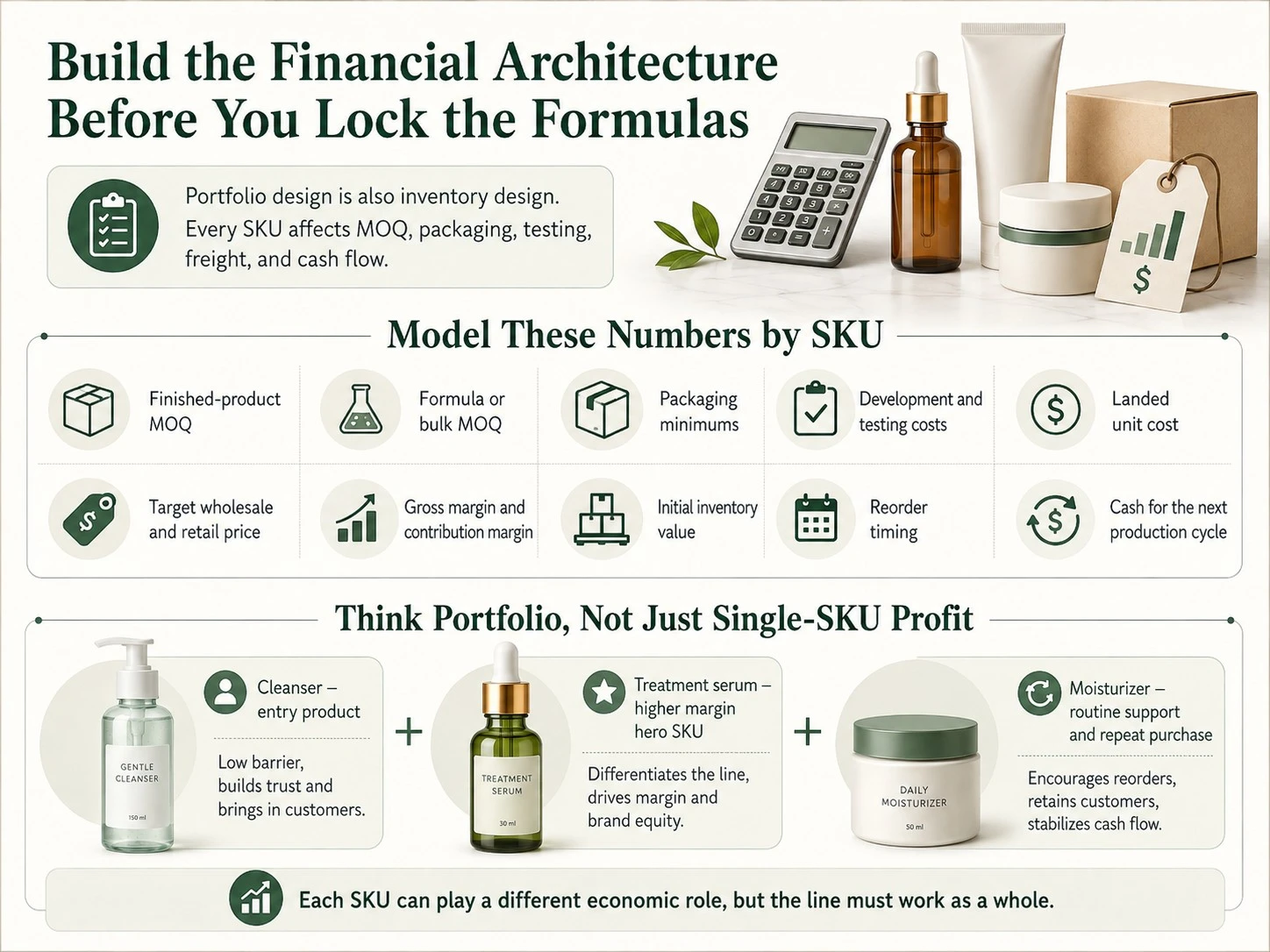
Portfolio design is also inventory design. A product line that looks attractive in a presentation can become difficult to fund once each SKU is connected to formula MOQ, packaging MOQ, decoration, testing, freight, storage, samples, and launch marketing.
Model at least these numbers by SKU:
- finished-product MOQ;
- formula or bulk MOQ if different;
- bottle, jar, tube, pump, cap, carton, and decoration minimums;
- one-time development and testing costs;
- landed unit cost;
- target wholesale and retail prices;
- gross margin and contribution margin;
- initial inventory value;
- expected reorder timing;
- cash needed for the next production cycle.
The goal is not simply to make every SKU profitable on paper. The line also has to work as a portfolio. A lower-priced cleanser may help customers enter the brand, while a treatment serum may carry more margin. A moisturizer may improve routine completeness and repeat purchase. Those roles can justify different economics, but they should be planned deliberately.
Before committing to several SKUs, review What Is the MOQ for Private Label Skincare and How to Calculate Skincare Product Cost and Profit Margin.
Develop Formula, Packaging, and Testing Together

Formula development should not finish first and hand the result to packaging as a separate task. The formula has to remain stable, dispense correctly, interact appropriately with the package, survive expected storage and transport conditions, and still provide the intended customer experience.
A lightweight serum may require a different pump or dropper decision from a high-viscosity emulsion. An air-sensitive formula may require a different packaging strategy from a basic rinse-off cleanser. A formula that changes viscosity during stability work can also change dispensing performance.
Testing should therefore be planned around the actual formula-package combination and intended claims rather than treated as one generic checklist. There is no single test list that applies identically to every cosmetic. In the United States, current guidance similarly leaves the specific testing program to the business while requiring adequate safety substantiation.[2]
Depending on the product, market, formula, package, and claims, development may involve stability work, packaging compatibility, microbiological evaluation, preservation testing, safety assessment, performance testing, or other evidence. The exact plan should be decided before the launch schedule is treated as fixed.
For the deeper technical workflow, see our Skincare Packaging Guide: How Brands Choose Packaging and Skincare Product Testing Guide: What Brands Need.
Once production begins, manufacturing also needs disciplined quality systems. ISO 22716 provides cosmetic GMP guidance covering production, control, storage, and shipment.[1]
Choose Target Markets Before Final Claims and Packaging
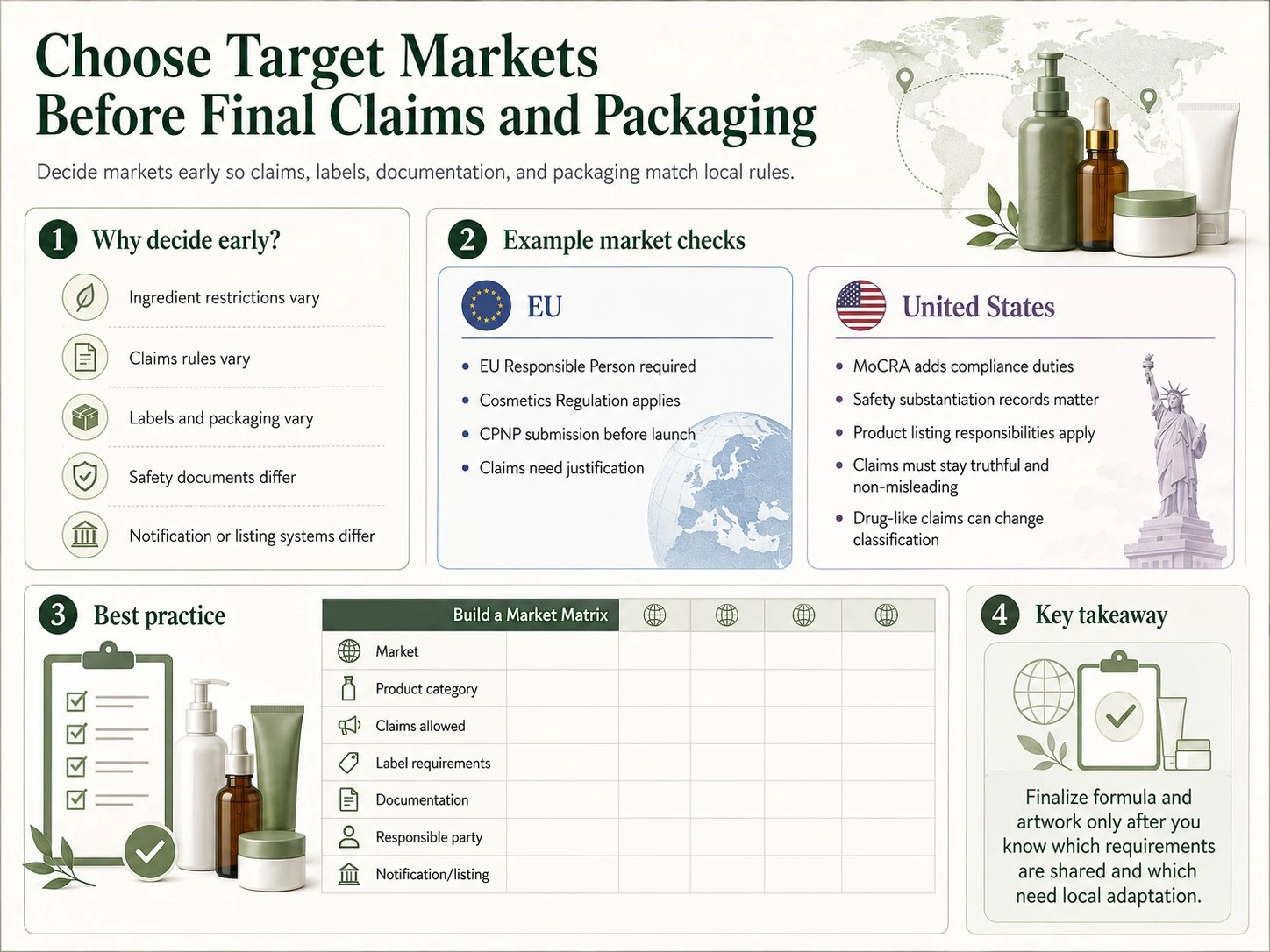
A common sequencing error is to finish formulas and artwork first, then ask how to sell the same products globally. Target markets should be decided earlier because ingredient restrictions, responsible-party requirements, safety documentation, notification or listing systems, labels, and acceptable claims vary by jurisdiction.
For example, cosmetic products placed on the EU market require an EU-based Responsible Person and must comply with the Cosmetics Regulation; product information is submitted through the Cosmetic Products Notification Portal before market placement.[4][5] Cosmetic claims in the EU also have common criteria for justification.[6]
In the United States, MoCRA introduced requirements that include safety-substantiation records and cosmetic product listing responsibilities for the responsible person, subject to the law’s applicable details and exemptions.[7] U.S. cosmetic claims must also remain truthful and not misleading, and claims that move into treatment or disease territory can change the product’s regulatory classification.[3]
These are examples, not a universal worldwide template. If you plan to launch in several markets, build one market matrix before finalizing the formula and artwork so that the team knows which requirements are shared and which need local adaptation.
Choose a Manufacturer for the Whole Line, Not Just the First Formula
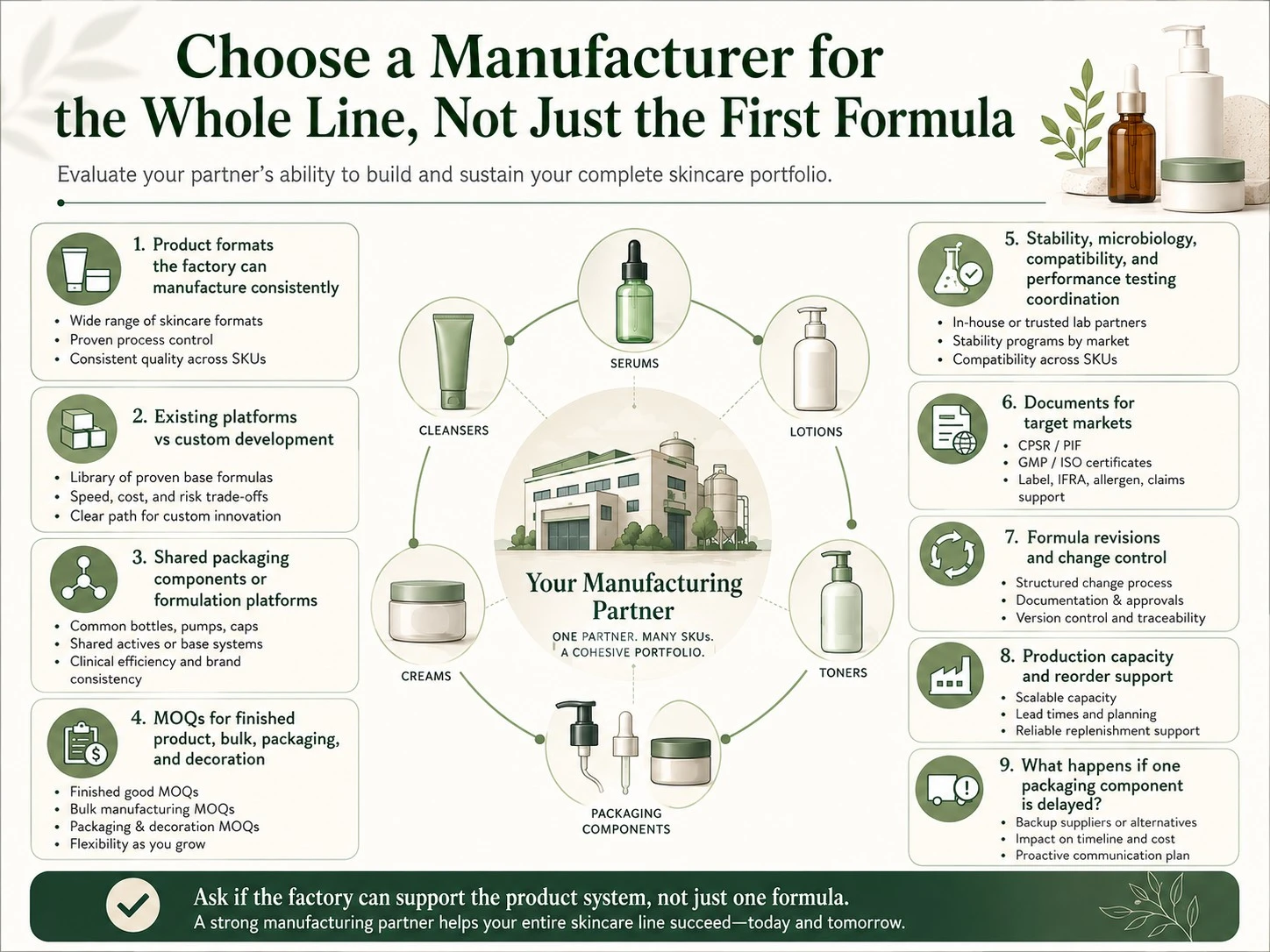
A manufacturer may be able to produce one attractive serum without being the right partner for a multi-SKU portfolio. Evaluate the capabilities needed for the complete line and the next likely expansion phase.
Ask questions such as:
- Which product formats can the factory manufacture consistently?
- Which formulas are available as existing platforms, and which require custom development?
- Can related products share compatible packaging components or formulation platforms without becoming repetitive?
- What are the MOQs for finished product, bulk formula, primary packaging, and decoration?
- How are stability, microbiology, compatibility, and performance testing coordinated?
- What documents can be supplied for your target markets?
- How are formula revisions and change control handled?
- Can production capacity support reorders if one SKU grows faster than the others?
- What happens when one package component is delayed but the rest of the line is ready?
A useful manufacturer discussion is therefore not “Can you make this serum?” but “Can you support the product system we are trying to build?” Review How to Choose a Skincare Manufacturer before supplier selection.
Launch in Phases Instead of Guessing the Full Future Portfolio
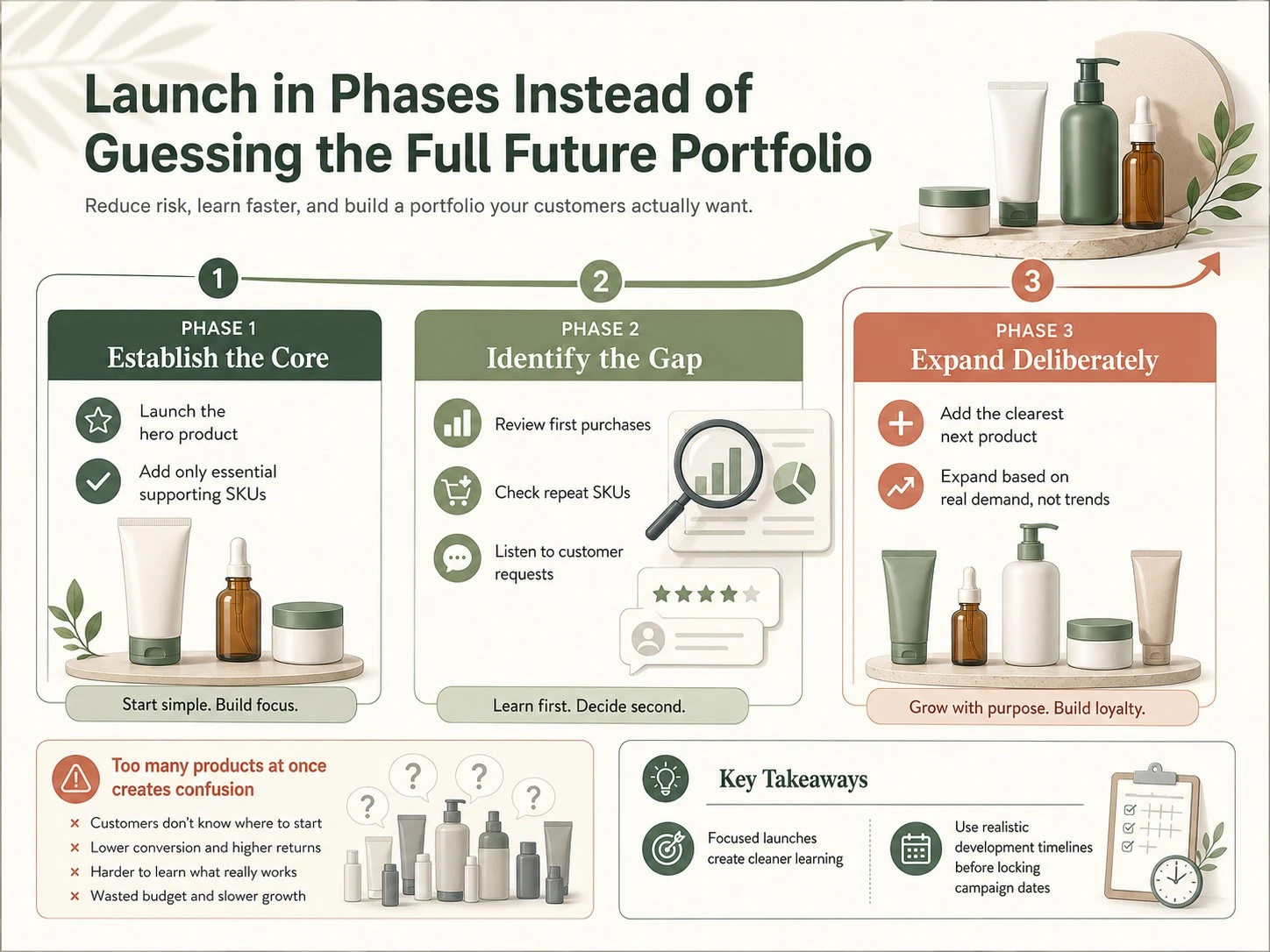
The first launch does not need to predict every product the brand will ever sell. A better structure is to define the likely expansion map but make later SKUs earn their place through customer and commercial data.
- Phase 1: establish the core. Launch the hero product and only the supporting SKUs needed to make the proposition understandable.
- Phase 2: identify the gap. Review which product attracts first purchases, what customers buy together, which SKU repeats, and what customers repeatedly request.
- Phase 3: expand deliberately. Add the product that solves the clearest uncovered need rather than the product that happens to be trending that month.
This approach also makes product development easier to finance and diagnose. If ten products launch together and the range underperforms, it can be difficult to determine whether the problem is positioning, individual formulas, pricing, assortment, packaging, or marketing. A more focused launch produces cleaner learning.
Custom projects also need realistic development lead time. If your launch calendar is already fixed, compare it with How Long Does Skincare Product Development Take before locking campaign dates.
Common Skincare Product Line Mistakes
- Launching a complete routine because competitors have one. Product count is not a strategy.
- Giving every SKU the same hero ingredients and claims. Customers need a reason for each product to exist.
- Choosing formulas before setting price targets. A technically impressive product may not fit the required retail architecture.
- Ignoring packaging MOQs while negotiating formula MOQ. The bottle, pump, carton, or decoration may become the real inventory constraint.
- Developing every SKU from scratch. Full customization is valuable where differentiation matters, but it can add unnecessary time and cost to supporting products.
- Planning compliance after artwork is finished. Target-market requirements can affect claims, labels, ingredients, documentation, and launch timing.
- Treating testing as the last checkbox before production. Test outcomes can force formula, package, or claims changes.
- Using launch-day demand assumptions as reorder forecasts. Different SKUs can sell and repeat at very different rates.
- Adding new products before understanding the first line. Expansion should solve a demonstrated gap rather than hide weak positioning.
Final Thoughts
A skincare product line should behave like a system, not a shelf full of unrelated formulas. Start with the customer and the problem the brand wants to own. Give one product the clearest hero role, then make every additional SKU justify itself through a distinct routine, commercial, or customer function.
The strongest portfolio decisions happen before production: product roles, formulation route, price architecture, MOQ, packaging, target markets, testing, claims, and launch sequence should be reviewed together. That reduces the risk of discovering late in development that the formulas are good but the line is too expensive, too broad, too repetitive, or difficult to manufacture.
If your brand is planning a new skincare line, prepare your target customer, launch markets, product roles, target prices, claims direction, preferred packaging, and forecast quantities before speaking with a development partner. ZICAIL can use that information to review the most practical development route through custom skincare formulation, including where full customization is justified and where a proven platform may make more commercial sense.


