


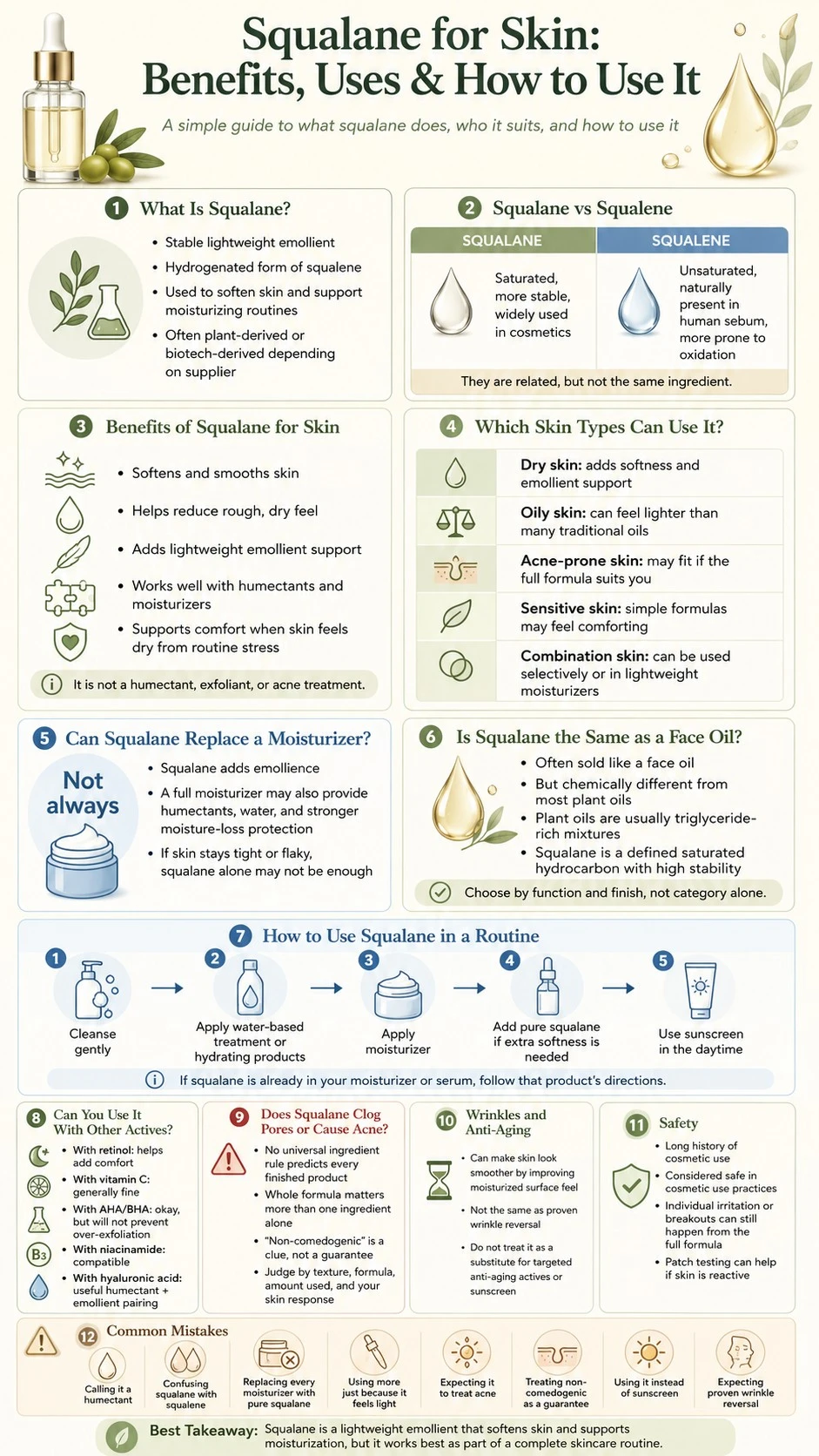
Squalane is often marketed as a facial oil, yet its value is easier to understand when you stop treating it as a special category of “oil” and look at its actual job in a formula. It is primarily an emollient: an ingredient that helps skin feel softer, smoother, and less rough.
That makes squalane very different from treatment actives such as retinol or salicylic acid. It does not need to exfoliate, accelerate skin turnover, or target pigmentation to be useful. Its strength is providing lipid-based comfort with a texture that many people find lighter than traditional plant oils.
The evidence also needs to be kept in proportion. Squalane has a long history of cosmetic use and a favorable safety assessment, but many broader claims made for it online—such as treating acne or directly reversing wrinkles—go beyond what strong human clinical evidence currently establishes.[1][2]
What Is Squalane?
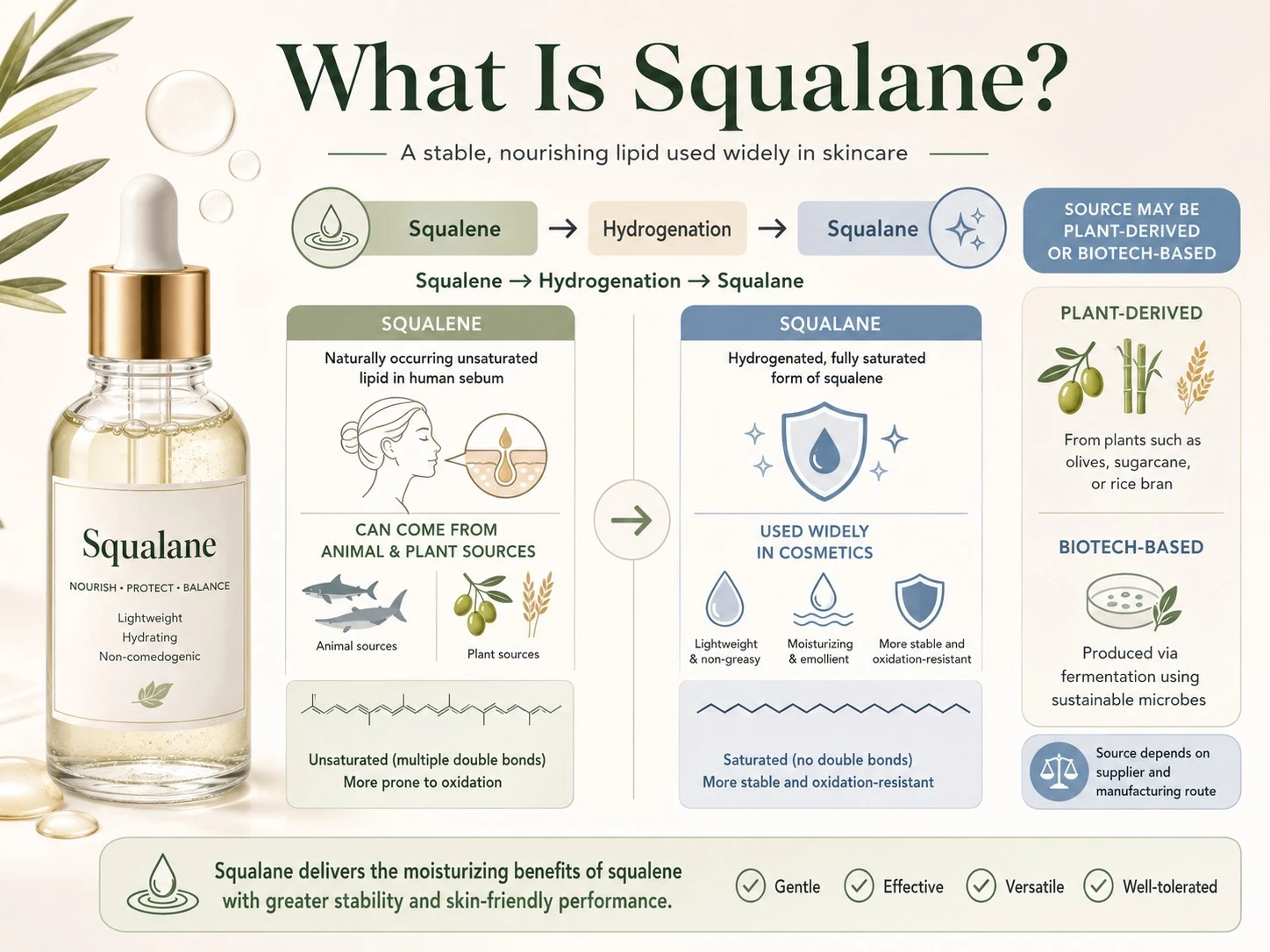
Squalane is a saturated hydrocarbon produced by hydrogenating squalene. Squalene is an unsaturated lipid naturally present in human sebum and also occurs in animal and plant sources. Hydrogenation makes squalane substantially more resistant to oxidation, which is one reason it is widely used in cosmetic formulations.[1][2]
Historically, commercial squalene was strongly associated with shark liver oil. Cosmetic supply chains can now use plant-derived or biotechnology-based feedstocks, so the origin of a particular squalane ingredient depends on its supplier and manufacturing route.
If plant origin, vegan positioning, traceability, or sustainability matters to you, check the supplier or finished-product information rather than assuming that the INCI name Squalane identifies its original feedstock.
Squalane vs Squalene: What Is the Difference?
The names differ by only one letter, but the distinction matters in formulation.
| Feature | Squalane | Squalene |
|---|---|---|
| Chemical form | Saturated, hydrogenated form | Unsaturated lipid |
| Natural presence in human sebum | Not the principal naturally occurring form | Naturally present in sebum |
| Oxidative stability | More stable | More susceptible to oxidation |
| Cosmetic role | Widely used as an emollient and formulation ingredient | Can also be used, but its lower oxidative stability creates additional formulation considerations |
Calling squalane “the same oil your skin naturally makes” is therefore an oversimplification. Human sebum contains squalene; cosmetic squalane is its more stable saturated relative.[1][2]
What Are the Benefits of Squalane for Skin?
Squalane’s best-supported skincare value comes from its role as an emollient rather than from treating a specific disease or concern.
| Benefit | What Squalane Contributes | Important Limit |
|---|---|---|
| Softer skin feel | Helps smooth and lubricate the outer skin surface | Does not permanently change skin structure |
| Less roughness | Emollient lipids can improve the feel of dry, rough skin | Persistent xerosis may need a more complete moisturizer system[3][4] |
| Moisturizing support | Complements humectants and more occlusive ingredients within a formula | It does not primarily bind water like glycerin or hyaluronic acid |
| Lightweight emollience | Provides slip and softness without requiring a traditional triglyceride plant oil | Whether a product feels light still depends on the complete formulation |
| Routine comfort | Can add lipid support when cleansing or treatment products leave skin feeling dry | It does not neutralize irritation caused by an overly aggressive routine |
This distinction between moisturizing functions is important. Humectants draw or retain water, emollients improve softness and fill spaces within the outer skin surface, and occlusive ingredients reduce evaporation to different degrees.[3] See Humectants vs Emollients vs Occlusives: Key Differences for the full comparison.
Which Skin Types Can Use Squalane?
Squalane is not restricted to one skin type. The better question is whether its emollient role and the texture of the finished product match what your skin currently needs.
| Skin Type or Situation | Where Squalane May Fit | What to Check |
|---|---|---|
| Dry skin | Adds emollient support and can reduce a rough or tight feel | Very dry skin may still need humectants and stronger moisture-loss control |
| Oily skin | A lightweight squalane-containing formula can provide softness without necessarily requiring a rich cream | Do not add facial oil automatically if your existing moisturizer already provides enough comfort |
| Acne-prone skin | Can be used as moisturizing support when the finished product suits the individual | Squalane is not an acne treatment, and one raw ingredient cannot predict the comedogenicity of every finished formula[6] |
| Sensitive or treatment-stressed skin | A simple emollient formula may help improve comfort | Check the entire ingredient list because fragrance or other actives may determine tolerance |
| Combination skin | Can be applied selectively or used in a lightweight moisturizer | You may not need the same amount on oilier and drier facial areas |
If dryness is the dominant problem, Skincare Routine for Dry Skin: Simple AM & PM Steps provides the broader routine rather than treating one emollient as the entire solution.
Can Squalane Replace a Moisturizer?
Pure squalane can make skin feel softer and reduce the dry feel associated with insufficient surface lipids, but it does not reproduce every function of a well-designed moisturizer.
A complete moisturizer may combine:
- water and humectants to increase water availability in the stratum corneum;
- emollients such as squalane to improve softness and flexibility;
- more occlusive materials when stronger water-loss reduction is needed;
- other lipids or supporting ingredients selected for the product’s intended skin condition.[3][4]
If a few drops of squalane alone keep your skin comfortable, there is no rule requiring another layer. But if skin remains tight, flaky, or dehydrated, replacing a complete moisturizer with more oil is unlikely to solve every missing function.
Is Squalane the Same as a Face Oil?
Pure squalane is commonly sold in the facial-oil category because it is an anhydrous lipid liquid. Chemically and compositionally, however, it is different from most botanical oils.
Plant oils are usually complex mixtures dominated by triglycerides and fatty acids, with composition varying by botanical source. Squalane is a defined saturated hydrocarbon. That difference affects oxidation stability, sensory feel, and how formulators use the ingredient.
Neither category is automatically superior. Choose according to the function and finish you need. If you are deciding where oil-type products belong relative to treatment serums, Face Oil vs Serum: Differences, Benefits & Which to Use addresses that routine decision directly.
How to Use Squalane in a Skincare Routine
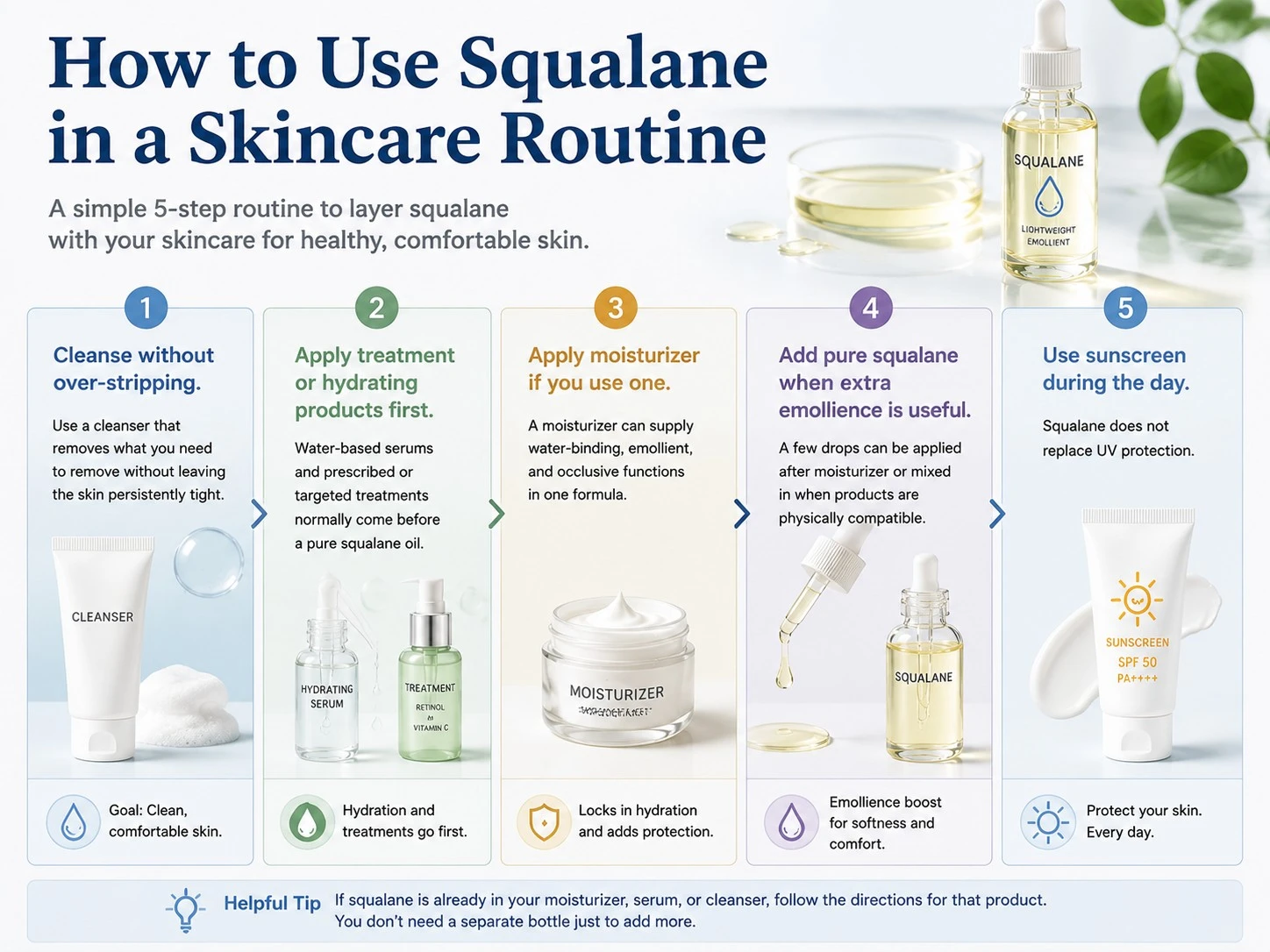
You do not need a special “squalane routine.” Treat it as part of the moisturizing system already built into your products.
- Cleanse without over-stripping. Use a cleanser that removes what you need to remove without leaving the skin persistently tight.
- Apply treatment or hydrating products first. Water-based serums and prescribed or targeted treatments normally come before a pure squalane oil.
- Apply moisturizer if you use one. A moisturizer can supply water-binding, emollient, and occlusive functions in one formula.
- Add pure squalane when extra emollience is useful. A few drops can be applied after moisturizer or mixed into the application when the products are physically compatible.
- Use sunscreen during the day. Squalane does not replace UV protection.
If squalane is already inside your moisturizer, serum, or cleanser, follow the directions for that product rather than adding a separate bottle simply to increase the amount.
Can You Use Squalane With Retinol, Vitamin C, or Acids?
Squalane is generally straightforward to use alongside treatment ingredients because it is not an exfoliating acid or another strong treatment active.
- Retinol and other retinoids: squalane can provide additional emollient support when a retinoid routine feels dry.
- Vitamin C: there is no general reason to separate squalane from a vitamin C product solely because of ingredient incompatibility.
- AHA or BHA: squalane can support comfort, but it does not prevent irritation from excessive exfoliation.
- Niacinamide: the two can coexist because they perform different formulation and skincare roles.
- Hyaluronic acid: a humectant-plus-emollient combination can make sense when the skin needs both water-binding and lipid-based softness.
When a routine contains several active products, judge the total treatment load rather than asking whether squalane itself is compatible with each one.
Does Squalane Clog Pores or Cause Acne?
There is not a reliable universal rule that allows you to look at squalane—or most individual cosmetic ingredients—and guarantee how every finished product will behave on acne-prone skin.
Comedogenicity research has shown why raw-material ratings should not automatically be transferred to complete cosmetic formulas: finished products containing ingredients considered comedogenic are not necessarily comedogenic themselves.[6]
The same caution works in the other direction. Calling squalane “non-comedogenic” does not guarantee that every squalane-containing moisturizer or facial oil will suit every acne-prone user.
Evaluate the full formulation, application amount, other products in the routine, and your actual skin response. What Does Non-Comedogenic Mean in Skincare? explains why the label is a screening clue rather than a breakout guarantee.
Does Squalane Help With Wrinkles or Anti-Aging?
Squalane can make dry skin look smoother because emollience and moisturization improve surface softness. That is different from proving that it reverses wrinkles or remodels aged skin.
Laboratory research published in 2025 found that squalane affected several UVA-related oxidative, inflammatory, and collagen-associated pathways in cultured human dermal fibroblasts.[5] This is mechanistically interesting, but an in vitro cell study is not clinical evidence that applying a squalane oil to the face reverses wrinkles in people.
For consumers, the better-supported expectation is moisturization and improved skin feel. Treat direct collagen-rebuilding, wrinkle-removal, or UV-protection claims more cautiously unless the finished product itself has appropriate human evidence.
Is Squalane Safe for Skin?
Squalane has a long history of cosmetic use. A 2023 safety review reconfirmed that squalane and squalene are safe as cosmetic ingredients under the practices of use and concentrations described in that assessment.[1]
That does not mean every squalane-containing product is guaranteed to suit every person. Irritation, allergy, breakouts, or discomfort can be related to another component of the finished formula or to an individual’s skin response.
If your skin is highly reactive or the product contains several unfamiliar ingredients, introducing it cautiously or using a patch test can make it easier to identify an unwanted reaction.
Common Squalane Skincare Mistakes
- Calling squalane a humectant. Its primary skincare role is emollience, not water binding.
- Assuming it is identical to squalene. Hydrogenation changes oxidative stability and makes squalane more practical for cosmetic use.
- Replacing every moisturizer with pure squalane. Some skin needs water-binding and stronger occlusive support as well.
- Using more because the oil feels lightweight. Additional product does not automatically create additional benefit.
- Expecting it to treat acne. Squalane may support comfort but does not replace acne-targeted treatment.
- Treating “non-comedogenic” as a guarantee. Finished-formula performance and individual response matter more than a simplistic ingredient rating.
- Using it as sunscreen. Laboratory antioxidant findings do not make cosmetic squalane a substitute for tested UV protection.
- Expecting proven wrinkle reversal. Moisturizing effects and laboratory mechanisms should not be converted into unsupported clinical anti-aging claims.
Final Thoughts
Squalane is useful because it does not need to be a powerful treatment active. It is a stable emollient that can improve softness, reduce a rough or dry feel, and make moisturizing formulas more comfortable to use.
The key is to keep its role precise. Squalane provides lipid-based emollience; humectants provide water-binding support; more occlusive ingredients can provide stronger protection against water loss; and treatment actives address separate concerns such as acne or pigmentation. Choose the combination your skin actually needs instead of expecting one ingredient to perform every job.
FAQs About Squalane for Skin
Is Squalane Good for Your Face?
Yes. Squalane is widely used as a facial skincare emollient because it improves softness and surface smoothness. Whether a specific product suits you still depends on its complete formula and your skin.
Does Squalane Clog Pores?
You cannot reliably predict the comedogenicity of every finished product from squalane alone. Formula composition, concentration, application, and individual response all matter.[6]
Is Squalane Good for Oily Skin?
It can be. Oily skin can still need emollient support, particularly when cleansing or treatment products cause dryness. Use a texture and amount that remain comfortable rather than adding oil simply because squalane is considered lightweight.
Can I Use Squalane Every Day?
Yes. Squalane is commonly used in daily moisturizers, serums, and facial-oil products. Frequency should follow the finished product directions and what your skin needs.
Should Squalane Go Before or After Moisturizer?
Pure squalane oil is usually most practical after water-based products and can be applied after moisturizer when extra emollience is needed. If squalane is already part of a formulated serum or cream, follow that product’s normal application order.
Is Squalane Better Than Hyaluronic Acid?
They perform different jobs. Hyaluronic acid is primarily a humectant that helps bind water, while squalane is an emollient that improves softness and lipid-based comfort. A formula can use both rather than treating them as competing ingredients.
Sources
[1] Fiume M et al. Squalane and Squalene
[2] Kim SK, Karadeniz F. Biological Importance and Applications of Squalene and Squalane
[3] Rajkumar J et al. The Skin Barrier and Moisturization: Function, Disruption, and Mechanisms of Repair
[4] Szepietowski JC, Tadini G. Basic Emollients for Xerosis Cutis Not Associated With Atopic Dermatitis: A Review of Clinical Studies
[5] Wolosik K et al. Squalane as a Promising Agent Protecting UV-Induced Inhibition of Collagen Biosynthesis and Wound Healing in Human Dermal Fibroblast
[6] Draelos ZD, DiNardo JC. A Re-Evaluation of the Comedogenicity Concept


