

The Three Products Every Basic Skincare Routine Needs
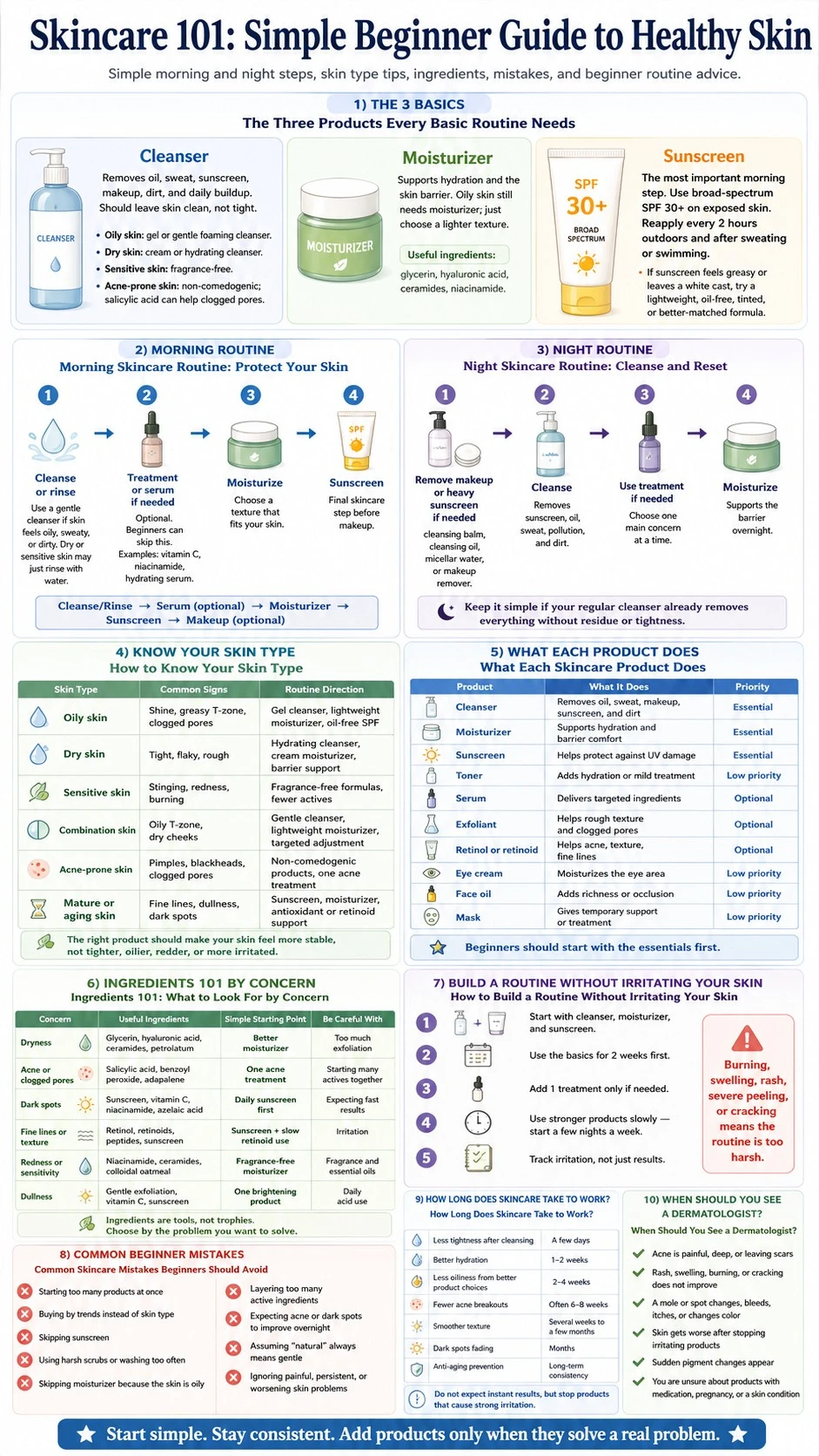
Most people should start with cleanser, moisturizer, and sunscreen. These cover the core needs of daily skin care: cleaning, hydration, and UV protection. [1][4]
Cleanser
Cleanser removes oil, sweat, sunscreen, makeup, dirt, and daily buildup. A good cleanser should leave your face clean, not tight, burning, or squeaky.
Use a gentle, non-abrasive cleanser and lukewarm water. Wash with your fingertips instead of a rough cloth or scrub brush. Harsh scrubbing can irritate the skin and make dryness, redness, or breakouts worse. [3]
Choose your cleanser based on how your skin feels:
- Oily skin: gel or gentle foaming cleanser.
- Dry skin: cream, lotion, or hydrating cleanser.
- Sensitive skin: fragrance-free cleanser with a simple formula.
- Acne-prone skin: non-comedogenic cleanser; salicylic acid can help clogged pores.
Cleanser is important, but over-cleansing is not. Washing too often can strip the skin and make it feel more irritated.
Moisturizer
Moisturizer helps reduce tightness, supports the skin barrier, and makes treatment products easier to tolerate. It is not only for dry skin. Oily and acne-prone skin still need moisturizer, but the texture should be lighter.
Useful moisturizer ingredients include:
- Glycerin: helps draw water into the skin.
- Hyaluronic acid: adds lightweight hydration.
- Ceramides: help support the skin barrier.
- Niacinamide: can support barrier comfort and reduce visible redness.
Choose a light lotion or gel-cream for oily skin, a richer cream for dry or flaky skin, and a fragrance-free formula if your skin stings or turns red easily.
Sunscreen
Sunscreen is the most important morning skincare step. It helps protect against sunburn, early skin aging, dark spots, and long-term UV damage.
Use broad-spectrum SPF 30 or higher when your skin is exposed to daylight, especially outdoors. Apply it to easy-to-miss areas such as the ears, nose, lips, neck, hands, hairline, and exposed scalp. Reapply at least every two hours when outdoors, and more often after swimming or sweating. [5]
For this beginner routine, the key point is simple: use enough sunscreen and reapply when needed.
If sunscreen feels greasy or leaves a white cast, try a lightweight, oil-free, tinted, or better-matched formula.
Morning Skincare Routine: Protect Your Skin
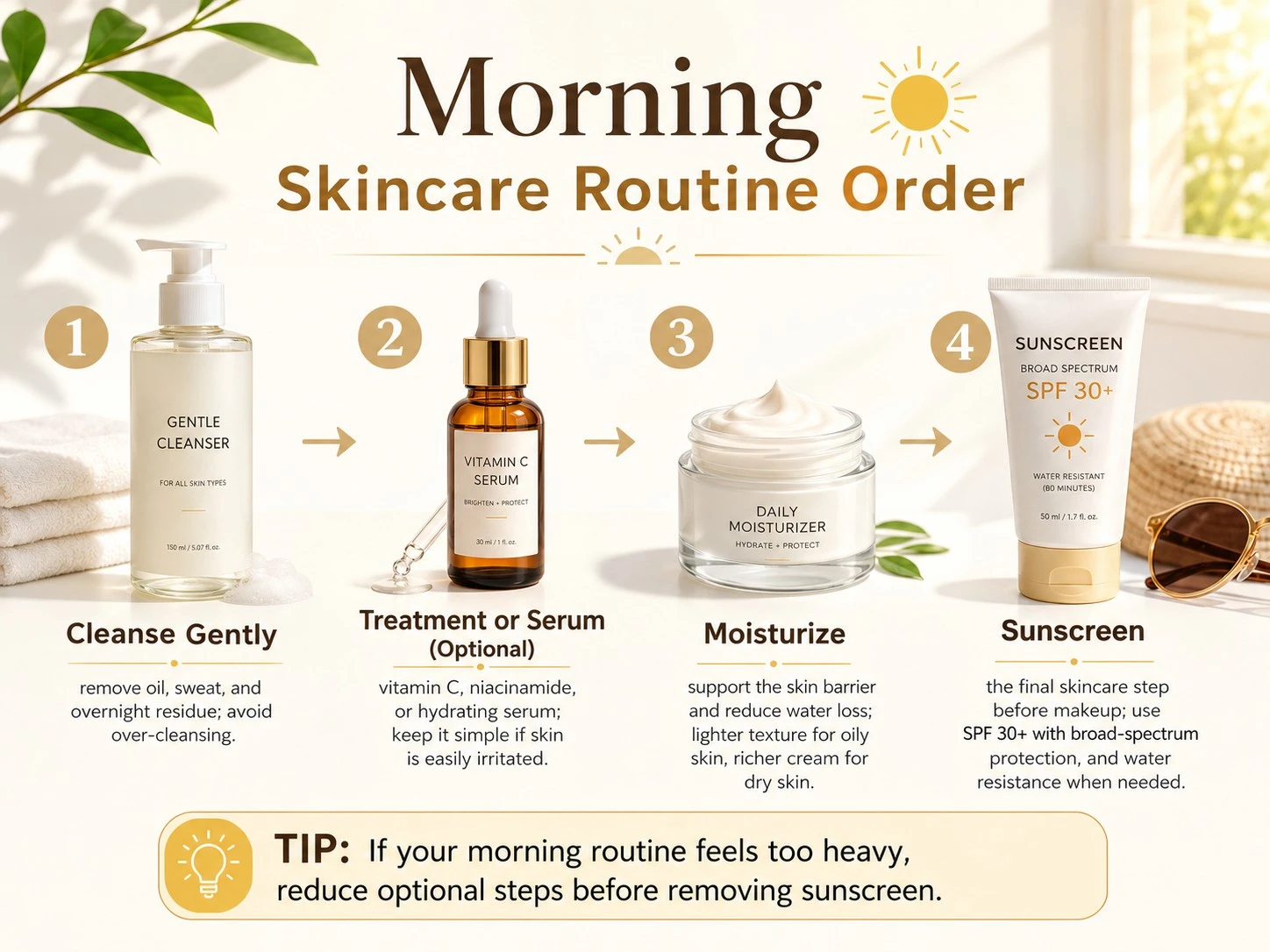
Your morning routine should prepare your skin for the day. The focus is protection, not heavy treatment.
Step 1: Cleanse or Rinse
Use a gentle cleanser if your face feels oily, sweaty, or dirty in the morning. If your skin is dry or sensitive, rinsing with water can be enough.
Do not use hot water or harsh soap. Your face should feel fresh after washing, not tight or rough.
Step 2: Use Treatment or Serum If Needed
This step is optional. Beginners can skip it until the basic routine feels stable.
If you already have a specific concern, you can use a light morning treatment such as vitamin C, niacinamide, or a hydrating serum. Skip this step if your basic routine is not stable yet.
Serums are tools, not requirements.
Step 3: Moisturize
Apply moisturizer after cleansing or treatment. Choose a texture that fits your skin: lighter for oily skin, creamier for dry skin, and fragrance-free for sensitive skin.
If your sunscreen is very moisturizing, you may not need a separate moisturizer every morning. But do not use less sunscreen just to make it feel like moisturizer.
Step 4: Apply Sunscreen
Sunscreen should be the last skincare step before makeup. Apply it after moisturizer and before foundation or tinted products.
A simple morning order is:
- Cleanse or rinse.
- Treatment or serum if needed.
- Moisturizer.
- Sunscreen.
- Makeup if you wear it.
This order helps each step do its job without making the routine difficult to follow. [2]
Night Skincare Routine: Cleanse and Reset
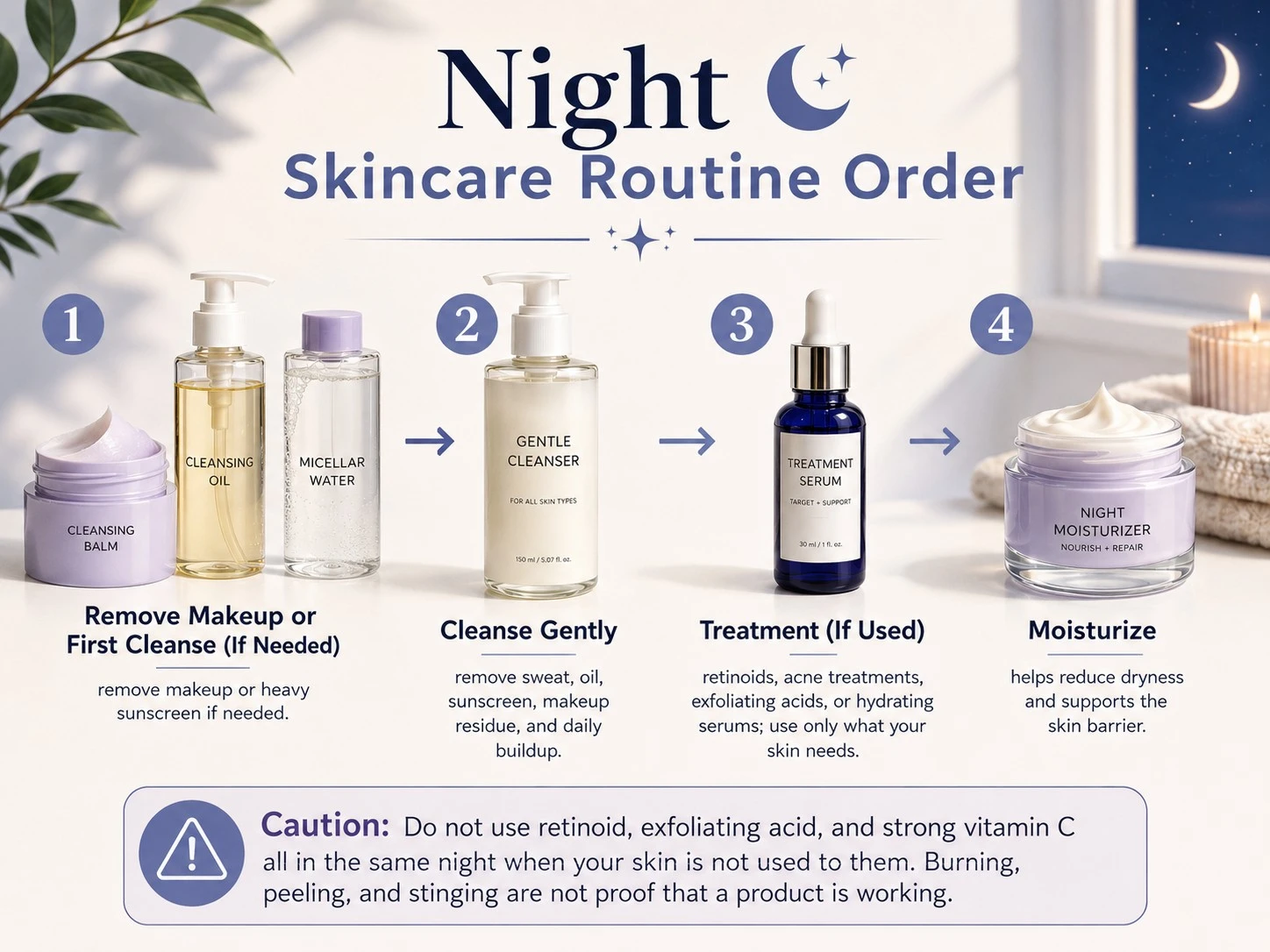
Your night routine removes the day and gives your skin a calmer base. This is also when many treatment products fit best.
Step 1: Remove Makeup or Heavy Sunscreen If Needed
If you wear makeup, heavy sunscreen, or water-resistant sunscreen, you may need a first removal step. A cleansing balm, cleansing oil, micellar water, or makeup remover can help break down these products.
Double cleansing can be useful, but it is not required for everyone. If your regular cleanser removes everything without residue or tightness, keep the routine simple.
Step 2: Cleanse
Night cleansing removes sunscreen, makeup, oil, sweat, pollution, and dirt. For most people, it matters more than morning cleansing.
Use lukewarm water and a gentle cleanser. Avoid rough scrubbing. Clean skin should feel calm, not raw.
Step 3: Use Treatment If Needed
Night is a common time for acne treatments, retinoids, dark spot products, and exfoliants. Choose one main concern first and use one treatment direction at a time.
If acne is your concern, use one acne treatment. If rough texture is your concern, introduce one exfoliant or retinoid slowly. If dark spots are your concern, keep daily sunscreen consistent before adding a brightening product.
Step 4: Moisturize
Finish with moisturizer. This helps reduce dryness and supports the skin barrier overnight.
If your skin feels dry, burning, or flaky, reduce strong products before adding more.
How to Know Your Skin Type
Your skin type helps you choose the right products. It is not a label you must keep forever. Skin can change with weather, age, hormones, medication, stress, travel, and product use.
Use this table as a starting point.
| Skin Type | Common Signs | Routine Direction | Best Next Guide |
|---|---|---|---|
| Oily skin | Shine, greasy T-zone, clogged pores | Gel cleanser, lightweight moisturizer, oil-free SPF | Skin Type Guide / Oily Skin Routine |
| Dry skin | Tight, flaky, rough | Hydrating cleanser, cream moisturizer, barrier support | Dry Skin Routine |
| Sensitive skin | Stinging, redness, burning | Fragrance-free formulas, fewer actives | Sensitive Skin Guide |
| Combination skin | Oily T-zone, dry cheeks | Gentle cleanser, lightweight moisturizer, targeted adjustment | Skin Type Guide |
| Acne-prone skin | Pimples, blackheads, clogged pores | Non-comedogenic products, one acne treatment | Acne Care Guide |
| Mature or aging skin | Fine lines, dullness, dark spots | Sunscreen, moisturizer, antioxidant or retinoid support | Anti-Aging Skincare Guide |
The right product should make your skin feel more stable, not tighter, oilier, redder, or more irritated.
What Each Skincare Product Does
Not every skincare product is essential. Some products are core routine steps. Others are optional tools for specific concerns.
| Product | What It Does | Who Needs It | Beginner Priority |
|---|---|---|---|
| Cleanser | Removes oil, sweat, makeup, sunscreen, and dirt | Everyone | Essential |
| Moisturizer | Supports hydration and barrier comfort | Everyone | Essential |
| Sunscreen | Helps protect against UV damage | Everyone exposed to daylight | Essential |
| Toner | Adds hydration or mild treatment, depending on formula | Optional | Low |
| Serum | Delivers targeted ingredients | By concern | Optional |
| Exfoliant | Helps rough texture and clogged pores | Some skin types | Optional |
| Retinol / retinoid | Helps acne, texture, fine lines, and aging signs | By concern | Optional |
| Eye cream | Moisturizes the eye area; not mandatory | Optional | Low |
| Face oil | Adds richness or occlusion | Mostly dry skin | Low |
| Mask | Gives temporary support or treatment | Optional | Low |
If you are a beginner, do not build your routine from the whole table. Start with the essential items first. Add optional products only when they solve a real problem.
Ingredients 101: What to Look For by Concern
Ingredients are tools, not trophies. A product is not better because it has more active ingredients. The best choice depends on the concern you want to treat and how well your skin tolerates the formula.
| Concern | Useful Ingredients | Simple Starting Point | Be Careful With |
|---|---|---|---|
| Dryness | Glycerin, hyaluronic acid, ceramides, petrolatum | Better moisturizer | Too much exfoliation |
| Acne / clogged pores | Salicylic acid, benzoyl peroxide, adapalene | One acne treatment | Starting many actives together |
| Dark spots | Sunscreen, vitamin C, niacinamide, azelaic acid | Daily sunscreen first | Expecting fast results |
| Fine lines / texture | Retinol, retinoids, peptides, sunscreen | Sunscreen + slow retinoid use | Irritation |
| Redness / sensitivity | Niacinamide, ceramides, colloidal oatmeal | Fragrance-free moisturizer | Fragrance and essential oils |
| Dullness | Gentle exfoliation, vitamin C, sunscreen | One brightening product | Daily acid use |
For acne-prone skin, benzoyl peroxide and topical retinoids are strongly supported treatment options. Salicylic acid and azelaic acid can also be useful, depending on the concern and skin tolerance. [6]
For dryness, start with a better moisturizer and a gentler cleanser, not exfoliation. For dark spots, start with daily sunscreen before brightening products. For sensitivity, a short fragrance-free routine often works better than a long routine full of “calming” products.
A better question than “What ingredient is best?” is “What problem am I trying to solve?”
How to Build a Routine Without Irritating Your Skin
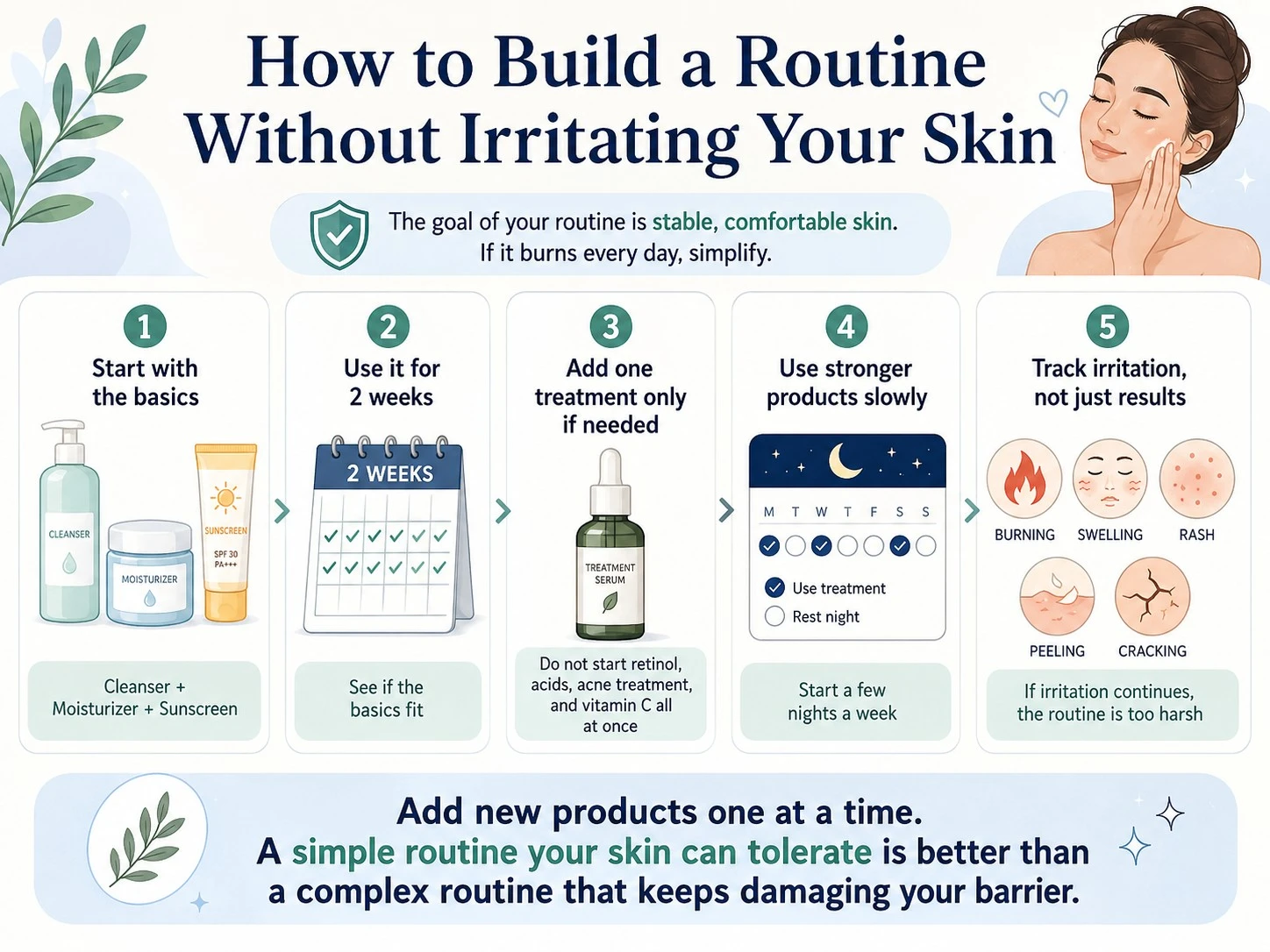
A skincare routine should make your skin more stable. If it burns every day, it needs to be simplified.
Use this order when starting:
- Start with cleanser, moisturizer, and sunscreen.
These are the foundation. - Use the routine for two weeks.
This helps you see whether the basics fit. - Add one treatment only if needed.
Do not start retinol, exfoliating acids, acne treatment, and vitamin C all at once. - Use stronger products slowly.
Start a few nights a week instead of every night. - Track irritation, not just results.
Burning, swelling, rash, severe peeling, or cracking means the routine is too harsh. - Add new products one at a time. A simple routine your skin can tolerate is better than a complex routine that keeps damaging your barrier.
Common Skincare Mistakes Beginners Should Avoid
Beginner skincare mistakes usually come from doing too much too soon.
Avoid these common problems:
- Starting too many products at once.
- Buying based on trends instead of skin type.
- Skipping sunscreen.
- Using harsh scrubs or washing too often.
- Skipping moisturizer because the skin is oily.
- Layering too many active ingredients.
- Expecting acne or dark spots to improve overnight.
- Assuming “natural” always means gentle.
- Ignoring painful, persistent, or worsening skin problems.
If your skin is tight, shiny, burning, peeling, and breaking out at the same time, reduce the routine before adding more.
How Long Does Skincare Take to Work?
Skincare is not instant. Hydration can improve quickly, but acne, texture, dark spots, and aging concerns take longer.
| Goal | Realistic Timeline |
|---|---|
| Less tightness after cleansing | A few days |
| Better hydration | 1–2 weeks |
| Less oiliness from better product choices | 2–4 weeks |
| Fewer acne breakouts | Often 6–8 weeks |
| Smoother texture | Several weeks to a few months |
| Dark spots fading | Months |
| Anti-aging prevention | Long-term consistency |
Do not judge every product after two days, but do not keep using a product that causes strong burning, swelling, rash, or severe peeling. Results can take time; serious irritation is not a normal “purge” for every product.
When Should You See a Dermatologist?
Skincare 101 can help with everyday care, but it cannot diagnose skin conditions. Some signs need professional help.
See a dermatologist if:
- Acne is painful, deep, or leaving scars.
- A rash, swelling, burning, or cracking does not improve.
- A mole or spot changes, bleeds, itches, or changes color.
- Your skin gets worse after stopping irritating products.
- You have sudden pigment changes.
- You are unsure whether a product is safe with medication, pregnancy, or a skin condition.
Getting help is not a failure of your routine. It is the right next step when basic care is not enough.
Final Thoughts
Skincare 101 is about building a simple, steady routine that fits your skin. Start with cleanser, moisturizer, and sunscreen. Learn your skin type, then add treatment only when you need it.
A good routine should make your skin feel cleaner, calmer, and easier to manage over time.
Skincare 101 FAQs
What skincare products does a beginner actually need?
A beginner needs three core products: a gentle cleanser, a moisturizer, and sunscreen. Toner, serum, exfoliant, retinol, eye cream, and masks are optional.
What is the correct order of skincare products?
In the morning, cleanse or rinse, use treatment if needed, moisturize, and apply sunscreen. At night, remove makeup or heavy sunscreen if needed, cleanse, use treatment if needed, and moisturize.
Do I need a serum?
No, serum is not required for a basic skincare routine. A serum can help if you have a specific concern, such as dullness, dark spots, dryness, or redness. Beginners should start with the basics before adding one.
Do I need toner?
No, toner is not a required step. Some toners add hydration or mild treatment, but toner should not replace cleanser, moisturizer, or sunscreen. If your routine already works, you do not need toner just to make it feel complete.
How do I know my skin type?
Look at how your skin feels after washing and during the day. Oily skin gets shiny or greasy. Dry skin feels tight or flaky. Sensitive skin stings or turns red easily. Combination skin is oily in some areas and dry in others.
Should I exfoliate every day?
No, most beginners should not exfoliate every day. Start once or twice a week if you need help with rough texture, dullness, or clogged pores. Stop or reduce use if your skin burns, peels, or feels irritated.
When should I add retinol?
Add retinol only after your basic routine is stable. Use it at night, start slowly, and wear sunscreen during the day. If you are pregnant, using skin medication, or have a skin condition, ask a professional before using retinoids.
Sources
[1] American Academy of Dermatology Association. Basic skin care
[2] American Academy of Dermatology Association. Should I apply my skin care products in a certain order?
[3] American Academy of Dermatology Association. Face washing 101
[4] American Academy of Dermatology Association. Skin care on a budget
[5] U.S. Food and Drug Administration. Sunscreen: How to Help Protect Your Skin from the Sun
[6] American Academy of Dermatology Association. American Academy of Dermatology issues updated guidelines for the management of acne


