


Glycolic acid appears in cleansers, toners, serums, creams, masks, and professional peels, but those products are not interchangeable. The same percentage can behave differently depending on pH, contact time, vehicle, and the rest of the formula, so choosing glycolic acid by the number on the label alone can be misleading.[1]
The practical question is whether glycolic acid matches your main skin concern and whether your routine can tolerate another exfoliating step. Used well, it can be a useful part of a skincare routine. Used too aggressively, it can create the redness, stinging, tightness, and peeling that people often mistake for stronger results.
What Is Glycolic Acid and How Does It Work?
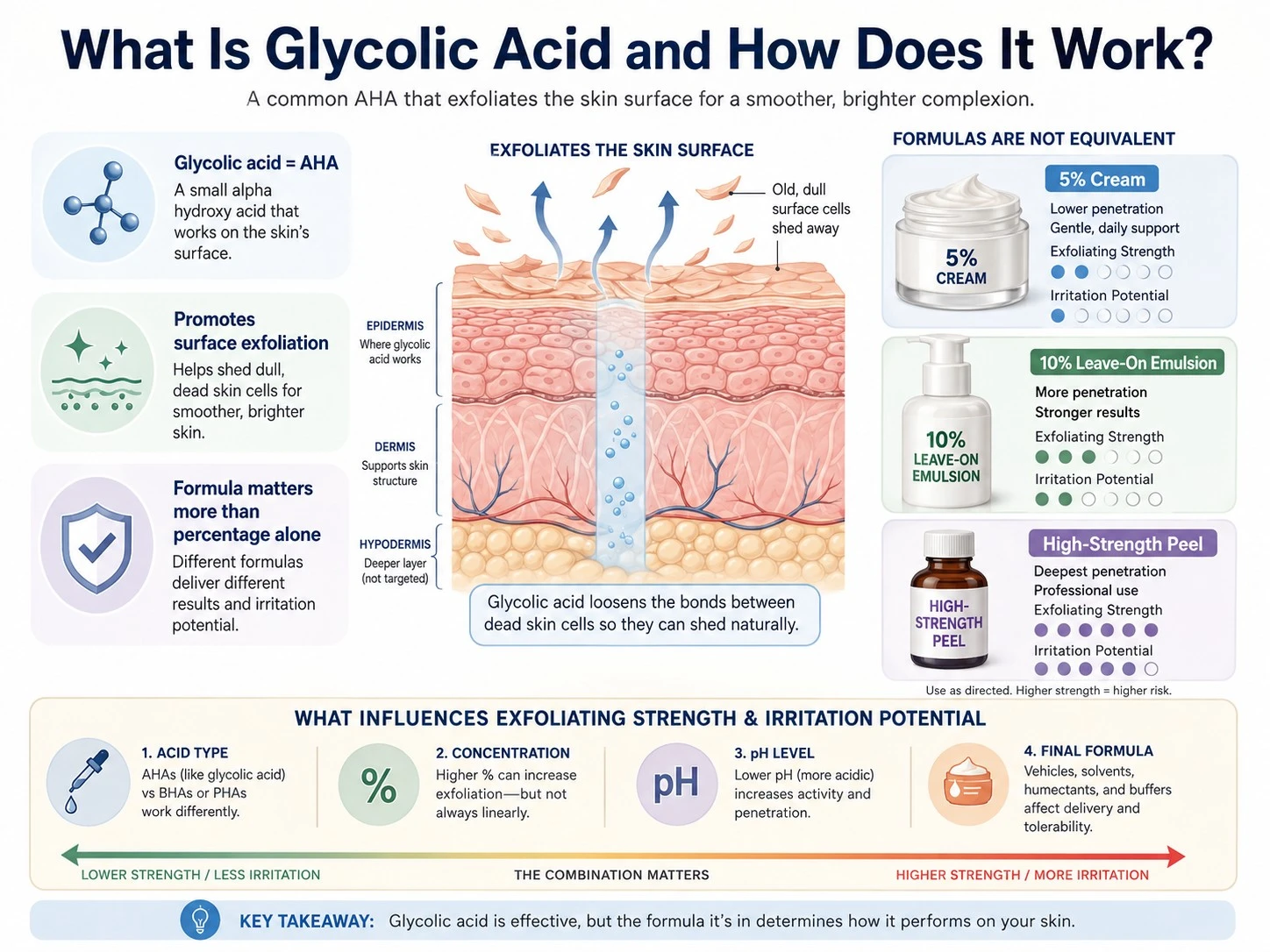
Glycolic acid is one of the most common alpha hydroxy acids used in cosmetic skincare. AHAs promote exfoliation by increasing shedding at the skin surface, and the degree of exfoliation depends on the acid type, concentration, pH, and other ingredients in the finished product.[1]
That is why a 5% cream, a 10% leave-on emulsion, and a high-strength peel should not be treated as equivalent simply because they all contain glycolic acid. The finished formulation determines how much exfoliating activity reaches the skin and how much irritation the user may experience.
If you want a broader overview of acids and other actives, see our Skincare Active Ingredients guide.
What Can Glycolic Acid Help With?
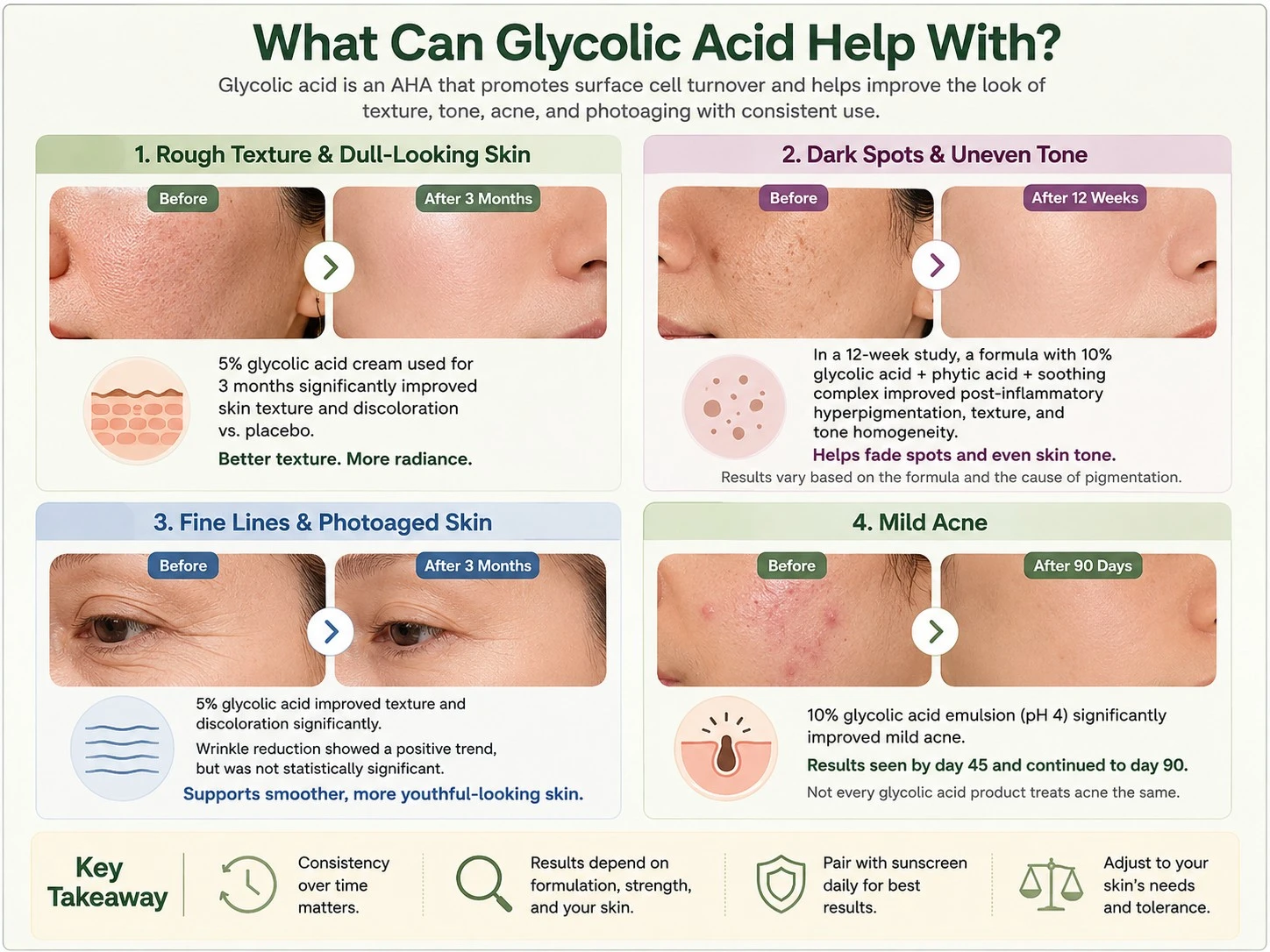
The strongest practical use case for glycolic acid is surface renewal. Clinical evidence is more convincing for texture and discoloration than for dramatic wrinkle reduction, and results depend heavily on the exact formulation being studied.
Rough Texture and Dull-Looking Skin
A randomized placebo-controlled study of a 5% glycolic acid cream used for three months found statistically significant improvement in general skin texture and discoloration compared with the control side.[2] This supports glycolic acid as a reasonable option when roughness and uneven-looking surface tone are the main concerns.
Do not expect an instant resurfacing effect from every low-strength product. Visible improvement usually depends on repeated use over time rather than one aggressive application.
Dark Spots and Uneven Tone
Glycolic acid can help improve the appearance of some superficial discoloration by increasing surface exfoliation. The 5% trial above showed improvement in discoloration, and a separate 12-week clinical study of a combination formula containing 10% glycolic acid, phytic acid, and a soothing complex reported improvement in post-inflammatory hyperpigmentation, hyperpigmentation, texture, and tone homogeneity.[2][4]
The second study tested a combination formula, so its results cannot be attributed to glycolic acid alone. Dark spots also have different causes, and deeper or persistent pigmentation may need a different treatment strategy.
Fine Lines and Photoaged Skin
Glycolic acid is commonly used in products aimed at photoaged skin, but the evidence should be described carefully. In the 5% randomized trial, skin texture and discoloration improved significantly, while the reduction in wrinkles showed only a favorable trend and did not reach statistical significance.[2]
For that reason, glycolic acid is better viewed as a resurfacing ingredient that can improve some visible signs associated with photoaging rather than as a stand-alone wrinkle treatment.
Mild Acne
A randomized double-blind placebo-controlled trial of a 10% glycolic acid oil-in-water emulsion at pH 4 found significant improvement in mild acne, with a difference from placebo evident by day 45 and continuing through day 90.[3]
That result applies to the tested formula and does not mean every glycolic-acid product treats acne equally. If blackheads and clogged pores are your dominant concern, compare glycolic acid with a pore-focused option such as Salicylic Acid for Skin rather than choosing by trend alone.
What Percentage of Glycolic Acid Should You Use?
There is no single percentage that is best for everyone. Clinical studies have reported benefits with 5% and 10% leave-on formulations, but percentage does not tell the whole story because pH, formulation, contact time, and frequency also affect how strongly an AHA exfoliates.[1][2][3]
- Rinse-off cleanser: Contact time is short, so the experience can be different from a leave-on acid even when the ingredient appears prominently on the label.
- Leave-on toner, serum, or cream: Longer skin contact makes frequency and overall routine tolerance more important.
- High-strength peel: This is a different use category from ordinary daily or weekly skincare and should not be treated as a stronger version of the same home routine.
A higher percentage is not automatically better. If a lower-strength formula produces the result you want without persistent irritation, increasing the strength adds little value.
How to Use Glycolic Acid Safely
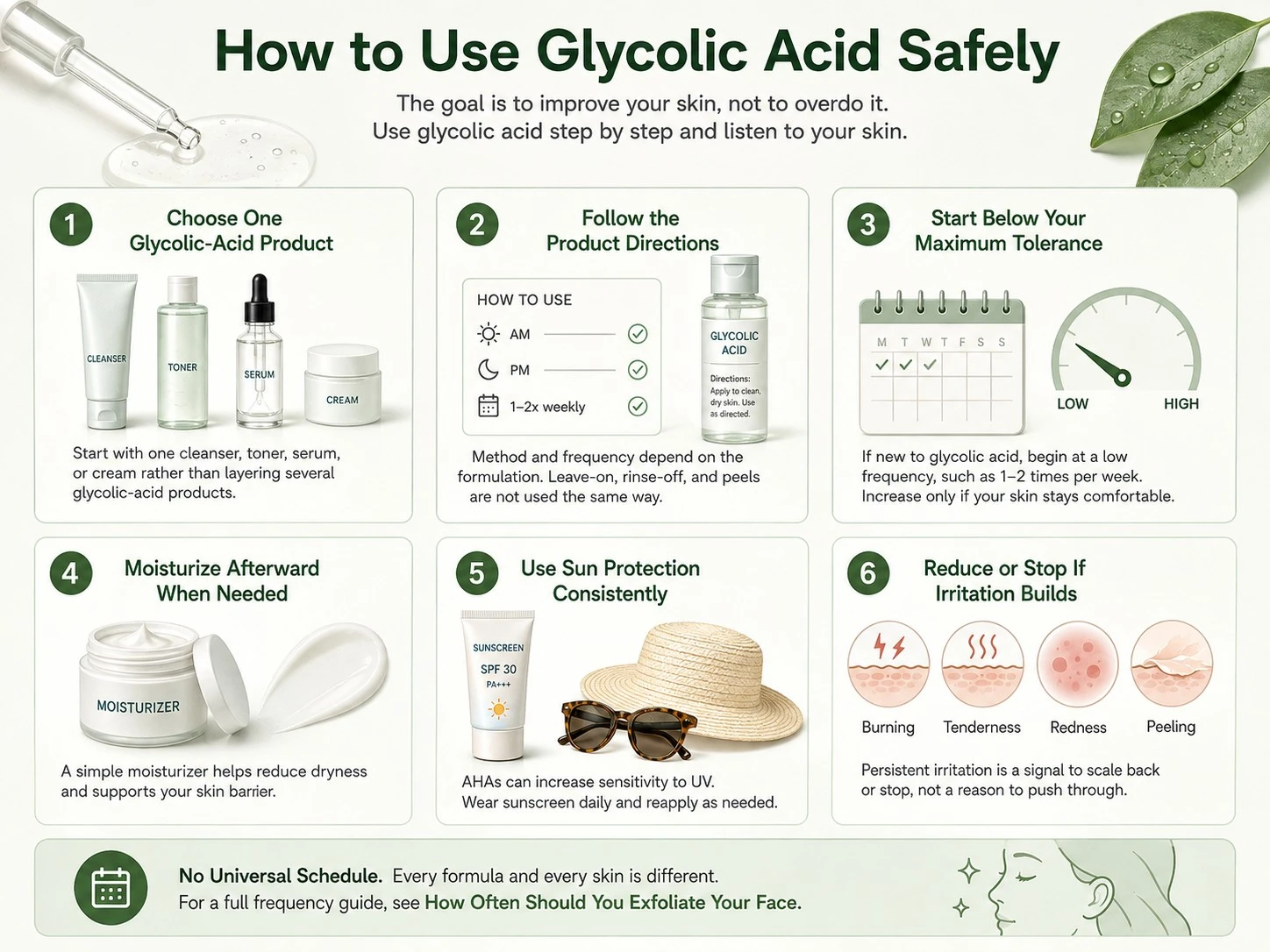
The goal is to introduce enough exfoliation to improve the target concern without turning the rest of the routine into a recovery plan.
- Choose one glycolic-acid product: Start with one cleanser, toner, serum, or cream rather than layering several glycolic-acid products.
- Follow the product directions: Application method and frequency depend on the formulation. Do not assume a leave-on acid, rinse-off cleanser, and peel should be used the same way.
- Start below your maximum tolerance: If glycolic acid is new to your routine, begin at a low frequency, such as once or twice weekly, and increase only if your skin remains comfortable.
- Moisturize afterward when needed: A simple moisturizer can help reduce dryness and keep the routine easier to evaluate.
- Use sun protection consistently: AHA use can temporarily increase sensitivity to UV radiation and the possibility of sunburn.[1] See How to Use Sunscreen Correctly for Full Protection for application guidance.
- Reduce or stop if irritation builds: Persistent burning, tenderness, redness, or peeling is a reason to scale back rather than push through.
There is no universal schedule for every glycolic-acid formula. For a broader frequency framework, see How Often Should You Exfoliate Your Face.
How to Combine Glycolic Acid With Other Skincare
Most combination problems are not about ingredients chemically “canceling each other out.” They are about total irritation. If two products both increase dryness, peeling, or sensitivity, using them together can make it harder to tell which product is causing the problem.
- Retinol or other retinoids: Introduce separately first. If both are tolerated, alternating nights is often easier to assess than starting both in the same routine. See our Retinol Guide.
- Salicylic acid or another exfoliating acid: Avoid adding multiple exfoliating acids at once when you are still learning your tolerance.
- Physical scrubs or exfoliating tools: Repeated chemical plus mechanical exfoliation can increase the total irritation load.
- Moisturizer and basic hydrating products: These can usually remain in the routine and may make glycolic acid easier to tolerate.
If your routine already includes several active treatments, change one variable at a time. That makes it much easier to identify whether a new problem is caused by glycolic acid, another active, or the combination.
When Glycolic Acid Is Not the Right Choice
Do not keep increasing exfoliation when the skin is already showing clear signs of irritation. Burning, persistent stinging, swelling, rash, tenderness, and peeling are recognized adverse reactions associated with AHA-containing products.[1]
Pause glycolic acid when your skin is sunburned, raw, actively peeling, or recovering from obvious over-exfoliation. If you are already dealing with tightness, burning, and repeated flaking, use our Over-Exfoliated Skin and Skin Barrier guides before trying to increase exfoliation again.
Severe pain, blistering, marked swelling, a spreading rash, or symptoms that do not improve after stopping the product should be assessed by a qualified healthcare professional.
Common Glycolic Acid Mistakes
- Choosing only by percentage: pH and formulation also affect exfoliating activity.[1]
- Using it every day immediately: The label maximum is not a target you must reach.
- Stacking several exfoliants: A glycolic toner, acid serum, scrub, and peel can create much more total exfoliation than expected.
- Treating burning as proof that it is working: Persistent discomfort is a warning sign, not a performance metric.
- Ignoring sunscreen: AHA use can increase UV sensitivity while the product is being used and for a period after discontinuation.[1]
- Expecting every dark spot to respond the same way: Pigmentation has multiple causes and may need a more specific approach.
- Assuming every breakout is “purging”: New bumps can also reflect irritation or a product that does not suit your skin. See Skin Purging vs Breakout if the pattern is unclear.
Final Thoughts
Glycolic acid is most useful when you want controlled surface exfoliation for concerns such as rough texture, dullness, uneven-looking tone, or selected cases of mild acne. Clinical studies support benefits from some low-strength leave-on formulations, but those results do not justify treating every glycolic-acid product as equivalent.[2][3]
Choose the product by your concern, formulation, and tolerance rather than percentage alone. Start conservatively, avoid unnecessary exfoliant stacking, and use consistent sun protection. If your skin becomes persistently red, tight, stingy, or flaky, reducing exfoliation is usually more useful than adding another active.
FAQs About Glycolic Acid for Skin
Can I use glycolic acid every day?
Some formulations are designed for daily use, and clinical studies have tested daily 5% and 10% leave-on products.[2][3] That does not mean daily use is necessary for everyone. Follow the directions for your product and reduce frequency if dryness, stinging, redness, or peeling develops.
How long does glycolic acid take to work?
Different concerns change at different speeds. A 10% mild-acne trial found a significant difference from placebo by day 45, while a 5% photoaging study assessed results after three months.[2][3] Expect gradual change over weeks rather than judging the product after a few applications.
Does glycolic acid help dark spots?
It can improve the appearance of some superficial discoloration. A 5% glycolic-acid trial showed improvement in discoloration, while a 10% glycolic-acid combination formula improved several pigmentation measures over 12 weeks.[2][4] Persistent pigmentation may need a more targeted diagnosis and treatment plan.
Is glycolic acid good for acne?
It can help some mild acne. A randomized trial of a 10% glycolic-acid emulsion showed significant improvement versus placebo.[3] For persistent inflammatory acne, painful lesions, or scarring, exfoliation alone may not be enough.
Can I use glycolic acid and retinol together?
They can exist in the same overall routine, but using both at once may be too irritating for some people. Introduce them separately first and consider alternating nights if you are unsure how your skin will respond.
Does glycolic acid cause skin purging?
A breakout after starting glycolic acid should not automatically be labeled purging. Exfoliation can change how clogged pores become visible, but irritation, product intolerance, or ordinary acne can also cause new bumps. If breakouts are widespread, painful, unusually persistent, or accompanied by burning and redness, reassess the product rather than assuming the reaction is temporary.
Sources
[1] U.S. Food and Drug Administration. Alpha Hydroxy Acids
[2] Thibault PK et al. A Double-Blind Randomized Clinical Trial on the Effectiveness of a Daily Glycolic Acid 5% Formulation in the Treatment of Photoaging
[3] Abels C et al. A 10% Glycolic Acid Containing Oil-in-Water Emulsion Improves Mild Acne: A Randomized Double-Blind Placebo-Controlled Trial
[4] Houshmand EB. Effect of Glycolic Acid, Phytic Acid, Soothing Complex Containing Emulsion on Hyperpigmentation and Skin Luminosity: A Clinical Evaluation


