

Polyglutamic acid has become a popular hydrating ingredient in serums, essences, and moisturizers. Its most credible role is straightforward: it helps a formula hold water at the skin’s surface and can leave skin feeling smoother and less tight. It is not a peel, acne treatment, or proven wrinkle treatment.
The evidence also needs context. Polyglutamic acid has useful material properties and encouraging laboratory data, but broad claims that it holds several thousand times its weight in water or is always more hydrating than hyaluronic acid do not predict how every finished product will perform. Formula design and how the product fits your routine are more useful guides.
What Is Polyglutamic Acid and How Does It Work?
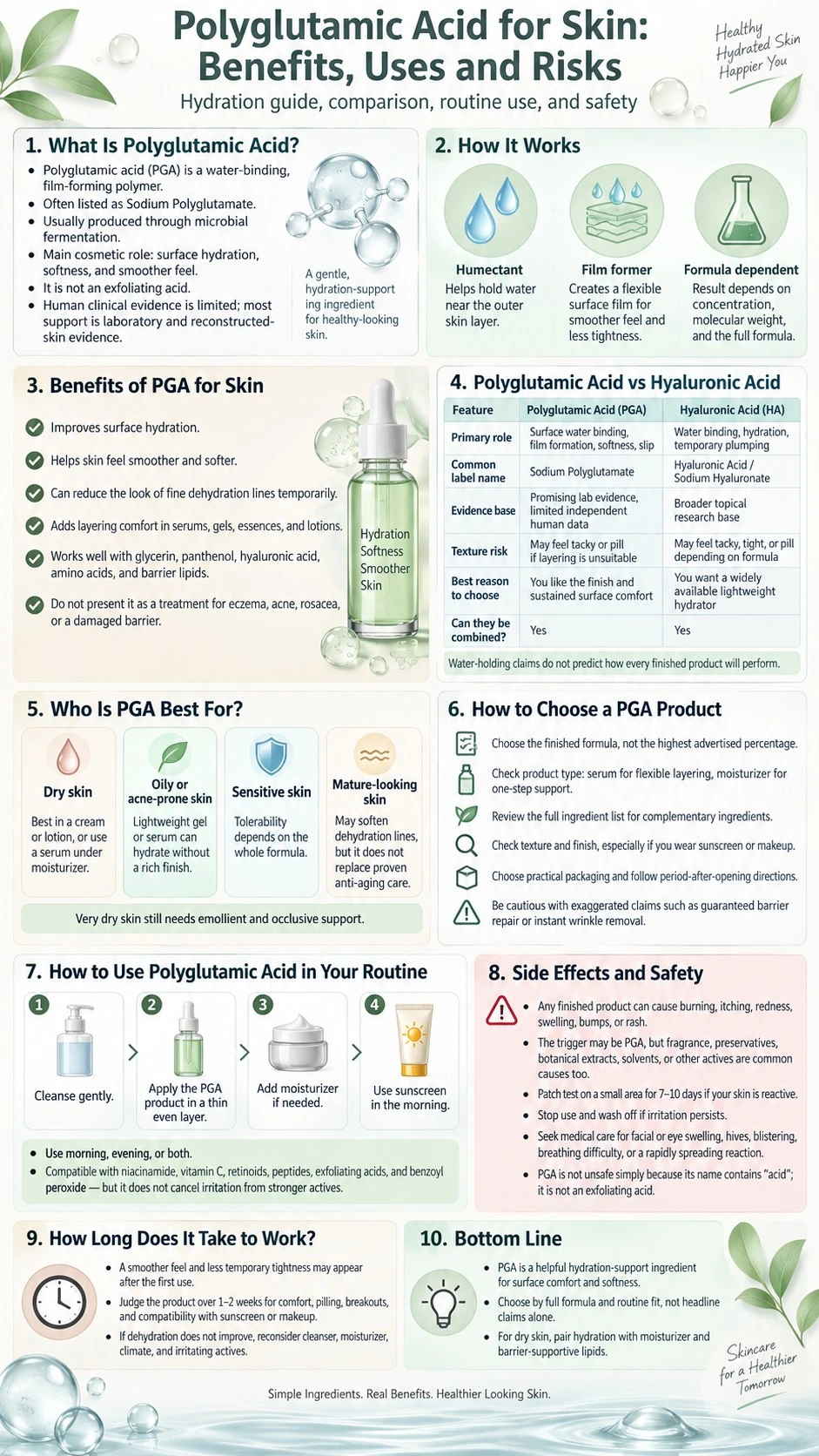
Polyglutamic acid, often shortened to PGA, is a polymer made from linked glutamic-acid units. The form used in cosmetics is commonly gamma-polyglutamic acid produced through microbial fermentation. On an ingredient list, you may see Sodium Polyglutamate rather than the consumer-facing name polyglutamic acid.
PGA is a large, water-soluble molecule. In a topical product, it mainly behaves as a humectant and film former: it associates with water and forms a flexible layer on the skin’s surface. That layer can reduce the dry, rough feel associated with dehydration and improve the product’s glide. Molecular weight, concentration, other polymers, glycerin, oils, and the base formula all affect the result.
Recent laboratory work found that a high-molecular-weight gamma-PGA increased several hydration- and barrier-related markers in keratinocytes and a reconstructed skin model. The study used 1% PGA in the reconstructed model, but it did not test a retail cosmetic on people. It supports a plausible mechanism, not a guarantee that every PGA serum repairs the skin barrier or produces the same result.[1]
What Are the Benefits of Polyglutamic Acid for Skin?
Polyglutamic acid is best understood as a hydration-support ingredient. Its likely benefits come from water binding, film formation, and the sensory effect of the finished formula.
- Improved surface hydration: PGA can help keep water close to the outer skin layer, which may reduce temporary tightness and make dehydrated skin feel more comfortable.
- A smoother, softer feel: A well-designed film-forming formula can soften the look of fine dehydration lines and improve slip. This is a temporary cosmetic effect, not permanent wrinkle correction.
- Better layering comfort: PGA can fit lightweight serums, gels, essences, and lotions. In the right polymer system, it can add cushion without requiring a heavy cream.
- Complementary barrier support: Laboratory findings suggest effects on proteins and pathways involved in barrier function and moisture retention. Human trials are still needed before those findings can be treated as established clinical benefits.[1]
- Compatibility with other hydrators: PGA can be formulated with glycerin, panthenol, ectoin, hyaluronic acid, amino acids, and barrier lipids. The combination may be more useful than asking one humectant to do every job.
PGA should not be presented as a treatment for eczema, acne, rosacea, or a damaged barrier. A hydrating product may improve comfort, but persistent inflammation, cracking, oozing, pain, or a spreading rash needs a different level of evaluation.
Polyglutamic Acid vs Hyaluronic Acid
Polyglutamic acid and hyaluronic acid are both hydrophilic polymers used to support hydration, but they are not interchangeable raw materials. Hyaluronic acid is a glycosaminoglycan naturally present in human tissues and has a much broader topical research base. PGA is a glutamic-acid polymer whose skincare evidence is newer and more laboratory-heavy.[2]
| Comparison point | Polyglutamic acid | Hyaluronic acid |
|---|---|---|
| Primary cosmetic role | Surface water binding, film formation, softness, and slip | Water binding, film formation, hydration, and temporary plumping |
| Common label name | Sodium Polyglutamate | Hyaluronic Acid, Sodium Hyaluronate, or related derivatives |
| Evidence base | Promising laboratory and reconstructed-skin evidence; limited independent human data | Broader topical literature, although results still belong to specific formulas |
| Texture risk | May feel tacky or pill when the polymer load or layering is unsuitable | May feel tacky, tight, or pill depending on molecular weight, amount, and vehicle |
| Best reason to choose it | You like the finish and sustained surface comfort of the product | You want a widely available, lightweight hydration option |
| Can they be combined? | Yes | Yes |
Claims that PGA holds four, ten, or thousands of times more water than hyaluronic acid are not a reliable shopping rule. Such numbers may come from different test methods, raw materials, molecular weights, or supplier conditions. They do not establish that one complete serum hydrates human skin better than another. For more detail on the comparison ingredient, see ZICAIL’s guide to hyaluronic acid.
Who Is Polyglutamic Acid Best For?
PGA can suit most skin types when the complete product is well tolerated. It is especially relevant when the main problem is dehydration: skin feels tight, looks temporarily dull, or shows fine lines that become less visible after moisturizing.
- Dry skin: Choose PGA in a cream or lotion, or place a serum under a moisturizer. PGA supplies water-binding support but does not replace oils, fatty alcohols, ceramides, petrolatum, or other emollient and occlusive ingredients.
- Oily or acne-prone skin: A lightweight PGA gel or serum can add hydration without a rich finish. The ingredient does not treat acne, and its presence does not prove the product is non-comedogenic.
- Sensitive skin: PGA itself is not an exfoliant, but sensitivity depends on the whole formula. Fragrance, essential oils, drying alcohols, preservatives, and added actives may matter more.
- Mature-looking skin: Improved hydration can temporarily soften dehydration lines and make skin look smoother. PGA has not been shown to rebuild lost facial volume or replace proven photoaging treatments.
If skin is persistently rough, flaky, or easily irritated, hydration and lipids usually need to work together. ZICAIL’s skin barrier guide explains why a humectant alone may not provide lasting comfort.
How to Choose a Polyglutamic Acid Product
Choose the finished formula rather than chasing the highest advertised percentage. A brand may quote the percentage of a supplier blend rather than the amount of pure PGA, and products with the same headline number can have very different textures and performance.
Check these practical factors:
- Product type: A serum works as a flexible hydration layer; a moisturizer can combine PGA with emollients and occlusives in one step.
- Full ingredient list: Glycerin, panthenol, hyaluronic acid, amino acids, ceramides, squalane, and suitable oils can make the formula more complete for its intended skin type.
- Texture and finish: Polymer-rich products may pill under sunscreen or makeup. A smaller amount and fewer stacked serums often work better than adding more product.
- Packaging and use period: Choose packaging you can close cleanly and follow the label’s storage and period-after-opening directions.
- Claims quality: Be cautious with exact water-holding multipliers, guaranteed barrier repair, instant wrinkle removal, or medical-treatment language that is not supported by finished-product testing.
For very dry skin, deciding between a serum and a cream matters more than whether PGA appears near the top of the label. A serum and moisturizer perform different routine jobs.
How to Use Polyglutamic Acid in Your Routine
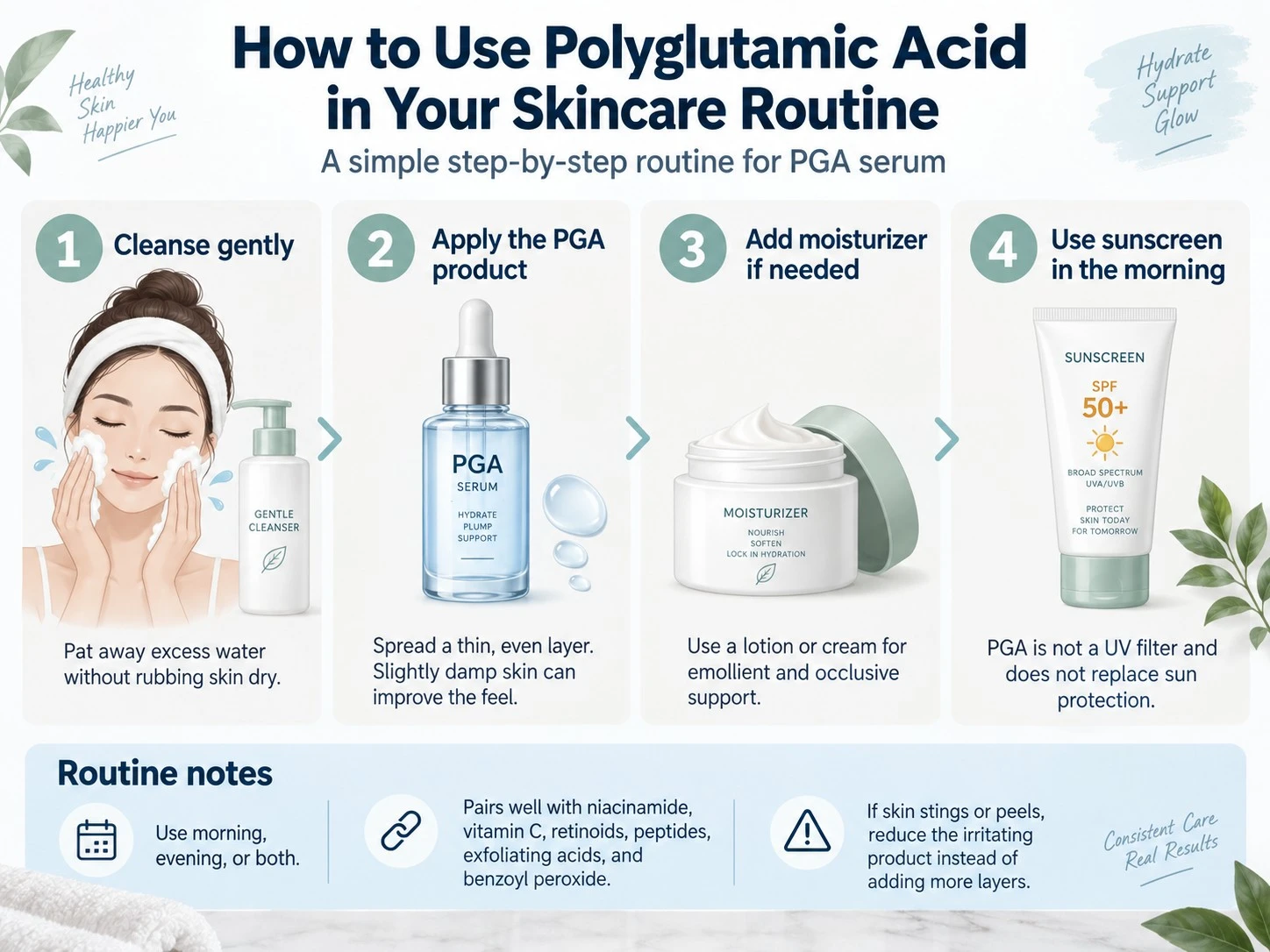
Use the product as directed on its label. For a typical leave-on PGA serum, this sequence is practical:
- Cleanse gently. Pat away excess water without rubbing the skin dry.
- Apply the PGA product. Spread a thin, even layer. Slightly damp skin can improve the feel of a humectant serum, but dripping-wet skin is not required.
- Add moisturizer when needed. A lotion or cream supplies emollient and occlusive support that a watery serum may lack.
- Finish the morning routine with sunscreen. PGA is not a UV filter and does not make skin sun-sensitive, but it also does not replace sun protection.
PGA can generally be used in the morning, evening, or both. It has no known routine-level conflict with niacinamide, vitamin C, retinoids, peptides, exfoliating acids, or benzoyl peroxide. However, it cannot cancel irritation caused by stronger actives. If a routine stings or peels, reduce the irritating product rather than adding more hydrating layers. ZICAIL’s skincare routine order guide covers the broader thin-to-thick layering principle.
Side Effects and Safety
Polyglutamic acid is not expected to exfoliate or deliberately irritate skin. Still, any cosmetic can cause burning, itching, redness, swelling, bumps, or a rash. The cause may be PGA, but fragrance, preservatives, botanical extracts, solvents, or another active in the same formula are often plausible alternatives.
If your skin is reactive, test the finished product on a small area before broader use. A practical home test is to apply the product to a small spot twice daily for seven to ten days, using it for the same contact time intended on the face. Stop if the test area becomes red, itchy, or swollen.[3]
Wash the product off and stop using it if irritation persists. Seek prompt medical care for facial or eye swelling, hives, blistering, breathing difficulty, or a rapidly spreading reaction. A dermatologist can help identify the trigger when reactions recur or the responsible ingredient is unclear.
There is no reason to assume that PGA is unsafe during pregnancy simply because its name contains “acid”; it is not an exfoliating acid. However, pregnancy decisions should be based on the complete ingredient list and the user’s medical circumstances, not the PGA label alone.
How Long Does Polyglutamic Acid Take to Work?
A smoother feel and less temporary tightness may be noticeable after the first application because film formation and surface hydration can happen quickly. The effect lasts only while the formula remains effective on the skin and the rest of the routine supports it.
Judge a product over one to two weeks for daily comfort, pilling, breakouts, and compatibility with sunscreen or makeup. Claims of longer-term barrier improvement need finished-product evidence; laboratory changes in proteins or gene expression do not establish a fixed timeline for visible results in people.[1]
If dehydration remains unchanged after several weeks, reconsider the cleanser, moisturizer, application amount, climate, and use of irritating actives. Adding another humectant is not always the answer when skin mainly lacks lipids or is inflamed.
FAQs About Polyglutamic Acid for Skin
Is polyglutamic acid an exfoliating acid?
No. In skincare, polyglutamic acid is used mainly as a water-binding, film-forming polymer. It does not loosen dead skin cells like alpha-hydroxy acids or beta-hydroxy acids, so it does not require the same exfoliation schedule.
Can you use polyglutamic acid every day?
Yes, many PGA serums and moisturizers are designed for daily use. Follow the product label and reduce frequency if the complete formula causes persistent stinging, redness, itching, or bumps.
Can you use polyglutamic acid with retinol or vitamin C?
Usually, yes. PGA has no known direct routine conflict with retinoids or vitamin C and can provide hydration alongside them. It will not prevent irritation from an overly strong active, so adjust that active if burning, peeling, or redness continues.
Is polyglutamic acid better than hyaluronic acid?
Not universally. PGA may provide a smooth, film-forming finish, while hyaluronic acid has a broader topical evidence base and many available molecular forms. The better choice is the finished product that gives sustained comfort, layers well, and supplies enough lipid support for your skin.
Sources
[2] Papakonstantinou E, Roth M, Karakiulakis G. Hyaluronic Acid: A Key Molecule in Skin Aging
[3] American Academy of Dermatology Association. How to Test Skin Care Products


