


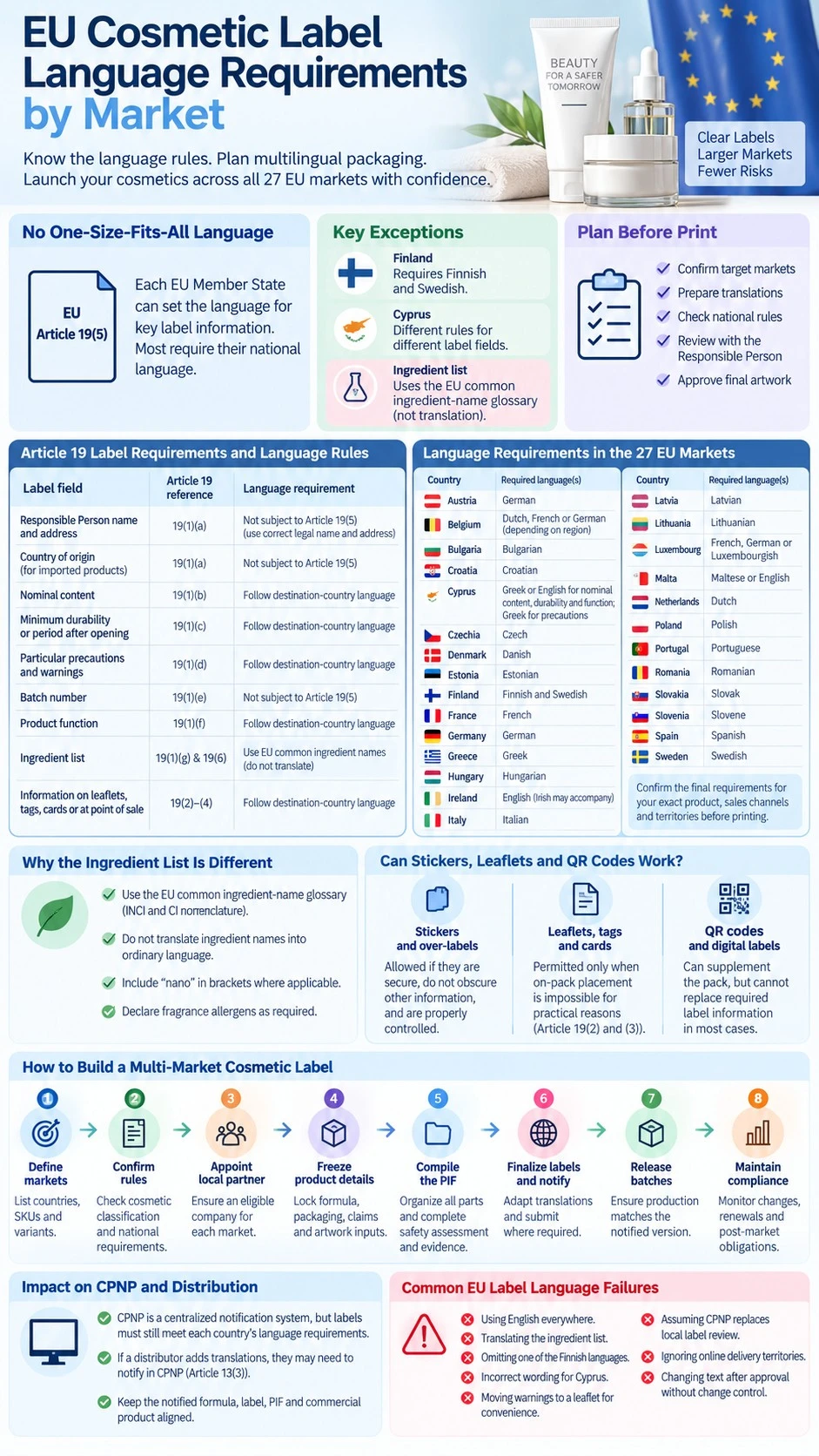
A label that works in Germany may fail in France, Finland, or Cyprus even when the formula, safety assessment, and CPNP notification are unchanged. For private label brands, language planning is therefore an artwork-control task as well as a regulatory task. The safest workflow starts with a confirmed sales-country list, maps every mandatory statement to the destination rule, and freezes translations before print production.
This guide explains which cosmetic label fields are controlled by national language law, provides a market-by-market planning table for the 27 EU Member States, and shows how to manage multilingual packs without confusing the ingredient list, claims, or notification obligations. It is a practical planning guide, not a substitute for review by the EU Responsible Person or the competent authority in each destination market.
What Does Article 19 Require on an EU Cosmetic Label?
Article 19 of Regulation (EC) No 1223/2009 requires specified information to appear in indelible, easily legible, and visible lettering on the container and packaging, subject to limited placement exceptions. The required particulars include the Responsible Person’s name and address, country of origin for imported products, nominal content, durability information, precautions, batch identification, product function when it is not clear from presentation, and the ingredient list.[1]
The EU rule is harmonized, but its language clause is selective. Article 19(5) says national law determines the language of the information in Article 19(1)(b), (c), (d), and (f), plus the information covered by paragraphs 2, 3, and 4.[1] This means a brand should not treat every printed element as if it followed the same translation rule.
| Label field | Article 19 reference | National-language treatment | Practical note |
|---|---|---|---|
| Responsible Person name and address | 19(1)(a) | Not one of the fields delegated by Article 19(5) | Use the legally correct name and physical address; highlight the PIF address if several addresses appear. |
| Country of origin for an imported cosmetic | 19(1)(a) | Not one of the fields delegated by Article 19(5) | Do not assume a marketing phrase automatically satisfies the origin requirement. |
| Nominal content | 19(1)(b) | Destination-country language rule applies | Symbols and metric units reduce text, but any required words must follow local law. |
| Minimum durability or period after opening | 19(1)(c) | Destination-country language rule applies | Use the prescribed symbol where applicable and localize any accompanying wording. |
| Particular precautions and professional-use warnings | 19(1)(d) | Destination-country language rule applies | Translate the complete safety meaning, including mandatory Annex wording. |
| Batch number or identifying reference | 19(1)(e) | Not one of the fields delegated by Article 19(5) | Keep the identifier consistent with manufacturing and traceability records. |
| Product function | 19(1)(f) | Destination-country language rule applies | It may be omitted only when the function is clear from presentation. |
| Ingredient list | 19(1)(g) and 19(6) | Use the EU common ingredient-name system | Do not translate INCI-style ingredient names into ordinary consumer wording. |
| Attached leaflet, label, tape, tag, card, or point-of-sale notice | 19(2)–(4) | Destination-country language rule applies | These are conditional placement routes, not a general permission to move text off-pack. |
EU Cosmetic Label Language Requirements by Market
The table below is an artwork-planning baseline for the 27 EU Member States. It describes the language normally used for the Article 19(5) fields, not every rule that may affect claims, recycling marks, aerosols, biocides, or other product categories. Confirm the final matrix for the exact SKU, sales channels, and territories before printing. Multilingual countries and fields with special treatment need particular attention.
| EU market | Planning language for required consumer information | Artwork note |
|---|---|---|
| Austria | German | Use German for the locally controlled mandatory fields. |
| Belgium | Dutch, French, or German according to the language region | For nationwide distribution, plan the languages needed across all intended regions and confirm the channel’s coverage. |
| Bulgaria | Bulgarian | Cyrillic artwork needs a native-language accuracy and legibility check. |
| Croatia | Croatian | Keep warning terminology consistent across pack components. |
| Cyprus | Greek or English for nominal content, durability, and function; Greek for precautions | Cyprus applies a field-specific rule: Article 19(1)(d) precautions must be in Greek, while points (b), (c), and (f) may be in Greek or English.[2] |
| Czechia | Czech | Use Czech diacritics correctly and check minimum type size visually. |
| Denmark | Danish | Localize safety and function statements, not the ingredient names. |
| Estonia | Estonian | Confirm translations against the final CPSR precautions. |
| Finland | Finnish and Swedish | Both languages are required for specified information; Tukes lists nominal content, durability information, and user instructions in both.[3] |
| France | French | French consumer-language rules can also affect voluntary presentation and claims beyond Article 19(5). |
| Germany | German | Translate mandatory consumer information before artwork release. |
| Greece | Greek | Do not treat English acceptance in Cyprus as acceptance in Greece. |
| Hungary | Hungarian | Review long agglutinative wording early because it can materially expand copy length. |
| Ireland | English; Irish may accompany English | HPRA states that labels should be in English, or Irish and English.[4] |
| Italy | Italian | Use consistent Italian terminology for precautions and product function. |
| Latvia | Latvian | Check all diacritics after font substitution and proof export. |
| Lithuania | Lithuanian | Validate the final print proof, not only the source translation file. |
| Luxembourg | French, German, or Luxembourgish | Confirm the selected language with the Responsible Person and distributor for the intended route to market. |
| Malta | Maltese or English | National implementation accepts the locally controlled label information in Maltese or English.[5] |
| Netherlands | Dutch | Do not rely on English simply because it is widely understood. |
| Poland | Polish | The Court of Justice has confirmed that required function information must be accessible on the permitted label medium in the prescribed language.[6] |
| Portugal | Portuguese | Use European Portuguese rather than assuming Brazilian Portuguese is interchangeable. |
| Romania | Romanian | Lock special characters and punctuation during prepress. |
| Slovakia | Slovak | Do not reuse Czech text without a dedicated Slovak review. |
| Slovenia | Slovene | Keep Slovene distinct from neighboring South Slavic languages. |
| Spain | Spanish | AEMPS requires at least nominal content, minimum durability, precautions, and product function in Spanish; assess additional regional consumer-language rules for the actual territory.[7] |
| Sweden | Swedish | Use Swedish for the nationally controlled mandatory particulars. |
A single “EU label” is therefore possible only when the artwork contains every required language for every destination it will serve and remains legible. The table is not permission to use the same translation for different countries that share a language: terminology, mandatory phrases, distributor expectations, and other national consumer rules may still differ.
Why the Ingredient List Is Different
The ingredient list is governed by Article 19(1)(g) and 19(6), not by the national-language list in Article 19(5). Ingredient names must use the common ingredient name in the glossary compiled and updated by the European Commission. That glossary takes account of internationally recognized systems including INCI, and CI nomenclature is used for applicable colorants.[8]
This creates a common mistake: a brand translates ingredients such as Aqua, Glycerin, or botanical names into ordinary language because the rest of the label is localized. Doing so can break the standardized ingredient declaration. Translate consumer instructions and product function where required, but keep ingredient names in the prescribed nomenclature.
The ingredient declaration still needs regulatory maintenance. Nanomaterials require “nano” in brackets after the ingredient name where applicable, colorants may use CI numbers, and fragrance allergens must be declared under the names and thresholds in the Cosmetics Regulation. Language planning cannot be separated from the current EU fragrance allergen labeling requirements.
How to Build a Multi-Market Cosmetic Label
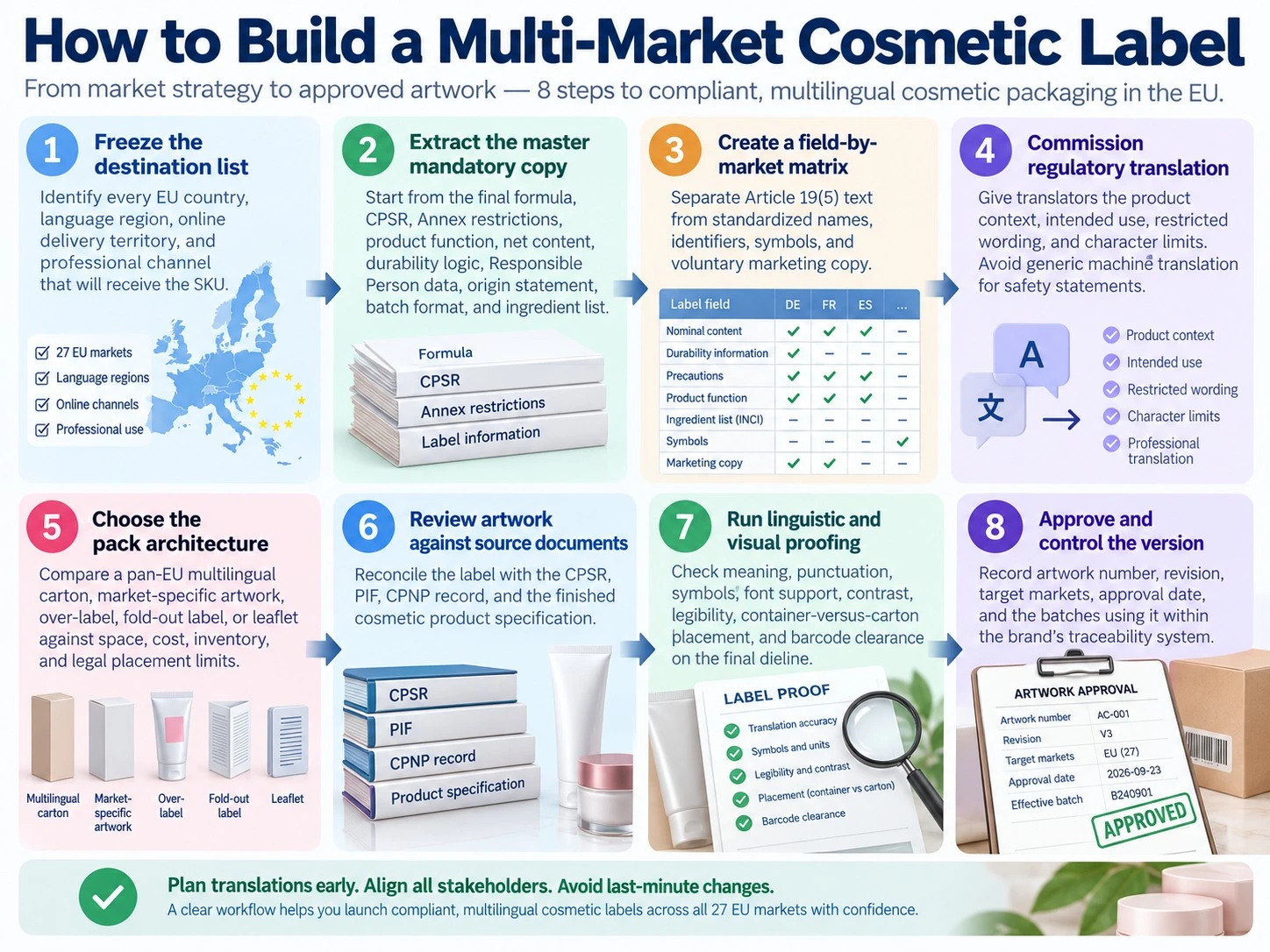
- Freeze the destination list: identify every EU country, language region, online delivery territory, and professional channel that will receive the SKU.
- Extract the master mandatory copy: start from the final formula, CPSR, Annex restrictions, product function, net content, durability logic, Responsible Person data, origin statement, batch format, and ingredient list.
- Create a field-by-market matrix: separate Article 19(5) text from standardized names, identifiers, symbols, and voluntary marketing copy.
- Commission regulatory translation: give translators the product context, intended use, restricted wording, and character limits; avoid generic machine translation for safety statements.
- Choose the pack architecture: compare a pan-EU multilingual carton, market-specific artwork, over-label, fold-out label, or leaflet against space, cost, inventory, and legal placement limits.
- Review artwork against source documents: reconcile the label with the CPSR, PIF, CPNP record, and the finished cosmetic product specification.
- Run linguistic and visual proofing: check meaning, punctuation, symbols, font support, contrast, legibility, container-versus-carton placement, and barcode clearance on the final dieline.
- Approve and control the version: record artwork number, revision, target markets, approval date, and the batches using it within the brand’s batch code and product traceability system.
This sequence prevents a common private label failure: approving a visually finished pack before the safety assessor, Responsible Person, distributor, and translators have agreed on the exact mandatory copy. Late translation then causes cramped text, unauthorized abbreviations, or missing languages.
Can Stickers, Leaflets, and QR Codes Solve Space Problems?
Over-labels and stickers
A well-controlled sticker can be a practical way to create a market-specific version, but it must not obscure other required information, detach during normal handling, or make the label difficult to read. The Responsible Person and distributor should approve the translated copy, placement, material compatibility, and revision control before application.
Leaflets, tags, and cards
Article 19(2) permits particular precautions and the ingredient list to appear on an enclosed or attached leaflet, label, tape, tag, or card only where placing them on the container and packaging is impossible for practical reasons. The hand-and-book symbol or an abbreviated indication must direct consumers to that information. It is a limited exception, not a design preference.[1]
For small unpackaged soaps, bath balls, and similar products, Article 19(3) provides a point-of-sale route for the ingredient list when the practical exception cannot be used. Brands should document why the chosen exception applies.
QR codes and digital labels
A QR code can supplement the pack with translations, tutorials, or updated brand content, but Article 19 does not generally allow a website to replace mandatory physical label information. The Court of Justice held in Case C-667/19 that a reference to a separate company catalogue did not satisfy the permitted labelling routes for required information.[6] Treat digital content as additional unless a specific legal provision expressly authorizes digital-only delivery.
How Language Rules Affect CPNP and Distribution
CPNP is a centralized notification system. Once a product is notified, no separate national cosmetic notification is generally required within the EU.[9] That does not make the notified label automatically suitable for every market. The physical product must still meet the destination country’s language law.
A distributor must act with due care and verify, before making a product available, that required label information is present and that Article 19(5) language requirements are fulfilled. When a distributor translates, on its own initiative, any label element to comply with national law, Article 13(3) can trigger a distributor notification in CPNP. The Commission’s CPNP guidance expressly identifies distributors performing such translations as portal users.[9]
The practical control point is change management. A translated sticker, carton, or leaflet is not merely sales collateral; it is a regulated artwork version. The Responsible Person, brand, manufacturer, and distributor should agree who owns translation approval, CPNP action, stock segregation, and market release. For the broader launch sequence, see ZICAIL’s EU cosmetics compliance guide.
Common EU Label Language Failures
- Using English everywhere: widespread consumer understanding does not override the language chosen by national law.
- Translating the INCI list: ordinary-language ingredient translations can conflict with the prescribed common ingredient names.
- Localizing only the carton: some information must also appear on the immediate container, subject to Article 19 exceptions.
- Omitting one Finnish language: Finnish-only or Swedish-only artwork does not meet the bilingual requirement for the specified fields.
- Treating Cyprus as simply Greek or English: precautions must be Greek, even though other specified fields may be Greek or English.
- Moving warnings to a leaflet for convenience: the practical-impossibility condition must be satisfied before using the Article 19(2) route.
- Assuming CPNP replaces local label review: centralized notification and destination-language compliance are separate obligations.
- Ignoring online delivery territories: the label must be compliant where the cosmetic is made available to the end user, not only where the warehouse is located.
- Changing text after approval: even a small translation edit can alter a precaution, claim, or product function and should enter artwork change control.
Plan EU-Ready Cosmetic Artwork With ZICAIL
For a private label project, the most efficient language decision is made before the dieline is finalized. ZICAIL can coordinate formula documentation, required precautions, ingredient declarations, batch coding, packaging layout inputs, and market-specific artwork files with your EU compliance partners. The final legal release remains subject to the appointed Responsible Person and destination-market review.
Send ZICAIL your target EU countries, product format, pack dimensions, claims, and launch schedule. We can help convert that scope into an artwork matrix and manufacturing brief that reduces late-stage translation changes, obsolete packaging inventory, and avoidable market delays.


