
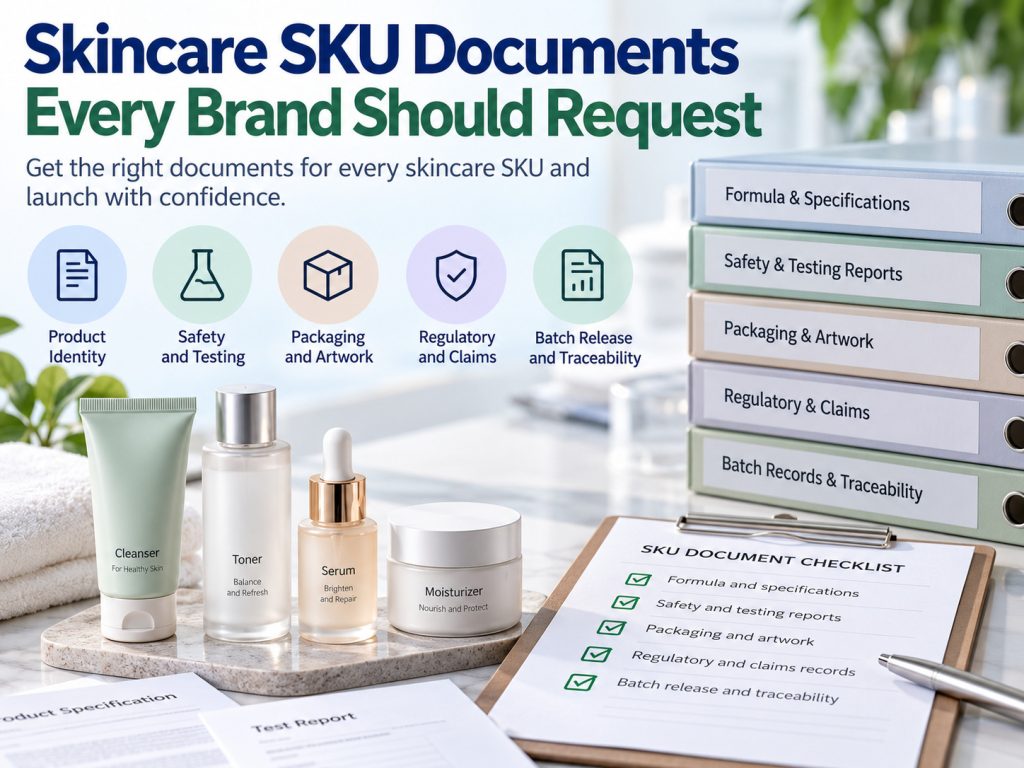


A skincare brand does not need a random folder of certificates. It needs a controlled record showing exactly what each SKU is, how it was assessed, which packaging and artwork were approved, and which batch was released. That distinction becomes critical when one formula is sold in several sizes, fragrances, packages or markets.
The best approach is to create a master document file for each commercial SKU, then connect it to shared formula records, supplier-level certificates and batch-specific release records. This guide explains what to request, what may be shared, and when a change should trigger a document review.
Build One Controlled Master File for Each SKU
A SKU is the exact sellable configuration of a product—not just the bulk formula. A 50 mL serum in an airless pump and the same serum in a 15 mL dropper may use the same formula, but they have different component specifications, fill quantities, artwork, compatibility risks and traceability records. Each therefore needs a distinct SKU file or a clearly controlled SKU annex.
Start the file with a document register. Record the document title, document number, revision, issuer, owner, approval date, status, applicable formula and packaging versions, target markets, review or expiry date, and storage location. If confidential formula information is restricted, record who can access it and how it will be supplied to an authorized safety assessor or regulator.
| Document group | Typical records | Update trigger | When to obtain |
|---|---|---|---|
| Product identity | SKU code, formula code, final INCI list, intended use and finished product specification | Formula, use, name or specification change | Before testing and purchase-order approval |
| Safety and testing | Safety substantiation, stability, microbiology, challenge testing and compatibility evidence | Material change that may affect safety, preservation, shelf life or pack interaction | Before launch, with agreed interim controls if testing is still active |
| Packaging and artwork | Component specifications, approved artwork, label copy, coding location and pack bill of materials | Component, supplier, decoration, label or fill-size change | Before production release |
| Regulatory and claims | Market assessment, notification or listing data, warnings and claims evidence | New market, new claim, legal change or artwork revision | Before placing the product on that market |
| Batch and traceability | Batch record, test results, COA or release decision, deviations and distribution linkage | Every production batch | Before batch shipment or sale |
These groups form a practical control system, not a universal statutory list. Required records vary by formula, claims, packaging, sales market and the legal role of each party.
Request the Core Product Identity and Specification Documents
Every SKU file should make the product unambiguous. Request the approved product name, your internal SKU number, the manufacturer’s product or formula code, formula revision, final INCI declaration, intended use, directions, warnings, nominal fill, shelf-life basis and exact packaging configuration. The codes on these documents should agree with the purchase order, artwork and production record.
The finished cosmetic product specification should define the acceptance criteria used to release the product, such as appearance, odor, pH, viscosity or other relevant physical, chemical and microbiological limits. A marketing brief is not a specification, and a sample approval alone does not define objective release limits.
Also request a signed or otherwise controlled version of the final INCI list. Confirm whether the list is tied to the formula revision and whether market-specific naming or allergen disclosures require a separate label version. For the complete division between brand handover documents and factory-controlled records, see ZICAIL’s broader guide to documents a skincare manufacturer should provide.
Match Testing Reports to the Exact Commercial SKU
A report is useful only when its applicability is clear. The brand should be able to connect each result to the tested formula revision, batch, packaging configuration, test method, laboratory, dates, acceptance criteria and conclusion. A report for a similar stock formula or a different jar does not automatically support the SKU being launched.
The FDA does not prescribe one universal set of tests for every cosmetic. The manufacturer or distributor remains responsible for product safety, and the necessary evidence depends on the product and available data.[1] This is why a brand should request both the available reports and a documented rationale explaining why they are applicable.
| Record | What to verify | When a new test or formal review may be needed |
|---|---|---|
| Stability report | Formula, pack, conditions, intervals, parameters, results and shelf-life conclusion | Meaningful formula, process, fill-size or storage-condition change |
| Microbiological quality report | Batch identity, method, limits, organisms assessed and result | Per the release plan and after relevant manufacturing or specification changes |
| Preservative efficacy or challenge test | Formula revision, protocol, inoculation points, reduction criteria and conclusion | Preservative system, water activity, pH, high-risk ingredient or use-pattern change |
| Packaging compatibility report | Exact contact materials, closure, pump or dropper, decoration, orientation and observations | Primary pack, liner, seal, decoration, supplier or fill-size change |
| Safety substantiation file | Ingredient and finished-product evidence, exposure assumptions, qualifications and conclusion | Formula, intended use, user group, directions, warnings or market change |
Testing does not always have to be repeated from zero. A qualified reviewer may bridge existing evidence when formulas and packs are sufficiently comparable, but that decision should be documented. Use a written applicability statement rather than relying on an informal email saying that the product is “the same.” For a clearer testing plan, compare stability, compatibility and challenge testing and review the role of cosmetic microbiological testing.
Keep Packaging, Artwork and Claims Evidence in the Same SKU File
The master file should identify every primary and secondary packaging component that can affect product quality or labeling. Request component drawings or specifications, material descriptions, capacity and tolerance data, closure or pump details, decoration requirements, approved color standards, packaging bill of materials and the final approved artwork files.
For primary packaging, connect the component specification to the tested configuration. A switch from one resin, liner, pump or decoration process to another can alter leakage, dispensing, migration, odor, discoloration or formula stability. The change-control process should therefore require a documented compatibility review before substitution. ZICAIL’s guide to packaging compatibility testing for skincare products explains the main failure modes.
Keep a claims matrix beside the artwork. For each claim, record the exact wording, where it appears, the evidence used, the applicable market and the person who approved it. Ingredient literature alone may not substantiate a finished-product performance claim. If the label says “clinically tested,” “24-hour hydration” or presents a measured percentage improvement, the SKU file should contain evidence that supports that exact representation. See the guide to instrumental, clinical and consumer claim testing.
Separate Per-SKU Files From Per-Batch Release Documents
The SKU master file defines what the product should be. The batch release packet records what was actually made and whether it met the approved requirements. Both are necessary, but they operate on different timelines.
| Per-SKU master record | Per-batch release record |
|---|---|
| Approved formula code and revision | Batch number and actual manufacturing record |
| Final product specification | Batch test results and release status |
| Approved INCI list and artwork | Label and packaging line-clearance or reconciliation record |
| Approved packaging bill of materials | Component lot references and quantities used |
| Applicable safety and test reports | Deviations, investigations, rework and final disposition |
| Change history and approvals | Manufacturing, expiry or best-before data and shipment linkage |
Ask the manufacturer to define what it will issue for every batch. Depending on the agreement, this may be a certificate of analysis, a certificate of conformity, a release summary or access to specified results rather than the complete batch manufacturing record. A COA should identify the relevant batch and report agreed results or conformance; it is not interchangeable with an SDS or TDS. The differences are explained in COA vs SDS vs TDS for cosmetics.
FDA’s cosmetic GMP inspection guidance emphasizes production, laboratory and distribution records, including material lots, processing, batch code marks, finished-product results and consignee information.[2] The brand does not necessarily receive every factory record, but the quality agreement should define access, retention and retrieval responsibilities. A readable lot code must connect the unit to the relevant records; see ZICAIL’s cosmetic batch code and traceability guide.
Add Market-Specific Regulatory Files Without Calling Them Universal
A document pack is incomplete until it is mapped to the market where the SKU will be sold. Avoid asking for a generic “global compliance certificate.” Different jurisdictions place different duties on the brand, responsible person, manufacturer, importer or safety assessor.
| Market | Brand or responsible-party record | Manufacturer data commonly needed |
|---|---|---|
| United States | Safety substantiation records, product listing data, label file and adverse-event traceability | Ingredient information, facility details where applicable, safety and test support, batch and label records |
| European Union | PIF, CPSR, CPNP notification support, responsible person details and compliant label | Formula and raw-material data, manufacturing method and GMP statement, test evidence and claims support |
| Great Britain | UK Responsible Person file, PIF/CPSR support, SCPN notification data and compliant label | Formula, manufacturing, testing, packaging and claims information needed for the file |
| Other target markets | Local notification, registration, language, ingredient and labeling records as applicable | Market-specific technical data requested by the brand’s regulatory reviewer |
In the United States, MoCRA requires the responsible person to maintain records supporting adequate safety substantiation and to list each marketed cosmetic product with FDA, subject to applicable provisions and exemptions.[3] FDA does not generally approve cosmetic products or ingredients before marketing, apart from color additives, so a brand should not treat an “FDA approval certificate” as a normal finished-cosmetic document.[1]
For the EU, the responsible person must maintain a Product Information File for the product, and the Cosmetic Product Safety Report is a central component of that file.[4] The manufacturer may supply much of the underlying technical evidence, but the brand or responsible person should confirm that the assembled file covers the exact marketed SKU. Do not assume that a supplier’s standard declaration replaces the market-specific assessment.
In Great Britain, the Responsible Person must keep an up-to-date PIF in English, notify the product before it is made available to consumers and be able to substantiate marketing claims.[6] This is a separate market process from the EU CPNP route, even when much of the underlying technical file is shared.
Do Not Duplicate Facility-Level Documents for Every SKU
Some documents matter to every product but do not need a separate copy inside every SKU folder. Examples include the current GMP or ISO 22716 certificate, facility audit report, insurance certificate, business license, quality manual summary and general supplier questionnaire. ISO 22716 provides guidelines for cosmetic production, control, storage and shipment; it describes a facility quality framework rather than a product-specific approval.[5]
Maintain these records once in an approved-supplier dossier, then reference them from the SKU register. The reference should show the facility name, certificate scope, issuer, certificate number and validity period. If the manufacturing site changes, every affected SKU should be reviewed even though the new certificate is stored only once.
Use a Document Register to Control Versions and Missing Files
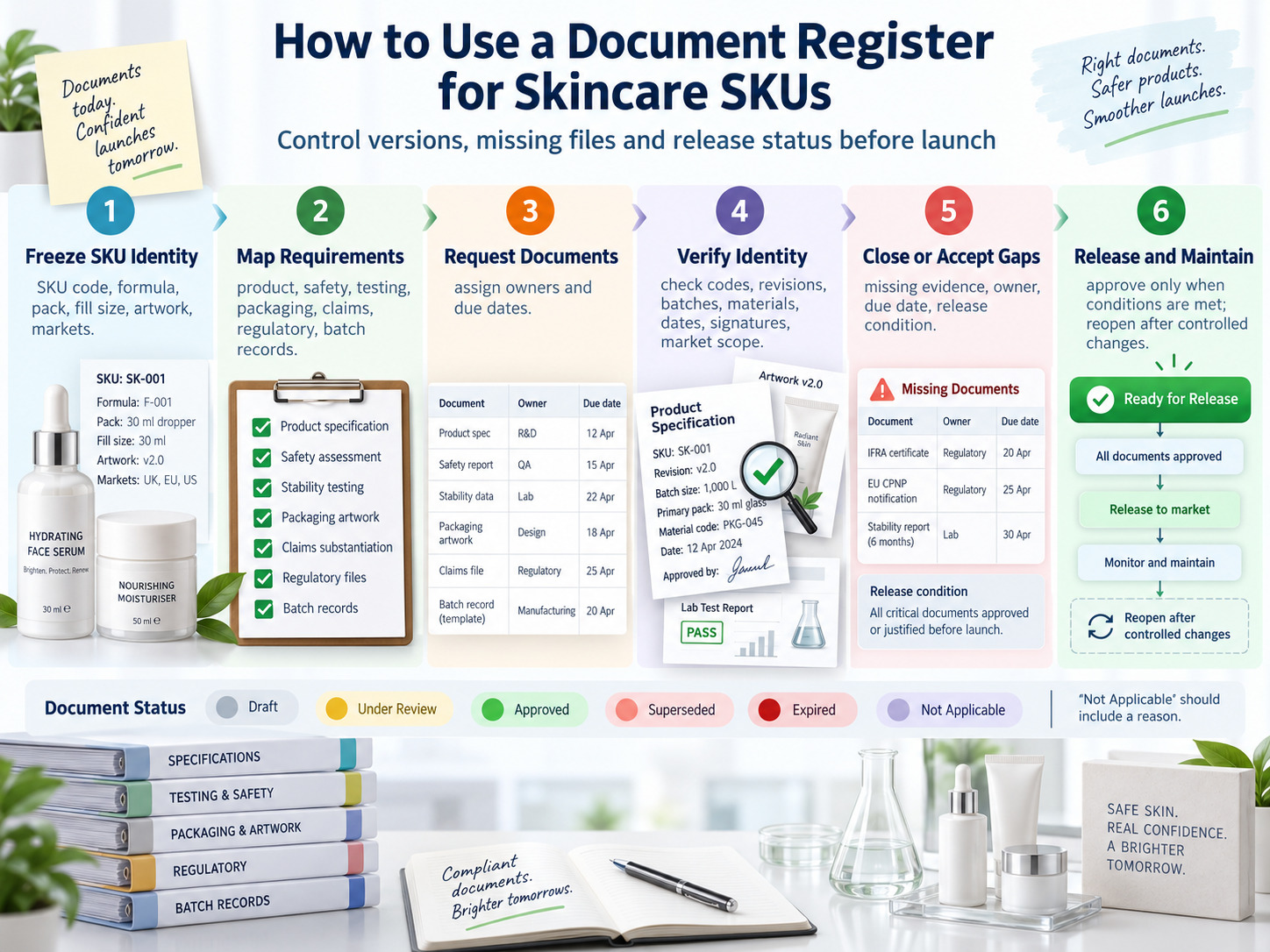
A useful document register is both a checklist and a release control. Build it before the first purchase order, not after the product has already shipped.
- Freeze the SKU identity. Assign the commercial SKU code and record the approved formula, pack, fill size, artwork and intended markets.
- Map the requirements. List the product, safety, testing, packaging, claims, regulatory and batch records needed for the formula and each market.
- Request documents with owners and dates. State whether the manufacturer, component supplier, laboratory, brand, responsible person or safety assessor must issue or approve each item.
- Verify identity and applicability. Check codes, revisions, batches, test samples, packaging materials, dates, signatures and market scope instead of reviewing filenames alone.
- Close or formally accept gaps. Record missing evidence, interim controls, responsible owner, due date and release condition. Do not silently mark an inapplicable or unavailable document as complete.
- Release and maintain the file. Approve the SKU only when required conditions are met, attach each batch release packet, and reopen the assessment whenever a controlled change occurs.
Use status labels such as Draft, Under Review, Approved, Superseded, Expired and Not Applicable. “Not Applicable” should always include a reason. A missing document and a justified non-requirement are not the same thing.
Common Documentation Mistakes to Avoid
- Requesting names instead of deliverables: “Need stability” is vague; define the report, tested version, acceptance criteria and completion stage required.
- Using one folder for an entire range: shared formulas can reduce duplication, but each sellable pack still needs a controlled link to its own artwork, packaging and batch records.
- Accepting reports without applicability: the file should explain why data from another batch, size or pack supports the current SKU.
- Confusing certificates: a GMP certificate does not prove that one batch met its specification, and a batch COA does not establish facility-wide GMP status.
- Ignoring revisions: an updated formula, pump, label or claim can make earlier evidence partly or fully obsolete.
- Waiting until launch: regulatory reviewers and safety assessors may identify data gaps that affect the formula, pack or claims, so the document schedule should begin during development.
Build a SKU Document Schedule With ZICAIL
Before confirming a private label skincare order, convert your document expectations into a written schedule tied to development, testing, artwork approval, production and batch release. ZICAIL can help brands align formula, packaging and manufacturing records with the agreed SKU configuration and target-market brief.
Contact ZICAIL with your product types, pack formats, target markets and launch plan to discuss the document handover and release records required for your project.


