


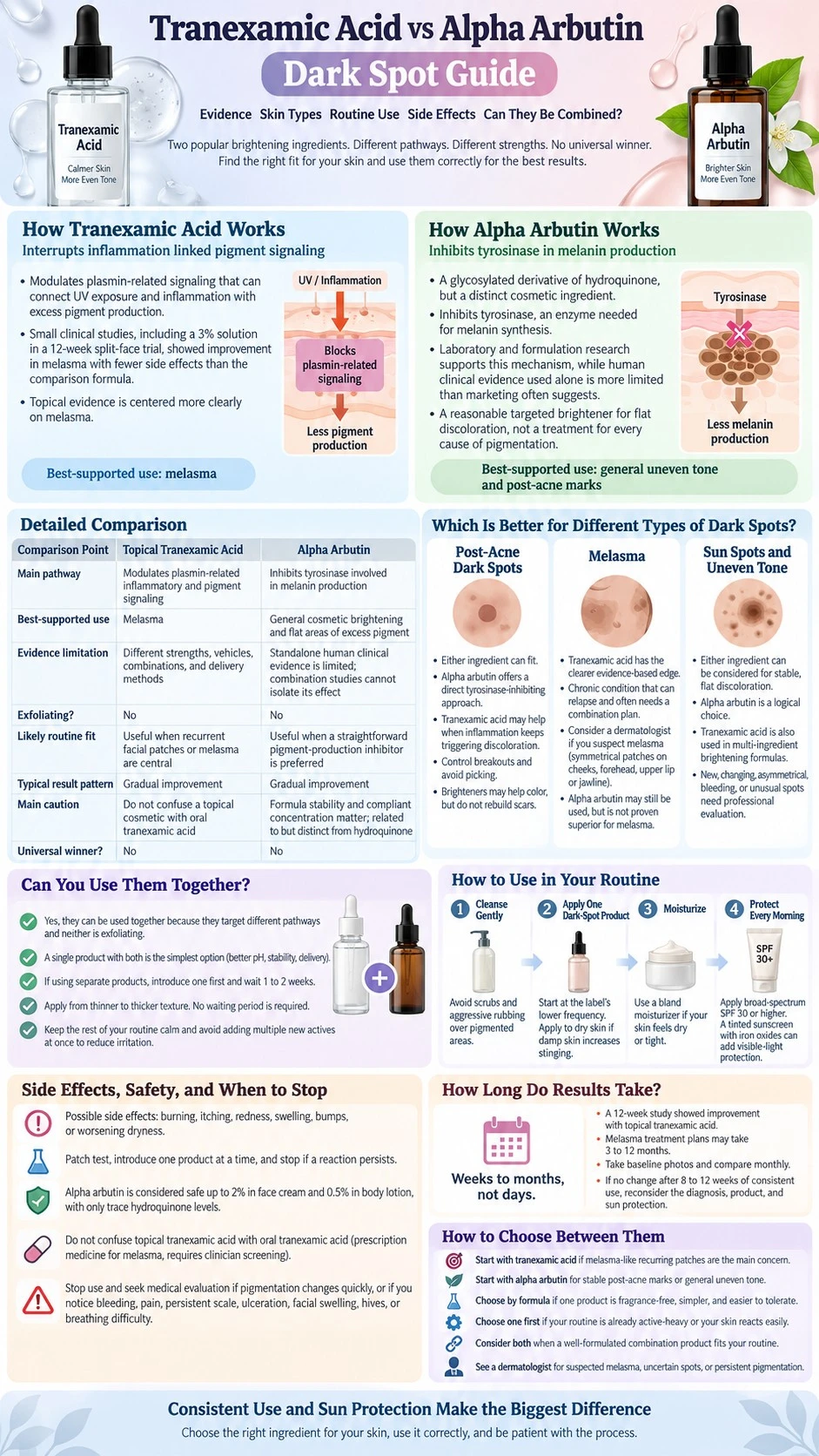
There is no high-quality direct head-to-head trial showing that topical tranexamic acid or alpha arbutin is universally faster or better for every dark spot. The useful distinction is narrower: tranexamic acid has more direct clinical relevance to melasma, while alpha arbutin targets a well-established step in melanin production. Your pigmentation pattern, the finished product, and consistent sun protection should decide the winner.
How Tranexamic Acid and Alpha Arbutin Work
Both are non-exfoliating brightening ingredients. They do not deliberately shed the skin surface like glycolic or salicylic acid, and they act through different pathways.
Tranexamic acid
Topical tranexamic acid is thought to interrupt plasmin-related signaling that can connect ultraviolet exposure and inflammation with excess pigment production. Small clinical studies have evaluated topical formulas for melasma, including a randomized split-face trial in which a 3% tranexamic acid solution improved melasma over 12 weeks with fewer side effects than the comparison formula.[1] That result supports potential, but it does not prove every cosmetic serum works equally well.
The most defensible reason to choose tranexamic acid for skin is therefore condition fit: its topical evidence is centered more clearly on melasma than alpha arbutin’s evidence is. Product vehicle, concentration, co-ingredients, and study design still make cross-product comparisons unreliable.
Alpha arbutin
Alpha arbutin is a glycosylated derivative of hydroquinone, but it is a distinct cosmetic ingredient—not the same treatment as prescription hydroquinone. It inhibits tyrosinase, an enzyme needed for melanin synthesis. Laboratory and formulation research supports this mechanism, while the human clinical evidence for alpha arbutin used alone is more limited than marketing language often suggests.[2]
That makes alpha arbutin for skin a reasonable targeted brightener for flat discoloration, not a guaranteed treatment for every cause of pigmentation. It will not raise an indented acne scar or diagnose a changing lesion.
Tranexamic Acid vs Alpha Arbutin: Detailed Comparison
| Comparison point | Topical tranexamic acid | Alpha arbutin |
|---|---|---|
| Main pathway | Modulates plasmin-related inflammatory and pigment signaling | Inhibits tyrosinase involved in melanin production |
| Best-supported use | Melasma is the clearest clinical use case | General cosmetic brightening and flat areas of excess pigment |
| Evidence limitation | Studies use different strengths, vehicles, combinations, and delivery methods | Standalone human clinical evidence is relatively limited; combination studies cannot isolate its effect |
| Exfoliating? | No | No |
| Likely routine fit | Useful when recurrent facial patches or melasma are central | Useful when a straightforward pigment-production inhibitor is preferred |
| Typical result pattern | Gradual improvement, not overnight fading | Gradual improvement, not overnight fading |
| Main caution | Do not confuse a topical cosmetic with prescription oral tranexamic acid | Formula stability and compliant concentration matter; it is related to but distinct from hydroquinone |
| Universal winner? | No direct evidence proves it always works faster or better | No direct evidence proves it always works faster or better |
The comparison should be made product by product. A well-designed alpha-arbutin formula may suit you better than an irritating tranexamic acid blend, and the reverse can also be true. Percentage alone cannot reveal delivery, stability, supporting ingredients, or real-world tolerance.
Which Is Better for Different Types of Dark Spots?
First identify what you are trying to fade. Hyperpigmentation is an umbrella term, not one diagnosis.
Post-acne dark spots
Either ingredient can fit a routine for flat brown or gray-brown marks left after acne. Alpha arbutin offers a direct tyrosinase-inhibiting approach; tranexamic acid may be attractive when inflammation appears to keep triggering discoloration. There is not enough direct evidence to promise that one will clear post-acne hyperpigmentation faster.
Control new breakouts and avoid picking, because new inflammation creates new marks. Also distinguish acne scars from dark spots: topical brighteners may help color, but they do not rebuild indented or raised scar tissue.
Melasma
Tranexamic acid has the clearer evidence-based edge for melasma, but that is not the same as saying an over-the-counter serum is the best treatment for every person. Melasma is chronic, can relapse, and often needs a combination plan. The American Academy of Dermatology notes that tranexamic acid may be applied topically or prescribed orally in difficult cases, alongside sun protection and other treatment.[3]
If you suspect melasma—often symmetrical brown or gray-brown patches on the cheeks, forehead, upper lip, or jawline—consider a dermatologist rather than cycling through products. Alpha arbutin may still be used in a cosmetic routine, but evidence does not establish it as superior to tranexamic acid for melasma.
Sun spots and general uneven tone
Either ingredient can be considered for stable, flat discoloration after the spot has been properly identified. Alpha arbutin’s direct tyrosinase focus makes it a logical cosmetic choice; topical tranexamic acid is also used in multi-ingredient brightening formulas. New, changing, asymmetrical, bleeding, crusting, or unusually colored spots need professional evaluation before you try to fade them.
Can You Use Tranexamic Acid and Alpha Arbutin Together?
Yes, the two ingredients can appear in the same routine because they target different pigment pathways and neither is inherently exfoliating. A single product formulated with both is the simplest option: the manufacturer controls pH, stability, and delivery, and you avoid duplicating solvents or other supporting actives.
If you use separate products, introduce one first and watch your skin for about one to two weeks before adding the second. Apply from thinner to thicker texture unless the product directions say otherwise. There is no established waiting period required between them, and using more layers does not guarantee faster fading.
Keep the rest of the routine calm. Combining both with a new retinoid, exfoliating acid, strong vitamin C formula, and benzoyl peroxide at once makes irritation harder to trace. Irritation itself can prolong post-inflammatory pigmentation, particularly in deeper skin tones.
How to Use Either Ingredient in Your Routine
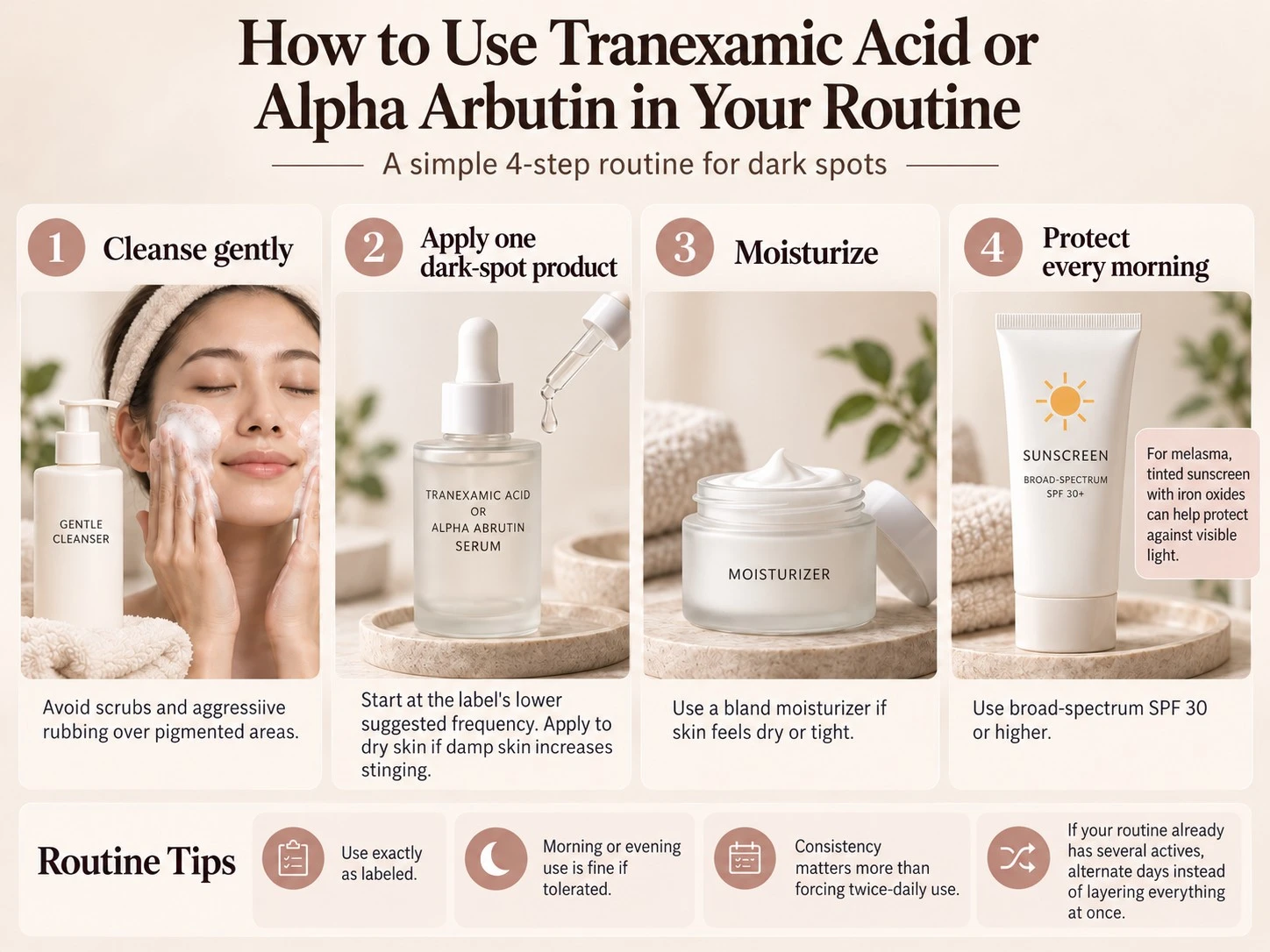
Use the product exactly as labeled; cosmetic formulas vary. A simple routine is usually enough:
- Cleanse gently. Avoid scrubs and aggressive rubbing over pigmented areas.
- Apply one dark-spot product. Start at the label’s lower suggested frequency. Apply to dry skin if damp skin increases stinging.
- Moisturize. Use a bland moisturizer if your skin feels dry or tight.
- Protect every morning. Apply broad-spectrum SPF 30 or higher. The AAD recommends sun protection as part of melasma care and often advises tinted sunscreen containing iron oxide, which helps address visible light as well as ultraviolet exposure.[3] Follow a reliable sunscreen application routine.
You can use a tolerated product in the morning or evening unless its label limits timing. Consistency is more important than forcing twice-daily use. If your routine already contains several actives, alternate days rather than treating every open step as an invitation to layer more.
Side Effects, Safety, and When to Stop
Topical tranexamic acid and alpha arbutin are generally used as non-exfoliating ingredients, but finished products can still cause burning, itching, redness, swelling, bumps, or worsening dryness. Patch test when practical, introduce one product at a time, and stop if a reaction persists.
For alpha arbutin, the European Commission’s Scientific Committee on Consumer Safety concluded that cosmetic use is safe up to 2% in face cream and 0.5% in body lotion, provided hydroquinone remains at unavoidable trace levels.[4] This is a safety assessment, not proof that a 2% product is more effective than a lower-strength or differently formulated product.
Do not treat topical and oral tranexamic acid as interchangeable. Oral tranexamic acid is a prescription medicine used off-label for melasma and requires clinician screening, especially for clotting risk and relevant medical history.[3] A cosmetic serum does not carry the same dosing or evidence profile.
Stop self-treatment and arrange evaluation if pigmentation changes quickly, affects only one unusual lesion, or comes with bleeding, pain, persistent scale, or ulceration. Seek prompt care for facial swelling, hives, or breathing difficulty after any product.
How Long Do Results Take?
Expect weeks to months, not days. The topical tranexamic acid split-face study assessed results over 12 weeks.[1] The AAD notes that melasma treatment plans may take 3 to 12 months to show results.[3] Those time frames describe particular studies and a chronic condition; they are not guarantees for an over-the-counter serum.
Take baseline photos in the same location and lighting, then compare monthly rather than daily. Also track irritation and whether new spots are forming. If color is not changing after a consistent, label-directed trial of roughly 8 to 12 weeks, reconsider the diagnosis, product, and sun protection instead of automatically adding more actives.
How to Choose Between Them
- Start with tranexamic acid if melasma-like recurring patches are the primary concern and you want the option with more direct melasma research.
- Start with alpha arbutin if you want a simple tyrosinase-inhibiting cosmetic for stable post-acne marks or general uneven tone.
- Choose by formula if one product is fragrance-free, simpler, and easier for your skin to tolerate.
- Choose one first if your routine is already active-heavy or your skin reacts easily.
- Consider both when a well-formulated combination product fits your routine, not because two bottles automatically double the result.
- See a dermatologist for suspected melasma, uncertain spots, persistent pigmentation, or a faster and more individualized treatment plan.
FAQs About Tranexamic Acid and Alpha Arbutin
Which is better for acne dark spots?
There is no proven universal winner for post-acne hyperpigmentation. Alpha arbutin directly inhibits a pigment-making enzyme, while tranexamic acid acts on signaling linked to inflammation and melanogenesis. Choose the better-tolerated formula, treat active acne, avoid picking, and use sunscreen so new marks do not keep replacing old ones.
Can you use tranexamic acid and alpha arbutin every day?
Many leave-on products are designed for daily use, but follow each label and build frequency gradually. Daily use is appropriate only if your skin stays comfortable. Reduce frequency or stop if you develop persistent burning, itching, redness, swelling, or scaling.
Can you use them with vitamin C, niacinamide, or retinoids?
Often, yes. Tranexamic acid and alpha arbutin can coexist with vitamin C or niacinamide in well-formulated products. Retinoids can also be part of a pigmentation routine, but they raise the irritation burden for some users. Introduce one change at a time and separate products by time of day or alternate nights if layering causes discomfort.
Which ingredient is better for sensitive skin?
Neither wins automatically. Both are non-exfoliating, but irritation can come from the full formula, including fragrance, solvents, preservatives, acids, or companion actives. Favor a simple product, patch test, and start less often than the maximum label frequency.
Can you use tranexamic acid or alpha arbutin during pregnancy?
Pregnancy-specific evidence for cosmetic topical use is limited, and a product may contain other ingredients that change the answer. Ask your obstetric clinician or dermatologist to review the exact ingredient list. Never use oral tranexamic acid for pigmentation without a prescribing clinician.
Sources
[1] Ebrahimi B, Fatemi Naeini F. Topical Tranexamic Acid as a Promising Treatment for Melasma
[2] Boo YC. Arbutin as a Skin Depigmenting Agent with Antimelanogenic and Antioxidant Properties
[3] American Academy of Dermatology Association. Melasma: Diagnosis and Treatment
[4] Scientific Committee on Consumer Safety. Safety of Alpha-Arbutin and Beta-Arbutin in Cosmetic Products


