


Niacinamide and vitamin C are two of the most common ingredients in brightening and anti-aging skincare, yet they are also the subject of a persistent compatibility rule: use one, but never use them together.
That rule oversimplifies the evidence. The important distinction is between using two finished skincare products on your skin and formulating vitamin C and niacinamide together inside one product. Formulation chemistry can be complex, especially with L-ascorbic acid, but that does not translate into a universal need to keep the ingredients out of the same routine.
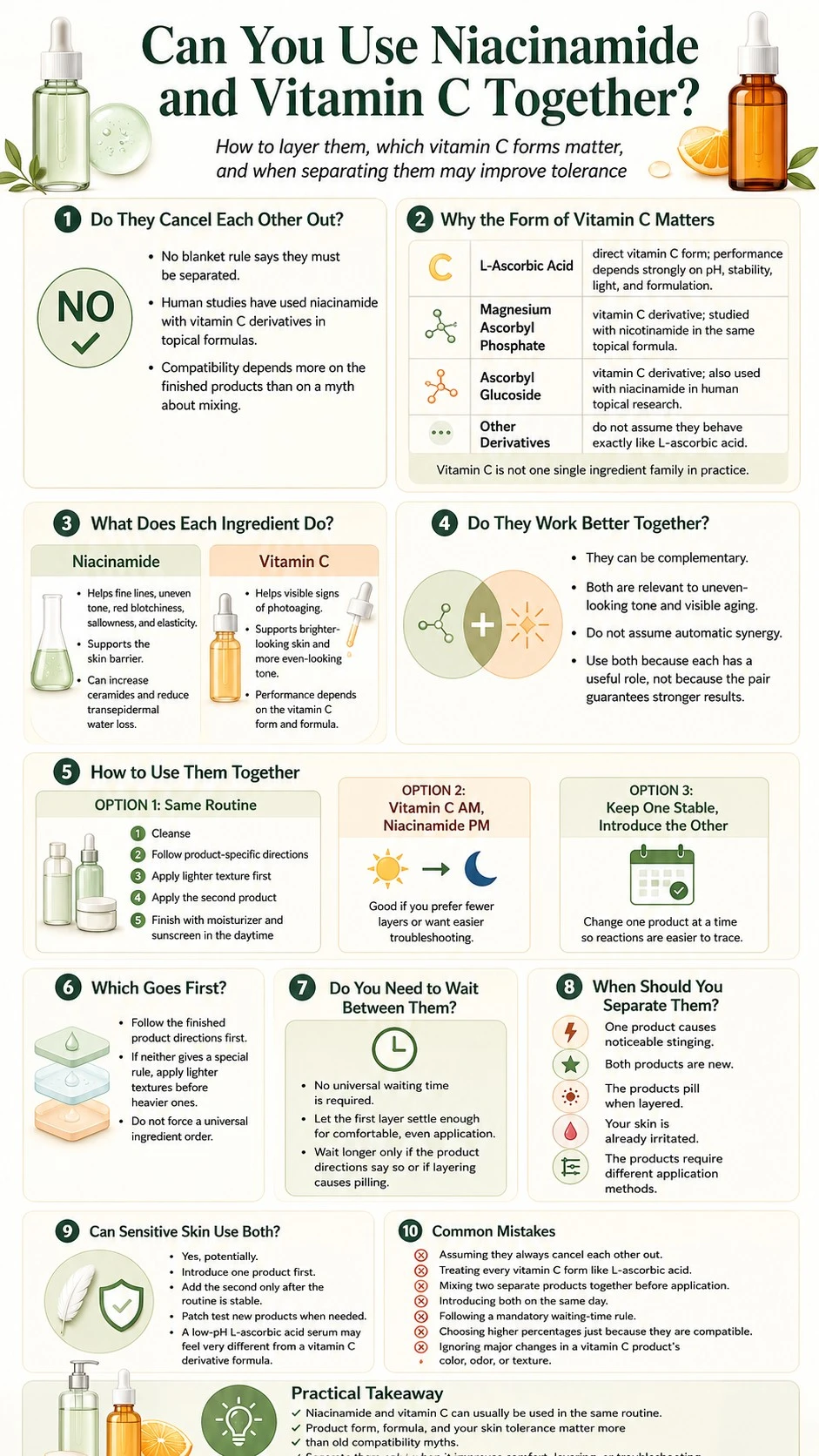
Do Niacinamide and Vitamin C Cancel Each Other Out?
There is no good clinical evidence that niacinamide and vitamin C automatically neutralize each other when both are used in skincare.
A randomized clinical trial evaluated a topical combination containing 10% nicotinamide, 5% magnesium ascorbyl phosphate, and 5% hyaluronic acid for facial melasma. The combination was used twice daily for 60 days and was reported as safe and well tolerated in the study population.[3]
Another human study used a topical gel containing niacinamide and ascorbyl glucoside when evaluating facial hyperpigmentation and enhanced delivery with high-frequency ultrasound.[4]
These studies do not prove that every possible niacinamide and vitamin C product combination is optimal. They do show why a blanket claim that the two ingredient families cannot coexist in topical skincare is not supported.
Why the Form of Vitamin C Matters
Niacinamide is a specific molecule, also called nicotinamide. “Vitamin C” is a broader skincare label that can refer to L-ascorbic acid or to several derivatives.
| Vitamin C Form | What It Means for This Combination |
|---|---|
| L-Ascorbic Acid | The direct form of vitamin C. Delivery and stability depend strongly on the finished formulation and pH.[5][6] |
| Magnesium Ascorbyl Phosphate | A vitamin C derivative that has been clinically studied in the same topical formula as nicotinamide.[3] |
| Ascorbyl Glucoside | A vitamin C derivative that has also been used with niacinamide in human topical research.[4] |
| Other Vitamin C Derivatives | Do not assume they have the same stability, penetration, concentration, or clinical evidence as L-ascorbic acid. |
L-ascorbic acid deserves particular attention because its skin delivery and degradation depend on factors including pH and formulation conditions.[5][6] That is primarily a reason for formulators to design and package vitamin C carefully. It does not establish that a separate niacinamide product must never be applied in the same routine.
For the differences between vitamin C forms and their broader uses, see Vitamin C for Skin.
What Does Each Ingredient Do?
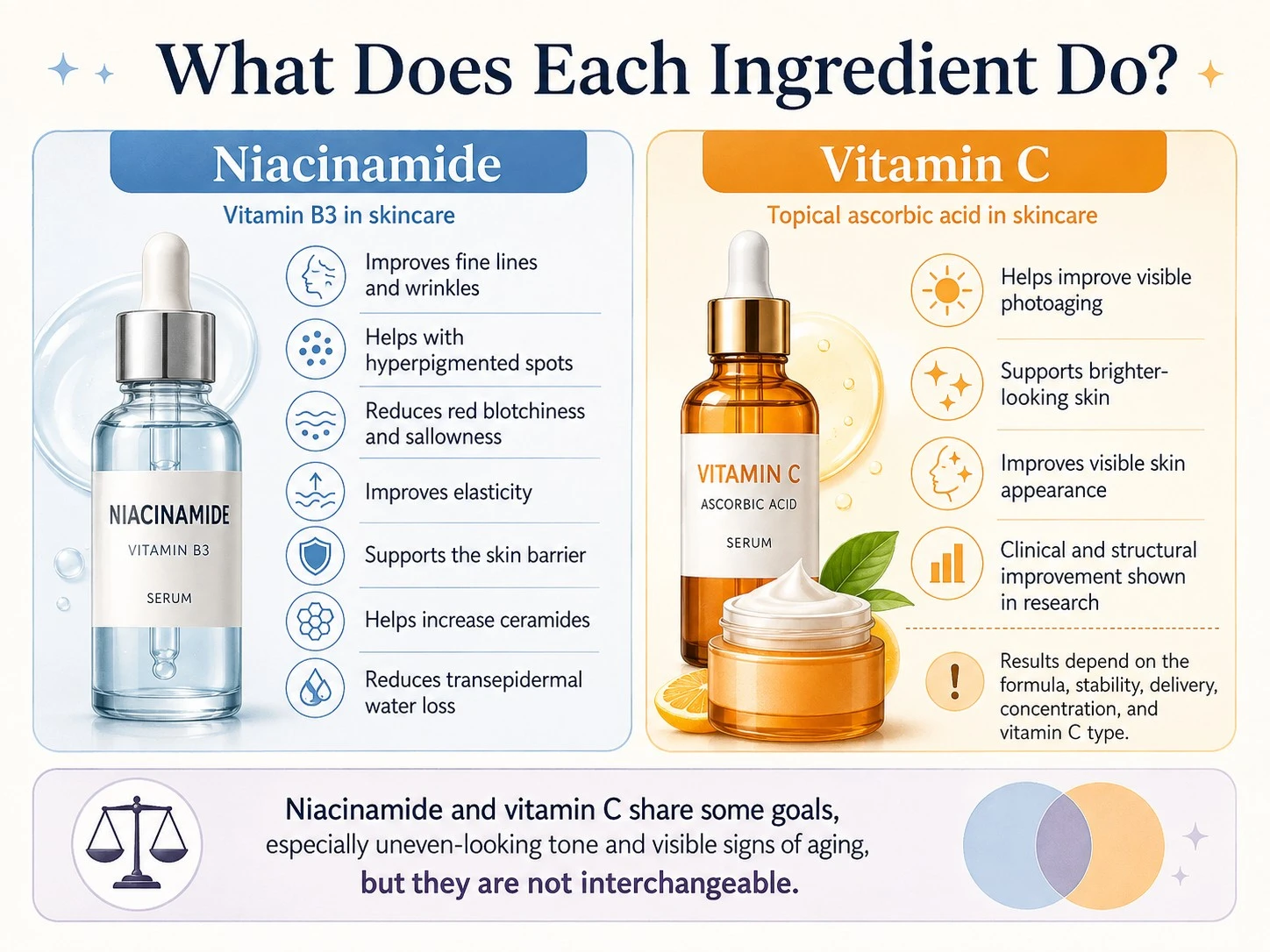
The two ingredients have some overlapping cosmetic goals, particularly uneven-looking tone and visible signs of aging, but they are not interchangeable.
Niacinamide
Niacinamide is a form of vitamin B3. In a randomized split-face study, 5% topical niacinamide used twice daily for 12 weeks improved several measures of aging facial skin, including fine lines and wrinkles, hyperpigmented spots, red blotchiness, sallowness, and elasticity.[1]
Topical nicotinamide has also been shown to increase several stratum-corneum lipids, including ceramides, and to reduce transepidermal water loss in dry skin.[7]
For more detail on concentration, uses, and application, see Niacinamide for Skin.
Vitamin C
Topical ascorbic acid has controlled clinical evidence for improving visible features of photoaged skin. A six-month randomized double-blind study of a 5% vitamin C cream found clinical and structural improvement compared with the vehicle-treated area.[2]
Results from one vitamin C formula should not automatically be applied to every serum or derivative. Stability, delivery, concentration, and the vitamin C molecule itself can change product performance.
Do Niacinamide and Vitamin C Work Better Together?
They can be complementary, but there is not enough evidence to claim that combining them always produces a special synergistic effect.
Both ingredients have independent evidence relevant to uneven-looking pigmentation and visible skin aging.[1][2] Combination products containing niacinamide and vitamin C derivatives have also been clinically tested.[3][4]
However, those combination studies involved specific finished formulas and, in some cases, additional ingredients or treatment methods. They cannot tell us how much of the outcome came from niacinamide, vitamin C, another ingredient, or a unique interaction between them.
Use both because each addresses a goal in your routine, not because pairing them guarantees stronger results.
How to Use Niacinamide and Vitamin C Together
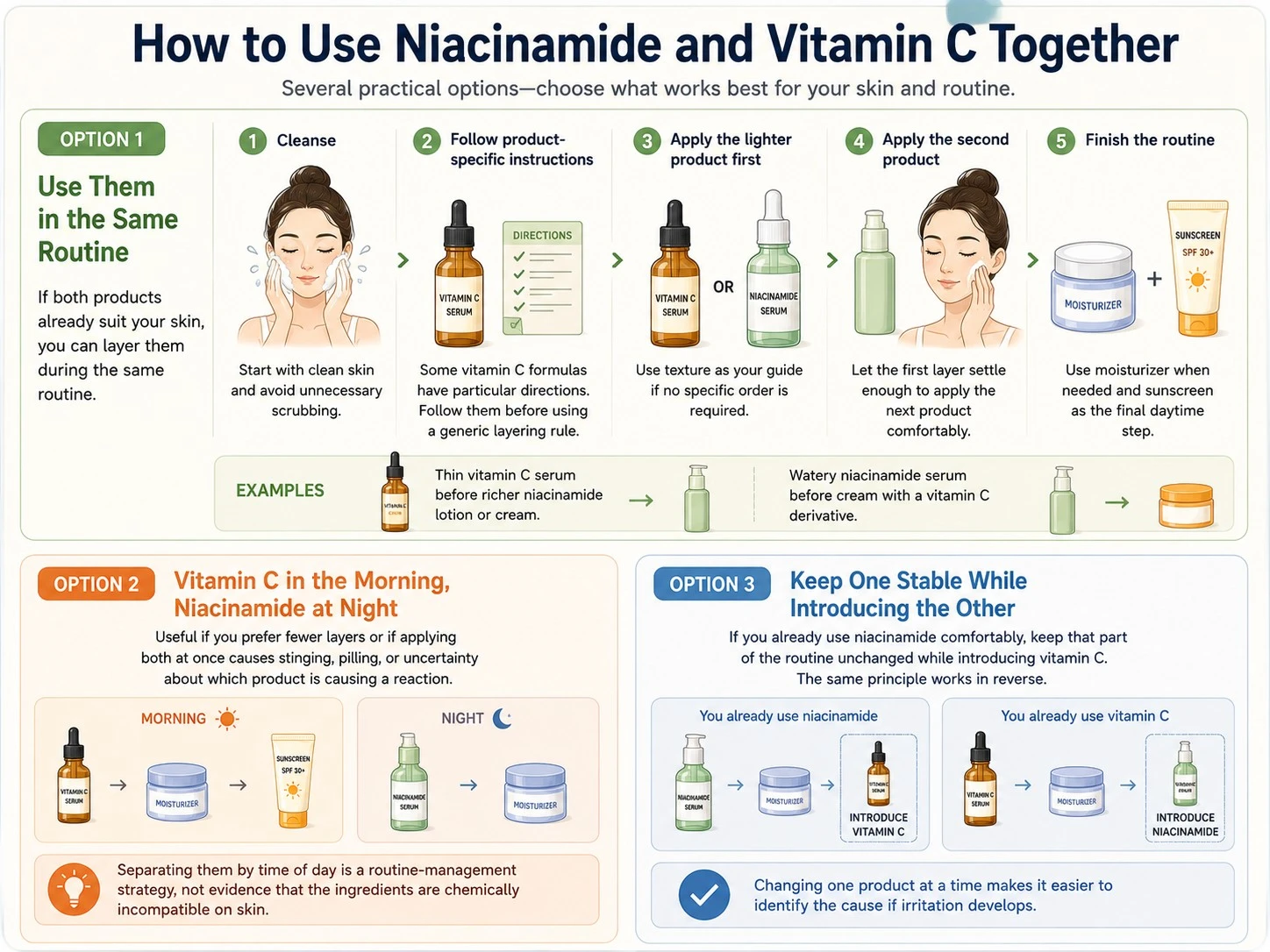
You have several practical options. There is no requirement to choose one method for everyone.
Option 1: Use Them in the Same Routine
If both products already suit your skin, you can layer them during the same routine.
- Cleanse: Start with clean skin and avoid unnecessary scrubbing.
- Follow product-specific instructions: Some vitamin C formulas have particular application directions, so use those before applying a generic layering rule.
- Apply the lighter product first: If neither product requires a specific order, use texture as the practical guide.
- Apply the second product: Let the first layer settle enough to apply the next product comfortably.
- Finish the routine: Use moisturizer when needed and sunscreen as the final daytime skincare step.
For example, a thin vitamin C serum may come before a richer niacinamide lotion, while a watery niacinamide serum may come before a cream containing a vitamin C derivative.
Option 2: Vitamin C in the Morning, Niacinamide at Night
This is useful if you prefer fewer layers or if applying both at once causes stinging, pilling, or uncertainty about which product is causing a reaction.
Separating them by time of day is a routine-management strategy, not evidence that the ingredients are chemically incompatible on skin.
Option 3: Keep One Stable While Introducing the Other
If you already use niacinamide comfortably, keep that part of the routine unchanged while introducing vitamin C. The same principle works in reverse.
Changing one product at a time makes it easier to identify the cause if irritation develops.
Which Goes First: Vitamin C or Niacinamide?
There is no universal ingredient-based order.
Follow the directions for the finished products first. If neither formula specifies a special application method, use the usual texture principle: lighter products before heavier products.
Do not automatically put vitamin C first solely because every vitamin C product is assumed to require the same pH. L-ascorbic acid and vitamin C derivatives can have very different formulation requirements.
For help organizing the rest of your products, see Skincare Routine Order.
Do You Need to Wait Between Niacinamide and Vitamin C?
There is no evidence-based universal waiting time required simply because the products contain niacinamide and vitamin C.
Allow the first layer enough time to spread and settle so the next product can be applied evenly. A longer waiting period may be useful when a specific product directs you to use one, or when immediate layering causes pilling, but it is not a standard compatibility requirement.
When Should You Separate Them?
Separate the products when it makes the routine easier to tolerate or troubleshoot.
- One product causes noticeable stinging: Use it separately so you can assess the reaction more clearly.
- Both products are new: Introduce one before adding the other.
- The products pill when layered: Change the order, reduce the amount, allow more settling time, or use them at different times of day.
- Your skin is already irritated: Simplify the routine instead of maintaining every active ingredient.
- The product directions require different application methods: Follow the finished formulations rather than forcing them into one routine.
If your skincare causes persistent burning, increasing redness, swelling, rash, or repeated peeling, see Why Does Skincare Burn and reduce the products most likely to be contributing.
Can Sensitive Skin Use Both?
Yes, potentially, but introducing both simultaneously makes reactions harder to interpret.
Niacinamide has been well tolerated in controlled facial studies, while the feel of a vitamin C product can vary considerably by molecule and formulation.[1][2] A low-pH L-ascorbic-acid serum, for example, may feel different from a cream containing a vitamin C derivative.
If your skin is easily irritated, introduce one product first and add the second only after the routine is stable. Patch testing a new product can also help identify obvious intolerance before broader facial use; see How to Patch Test Skincare Products Before Using Them.
Common Niacinamide and Vitamin C Mistakes
- Assuming the two ingredients always cancel each other out: Human studies have used niacinamide with vitamin C derivatives in the same topical formulations.[3][4]
- Treating every vitamin C form as L-ascorbic acid: Vitamin C derivatives differ in chemistry, stability, and evidence.
- Mixing two separate products together before application: Unless the products are specifically designed for mixing, use each finished formulation as directed.
- Introducing both on the same day: This makes irritation harder to trace.
- Following a mandatory waiting-time rule: There is no universal niacinamide-vitamin-C timer.
- Choosing higher percentages simply because the ingredients are compatible: Compatibility does not mean more is better.
- Ignoring changes in a vitamin C product: A formula that has changed substantially in color, odor, texture, or storage condition should be evaluated according to its product instructions rather than fixed by changing layering order.
Final Thoughts
Niacinamide and vitamin C can generally be used together. Human studies of formulas containing niacinamide with vitamin C derivatives provide direct evidence that the two ingredient families can coexist in topical skincare.[3][4]
What the evidence does not support is treating every vitamin C product as chemically identical. L-ascorbic acid is particularly sensitive to formulation conditions, while derivatives can behave differently.[5][6]
If both products suit your skin, use them in the same routine if that is convenient. If layering creates irritation, pilling, or confusion about which product is causing a problem, separate them by time of day rather than assuming the combination itself is forbidden.
FAQs About Niacinamide and Vitamin C
Can I apply niacinamide and vitamin C at the same time?
Yes. They can generally be used in the same routine, and human studies have used topical formulations containing niacinamide together with vitamin C derivatives.[3][4]
Should vitamin C or niacinamide go first?
Follow the directions for the individual products first. If neither requires a specific order, apply the lighter formulation before the thicker one rather than choosing solely by ingredient name.
Should I use vitamin C in the morning and niacinamide at night?
You can, but it is not required. Separating them by time of day can simplify the routine or make irritation easier to identify.
Do I need to wait between niacinamide and vitamin C?
No universal waiting period is required. Let the first product settle enough for comfortable, even application of the next product and follow any product-specific directions.
Can I use 10% niacinamide with vitamin C?
The niacinamide percentage alone does not create a vitamin C incompatibility. Whether a 10% niacinamide formula suits you depends on the complete product and your skin’s tolerance; a higher percentage is not automatically more effective.
Can niacinamide and vitamin C irritate skin?
Either finished product can cause discomfort if it does not suit your skin. If persistent burning, redness, rash, swelling, or peeling develops after adding a new product, reduce or stop the suspected product and simplify the routine.
Sources
[1] Bissett DL et al. Niacinamide: A B Vitamin That Improves Aging Facial Skin Appearance
[2] Humbert PG et al. Topical Ascorbic Acid on Photoaged Skin: Clinical, Topographical and Ultrastructural Evaluation: Double-Blind Study vs. Placebo
[3] Barbosa M et al. Efficacy and Safety of Nicotinamide 10%, Associated With Magnesium Ascorbyl Phosphate 5% and Hyaluronic Acid 5%, Compared to Hydroquinone 4% in Women With Facial Melasma
[4] Lee WR et al. Ultrasound Enhanced Skin-Lightening Effect of Vitamin C and Niacinamide
[5] Pinnell SR et al. Topical L-Ascorbic Acid: Percutaneous Absorption Studies
[6] Ahmad I et al. Photochemical Interaction of Ascorbic Acid With Riboflavin, Nicotinamide and Alpha-Tocopherol in Cream Formulations
[7] Tanno O et al. Nicotinamide Increases Biosynthesis of Ceramides as Well as Other Stratum Corneum Lipids to Improve the Epidermal Permeability Barrier


