


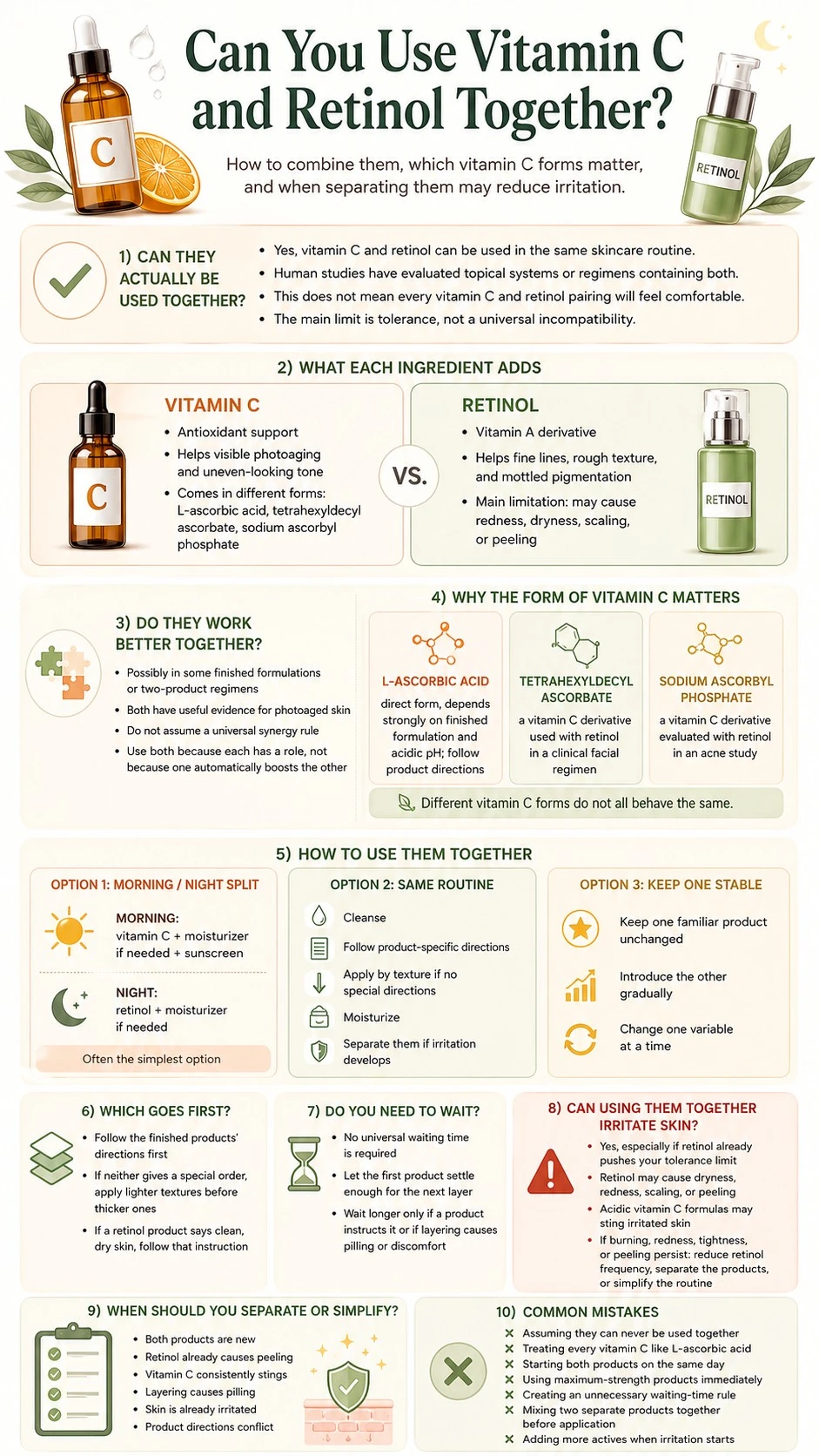
Vitamin C and retinol are both widely used for visible signs of skin aging, uneven-looking tone, and photodamage. Because they are active ingredients, they are also frequently placed on lists of products that supposedly should never be mixed.
The evidence does not support such a broad restriction. The more useful question is whether your particular vitamin C and retinol products can fit into the same routine without creating unnecessary irritation.
Can Vitamin C and Retinol Actually Be Used Together?
Yes. Direct human research has evaluated topical systems containing both ingredients.
Two double-blind studies tested a preparation containing retinol and vitamin C on aged or photoaged human skin for three to six months and documented structural skin changes with repeated application.[1]
A separate 12-week clinical trial used a two-product regimen consisting of a 0.5% retinol treatment and a moisturizer containing 30% tetrahexyldecyl ascorbate, a vitamin C derivative. The regimen improved multiple measures of photodamaged skin, although temporary dryness increased during the earlier weeks of treatment.[2]
Another randomized double-blind study evaluated 5% sodium ascorbyl phosphate, a vitamin C derivative, with 0.2% retinol for acne and found the combination effective in the tested formulation.[3]
These studies show that vitamin C and retinol can coexist in topical skincare. They do not prove that every vitamin C serum and every retinol formula will layer comfortably or that using them together always creates a special synergistic benefit.
What Does Each Ingredient Add to the Routine?
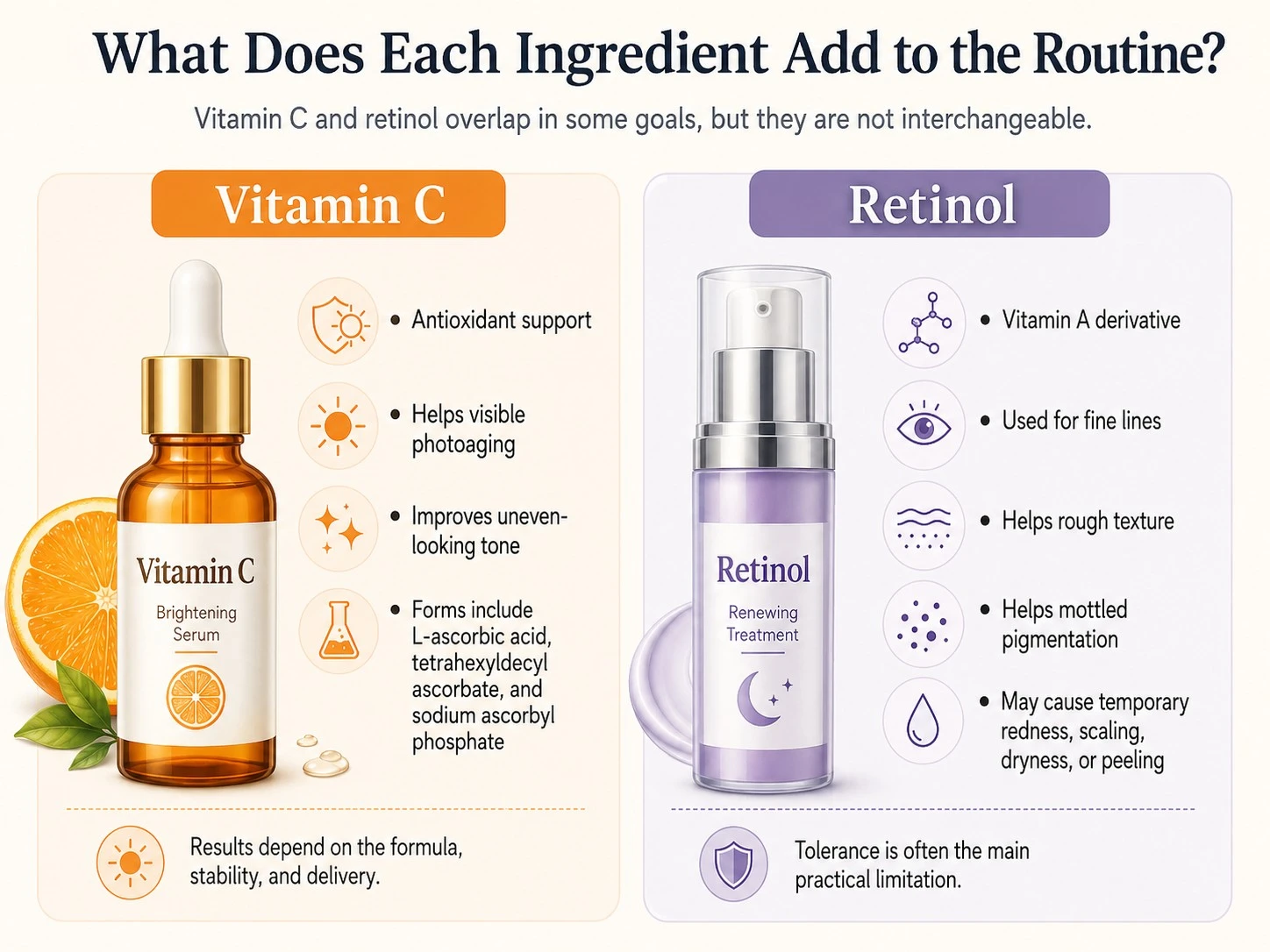
Vitamin C and retinol overlap in some goals, but they are not interchangeable.
Vitamin C
Topical vitamin C is used primarily for antioxidant support and visible concerns associated with photoaging, including uneven-looking tone and skin surface changes. Controlled research with topical ascorbic acid has shown improvement in photoaged skin with consistent use.[5]
“Vitamin C” can describe several different ingredients. L-ascorbic acid is the direct form, while skincare products may also use derivatives such as tetrahexyldecyl ascorbate or sodium ascorbyl phosphate.
For the broader ingredient evidence and different vitamin C forms, see Vitamin C for Skin.
Retinol
Retinol is a vitamin A derivative used for visible signs of photoaging, including fine lines, rough texture, and mottled pigmentation. Long-term controlled research with stabilized topical retinol has shown progressive improvement in photodamaged skin.[4]
Its main practical limitation is tolerance. Even well-formulated retinol can cause temporary redness, scaling, dryness, or peeling in some users.[7]
See our Retinol Guide for more detail on retinol itself.
Do Vitamin C and Retinol Work Better Together?
Possibly in some finished formulations, but a universal synergy claim would go beyond the evidence.
Both ingredients have independent evidence relevant to photoaged skin, and combination studies show that carefully formulated retinol-vitamin C systems can produce useful results.[1][2][3][4][5]
However, the studies differ substantially. Some used a preparation containing both ingredients, some used two products as a regimen, and some used vitamin C derivatives rather than L-ascorbic acid. Several formulas also contained additional active or supporting ingredients.
For everyday skincare, the practical reason to use both is therefore simple: each ingredient has a useful role in your routine. You do not need to assume that one multiplies the effectiveness of the other.
Does the Form of Vitamin C Matter?
Yes. This is one reason broad vitamin C and retinol compatibility rules can be misleading.
| Vitamin C Form | What Matters With Retinol |
|---|---|
| L-Ascorbic Acid | Its penetration depends strongly on the finished formulation and an appropriately acidic pH.[6] Follow the specific product directions rather than applying a universal layering rule. |
| Tetrahexyldecyl Ascorbate | This lipid-soluble vitamin C derivative was used in a clinical facial regimen together with 0.5% retinol.[2] |
| Sodium Ascorbyl Phosphate | This vitamin C derivative has been evaluated together with retinol in a randomized acne study.[3] |
| Other Vitamin C Derivatives | Do not assume their stability, penetration, concentration, or clinical evidence is identical to L-ascorbic acid. |
This also means the common argument that vitamin C and retinol cannot be combined because they “need different pH levels” is too simplistic. Finished skincare products are complete formulations, and different vitamin C forms have different formulation requirements.
How to Use Vitamin C and Retinol Together
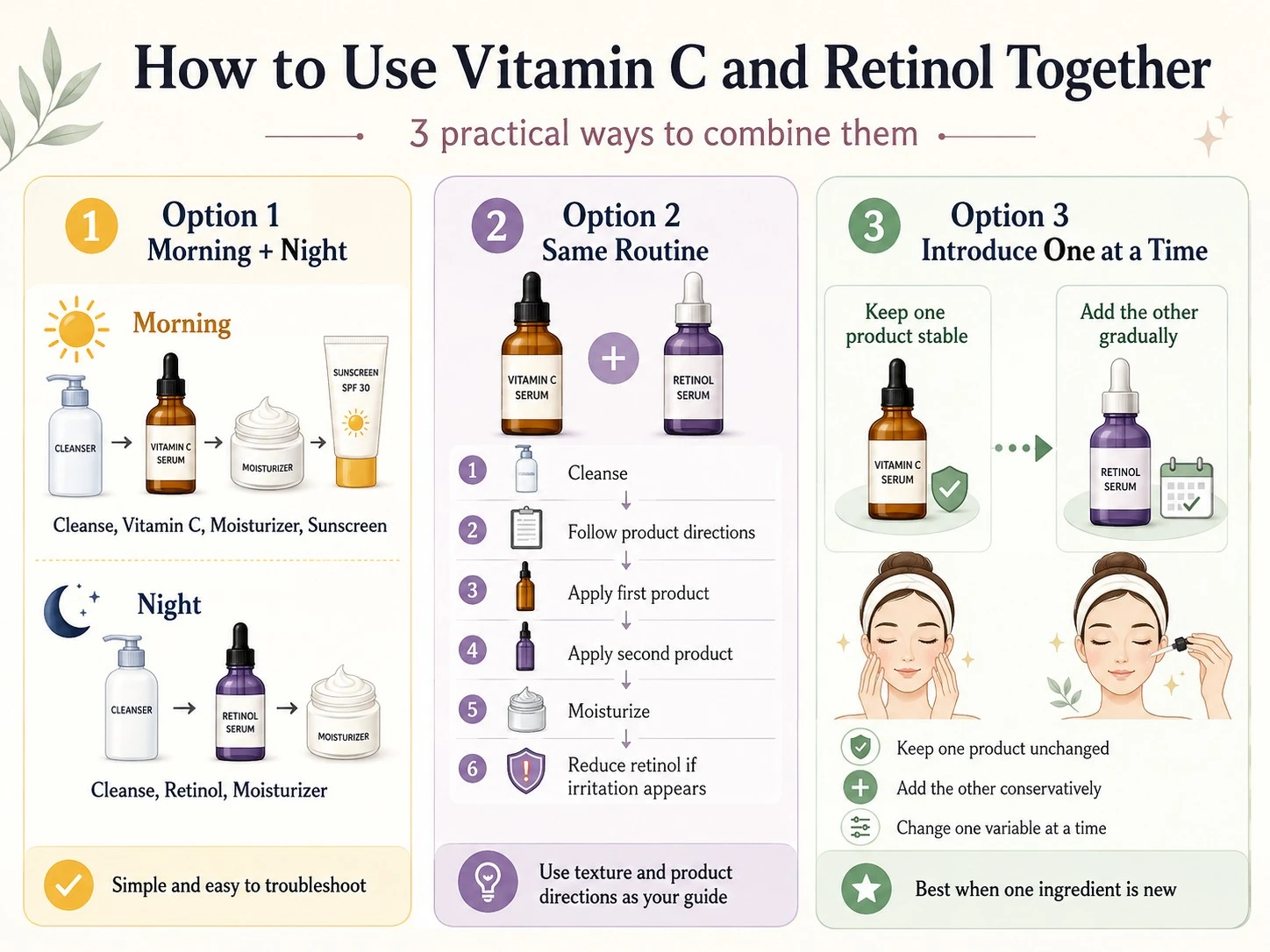
There are three practical approaches. None is required for everyone.
Option 1: Vitamin C in the Morning and Retinol at Night
This is often the simplest arrangement, especially when retinol is new to your routine.
- Morning: Cleanse as needed, apply vitamin C, add moisturizer if needed, and finish with sunscreen.
- Night: Cleanse, apply retinol according to its directions, and add moisturizer as needed.
Separating them this way is convenient and makes irritation easier to troubleshoot. It is not required because the ingredients are inherently incompatible.
Option 2: Use Them in the Same Routine
If both products are already well tolerated, they can be used during the same routine.
- Cleanse: Start with clean skin.
- Follow product-specific directions: Give priority to instructions for your vitamin C and retinol formulas.
- Apply the first product: If neither formula requires a particular position, use texture as a practical guide.
- Apply the second product: Let the first layer settle enough for comfortable application.
- Moisturize: Add moisturizer when needed.
- Adjust if irritation develops: Reduce retinol frequency or separate the products rather than forcing both into the same application.
There is no universal rule that vitamin C must always go before retinol solely because of the ingredient names.
Option 3: Keep One Product Stable While Introducing the Other
This is the best approach when one ingredient is new to you.
If vitamin C already works comfortably in your routine, keep it unchanged while introducing retinol conservatively. If retinol is already established, add the vitamin C product without simultaneously changing your retinol frequency.
One change at a time makes it much easier to identify which product causes a reaction.
Which Goes First: Vitamin C or Retinol?
Follow the directions for the finished products first.
If neither product specifies a particular application order, use texture rather than an ingredient myth: lighter products generally fit before thicker ones. A thin vitamin C serum may therefore come before a retinol cream, while another product combination may require a different order.
Some retinol formulas direct users to apply them to clean, dry skin. When your product has a specific instruction like this, follow it instead of forcing a generic serum-order rule.
For the rest of your products, see Skincare Routine Order.
Do You Need to Wait Between Vitamin C and Retinol?
There is no universal waiting period required simply because one product contains vitamin C and the other contains retinol.
Let the first product settle enough to apply the second evenly. A longer interval can be useful if immediate layering causes pilling or discomfort, or if the product directions specify one, but an arbitrary 10-, 20-, or 30-minute wait is not a general compatibility requirement.
Can Using Them Together Irritate Your Skin?
Yes, particularly if your retinol exposure already pushes your tolerance limit.
Retinol formulations can cause temporary scaling, redness, dryness, or peeling, although the frequency and severity vary considerably by formulation and user.[2][7] An acidic vitamin C formula can also sting on skin that is already irritated.
That does not mean the ingredients are chemically incompatible. It means two active products can create a routine that is less comfortable than either product alone.
If persistent burning, redness, tightness, or peeling develops, reduce the retinol frequency, separate the products, or temporarily simplify the routine. Do not treat irritation as proof that the combination is working faster.
If the skin has become persistently reactive, review our Skin Barrier guide before adding more active products.
When Should You Separate or Simplify the Routine?
Use vitamin C and retinol at different times when doing so makes the routine easier to tolerate or evaluate.
- Both products are new: Introduce one first.
- Retinol already causes peeling: Reduce retinol exposure before adding another active.
- Vitamin C consistently stings: Use it separately while you determine whether the formula suits your skin.
- Layering causes pilling: Change the order, amount, settling time, or time of day.
- Your skin is already irritated: Simplify instead of trying to maintain every active product.
- The product directions conflict: Follow the individual formulas rather than a generic ingredient-pairing rule.
Persistent or worsening burning deserves more attention than product order. See Why Does Skincare Burn if discomfort continues.
Common Vitamin C and Retinol Mistakes
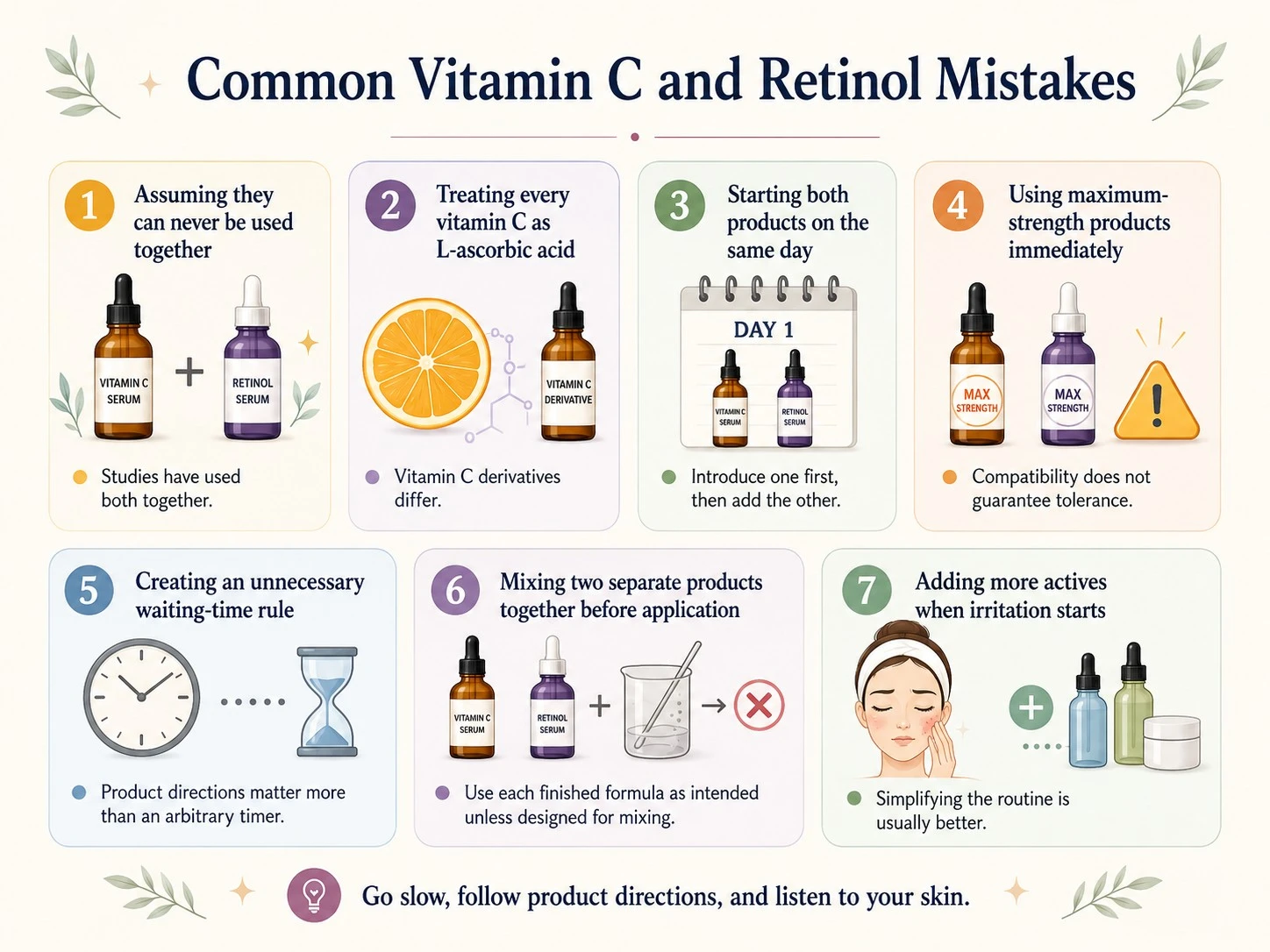
- Assuming they can never be used together: Human studies have evaluated topical systems and routines containing both ingredients.[1][2][3]
- Treating every vitamin C as L-ascorbic acid: Vitamin C derivatives differ in chemistry and formulation requirements.
- Starting both products on the same day: This makes irritation harder to identify.
- Using maximum-strength products immediately: Compatibility does not guarantee tolerance.
- Creating an unnecessary waiting-time rule: Product directions matter more than an arbitrary timer.
- Mixing two separate products together before application: Unless they are specifically designed for mixing, use each finished formula as intended.
- Adding more actives when irritation starts: Simplifying the routine is more useful than trying to compensate for excessive retinol exposure.
Final Thoughts
Vitamin C and retinol can be used together. Human studies have evaluated preparations, dual-product regimens, and specific vitamin C derivatives alongside retinol, so a universal incompatibility rule is not supported.[1][2][3]
The important caveat is that these studies tested specific formulations. They do not establish that every vitamin C serum and retinol product will behave identically or that using the pair always creates additional benefit.
If both products suit your skin, use them in the same routine or separate them according to convenience. If retinol is new or irritation develops, vitamin C in the morning and retinol at night is a simple way to keep both ingredients without making the routine unnecessarily difficult.
FAQs About Vitamin C and Retinol
Can I use vitamin C and retinol at the same time?
Yes. Human research has evaluated topical preparations and regimens containing both vitamin C and retinol.[1][2][3] Whether using them simultaneously suits you depends on the specific products and your tolerance.
Is vitamin C better in the morning and retinol at night?
It is a practical arrangement, but not a requirement. Morning vitamin C and nighttime retinol keeps the routine simple and makes irritation easier to identify.
Should vitamin C or retinol go first?
Follow the directions for each finished product. If neither requires a specific position, lighter formulations generally go before thicker ones rather than choosing order solely by ingredient name.
Do I need to wait between vitamin C and retinol?
No universal waiting time is required. Allow the first product to settle enough for comfortable application of the second unless your product directions specify otherwise.
Can sensitive skin use vitamin C and retinol together?
Potentially, but introducing them separately is easier to assess. If retinol already causes persistent redness, stinging, or peeling, reduce retinol exposure before adding another active product.
Can I use vitamin C every morning and retinol every night?
You can if both products are designed for that frequency and your skin tolerates the routine. Daily use is not a target everyone needs to reach, especially with retinol. Adjust frequency when persistent dryness, scaling, redness, or discomfort develops.
Sources
[1] Seité S et al. Histological Evaluation of a Topically Applied Retinol-Vitamin C Combination
[2] Herndon JH Jr et al. An Open Label Clinical Trial to Evaluate the Efficacy and Tolerance of a Retinol and Vitamin C Facial Regimen in Women With Mild-to-Moderate Hyperpigmentation and Photodamaged Facial Skin
[3] Ruamrak C et al. Comparison of Clinical Efficacies of Sodium Ascorbyl Phosphate, Retinol and Their Combination in Acne Treatment
[4] Randhawa M et al. One-Year Topical Stabilized Retinol Treatment Improves Photodamaged Skin in a Double-Blind, Vehicle-Controlled Trial
[5] Humbert PG et al. Topical Ascorbic Acid on Photoaged Skin: Clinical, Topographical and Ultrastructural Evaluation
[6] Pinnell SR et al. Topical L-Ascorbic Acid: Percutaneous Absorption Studies
[7] Farris PK et al. Efficacy and Tolerability of Topical 0.1% Stabilized Bioactive Retinol for Photoaging: A Vehicle-Controlled Integrated Analysis


