


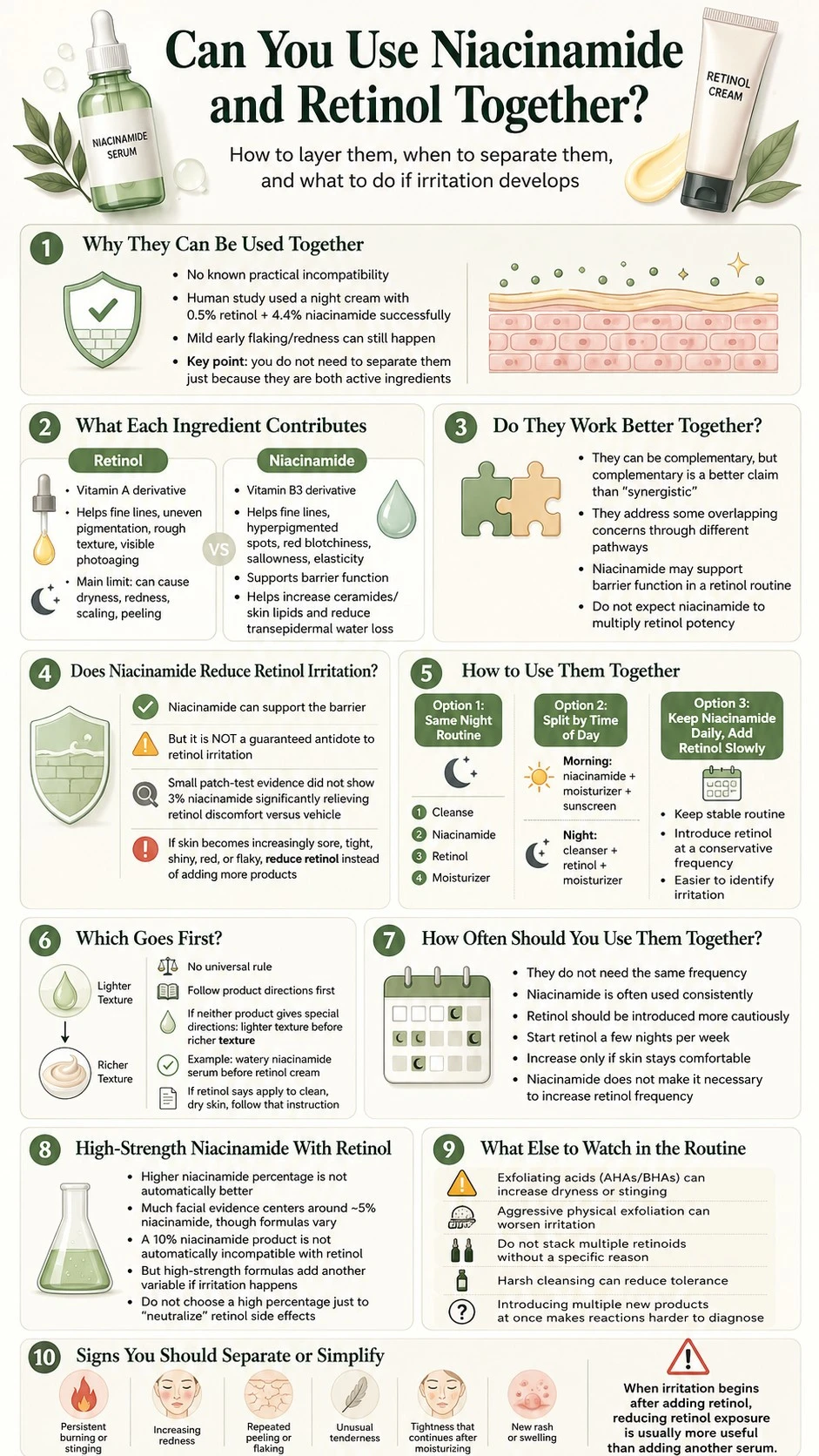
Niacinamide and retinol are often discussed as if active ingredients need to be carefully separated to avoid “conflicts.” In this case, the more useful concern is not chemical incompatibility. It is whether your complete routine is comfortable enough to use consistently.
Retinol can improve visible signs of photoaging but may also cause dryness, redness, scaling, or peeling in some users.[2] Niacinamide is generally well tolerated and has separate evidence for improving several aspects of aging skin and supporting the epidermal barrier.[3][4] That makes the pair reasonable, but it does not mean combining them automatically makes either ingredient more effective.
Why Niacinamide and Retinol Can Be Used Together
There is no established skincare rule requiring niacinamide and retinol to be used at different times. A 10-week human study evaluated a finished night cream containing 0.5% retinol and 4.4% niacinamide together with resveratrol and hexylresorcinol. The formula was used successfully throughout the study, although some mild retinoid-related flaking and redness occurred early in treatment.[1]
That study is useful evidence that the two ingredients can coexist in a finished topical formulation. It does not prove that retinol and niacinamide alone have a special synergistic effect because several active ingredients and a moisturizing base were used together.
The practical conclusion is simpler: you do not need to separate niacinamide and retinol merely because they appear together in your routine.
What Does Each Ingredient Contribute?
Retinol
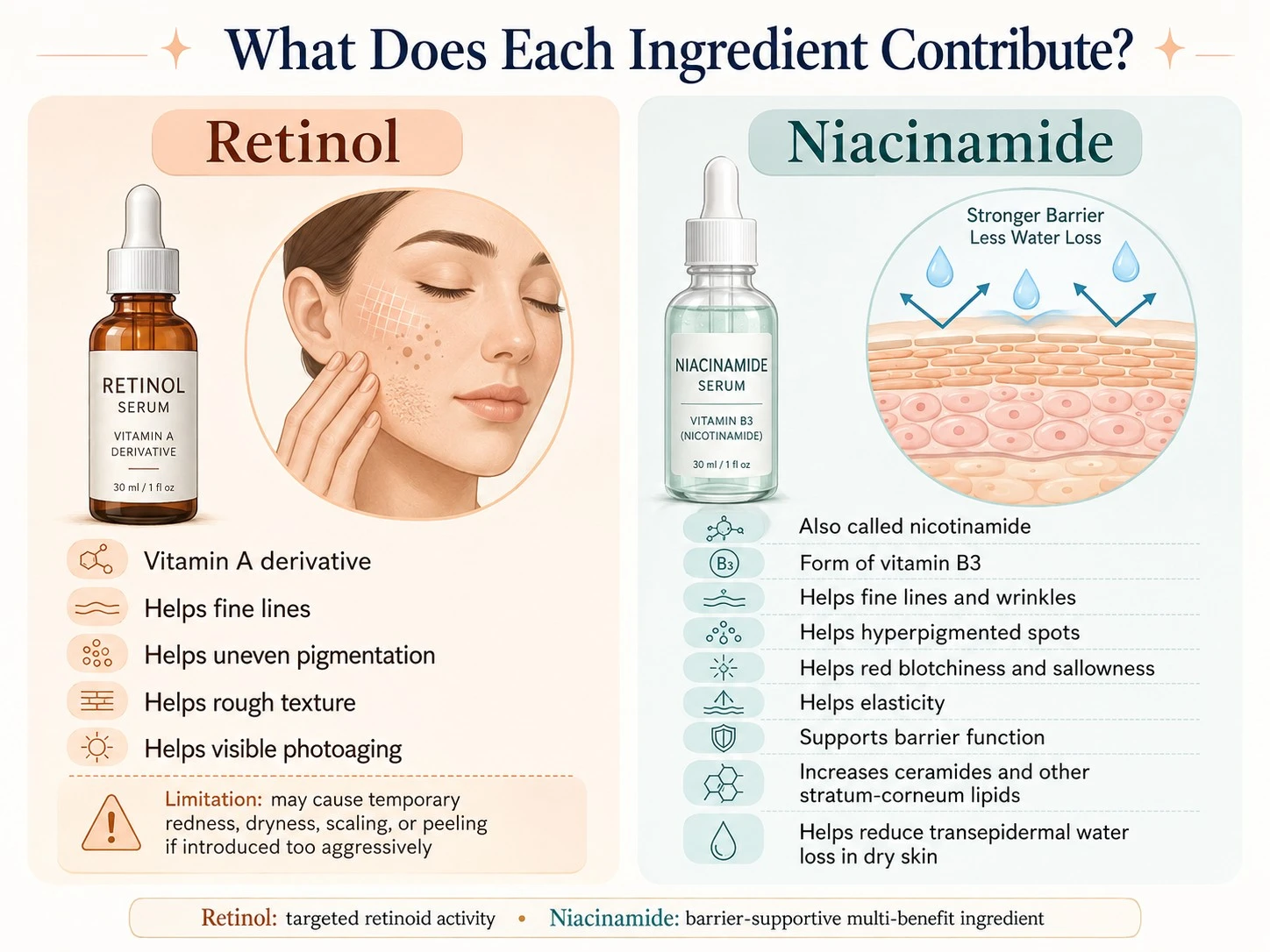
Retinol is a vitamin A derivative used primarily for concerns such as fine lines, uneven pigmentation, rough texture, and other visible signs of photoaging. Controlled clinical research supports improvement in these areas with properly formulated topical retinol.[2]
Its main practical limitation is tolerance. Even a useful retinol formula can cause temporary redness, dryness, scaling, or peeling, particularly when you introduce it too aggressively.
For a complete explanation of the ingredient itself, see our Retinol Guide.
Niacinamide
Niacinamide, also called nicotinamide, is a form of vitamin B3. A randomized split-face study using 5% topical niacinamide found improvements in fine lines, wrinkles, hyperpigmented spots, red blotchiness, sallowness, and elasticity over 12 weeks.[3]
Niacinamide also has a different role that is particularly relevant to retinoid routines. Experimental and human research has found increased production of ceramides and other stratum-corneum lipids, together with reduced transepidermal water loss in dry skin.[4]
See our Niacinamide for Skin guide for its broader uses and application guidance.
Do Niacinamide and Retinol Work Better Together?
They can be complementary, but “complementary” is more defensible than “synergistic.”
Retinol and niacinamide address some overlapping cosmetic concerns, including uneven tone and visible skin aging, while acting through different biological pathways.[2][3] Niacinamide also has evidence relevant to barrier function, which can make it a logical supporting ingredient in a routine containing an active that may cause dryness or peeling.[4]
However, most clinical studies of products containing both ingredients also include moisturizers or additional actives. Their results cannot establish how much of the final effect comes specifically from combining niacinamide with retinol.[1]
Use the pair because each ingredient has a useful role, not because you expect niacinamide to multiply the potency of retinol.
Does Niacinamide Reduce Retinol Irritation?
This claim needs more caution than it usually receives.
Niacinamide can support epidermal barrier function, and that makes it reasonable to include in a retinol routine.[4] But barrier support does not prove that niacinamide will directly prevent retinol-induced redness, burning, or peeling.
In a five-day randomized, double-blind patch test, 3% niacinamide did not significantly relieve retinol-induced discomfort compared with the vehicle control. Two lipid-based treatments tested in the same experiment performed better.[5]
The practical distinction is important: niacinamide can be a useful supporting skincare ingredient, but it should not be used to justify continuing a retinol routine that is clearly too irritating.
If your skin is becoming increasingly sore, tight, shiny, red, or flaky, reduce the retinol exposure and review our Skin Barrier guide rather than adding more products in an attempt to compensate.
How to Use Niacinamide and Retinol Together

There are several reasonable ways to combine them. Choose the simplest option that lets you use retinol consistently without persistent irritation.
Option 1: Use Both in the Same Night Routine
If both products already suit your skin, they can be used together:
- Cleanse: Wash with a gentle cleanser and follow any drying instructions required by your retinol product.
- Apply niacinamide: If your niacinamide product is a lightweight serum, apply it according to its directions.
- Apply retinol: Use the amount and frequency specified for your retinol formula.
- Moisturize: Finish with moisturizer when your routine needs it.
The exact order can change when the products have different textures or their directions specify another application method. Ingredient compatibility does not require niacinamide to be applied before retinol.
Option 2: Niacinamide in the Morning, Retinol at Night
Separating them by time of day is useful when you prefer a shorter evening routine or want to introduce retinol without changing several steps at once.
- Morning: Niacinamide, moisturizer as needed, and sunscreen.
- Night: Cleanser, retinol, and moisturizer as needed.
This arrangement is about routine simplicity and tolerance, not because the ingredients become incompatible when applied together.
Option 3: Keep Niacinamide Daily and Use Retinol on Selected Nights
If niacinamide is already well established in your routine, you do not need to stop it while introducing retinol. Keep the stable part of your routine unchanged and add retinol at a conservative frequency.
This approach has one important advantage: if irritation develops, there are fewer new variables to investigate.
Which Goes First: Niacinamide or Retinol?
There is no universal ingredient rule saying niacinamide must always go before or after retinol.
When using separate products, follow the individual directions first. If neither product specifies a special order, a practical approach is to apply lighter products before richer ones. For example, a watery niacinamide serum would usually fit before a retinol cream.
If your retinol formula specifically instructs you to apply it directly to clean, dry skin, follow that direction instead of forcing a generic layering rule.
For the rest of your products, see our Skincare Routine Order guide.
How Often Should You Use Them Together?
Niacinamide and retinol do not need to share the same frequency.
Niacinamide is commonly used consistently in leave-on skincare and was applied twice daily in a 12-week 5% niacinamide trial.[3] Retinol frequency should be adjusted more cautiously because irritation varies with concentration, formulation, skin sensitivity, and exposure.[2]
If retinol is new to you, introduce it a few nights per week rather than treating nightly use as a goal you must reach. Increase only when your skin remains comfortable. Niacinamide can remain in the routine if it is already well tolerated.
There is no benefit in increasing retinol frequency simply because niacinamide is present.
Can You Use High-Strength Niacinamide With Retinol?
A higher niacinamide percentage is not automatically more useful alongside retinol. Much of the clinical evidence for facial niacinamide benefits has used concentrations around 5%, while successful finished formulas vary.[1][3]
If a 10% niacinamide serum already works comfortably for you, the percentage alone does not create a retinol incompatibility. But if you are introducing both products simultaneously, a strong or complex niacinamide formula adds another variable when irritation occurs.
Do not choose a high percentage solely because you expect it to neutralize retinol side effects. Current evidence does not support that assumption.[5]
What Else Should You Watch in the Routine?
Niacinamide is usually not the ingredient that limits this pairing. The bigger issue is the total irritation load from the rest of the routine.
- Exfoliating acids: AHAs and BHAs can add dryness or stinging when retinol is being introduced.
- Physical exfoliation: Aggressive scrubbing can make already irritated skin less comfortable.
- Other retinoids: Do not routinely stack retinol with retinal, tretinoin, adapalene, or another retinoid without a specific reason.
- Harsh cleansing: Persistent post-cleansing tightness can make a retinol routine harder to tolerate.
- Multiple new products: Introducing several actives simultaneously makes reactions difficult to diagnose.
If routine products begin causing persistent burning rather than brief, mild sensation, see Why Does Skincare Burn and simplify the routine before increasing active use.
Signs You Should Separate or Simplify the Routine
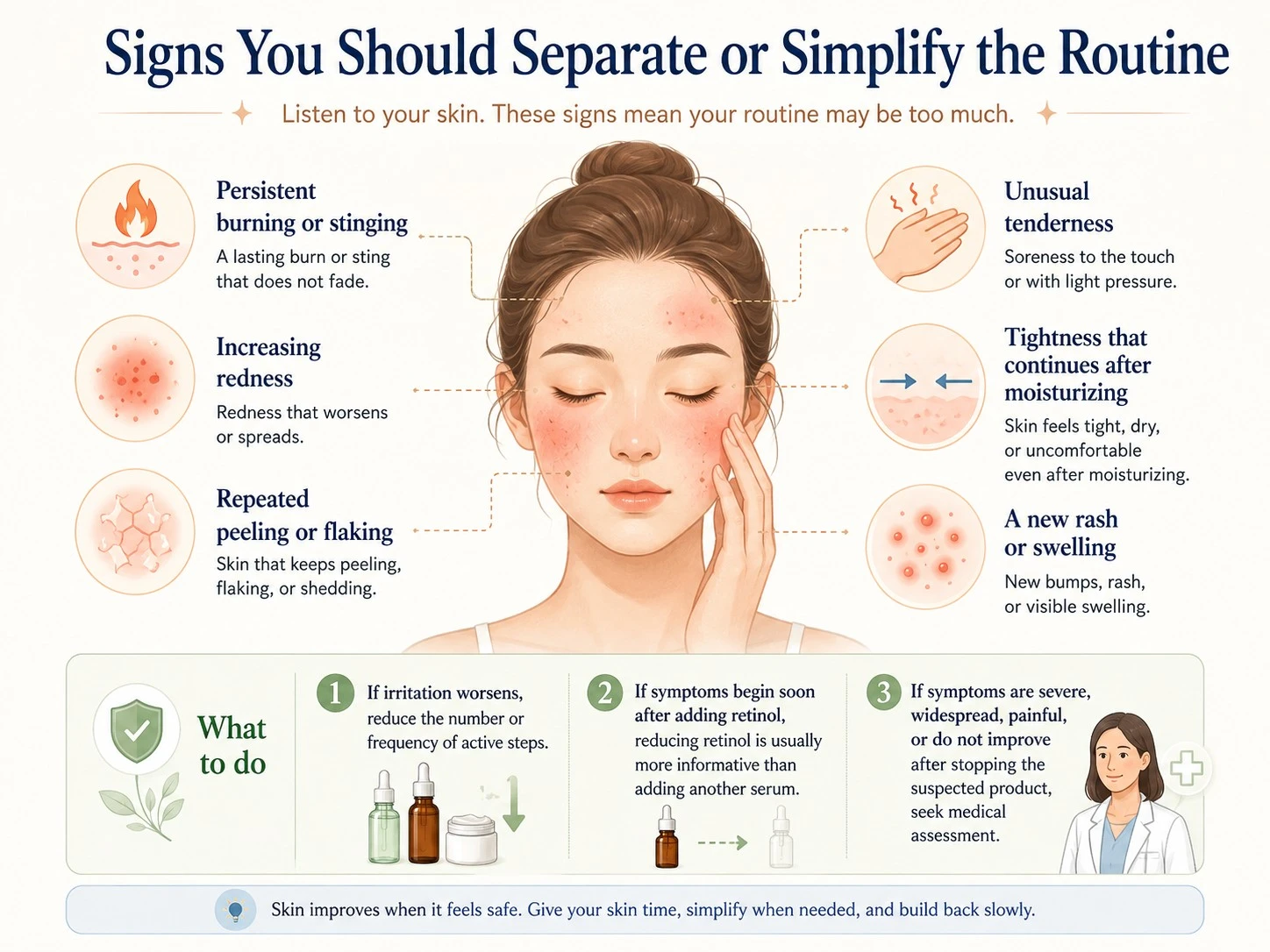
Using niacinamide and retinol together should not require you to tolerate progressively worsening irritation.
Reduce the number or frequency of active steps if you develop:
- Persistent burning or stinging
- Increasing redness
- Repeated peeling or flaking
- Unusual tenderness
- Tightness that continues after moisturizing
- A new rash or swelling
When a reaction begins shortly after retinol is added, reducing retinol exposure is usually more informative than adding another serum. If symptoms are severe, widespread, painful, or do not improve after stopping the suspected product, seek appropriate medical assessment.
Final Thoughts
Niacinamide and retinol can be used together, including in the same routine. Human research has even evaluated finished skincare containing both ingredients.[1] The pair makes practical sense because retinol provides established retinoid activity while niacinamide has separate evidence for skin appearance and barrier support.[2][3][4]
The important limitation is that niacinamide does not guarantee protection from retinol irritation.[5] Keep the routine simple, introduce retinol conservatively, and adjust the retinol rather than expecting niacinamide to compensate when your skin is clearly uncomfortable.
FAQs About Niacinamide and Retinol
Can I apply niacinamide and retinol at the same time?
Yes. They can be used in the same routine, and finished skincare products containing both have been studied in humans.[1] Separate them only when doing so makes your routine easier to tolerate or evaluate.
Should niacinamide go before or after retinol?
Follow the directions for each product. When neither specifies a special order, lighter products generally fit before richer ones, so a lightweight niacinamide serum may come before a retinol cream. There is no compatibility requirement that niacinamide must always be applied first.
Should I use niacinamide in the morning and retinol at night?
You can, but it is optional. Separating them by time of day is useful for simplifying the routine or introducing retinol gradually. It is not necessary because of an inherent incompatibility between the two ingredients.
Does niacinamide stop retinol irritation?
Not reliably. Niacinamide has evidence for supporting barrier function, but a randomized patch study found that 3% niacinamide did not significantly relieve retinol-induced discomfort compared with the vehicle control.[4][5]
Can I use 10% niacinamide with retinol?
Yes, if the niacinamide product already suits your skin. A 10% concentration does not inherently conflict with retinol, but higher percentage does not mean it will protect you better from retinol irritation. Much clinical facial niacinamide research has used lower concentrations such as 5%.[3]
What should I do if niacinamide and retinol make my skin burn?
Reduce or pause the active step most likely to be causing the reaction, particularly a newly introduced retinol. Keep the routine simple and do not add more actives to compensate. Persistent, worsening, or severe burning, swelling, rash, or pain deserves medical assessment.
Sources
[1] Farris P et al. Efficacy and Tolerability of a Skin Brightening/Anti-Aging Cosmeceutical Containing Retinol 0.5%, Niacinamide, Hexylresorcinol, and Resveratrol
[2] Farris PK et al. Efficacy and Tolerability of Topical 0.1% Stabilized Bioactive Retinol for Photoaging: A Vehicle-Controlled Integrated Analysis
[3] Bissett DL et al. Niacinamide: A B Vitamin That Improves Aging Facial Skin Appearance
[4] Tanno O et al. Nicotinamide Increases Biosynthesis of Ceramides as Well as Other Stratum Corneum Lipids to Improve the Epidermal Permeability Barrier
[5] Fang Y et al. Mitigation of Retinol-Induced Skin Irritation by Physiologic Lipids: Evidence From Patch Testing


