


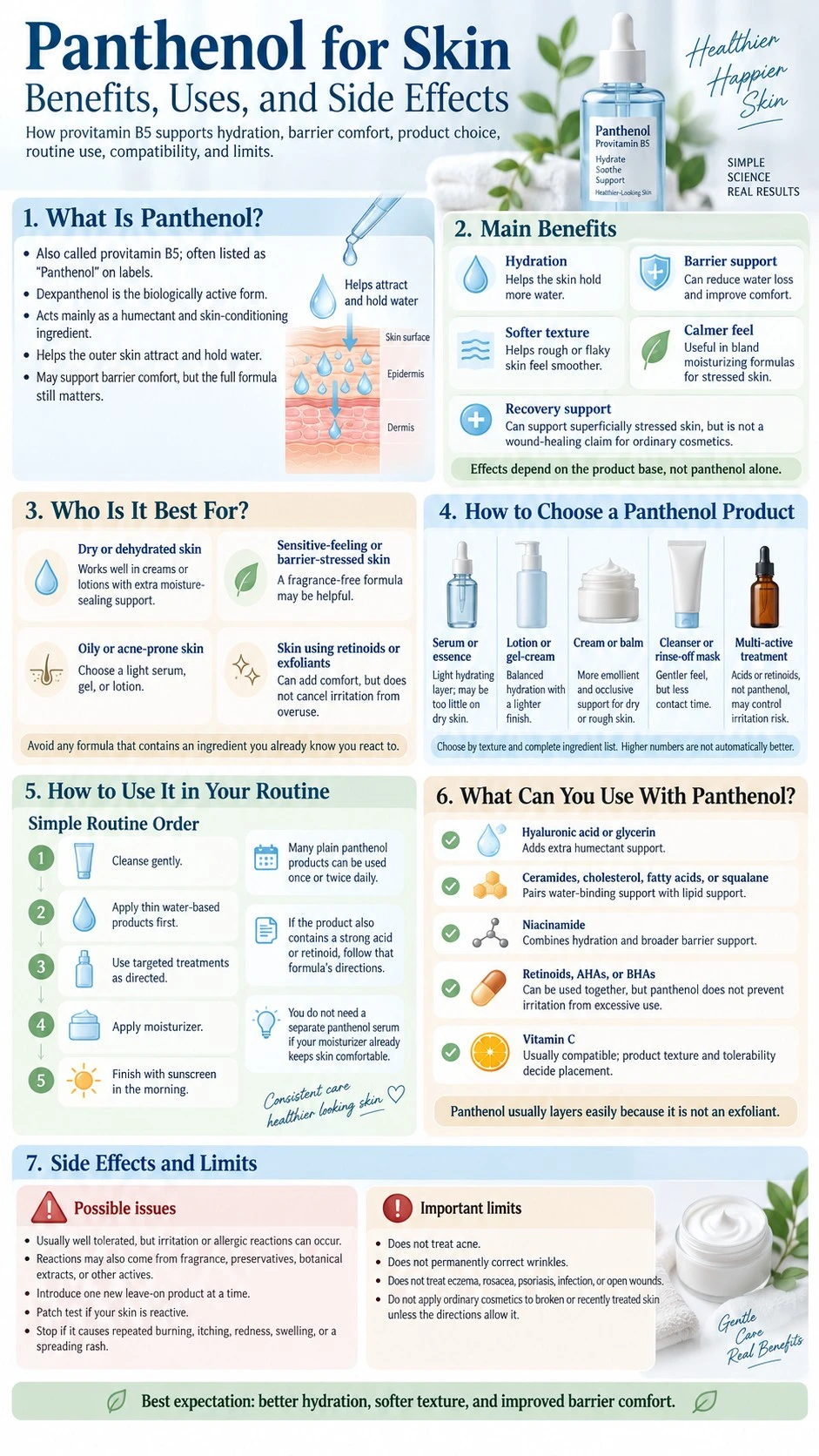
Panthenol appears in products ranging from watery serums to rich creams, often without being the headline ingredient. It can add moisture and comfort without exfoliating the skin or requiring a complicated schedule. The finished formula still determines performance: for dry skin, a panthenol moisturizer with emollient and moisture-sealing support may be more useful than a lightweight serum alone.
What Is Panthenol and How Does It Work?
Panthenol is the alcohol form and a precursor of pantothenic acid, or vitamin B5. After topical application, dexpanthenol can be converted in the skin to pantothenic acid, which is involved in normal cellular metabolism and epithelial function.[2] On a cosmetic label, the INCI name usually appears simply as “Panthenol.”
Dexpanthenol, also called D-panthenol, is the biologically active form. Cosmetic discussions often use panthenol and dexpanthenol interchangeably, although these terms are not chemically identical in every context. For the shopper, the more useful question is how the ingredient behaves in the finished formula.
Panthenol is hygroscopic, meaning it has an affinity for water. In skincare, it functions mainly as a humectant and conditioning agent: it helps increase water in the outermost skin layer and can make a dry or rough surface feel more flexible. It may also support recovery of the skin barrier, the outer structure that slows water loss and helps keep irritants out.
This does not mean panthenol forms a complete seal by itself. Dry skin often benefits from a formula that combines humectants with emollients and occlusives. The vehicle matters too: the same percentage of panthenol can perform differently in a serum, lotion, cream, or ointment.
Panthenol Benefits for Skin
Panthenol is most dependable as a hydration and comfort ingredient. A randomized, double-blind study in healthy volunteers found that 2.5% dexpanthenol in two lipophilic vehicles improved stratum corneum hydration and reduced transepidermal water loss after seven days compared with the matching vehicles.[1] That finding supports the ingredient’s potential, but it does not establish one ideal percentage or prove that every product will deliver the same result.
| Skin goal | What panthenol may contribute | Who may value it | Important limit |
|---|---|---|---|
| Better hydration | Helps the outer skin attract and retain water | Dehydrated, tight, or weather-stressed skin | A watery product may still need moisturizer on top |
| Barrier support | Can reduce water loss and support a more comfortable surface | Dry, sensitive-feeling, or over-cleansed skin | It does not replace all barrier lipids or remove the cause of ongoing damage |
| Softer, smoother feel | Conditions rough or flaky surface skin | Skin that feels coarse or looks temporarily dull | The effect is mainly cosmetic and does not resurface deep scars or wrinkles |
| Calmer-feeling skin | Can make a bland moisturizing formula more comfortable on irritated-feeling skin | Skin adjusting to retinoids or exfoliants | It cannot make an overly aggressive routine safe |
| Recovery support | Dexpanthenol has been studied in medical and postprocedure skin-care settings | Superficially stressed skin when an appropriate product is used | Medical findings should not be treated as proof that a cosmetic heals wounds |
Evidence for wound recovery comes from specific dexpanthenol preparations and clinical settings, including postprocedure care.[4] For everyday skincare, “supports barrier recovery” is a more realistic claim than “heals damaged skin.” The complete formula, the skin’s condition, and the cause of irritation all change the outcome.
Who Is Panthenol Best For?
Panthenol can fit most skin types, but the best product base depends on what the skin lacks.
- Dry or dehydrated skin: Panthenol can help with water content, while a cream or lotion can also provide oils and moisture-sealing ingredients. If you are unsure which problem you have, compare dehydrated vs dry skin before choosing a texture.
- Sensitive-feeling or barrier-stressed skin: A short, fragrance-free formula may be useful when the skin feels tight after cleansing or uncomfortable during cold, dry weather. Panthenol does not guarantee tolerance if the product also contains fragrance, essential oils, or strong actives.
- Oily or acne-prone skin: Choose a light serum, gel, or lotion if rich creams feel congesting. Panthenol hydrates but does not unclog pores, reduce acne bacteria, or replace an acne treatment.
- Skin using retinoids or exfoliating acids: Panthenol can add hydration and comfort around a drying treatment. It does not cancel burning, peeling, or barrier damage caused by using that treatment too often.
People with a known allergy to panthenol or another product ingredient should avoid the triggering formula. Persistent redness, itching, cracking, or scaling needs more than an ingredient swap if it may reflect dermatitis or another skin condition.
How to Choose a Panthenol Product
Start with the product type, then examine the rest of the formula. The panthenol percentage is not always disclosed, and a larger number is not automatically better.
- Serum or essence: Offers a light hydrating layer. It is most useful when your moisturizer needs extra humectant support, but it may feel insufficient alone on dry skin.
- Lotion or gel-cream: Balances hydration with a lighter finish and often suits normal, combination, or oily skin.
- Cream or balm: Adds more emollient or occlusive support and may suit dry, rough, or weather-stressed areas.
- Cleanser or rinse-off mask: Can contribute to a gentler feel, but contact time is shorter than with a leave-on product.
- Multi-active treatment: Check whether acids, retinoids, or other actives—not panthenol—control the product’s frequency and irritation risk.
For sensitive skin, a fragrance-free formula is a better starting point than assuming “B5” makes every product soothing. For acne-prone skin, assess the complete texture and your own response rather than labeling panthenol itself as pore-clogging. A guide to choosing a moisturizer can help match gel, lotion, and cream textures to your skin.
How to Use Panthenol in Your Skincare Routine
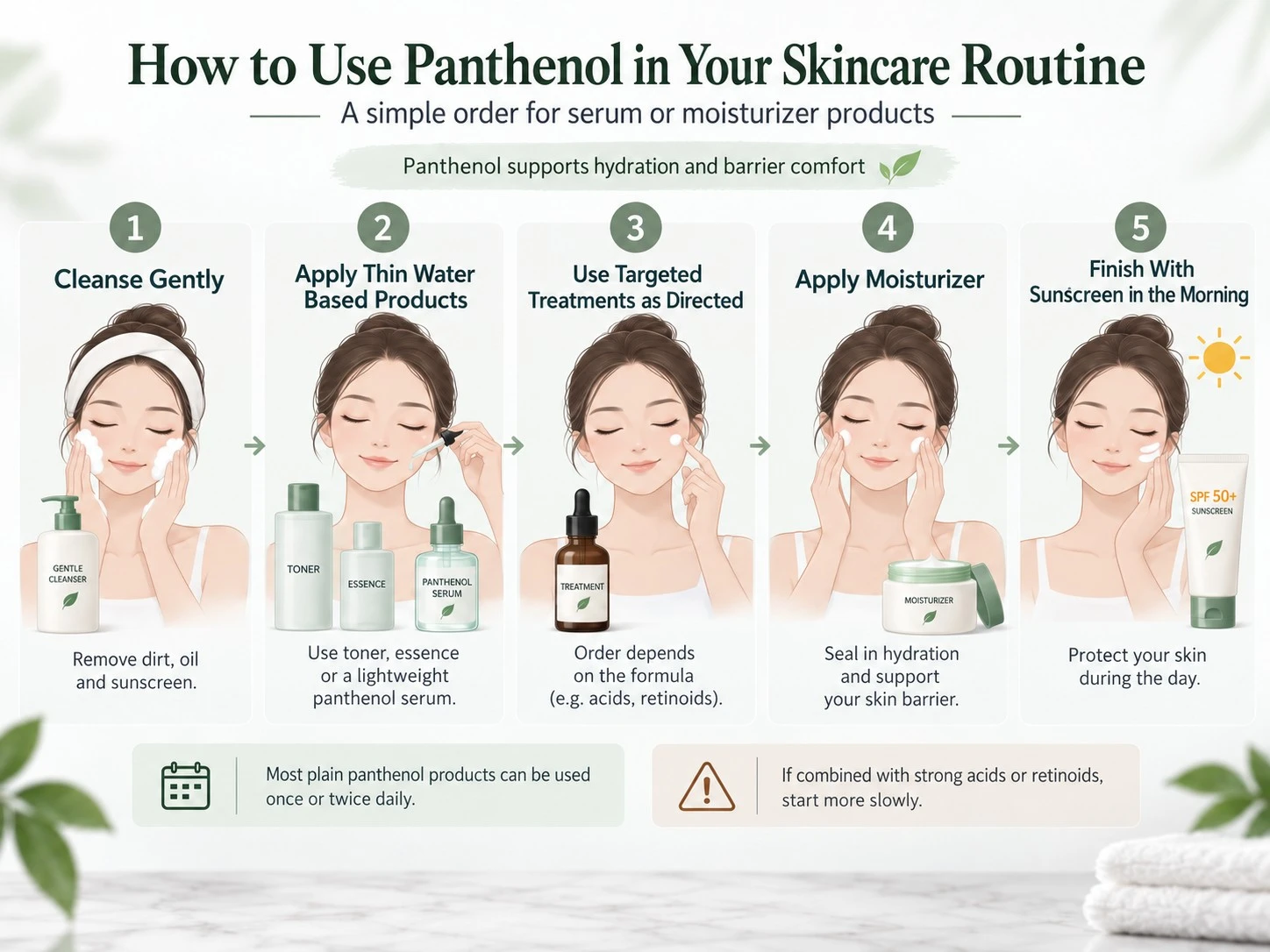
Follow the directions for the specific product. For a simple leave-on panthenol serum or moisturizer, use this order:
- Cleanse gently. Use lukewarm water and avoid leaving the skin squeaky or tight.
- Apply thin water-based products. If panthenol is in a toner, essence, or serum, apply a small, even layer after cleansing and before heavier creams.
- Use targeted treatments as directed. The order can vary by formula. If a prescription or exfoliant has specific instructions, follow those instead of forcing a universal “thin to thick” rule.
- Apply moisturizer. If the panthenol product is a serum, add a gel, lotion, or cream that matches your skin. If panthenol is already in your moisturizer, this can be the same step.
- Finish with sunscreen in the morning. Panthenol does not protect skin from ultraviolet radiation.
Many plain panthenol products can be used once or twice daily, but the complete formula controls frequency. A product that also contains a strong acid or retinoid may need slower use. You do not need a separate panthenol serum if your current moisturizer already keeps the skin comfortable.
The broader skincare routine order explains how sunscreen, treatments, oils, and masks fit around the basic steps.
What Can You Use With Panthenol?
Panthenol generally layers easily because it is not an exfoliant and does not have a low-pH activation requirement.
- Hyaluronic acid or glycerin: Adds complementary humectant support. Follow with moisturizer if a thin serum leaves dry skin tight.
- Ceramides, cholesterol, fatty acids, or squalane: Pair water-binding support with lipids and emollients that help the barrier feel less dry.
- Niacinamide: Can combine hydration and broader barrier support in one routine. Choose tolerable formulas rather than chasing the highest percentages.
- Retinoids, AHAs, or BHAs: Panthenol may support comfort, but it cannot prevent irritation from excessive strength or frequency. Reduce the irritating active when burning or peeling persists.
- Vitamin C: These ingredients can share a routine. Let the vitamin C formula’s pH and tolerability determine placement, and simplify if layering stings or pills.
There is usually no need to separate panthenol from another ingredient by time of day. Product directions, texture, and skin response matter more than ingredient-pairing rules.
Panthenol Side Effects and Limits
Panthenol and the related ingredients covered by a cosmetic safety assessment were concluded safe in the reported practices of use and concentration.[3] Topical dexpanthenol is generally well tolerated, although irritation and allergic contact reactions can occur.[2] A reaction to a panthenol product may also come from fragrance, preservatives, botanical extracts, or another active in the formula.
Introduce one new leave-on product at a time. If your skin is reactive, patch test the skincare product before applying it widely. A clear home patch test lowers uncertainty but cannot guarantee that a reaction will never develop.
Stop using the product if it repeatedly causes burning, itching, redness, swelling, or a spreading rash. Seek medical care for severe swelling, hives, blistering, eye involvement, breathing symptoms, signs of infection, or a reaction that continues after the product is stopped.
Panthenol also has clear limits. It can support hydration and surface comfort, but it does not treat acne, rosacea, eczema, psoriasis, infection, or an open wound simply because medical dexpanthenol products exist. Do not apply an ordinary cosmetic to broken or recently treated skin unless its directions and your clinician’s aftercare plan allow it.
FAQs About Panthenol for Skin
Can you use panthenol every day?
Yes, many simple panthenol serums and moisturizers are suitable for once- or twice-daily use. Follow the label because another ingredient in the same formula may require less frequent application. Reduce use or stop if the product causes persistent irritation.
Does panthenol clog pores?
Panthenol alone does not tell you whether a product will clog pores. Acne-prone skin may prefer a light gel or lotion, while rich oils, waxes, or occlusive ingredients in the same formula may feel congesting for some people. Panthenol is a hydrator, not an acne treatment.
Is panthenol the same as vitamin B5?
Panthenol is commonly called provitamin B5 because it is a precursor that can be converted to pantothenic acid, the vitamin B5 form used by the body. Dexpanthenol or D-panthenol names the biologically active form; cosmetic labels commonly list “Panthenol.”
Can you use panthenol with retinol?
Yes. Panthenol can add hydration and comfort to a retinol routine, and the two may appear in the same product. It does not neutralize retinol or guarantee that dryness will not occur. Use retinol at a tolerable frequency and reduce it if burning, marked redness, or peeling persists.
Sources
[1] Gehring W, Gloor M. Effect of Topically Applied Dexpanthenol on Epidermal Barrier Function and Stratum Corneum Hydration
[2] Ebner F, et al. Topical Use of Dexpanthenol in Skin Disorders
[3] Cosmetic Ingredient Review. Safety Assessment of Panthenol, Pantothenic Acid, and Derivatives as Used in Cosmetics
[4] Gorski J, et al. Dexpanthenol in Wound Healing after Medical and Cosmetic Interventions


