


What Can Cause Skin to Become Sensitive Suddenly?
Several causes can produce similar symptoms, so use timing and pattern rather than redness alone to narrow the problem.
| Possible Cause | Clues | Best First Move |
|---|---|---|
| New skincare or makeup product | Symptoms appeared after introducing or changing a formula | Stop the newest product and avoid adding replacements immediately |
| Too many active ingredients | Burning, tightness, dryness, or peeling after acids, retinoids, acne treatments, or several strong products | Pause unnecessary actives and simplify the routine |
| Over-exfoliation | New stinging, flaking, tightness, or tenderness after frequent acids, scrubs, peels, or exfoliating cleansers | Stop exfoliation until basic products feel comfortable again |
| Harsh cleansing or repeated friction | Skin feels tight, rough, itchy, or stingy after washing, scrubbing, shaving, or frequent wiping | Reduce friction and use a milder cleansing routine |
| Irritant contact dermatitis | Burning, dryness, cracking, tenderness, or rash after enough exposure to an irritating product or physical factor | Avoid the suspected irritant and support the skin while it recovers |
| Allergic contact dermatitis | Itchy, swollen, or eczematous rash that can appear hours or days after contact, sometimes after a product was previously tolerated | Stop the suspected product; recurrent reactions may need medical patch testing |
| Weather or environment | Symptoms begin during cold, low-humidity, windy, or otherwise irritating conditions | Reduce exposure where possible and increase gentle barrier-supportive care |
| Rosacea, eczema, or another skin condition | Sensitivity comes with a recurring pattern such as flushing, visible vessels, persistent itch, scaling, or a characteristic rash | Get the underlying condition assessed instead of repeatedly changing skincare |
Irritant contact dermatitis develops when chemical or physical stress damages the skin faster than it can repair itself.[3] Allergic contact dermatitis is different: it is an immune reaction to an allergen, and it can develop after previous exposures that caused no obvious problem.[4][5]
Why Does Everything Suddenly Sting, Even Moisturizer?
When the outer barrier is irritated, substances that normally feel neutral can reach more reactive skin and nerve endings more easily. The result can be stinging from water, moisturizer, sunscreen, sweat, or products that were comfortable before. Harsh surfactants, repeated irritation, and low-humidity conditions can all reduce barrier function or increase susceptibility to irritation.[3][8][9]
This does not mean every product that stings is “working,” nor does it prove that one specific ingredient is the problem. If several unrelated products suddenly burn at the same time, the shared clue may be the condition of your skin rather than all of those formulas becoming unsuitable at once.
If this pattern fits, review the signs in our Skin Barrier guide. If the change followed frequent exfoliation, compare your symptoms with Over-Exfoliated Skin.
How to Calm Skin That Has Suddenly Become Sensitive

The first goal is to reduce new irritation, not to build a more complicated “repair” routine.
- Pause recent additions: Stop new products and unnecessary acids, scrubs, retinoids, peels, or other irritating actives until the skin is comfortable again.
- Cleanse gently: Use lukewarm water, avoid scrubbing, and choose a cleanser that does not leave the face tight or squeaky. See How to Choose a Cleanser if your current wash feels stripping.
- Use a simple moisturizer: Choose a formula that reduces tightness without adding several active ingredients. Fragrance-free products are a practical starting point when skin is reactive.[10]
- Keep sun protection comfortable: Continue protecting exposed skin, but change the sunscreen if the current formula repeatedly burns or aggravates the reaction.
- Reintroduce slowly: Once basic cleansing, moisturizer, and water no longer cause persistent discomfort, add one non-essential product at a time rather than restarting the entire routine at once.
A simple routine does not need to be permanent. It gives you a stable baseline so you can tell whether the skin is recovering and which product causes symptoms when it is added back. Our Skincare Routine for Sensitive Skin provides a practical low-irritation morning and evening structure.
How to Find the Trigger Without Replacing Your Whole Routine
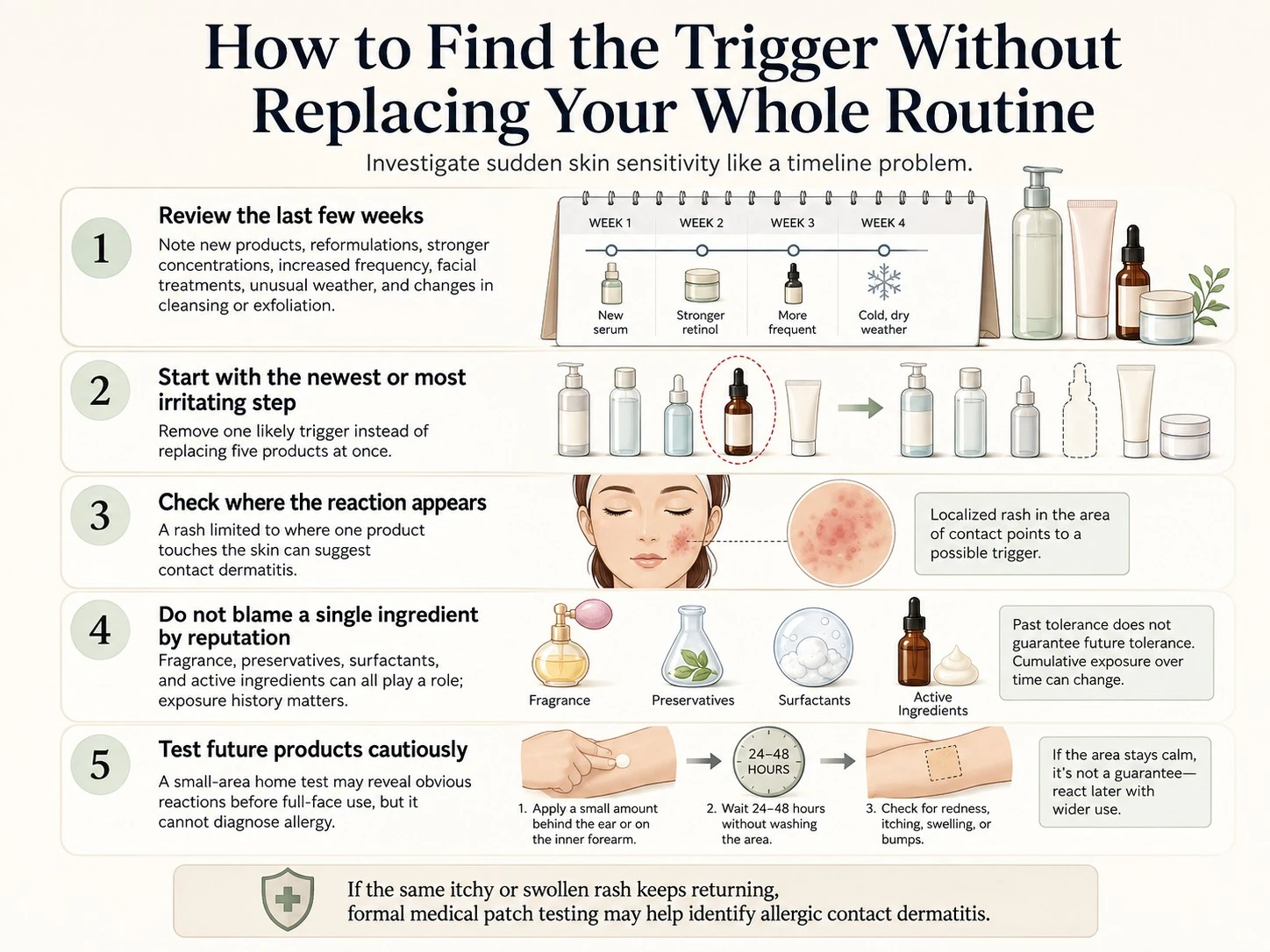
Sudden sensitivity is easier to investigate when you treat it like a timeline problem.
- Review the last few weeks: Note new products, reformulations, stronger concentrations, increased frequency, facial treatments, unusual weather, and changes in cleansing or exfoliation.
- Start with the newest or most irritating step: Removing one likely trigger gives clearer information than replacing five products simultaneously.
- Check where the reaction appears: A rash concentrated where one product touches the skin can be an important contact-dermatitis clue.
- Do not blame a single ingredient by reputation: Fragrance, preservatives, surfactants, active ingredients, and many other substances can cause reactions, but the complete exposure history matters.
- Test future products cautiously: A small-area home test can help identify obvious reactions before full-face use, although it cannot diagnose an allergy.[10]
For a practical introduction method, use our Patch Testing Guide. If the same itchy or swollen rash repeatedly returns, formal medical patch testing can help identify allergic contact dermatitis.[5]
When Sudden Sensitivity May Be Something Else
Skincare irritation is common, but some patterns deserve more than a routine reset.
| Pattern | What to Consider | Why It Matters |
|---|---|---|
| Intensely itchy, swollen, blistering, or recurring rash after a product | Allergic contact dermatitis | The trigger may need to be identified and avoided rather than simply buffered with moisturizer |
| Burning, dryness, cracking, or tenderness after repeated harsh exposure | Irritant contact dermatitis | Continued exposure can keep the inflammation active |
| Persistent central facial redness, flushing, visible vessels, or acne-like bumps | Rosacea | Rosacea can make skin highly reactive and needs condition-specific management[6] |
| Recurring dry, itchy, scaly patches | Eczema / dermatitis | Persistent inflammatory skin disease may need targeted treatment[7] |
| Small red or skin-colored bumps around the mouth, nose, or eyes | Perioral dermatitis | The rash can resemble acne or irritation but follows a different treatment path[11] |
Seek medical care for severe swelling, widespread hives, blistering, oozing, eye involvement, signs of infection, or a reaction that keeps worsening after the suspected trigger is removed. Persistent burning from skincare is also a reason to reassess the cause rather than repeatedly trying stronger “repair” products; see Why Does Skincare Burn?.
How Long Does Sudden Skin Sensitivity Take to Settle?

There is no reliable universal recovery time. Mild irritation can begin improving after the trigger is removed, while repeated irritant exposure, allergic contact dermatitis, or an underlying condition can keep symptoms active much longer.[3][4]
Use skin behavior rather than a fixed calendar date as the checkpoint. Basic cleansing, water, moisturizer, and sunscreen should become more comfortable; unusual tightness, tenderness, flaking, itching, or redness should be clearly decreasing before you restart optional active products.
If the skin is not trending toward its previous baseline, or the same reaction returns each time you simplify and restart products, stop treating the problem as ordinary temporary sensitivity and investigate the cause.
Common Mistakes When Skin Suddenly Becomes Sensitive
- Adding several soothing serums, masks, oils, and barrier products at once.
- Continuing acids or retinoids through persistent burning because irritation is mistaken for efficacy.
- Scrubbing away flakes or using a cleansing brush on tender skin.
- Switching the entire routine at once and losing the ability to identify the trigger.
- Assuming a product cannot be responsible because you used it safely in the past.
- Assuming “natural,” “clean,” or “hypoallergenic” means a product cannot irritate or trigger allergy.
- Calling every itchy rash a damaged barrier.
- Restarting all active products as soon as redness looks slightly better.
Final Thoughts
Skin that suddenly becomes sensitive usually gives you a clue in its recent history. A new product, increased active use, over-exfoliation, harsh cleansing, friction, environmental stress, or contact dermatitis can all turn previously comfortable skin into skin that stings and reacts.
Simplify first, remove likely triggers, and let basic skincare become comfortable again before rebuilding the routine one product at a time. If the pattern includes persistent rash, swelling, intense itching, flushing, visible vessels, or repeated reactions, identifying the underlying condition is more useful than continuing to shop for “sensitive skin” products.
FAQs About Sudden Skin Sensitivity
Can your skin suddenly become sensitive even if it was normal before?
Yes. Previously comfortable skin can become temporarily reactive after irritation, over-treatment, environmental stress, or contact dermatitis. A sudden change does not automatically mean your permanent skin type has changed.
Why do skincare products I have used for months suddenly burn?
If several familiar products start burning at once, an irritated barrier can make the skin more reactive. A specific product can also cause delayed allergic contact dermatitis even after earlier exposures caused no obvious reaction.[4][5]
Should I stop all skincare when my skin becomes sensitive?
Usually you do not need to stop basic care completely. Remove recent and unnecessary irritating products first, then keep cleansing, moisturizer, and sun protection as simple and comfortable as possible. Stop any basic product that clearly makes the reaction worse.
Does sudden sensitivity always mean my skin barrier is damaged?
No. Barrier irritation is common, but sudden burning, redness, or itching can also come from allergic contact dermatitis, rosacea, eczema, perioral dermatitis, or another condition. The pattern and history matter more than the label.
Can I exfoliate while my skin is suddenly sensitive?
Avoid unnecessary exfoliation while the skin is burning, tight, tender, peeling, or reacting to basic products. Restart only after the skin has returned close to its normal baseline and only if exfoliation serves a clear purpose.
When should I see a dermatologist for suddenly sensitive skin?
Seek professional assessment when sensitivity is persistent, keeps recurring, produces an intensely itchy or swollen rash, causes blisters or oozing, involves the eyes, or comes with persistent flushing, visible vessels, or another pattern that suggests a specific skin condition.
Sources
[1] Misery L, et al. Definition of Sensitive Skin: An Expert Position Paper from the Special Interest Group on Sensitive Skin of the International Forum for the Study of Itch
[2] DermNet. Sensitive Skin
[3] DermNet. Irritant Contact Dermatitis
[4] American Academy of Dermatology. Contact Dermatitis: Causes
[5] American Academy of Dermatology. Patch Testing Can Find What’s Causing Your Rash
[6] American Academy of Dermatology. Rosacea: Diagnosis and Treatment
[7] DermNet. Atopic Dermatitis
[8] Ananthapadmanabhan KP, et al. Cleansing Without Compromise: The Impact of Cleansers on the Skin Barrier and the Technology of Mild Cleansing
[9] Engebretsen KA, et al. The Effect of Environmental Humidity and Temperature on Skin Barrier Function and Dermatitis
[10] American Academy of Dermatology. How to Test Skin Care Products
[11] American Academy of Dermatology. Red Rash Around Your Mouth Could Be Perioral Dermatitis


