


Glycerin rarely gets the attention given to newer skincare actives, yet it appears in countless cleansers, serums, lotions, and creams for a simple reason: keeping water in the outer skin is one of the most basic jobs a skincare formula needs to do.
That does not mean every glycerin product is equally moisturizing, or that glycerin should be treated as a cure-all. Its effect depends on concentration, product format, the other ingredients around it, and what your skin actually lacks. Understanding that distinction makes glycerin much easier to use well.
What Is Glycerin in Skincare?
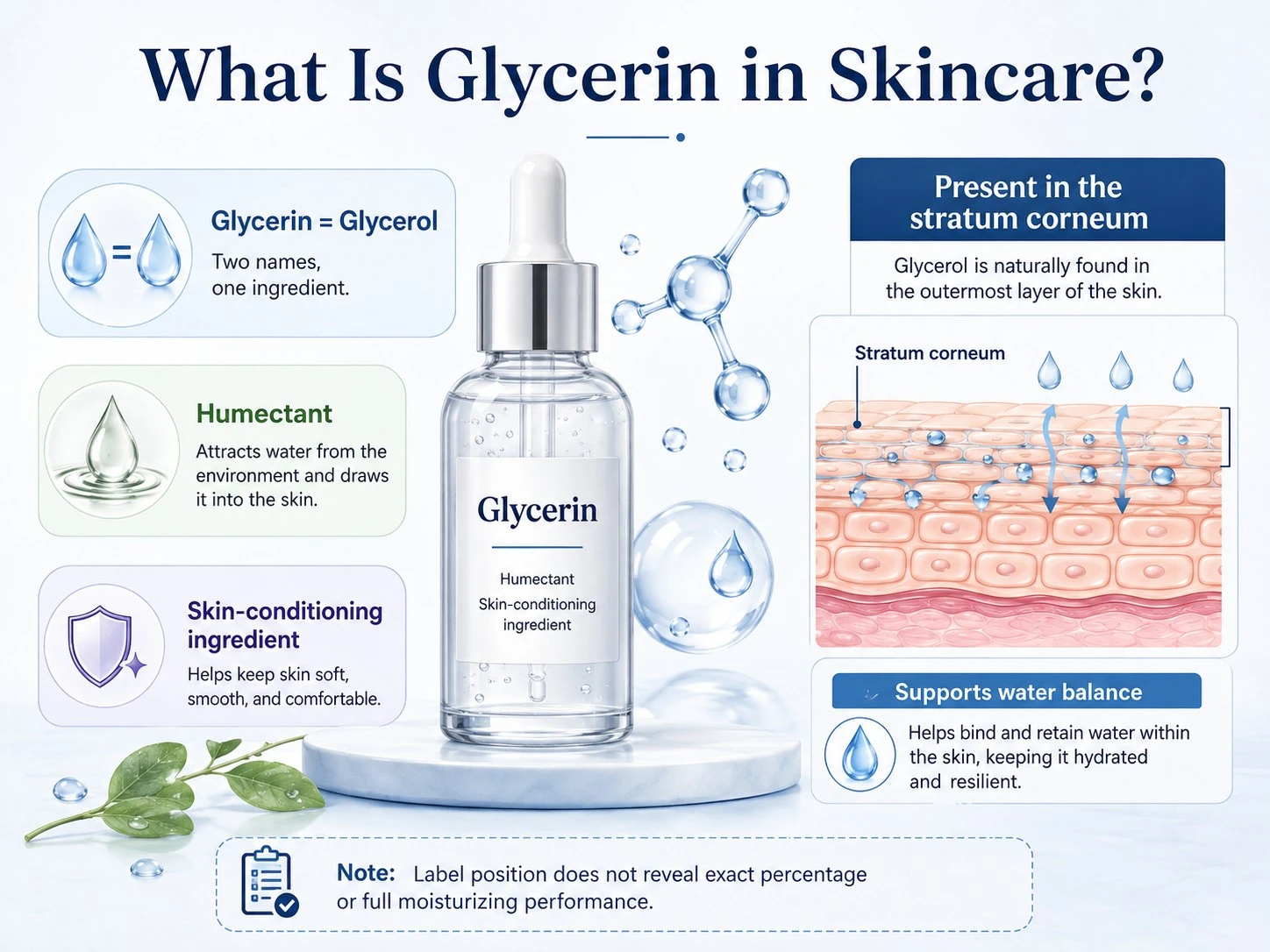
Glycerin and glycerol are two names for the same small, water-attracting molecule. In cosmetics, glycerin commonly functions as a humectant and skin-conditioning ingredient. Glycerol is also naturally present in the stratum corneum, the outermost part of the skin, where it participates in water balance.[2][5]
On a cosmetic label, you will usually see the ingredient listed as Glycerin. Its position can offer a rough clue about how the formula is built, but it does not reveal the exact percentage or predict how moisturizing the finished product will be. If you want to interpret labels more accurately, see How to Read a Skincare Ingredient List.
What Does Glycerin Do for Skin?
The useful way to judge glycerin is to separate its well-supported hydration role from broader claims that depend on the complete formula.
| Potential Benefit | What It Means in Practice | Important Limit |
|---|---|---|
| Improves hydration | Helps the stratum corneum bind and retain water, which can reduce the feeling of tightness and dryness.[1][3][4] | Hydration does not automatically mean every formula will reduce transepidermal water loss. |
| Softens rough-feeling skin | Better hydration can make the skin surface feel more flexible, smooth, and comfortable. | It does not exfoliate like an AHA or BHA. |
| Supports dry-skin care | Glycerin is commonly useful inside creams and ointments designed for dry skin.[6] | Very dry skin often needs emollient and occlusive support as well. |
| Supports outer-barrier conditions | Glycerol interacts with stratum-corneum water, proteins, and lipids, and some glycerol-containing formulas have improved barrier measurements.[1][2][3] | Do not translate this into a blanket claim that glycerin alone “repairs the skin barrier.” |
The last distinction matters. In a small double-blind human study, a cream containing 20% glycerin increased measured skin hydration after repeated use, but it did not produce a measurable improvement in transepidermal water loss or resistance to surfactant irritation.[4] A newer 30-person study found that adding 5% glycerol to certain propanediol formulas improved hydration and, in some combinations, reduced water loss.[3] Those different results show why the finished formula matters.
How Does Glycerin Work?
Glycerin is hygroscopic, meaning it can associate with water. In the stratum corneum, its role is more complex than simply “pulling moisture from the air.” Recent work on human stratum-corneum samples found that glycerol helped preserve water associated with soft keratin during drying.[1] Separate laboratory research found that glycerol also interacts with the skin’s lipid matrix and may help stabilize its organization under changing hydration conditions.[2]
That is why glycerin fits within the broader group of humectants, but should not be treated as interchangeable with emollients or occlusives. A humectant helps with water handling; an emollient improves surface softness and lipid feel; an occlusive slows water loss. Many effective moisturizers combine these jobs.
Does Glycerin Dry Out Skin in Low Humidity?
The common claim that glycerin automatically becomes drying whenever the air is dry is too simple. Research has documented glycerol-related water binding and lipid effects during drying or low-humidity conditions.[1][2] That does not mean climate is irrelevant. If your skin is very dry, flaky, or barrier-stressed, a watery humectant product alone may still feel insufficient because the routine also needs enough emollient and occlusive support to reduce water loss.
Is Glycerin Good for Every Skin Type?
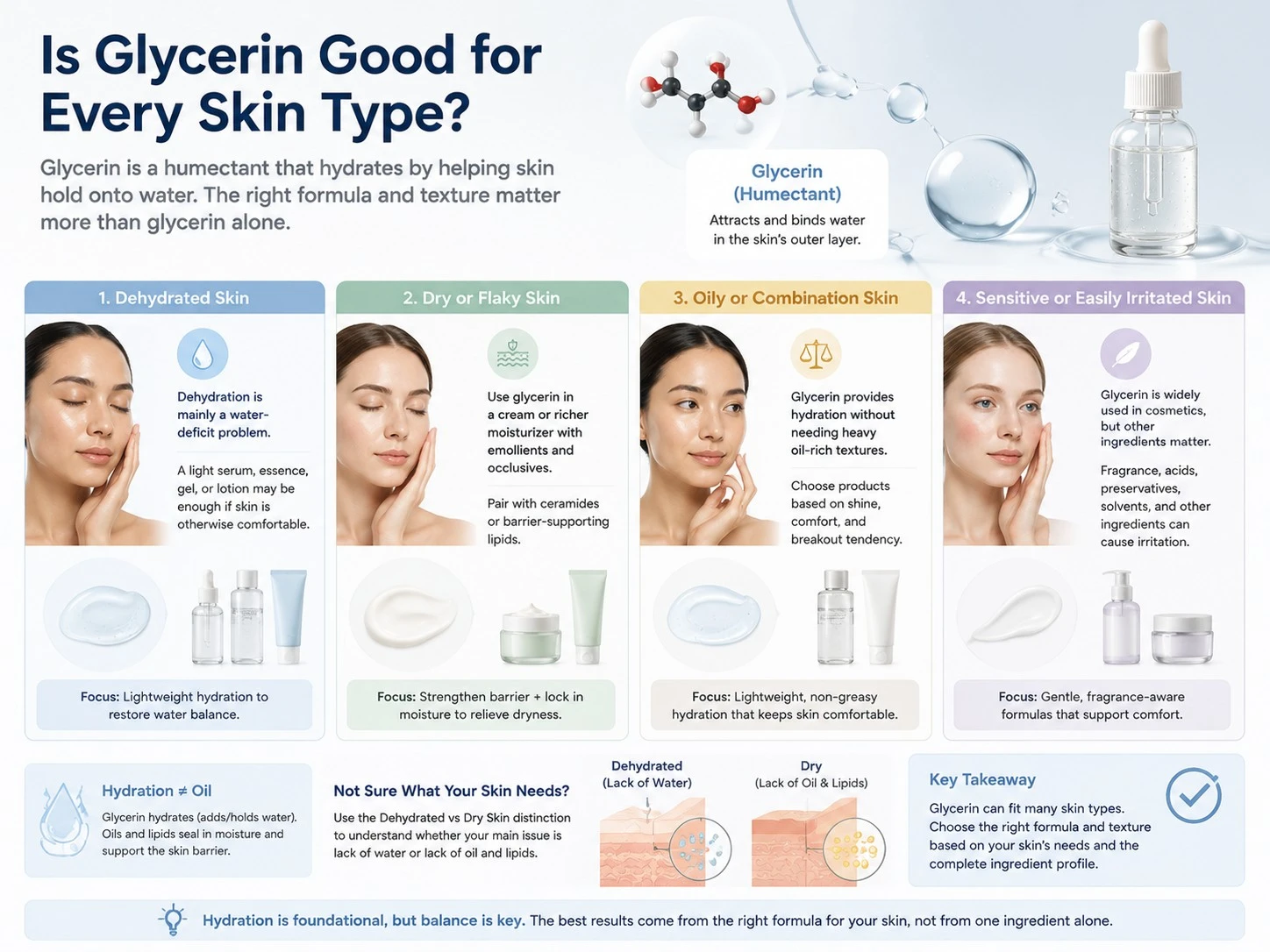
Glycerin can fit many skin types because hydration is not the same as adding oil. The product texture and surrounding formula usually matter more than the presence of glycerin itself.
- Dehydrated skin: glycerin is a logical humectant because dehydration is mainly a water-deficit problem. A light serum, essence, gel, or lotion may be enough if the skin is otherwise comfortable.
- Dry or flaky skin: look for glycerin inside a cream or richer moisturizer that also contains emollient or occlusive ingredients. Pairing it with ceramides or other barrier-supporting lipids can make more sense than chasing a high glycerin percentage alone.
- Oily or combination skin: glycerin can provide hydration without requiring a heavy oil-rich texture. Choose the finished product according to shine, comfort, and breakout tendency.
- Sensitive or easily irritated skin: glycerin itself is widely used in cosmetic formulas, but fragrance, exfoliating acids, preservatives, solvents, or other ingredients may determine whether the complete product feels comfortable.
If you are unsure whether your main problem is lack of water or lack of oil and lipids, the distinction in Dehydrated vs Dry Skin is more useful than choosing ingredients by skin-type labels alone.
Glycerin vs Hyaluronic Acid: Which Is Better?
Glycerin and hyaluronic acid are both humectants, so the comparison is not a simple winner-versus-loser decision. Both can increase the water available to the outer skin, but they differ in chemistry, molecular size, sensory behavior, and how formulators use them.
- Choose by formula, not hype: a well-balanced glycerin moisturizer can outperform a poorly designed hyaluronic acid serum for your skin, and the reverse can also be true.
- Glycerin is highly versatile: it works in many product types and is often used as a foundational humectant rather than a headline active.
- Hyaluronic acid comes in multiple molecular forms: different forms can influence texture and how a product is positioned.
- You do not have to choose one: many formulas combine glycerin with hyaluronic acid and other humectants.
For a deeper comparison of hyaluronic acid forms, product types, and use, see Hyaluronic Acid for Skin.
How to Use Glycerin in a Skincare Routine
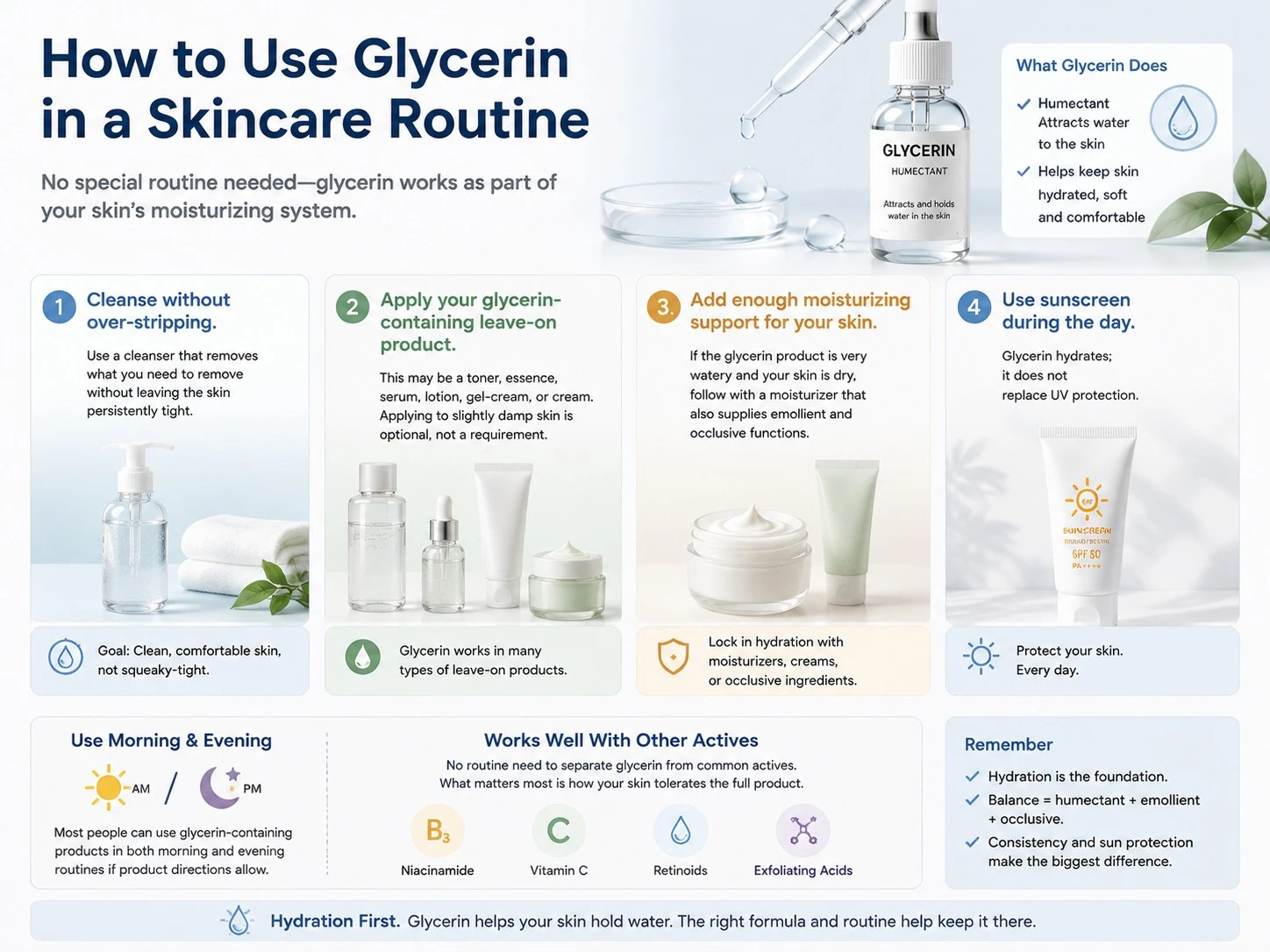
You do not need a special “glycerin routine.” Treat it as part of the moisturizing system already built into your products.
- Cleanse without over-stripping. Use a cleanser that removes what you need to remove without leaving the skin persistently tight.
- Apply your glycerin-containing leave-on product. This may be a toner, essence, serum, lotion, gel-cream, or cream. Applying to slightly damp skin is optional, not a requirement.
- Add enough moisturizing support for your skin. If the glycerin product is very watery and your skin is dry, follow with a moisturizer that also supplies emollient and occlusive functions.
- Use sunscreen during the day. Glycerin hydrates; it does not replace UV protection.
Most people can use glycerin-containing products in both morning and evening routines if the product directions allow it. There is also no routine need to separate glycerin from niacinamide, vitamin C, retinoids, or exfoliating acids simply because glycerin is present; the tolerability of the active product as a whole is the more important issue.
How to Choose a Glycerin Product
A better product decision starts with the formula’s job rather than trying to identify the highest possible glycerin concentration.
- For basic dehydration: a serum, essence, lotion, or gel-cream with glycerin can add lightweight hydration.
- For persistent dryness: prioritize a cream or ointment-style moisturizer that combines humectants with emollients and occlusives.[6]
- For a cleanser: glycerin can help support a less stripped skin feel, but rinse-off contact time is different from a leave-on moisturizer.
- For sensitive skin: evaluate fragrance and the full ingredient list rather than assuming “glycerin” makes the entire formula gentle.
There is no universal “best glycerin percentage” that applies to every serum, cleanser, or moisturizer. Concentration changes performance and sensory feel, but so do the water phase, polymers, lipids, occlusives, solvents, and application amount. A higher number is not automatically a better product.
Side Effects and Safety
Glycerin has a long history of cosmetic use, and a formal cosmetic safety assessment concluded that it is safe within the practices of use and concentrations evaluated.[5] That does not make every glycerin-containing product irritation-proof. Any finished formula can cause burning, redness, itching, or a rash in an individual user.
Using a properly formulated product is usually more practical than applying neat glycerin to the face. Pure glycerin can feel very sticky, and adding raw glycerin into a finished product can alter the product’s texture, preservation balance, and intended composition.
If a moisturizer repeatedly burns or stings, or if dryness remains severe despite consistent moisturizing, stop treating it as an ingredient-selection problem alone. Persistent, cracked, inflamed, itchy, or painful skin can need professional assessment.[6]
Final Thoughts
Glycerin is useful precisely because its job is uncomplicated: it helps the outer skin manage water. The strongest case for it is hydration, not a long list of unrelated “active” benefits.
For dehydrated skin, a lightweight glycerin formula may be enough to improve comfort. For dry or flaky skin, glycerin usually works best as one part of a broader moisturizing system that also softens the surface and slows water loss. Judge the finished formula, not the ingredient in isolation.
FAQs About Glycerin for Skin
Is glycerin the same as glycerol?
Yes. Glycerin and glycerol refer to the same chemical substance. “Glycerin” is the name you will commonly see on cosmetic ingredient lists, while “glycerol” is common in scientific literature.[5]
Can glycerin clog pores?
You cannot reliably predict whether a finished product will clog your pores from glycerin alone. Glycerin is used mainly as a water-soluble humectant, but pore-clogging and breakout experiences depend on the complete formula, how heavily it is applied, and the individual user.
Can glycerin lighten skin or fade dark spots?
Glycerin is not a pigment-targeting treatment. Better hydration can make a dry, rough surface look smoother and less dull, but glycerin should not be expected to fade hyperpigmentation on its own.
Can you use glycerin every day?
Yes, many glycerin-containing skincare products are designed for daily use. Follow the directions for the finished product and reduce or stop use if the formula causes persistent irritation.[5]
Is glycerin good for skin in dry weather?
It can be. The idea that glycerin inevitably dries skin in low humidity is not supported by a simple “air moisture” model; glycerol also interacts with water, keratin, and lipids within the stratum corneum.[1][2] In very dry conditions, however, a complete moisturizer with emollient and occlusive support is often more comfortable than a humectant-only serum.
Can you use glycerin with retinol, vitamin C, niacinamide, or acids?
Generally, yes. Glycerin is a moisturizing ingredient rather than an exfoliating or pH-dependent treatment that normally requires a separate application window. If a routine becomes irritating, simplify the active products first and assess the complete formulas rather than assuming glycerin is incompatible.
Sources
[1] Toyoshima R, Murashima K, Hatta I. Enhancement of water homeostasis by glycerol and urea in stratum corneum and the difference in the activity between them
[2] Sagrafena I, et al. Structure and function of skin barrier lipids: Effects of hydration and natural moisturizers in vitro
[3] Pinto JR, Monteiro E Silva SA, Leonardi GR. Effects of 1,3-propanediol associated, or not, with butylene glycol and/or glycerol on skin hydration and skin barrier function
[4] Lodén M, Wessman W. The influence of a cream containing 20% glycerin and its vehicle on skin barrier properties
[5] Cosmetic Ingredient Review. Safety Assessment of Glycerin as Used in Cosmetics
[6] American Academy of Dermatology Association. Dermatologists’ top tips for relieving dry skin


