


Skincare Routine Troubleshooting at a Glance
Use this table as a first check. It cannot diagnose your skin, but it can help you decide what to change first before replacing your whole routine.
| What You Notice | Likely Routine Problem | What to Try First |
|---|---|---|
| No visible improvement after a few days | Expectations are too fast | Give the routine more time unless irritation occurs |
| More dryness or tightness | Cleanser is too harsh, moisturizer is too light, or actives are too strong | Simplify and use a gentler cleanser and moisturizer |
| Burning or stinging | Skin may be irritated or overworked | Pause strong actives and go back to basics |
| More breakouts after adding products | Product mismatch, heavy layering, irritation, or acne flare | Stop the newest product and track changes |
| Skin looks dull or flaky | Over-exfoliation, dryness, or buildup | Reduce acids and support moisture first |
| Sunscreen pills | Too many layers, rubbing, or texture mismatch | Use fewer layers and let products settle |
| Skin feels greasy by midday | Texture mismatch or too many rich layers | Switch to lighter moisturizer or sunscreen |
| Dark spots are not improving | Sunscreen is missing, too little, or not reapplied | Use daily broad-spectrum SPF 30+ |
| Acne is not improving | Routine may not address the cause or may be irritating | Keep routine simple and consider dermatology care |
| Routine used to work but stopped | Skin, climate, hormones, season, or product condition changed | Change one product at a time |
Do not change everything at once. When you replace several products together, it becomes harder to know what helped or what caused the problem.
You May Be Expecting Results Too Soon
Some skincare changes show up quickly. Others take time. If your skin feels more hydrated after a few days, that can be a real early improvement. But concerns such as acne-prone skin, dark spots, texture, and fine lines often need longer.
| Goal | What You May Notice First | Realistic Timeline |
|---|---|---|
| Hydration / dryness comfort | Skin feels less tight or flaky | A few days to 2 weeks |
| Less tightness | Cleansing feels less harsh and moisturizer lasts longer | 1–2 weeks |
| Texture improvement | Skin feels smoother, with less roughness | Several weeks |
| Acne-prone skin | Fewer new clogged-feeling areas or less irritation | Several weeks or longer |
| Dark spots / uneven tone | Spots look less obvious and tone looks more even | Several months |
| Fine lines / aging-focused routine | Skin looks better supported and less dry first | Several months |
A few days without visible results is not always failure. Irritation is different. If a product causes repeated burning, peeling, swelling, or rash, do not force yourself to keep using it just to “give it time.”
Consistency matters, but pain is not proof that skincare is working.
Your Routine May Not Match Your Skin Type
A skincare routine can look correct on paper and still fail because the textures or ingredients do not fit your skin. Product order matters, but skin type and tolerance matter just as much.
| Skin Type / Concern | Mismatch Sign | Better Direction |
|---|---|---|
| Oily skin | Skin feels stripped after cleansing but greasy later | Use gentle cleanser, lightweight moisturizer, and non-greasy sunscreen |
| Dry skin | Skin stays tight even after moisturizer | Use creamier cleanser, richer moisturizer, and fewer drying actives |
| Sensitive skin | Products sting often or redness increases | Use a simpler fragrance-free routine and add actives slowly |
| Acne-prone skin | Breakouts increase with heavy layers or scrubs | Avoid heavy-feeling layers and harsh exfoliation |
| Combination skin | Oily areas feel greasy while dry areas feel tight | Use lighter layers and adjust amount by area |
| Dark spots / uneven tone | Brightening products do little | Use sunscreen daily and avoid harsh irritation |
| Mature or aging-focused skin | Anti-aging routine causes dryness or peeling | Use sunscreen, moisturizer, and one tolerated treatment at a time |
Oily skin still needs moisture. Dry skin does not need every rich product. Sensitive skin can use active ingredients, but not all at once. The best routine fits your actual skin, not the trendiest routine online.
You May Be Using Too Many Products or Actives
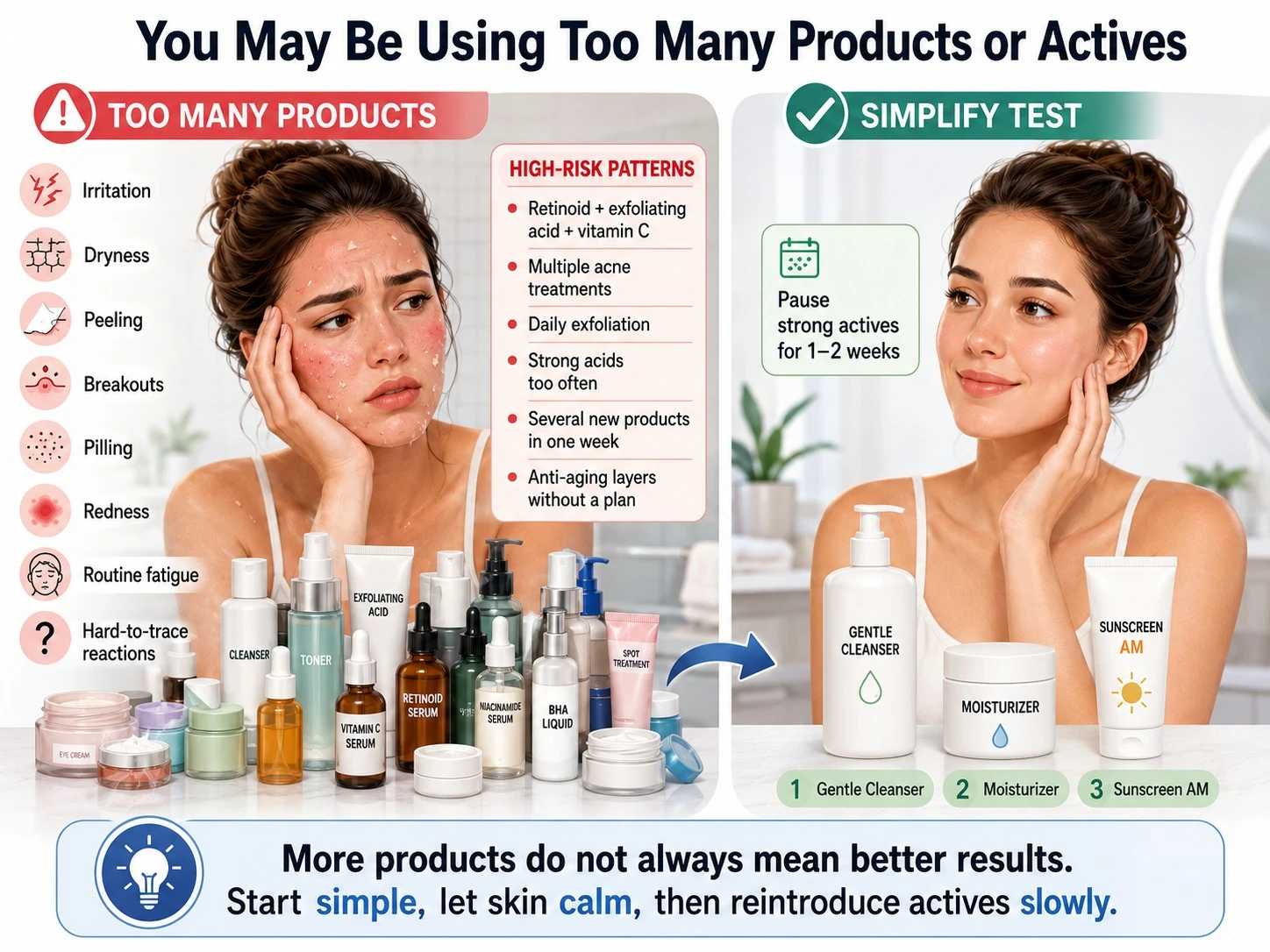
More products do not always mean better results. Too many layers can irritate the skin, cause pilling, trigger dryness, and make it hard to know which product is helping. Using several different products can also irritate the skin, especially when stronger treatment products are layered together. [1][2]
Too many products can lead to:
- Irritation
- Dryness
- Peeling
- Breakouts
- Pilling
- Redness
- Routine fatigue
- Hard-to-trace reactions
High-risk patterns include:
- Retinoid + exfoliating acid + strong vitamin C
- Multiple acne treatments at once
- Daily exfoliation
- Strong acids used too often
- Several new products in one week
- Anti-aging products layered without a plan
For 1–2 weeks, simplify your routine to the basics [2][6]:
- Gentle cleanser
- Moisturizer
- Sunscreen in the morning
- No exfoliating acids or strong actives until skin calms
This does not mean active ingredients are bad. It means your skin needs a routine it can tolerate before stronger products can help.
Your Skin Barrier May Be Irritated
If products that used to feel fine now sting, your skin may be irritated or overworked. This can happen after over-exfoliating, starting too many actives, using a harsh cleanser, or skipping moisturizer while using treatment products.
Signs your skin may be irritated include:
- Stinging from products that used to feel fine
- Tightness after moisturizing
- Peeling or rough patches
- Redness or heat
- Increased sensitivity
- Burning after cleansing
- Breakouts with irritation
To calm the routine:
- Pause strong actives.
- Use a gentle cleanser.
- Moisturize consistently.
- Avoid scrubs and frequent exfoliation.
- Use sunscreen in the morning.
- Reintroduce products one at a time.
Do not keep adding products to “fix” irritated skin. First, reduce the routine and let your skin become comfortable again.
You May Be Skipping Sunscreen or Using It Incorrectly
Sunscreen is easy to underestimate. If your routine targets dark spots, uneven tone, texture, acne marks, or aging signs, skipping sunscreen can make progress much harder.
Use a broad-spectrum sunscreen with SPF 30 or higher. If you spend time outdoors, sweat, swim, or towel your face, choose water resistance when needed and reapply as directed. [3][4]
Sunscreen mistakes that can weaken your routine:
- Skipping sunscreen on cloudy days
- Applying too little
- Relying only on makeup with SPF
- Not reapplying outdoors
- Using a sunscreen that feels so greasy you avoid it
- Skipping sunscreen while using exfoliants, retinoids, or brightening products
If sunscreen pills, feels heavy, or leaves a white cast, adjust the texture or reduce heavy layers underneath. Do not remove sunscreen from the routine. Change the formula until you find one you can use consistently.
Your Product Order, Amount, or Frequency May Be Wrong
Sometimes the product is not the main problem. The way you use it is. Wrong order, too much product, too much frequency, or inconsistent use can make a routine look ineffective. [5]
| Use Problem | Why It Hurts Results | Better Approach |
|---|---|---|
| Applying sunscreen before moisturizer | Later layers may disturb sunscreen application | Use sunscreen as the final morning skincare step |
| Using too little sunscreen | You may not get the labeled protection | Apply enough and reapply outdoors |
| Using retinoid too often at the start | Can cause dryness and irritation | Start slowly and moisturize |
| Exfoliating daily | Can irritate the skin barrier | Use less often and stop if stinging continues |
| Applying too much product | Can cause pilling, greasiness, or irritation | Use a thin, even layer |
| Not removing heavy sunscreen or makeup at night | Residue may build up | Use a first cleanse when needed |
| Switching products every few days | You cannot judge results clearly | Change one product at a time |
| Using treatment only when you remember | Inconsistent use makes results harder to see | Use a realistic schedule |
| Not moisturizing after treatment | Treatment may feel more irritating | Follow with moisturizer unless directed otherwise |
A routine should be simple enough to repeat. If your routine is too complex to use consistently, simplify it.
Your Products May Be Expired, Stored Poorly, or Mismatched
A product can stop performing well if it is old, contaminated, stored badly, or not compatible with the rest of your routine. This is easy to miss when the product used to work.
Check:
- Expiration date or PAO symbol
- Smell, color, or texture changes
- Sunscreen expiration
- Products stored in heat, sunlight, or bathroom humidity
- Pump, dropper, or jar contamination risk
- Formula separation
- Layering mismatch causing pilling
- Weather or seasonal change
- Product not designed for your skin concern
Stop using a product if it smells strange, changes color, separates, or suddenly irritates your skin. Be especially careful with sunscreen. If it is expired or has changed texture, do not rely on it for the same level of protection.
Seasonal changes can also make a routine feel wrong. A gel moisturizer that works in humid summer may not be enough in dry winter. A rich cream that works in cold weather may feel greasy in hot, humid weather.
The Skin Concern May Need a Different Approach
A skincare routine can support skin health, but it cannot fix every skin concern. Some issues need medical diagnosis, prescription treatment, or a different plan. This does not mean your routine failed. It means the concern may be beyond normal cosmetic care.
| Concern | Why Routine Alone May Not Be Enough | Better Next Step |
|---|---|---|
| Persistent acne | Acne can have hormonal, inflammatory, or medical causes | See a dermatologist if OTC care is not helping |
| Sudden painful breakouts | Could be more than a product mismatch | Stop new products and seek care if severe |
| Eczema-like dryness or itching | May need medical treatment and trigger control | Use gentle care and get professional guidance |
| Rosacea-like redness or flushing | Harsh products can worsen sensitivity | Avoid irritants and ask a dermatologist |
| Melasma or stubborn dark spots | Pigment concerns often need long-term sun protection and targeted care | Use daily sunscreen and consider professional advice |
| Deep acne scars | Routine products cannot fully correct deep scarring | Ask about professional treatment options |
| Severe irritation or rash | Could be allergy, dermatitis, or infection | Stop suspected products and seek care |
| Allergy-like reaction | Swelling, hives, or severe burning needs attention | Stop use and get medical help if serious |
If a basic routine makes symptoms worse, do not keep experimenting endlessly. Persistent or severe skin problems deserve professional help.
How to Reset Your Skincare Routine Safely

If your routine is causing irritation, breakouts, or confusion, reset before adding more products. A reset does not mean giving up on skincare. It helps you find what your skin tolerates.
A simple 7–14 day reset plan:
Days 1–3:
- Stop new active ingredients.
- Use a gentle cleanser.
- Use moisturizer.
- Use sunscreen in the morning.
Days 4–7:
- Continue the simple routine.
- Watch tightness, stinging, redness, and breakouts.
- Do not add exfoliant yet.
Week 2:
- Reintroduce one product at a time.
- Use active products slowly.
- Track reactions.
- Keep sunscreen and moisturizer consistent.
Track each product:
- Product name
- Start date
- Frequency
- Reaction
- What improved
- What got worse
If your skin improves after simplifying, the old routine was likely too irritating, too complex, or poorly matched. If your skin does not improve, or if symptoms are severe, stop self-testing and seek professional care.
When to See a Dermatologist
See a dermatologist if your routine is not helping and your skin problem is persistent, painful, spreading, or severe. Skincare articles can guide basic care, but they cannot diagnose medical skin conditions.
See a dermatologist if:
- Acne is persistent, painful, cystic, or scarring
- Irritation, burning, or rash continues
- You suspect eczema, rosacea, psoriasis, or allergic reaction
- Dark spots or melasma keep worsening
- A product causes swelling, hives, or severe reaction
- You have signs of infection
- OTC products make the issue worse
- You are pregnant, on medications, or using prescription skin treatments and unsure what is safe
You do not need to wait until your skin is severe to ask for help. Getting the right diagnosis can save time, money, and irritation.


