


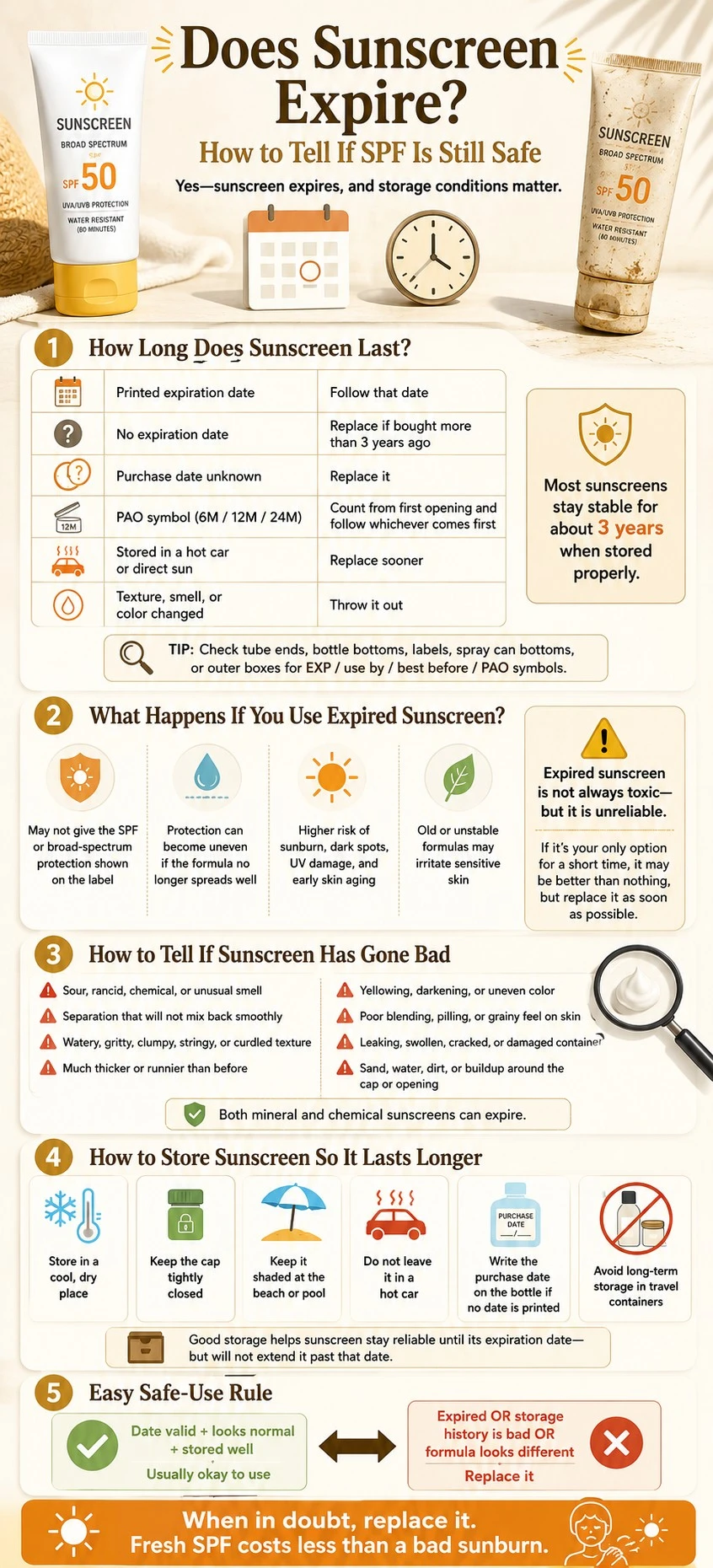
How Long Does Sunscreen Last?
Most sunscreens are made to stay stable for about three years when stored properly. If your sunscreen has a printed expiration date, follow that date first. If there is no date, use the purchase date only as a practical consumer guide. If you bought it more than three years ago, or you do not know when you bought it, replace it.[1]
That “three years” rule does not mean three years after opening. It also does not guarantee that every bottle is good for three full years after purchase, especially if it was stored poorly before or after you bought it.
Situation | What to Do |
|---|---|
Expiration date is printed | Follow that date |
No expiration date | Replace it if bought more than three years ago |
Purchase date unknown | Replace it |
Stored in a hot car or direct sun | Replace sooner |
Texture, smell, or color changed | Throw it out |
Bottle is unopened but old | Follow the same expiration rule |
PAO symbol says 6M, 12M, or 24M | Count from first opening and follow whichever comes first |
To find the date, check the crimped end of a tube, the tube neck, the bottom of the bottle, the back label, the spray can bottom, or the outer box. Look for terms such as EXP, expires, use by, or best before. You may also see an open-jar symbol such as 6M, 12M, or 24M. This is the Period After Opening, or PAO, and it tells you how long the product should be used after first opening.
If both an expiration date and PAO symbol appear, follow whichever comes first. A lot code or batch code is not always a clear expiration date for buyers. If you only see a batch code, check the brand’s website or contact customer service. If you cannot confirm the date, replace the sunscreen.
Unopened sunscreen can still expire. A sealed bottle may stay cleaner, but the formula still ages over time.
What Happens If You Use Expired Sunscreen?
The main problem with expired sunscreen is not that it suddenly becomes toxic. The bigger issue is that it may no longer provide the SPF and broad-spectrum protection shown on the label.
Expired SPF 30 does not always become “SPF 0” overnight, but you cannot know how much protection remains. Sunscreen needs a stable formula and an even film on the skin to work well. If the formula has weakened or no longer spreads evenly, your real protection may be much lower than expected.
That can increase your risk of sunburn, UV damage, dark spots, early skin aging, and long-term skin cancer risk. Spoiled or unstable sunscreen may also irritate the skin, especially around the eyes or on sensitive, acne-prone, rosacea-prone, or recently treated skin. As a formula ages, changes in filters, oils, preservatives, or contamination can make it less skin-friendly. I would not use expired sunscreen on the face because facial skin gets frequent UV exposure and is more likely to react to an unstable formula.
If you are outside and have no other option, an expired sunscreen that still looks and smells normal may be better than nothing for a short time. But do not treat it as reliable protection. Use shade, a hat, sunglasses, and protective clothing, then replace the sunscreen as soon as possible.
Safe-use rule: If the sunscreen is expired, visibly changed, or was stored in heat, do not rely on it for strong sun exposure.
How to Tell If Sunscreen Has Gone Bad

You cannot test SPF at home by looking at the product, but you can spot warning signs that a sunscreen should be thrown away. Do not “test” old sunscreen by applying it and waiting to see whether you burn.
Throw it out if you notice:[2]
- A sour, rancid, chemical, or unusual smell
- Separation that does not mix back into a smooth formula
- A watery, gritty, clumpy, stringy, or curdled texture
- A formula that has become much thicker or much runnier than before
- Yellowing, darkening, or uneven color
- Pilling, grainy particles, or poor blending on the skin
- A leaking, swollen, cracked, or damaged container
- Sand, water, dirt, or product buildup around the cap or opening
Mineral and chemical sunscreens can show different warning signs, but both expire. Even if mineral filters such as zinc oxide and titanium dioxide are physically stable, the finished formula can still break down. If the product no longer looks, smells, or applies like it did when new, replace it.
How to Store Sunscreen So It Lasts Longer
Good storage will not make sunscreen last past its expiration date, but it can help the formula stay reliable until then. Keep sunscreen closed, cool, dry, and away from direct sun.[3]
Use these storage rules:
Store it in a cool, dry place.
A drawer, cabinet, or closet is better than a sunny window, hot bathroom shelf, garage, or car.
Keep the cap tightly closed.
Close the bottle after each use to reduce air exposure, leaks, and contamination.
Protect it at the beach or pool.
Keep sunscreen inside a bag, under a towel, in the shade, or in a cooler pocket.
Do not leave it in a hot car.
If a bottle has been sitting in a hot car for days or weeks, replace it.
Write the purchase date on the bottle.
If there is no printed expiration date, write the month and year you bought it.
Avoid long-term storage in travel containers.
If you decant sunscreen for travel, use it quickly and keep the original expiration date in mind.
Bathroom storage is not always a disaster, but frequent heat and humidity are not ideal.


