


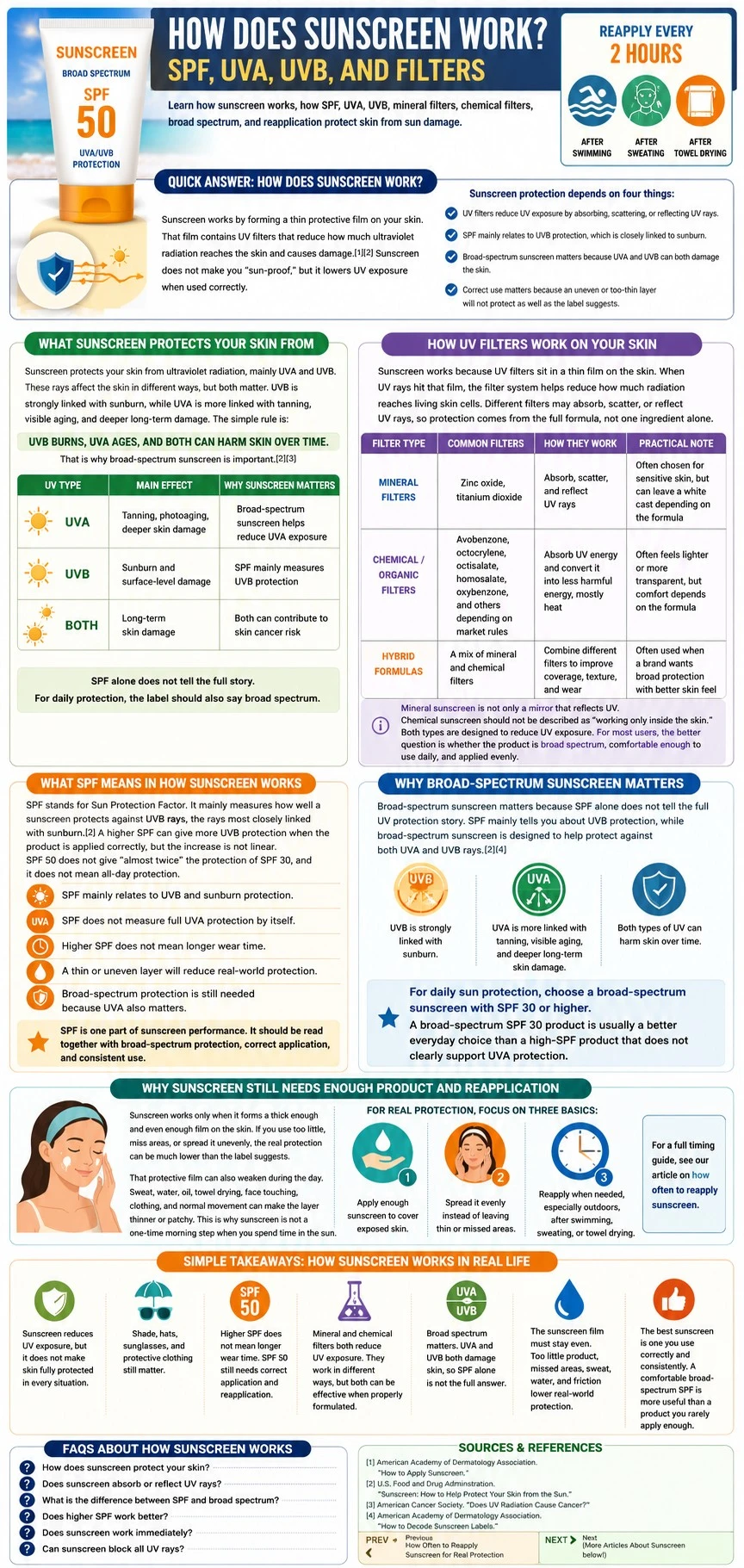
What Sunscreen Protects Your Skin From
Sunscreen protects your skin from ultraviolet radiation, mainly UVA and UVB. These rays affect the skin in different ways, but both matter. UVB is strongly linked with sunburn, while UVA is more linked with tanning, visible aging, and deeper long-term damage.
The simple rule is: UVB burns, UVA ages, and both can harm skin over time. That is why broad-spectrum sunscreen is important.[2][3]
| UV Type | Main Effect | Why Sunscreen Matters |
|---|---|---|
| UVA | Tanning, photoaging, deeper skin damage | Broad-spectrum sunscreen helps reduce UVA exposure |
| UVB | Sunburn and surface-level damage | SPF mainly measures UVB protection |
| Both | Long-term skin damage | Both can contribute to skin cancer risk |
SPF alone does not tell the full story. For daily protection, the label should also say broad spectrum.
How UV Filters Work on Your Skin
Sunscreen works because UV filters sit in a thin film on the skin. When UV rays hit that film, the filter system helps reduce how much radiation reaches living skin cells. Different filters may absorb, scatter, or reflect UV rays, so protection comes from the full formula, not one ingredient alone.
| Filter Type | Common Filters | How They Work | Practical Note |
|---|---|---|---|
| Mineral filters | Zinc oxide, titanium dioxide | Absorb, scatter, and reflect UV rays | Often chosen for sensitive skin, but can leave a white cast depending on the formula |
| Chemical / organic filters | Avobenzone, octocrylene, octisalate, homosalate, oxybenzone, and others depending on market rules | Absorb UV energy and convert it into less harmful energy, mostly heat | Often feels lighter or more transparent, but comfort depends on the formula |
| Hybrid formulas | A mix of mineral and chemical filters | Combine different filters to improve coverage, texture, and wear | Often used when a brand wants broad protection with better skin feel |
Mineral sunscreen is not only a mirror that reflects UV. Chemical sunscreen should not be described as “working only inside the skin.” Both types are designed to reduce UV exposure. For most users, the better question is whether the product is broad spectrum, comfortable enough to use daily, and applied evenly.
What SPF Means in How Sunscreen Works
SPF stands for Sun Protection Factor. It mainly measures how well a sunscreen protects against UVB rays, the rays most closely linked with sunburn.[2]
A higher SPF can give more UVB protection when the product is applied correctly, but the increase is not linear. SPF 50 does not give “almost twice” the protection of SPF 30, and it does not mean all-day protection.
The key points are simple:
- SPF mainly relates to UVB and sunburn protection.
- SPF does not measure full UVA protection by itself.
- Higher SPF does not mean longer wear time.
- A thin or uneven layer will reduce real-world protection.
- Broad-spectrum protection is still needed because UVA also matters.
SPF is one part of sunscreen performance. It should be read together with broad-spectrum protection, correct application, and consistent use.
Why Broad-Spectrum Sunscreen Matters

Broad-spectrum sunscreen matters because SPF alone does not tell the full UV protection story. SPF mainly tells you about UVB protection, while broad-spectrum sunscreen is designed to help protect against both UVA and UVB rays.[2][4]
This matters because UVB is strongly linked with sunburn, while UVA is more linked with tanning, visible aging, and deeper long-term skin damage. Both types of UV can harm skin over time.
For daily sun protection, choose a broad-spectrum sunscreen with SPF 30 or higher. A broad-spectrum SPF 30 product is usually a better everyday choice than a high-SPF product that does not clearly support UVA protection.
Why Sunscreen Still Needs Enough Product and Reapplication
Sunscreen works only when it forms a thick enough and even enough film on the skin. If you use too little, miss areas, or spread it unevenly, the real protection can be much lower than the label suggests.
That protective film can also weaken during the day. Sweat, water, oil, towel drying, face touching, clothing, and normal movement can make the layer thinner or patchy. This is why sunscreen is not a one-time morning step when you spend time in the sun.
For real protection, focus on three basics:
- Apply enough sunscreen to cover exposed skin.
- Spread it evenly instead of leaving thin or missed areas.
- Reapply when needed, especially outdoors, after swimming, sweating, or towel drying.
For a full timing guide, see our article on how often to reapply sunscreen.
Simple Takeaways: How Sunscreen Works in Real Life
Sunscreen reduces UV exposure, but it does not make skin fully protected in every situation. Real protection comes from the right product, enough application, and consistent use.
- Sunscreen does not block 100% of UV rays.[2] Shade, hats, sunglasses, and protective clothing still matter.
- Higher SPF does not mean longer wear time. SPF 50 still needs correct application and reapplication.
- Mineral and chemical filters both reduce UV exposure. They work in different ways, but both can be effective when properly formulated.
- Broad spectrum matters. UVA and UVB both damage skin, so SPF alone is not the full answer.
- The sunscreen film must stay even. Too little product, missed areas, sweat, water, and friction lower real-world protection.
- The best sunscreen is one you use correctly and consistently. A comfortable broad-spectrum SPF is more useful than a product you rarely apply enough.


