

Face Sunscreen vs Body Sunscreen: Key Differences
Face sunscreen and body sunscreen are not completely different sunscreen types. Both can use mineral filters, chemical filters, or hybrid filter systems. Both can also have SPF, broad-spectrum, and water-resistant claims depending on the product label.
The practical difference is how the formula is designed to feel and perform. Face sunscreen is usually made for daily wear, visible skin, eye-area comfort, and layering with skincare or makeup. Body sunscreen is usually made for larger exposed areas, outdoor activity, and more cost-effective coverage.
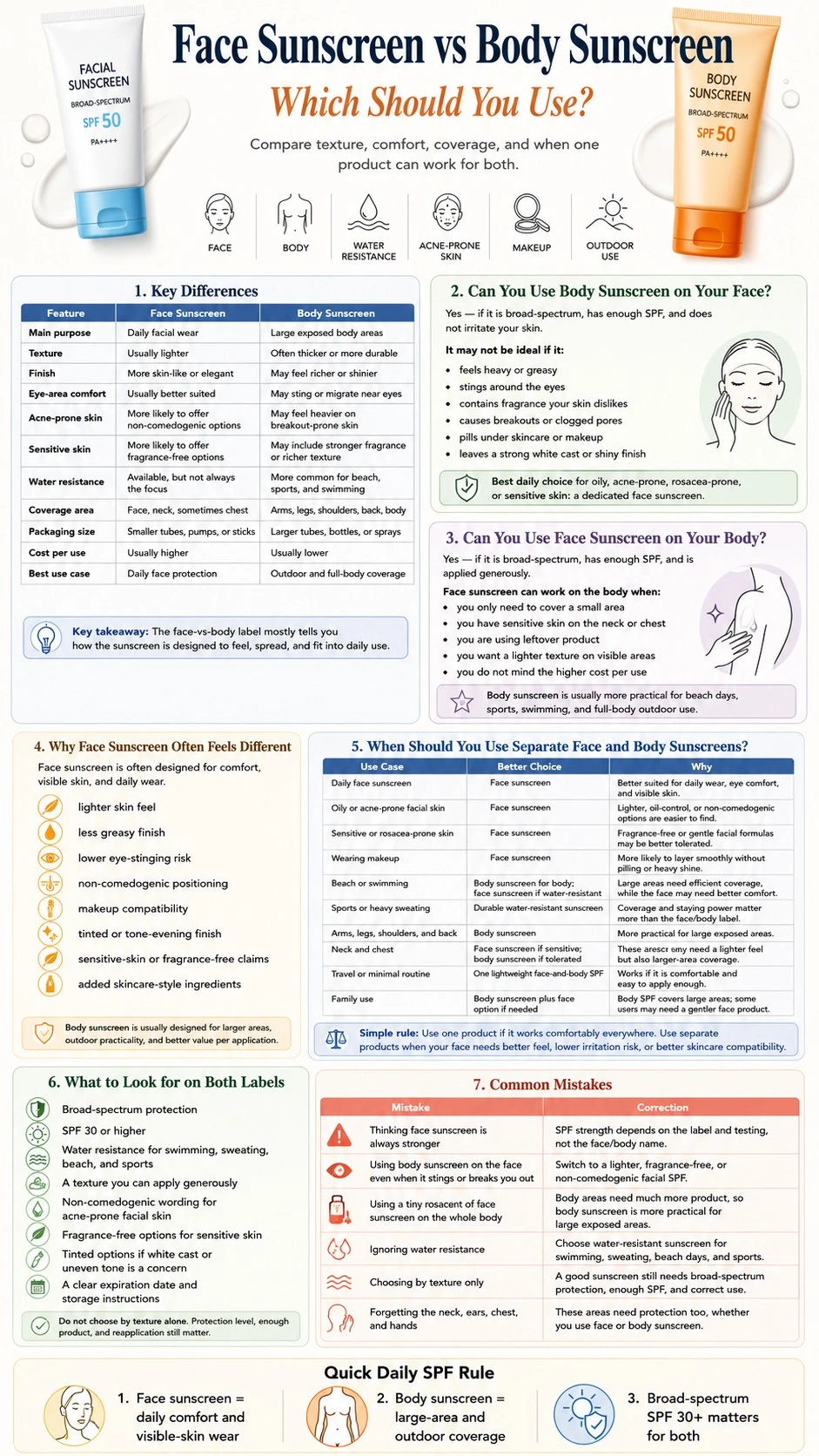
| Feature | Face Sunscreen | Body Sunscreen |
|---|---|---|
| Main purpose | Daily facial wear | Large exposed body areas |
| Texture | Usually lighter | Often thicker or more durable |
| Finish | More skin-like or elegant | May feel richer or shinier |
| Eye-area comfort | Usually better suited | May sting or migrate near eyes |
| Acne-prone skin | More likely to offer non-comedogenic options | May feel heavier on breakout-prone skin |
| Sensitive skin | More likely to offer fragrance-free options | May include stronger fragrance or richer texture |
| Water resistance | Available, but not always the focus | More common for beach, sports, and swimming |
| Coverage area | Face, neck, sometimes chest | Arms, legs, shoulders, back, body |
| Packaging size | Smaller tubes, pumps, or sticks | Larger tubes, bottles, or sprays |
| Cost per use | Usually higher | Usually lower |
| Best use case | Daily face protection | Outdoor and full-body coverage |
Key takeaway: The SPF number tells you the tested UVB protection level. The face-vs-body label mostly tells you how the sunscreen is designed to feel, spread, and fit into daily use.
Can You Use Body Sunscreen on Your Face?
Yes, you can use body sunscreen on your face if it is broad-spectrum, has enough SPF, and does not irritate your skin. The issue is usually comfort and tolerance, not basic sun protection.
Body sunscreen may not be ideal for your face if:
It feels heavy or greasy
It stings around the eyes
It contains fragrance your skin dislikes
It causes breakouts or clogged pores
It pills under skincare or makeup
It leaves a strong white cast or shiny finish
If your skin is oily, acne-prone, rosacea-prone, or sensitive, a dedicated face sunscreen is usually the better daily choice. If your body sunscreen feels comfortable, does not sting, and does not cause breakouts, it can work on the face.
Can You Use Face Sunscreen on Your Body?

Yes, you can use face sunscreen on your body. If the product is broad-spectrum, has enough SPF, and is applied in the right amount, it can protect body skin too.
The main issue is practicality. Body areas need much more sunscreen than the face, so using a small facial SPF tube on your arms, legs, shoulders, and back can become expensive and inconvenient. For beach days, sports, swimming, or full-body outdoor use, a body sunscreen is usually more efficient.
Face sunscreen can work on the body when:
You only need to cover a small area
You have sensitive skin on the neck or chest
You are using leftover product
You want a lighter texture on visible areas
You do not mind the higher cost per use
Face sunscreen is not automatically stronger than body sunscreen. The protection depends on the label, the formula, and how much you apply.
Why Face Sunscreen Often Feels Different
Face sunscreen often feels different because facial skin is visible, close to the eyes, more likely to get oily or break out, and often layered with moisturizer or makeup.
Many facial sunscreens are designed for comfort and daily wear. They may use lighter textures, gel creams, serum-like emulsions, oil-control ingredients, tint, fragrance-free systems, or skincare-style ingredients such as niacinamide, ceramides, hyaluronic acid, or antioxidants. These features make face sunscreen easier to wear consistently; they do not automatically make it stronger.
Face sunscreen may be formulated for:
Lighter skin feel
Less greasy finish
Lower eye-stinging risk
Non-comedogenic positioning
Makeup compatibility
Tinted or tone-evening finish
Sensitive-skin or fragrance-free claims
Added skincare-style ingredients
Body sunscreen has a different job: it needs to spread over larger areas, stay practical for outdoor use, and offer better value per application. That is why it may feel richer, thicker, or more durable.
When Should You Use Separate Face and Body Sunscreens?
Some people can use one sunscreen for both face and body. Separate products make more sense when your face needs a different texture, finish, or tolerance level than the rest of your body.
| Use Case | Better Choice | Why |
|---|---|---|
| Daily face sunscreen | Face sunscreen | Better suited for daily wear, eye comfort, and visible skin. |
| Oily or acne-prone facial skin | Face sunscreen | Lighter, oil-control, or non-comedogenic options are easier to find. |
| Sensitive or rosacea-prone skin | Face sunscreen | Fragrance-free or gentle facial formulas may be better tolerated. |
| Wearing makeup | Face sunscreen | More likely to layer smoothly without pilling or heavy shine. |
| Beach or swimming | Body sunscreen for body; face sunscreen if water-resistant | Large areas need efficient coverage, while the face may need better comfort. |
| Sports or heavy sweating | Durable water-resistant sunscreen | Coverage and staying power matter more than the face/body label. |
| Arms, legs, shoulders, and back | Body sunscreen | More practical for large exposed areas. |
| Neck and chest | Face sunscreen if sensitive; body sunscreen if tolerated | These areas may need a lighter feel but also larger-area coverage. |
| Travel or minimal routine | One lightweight face-and-body SPF | Works if it is comfortable and easy to apply enough. |
| Family use | Body sunscreen plus face option if needed | Body SPF covers large areas; some users may need a gentler face product. |
The simple rule: use one product if it works comfortably everywhere. Use separate products when your face needs better feel, lower irritation risk, or better compatibility with daily skincare.
What to Look for on Both Face and Body Sunscreen Labels
The label matters more than whether the product says “face” or “body.” Texture helps you use sunscreen consistently, but the label tells you whether the product fits your protection needs.
For both face and body sunscreen, look for:
Broad-spectrum protection
SPF 30 or higher
Water resistance when swimming, sweating, or doing beach and sports activities
A texture you can apply generously on that body area
Non-comedogenic wording for acne-prone facial skin
Fragrance-free options for sensitive skin
Tinted options if white cast or uneven tone is a concern
A clear expiration date and storage instructions
Do not choose by texture alone. A sunscreen still needs the right protection level, enough product on the skin, and reapplication during continued exposure.
Common Mistakes When Comparing Face and Body Sunscreen
Mistake: Thinking face sunscreen is always stronger
Correction: SPF strength depends on the label and testing, not the face/body name.Mistake: Using body sunscreen on the face even when it stings or breaks you out
Correction: Switch to a lighter, fragrance-free, or non-comedogenic facial SPF.Mistake: Using a tiny amount of face sunscreen on the whole body
Correction: Body areas need much more product, so body sunscreen is more practical for large exposed areas.Mistake: Ignoring water resistance
Correction: Choose water-resistant sunscreen for swimming, sweating, beach days, and sports.Mistake: Choosing by texture only
Correction: A good sunscreen still needs broad-spectrum protection, enough SPF, and correct use.Mistake: Forgetting the neck, ears, chest, and hands
Correction: These areas need protection too, whether you use face or body sunscreen.
Final Takeaway: Face Sunscreen vs Body Sunscreen
Face and body sunscreens can both protect skin when the label and application are right. The difference is mainly skin feel, tolerance, area size, cost, and use case.
Face sunscreen is better for daily facial wear, acne-prone skin, sensitive skin, eye comfort, and makeup. Body sunscreen is better for arms, legs, shoulders, swimming, sports, and cost-effective coverage. One product can work for both if it is broad-spectrum SPF 30+, comfortable, non-irritating, and used generously.


