


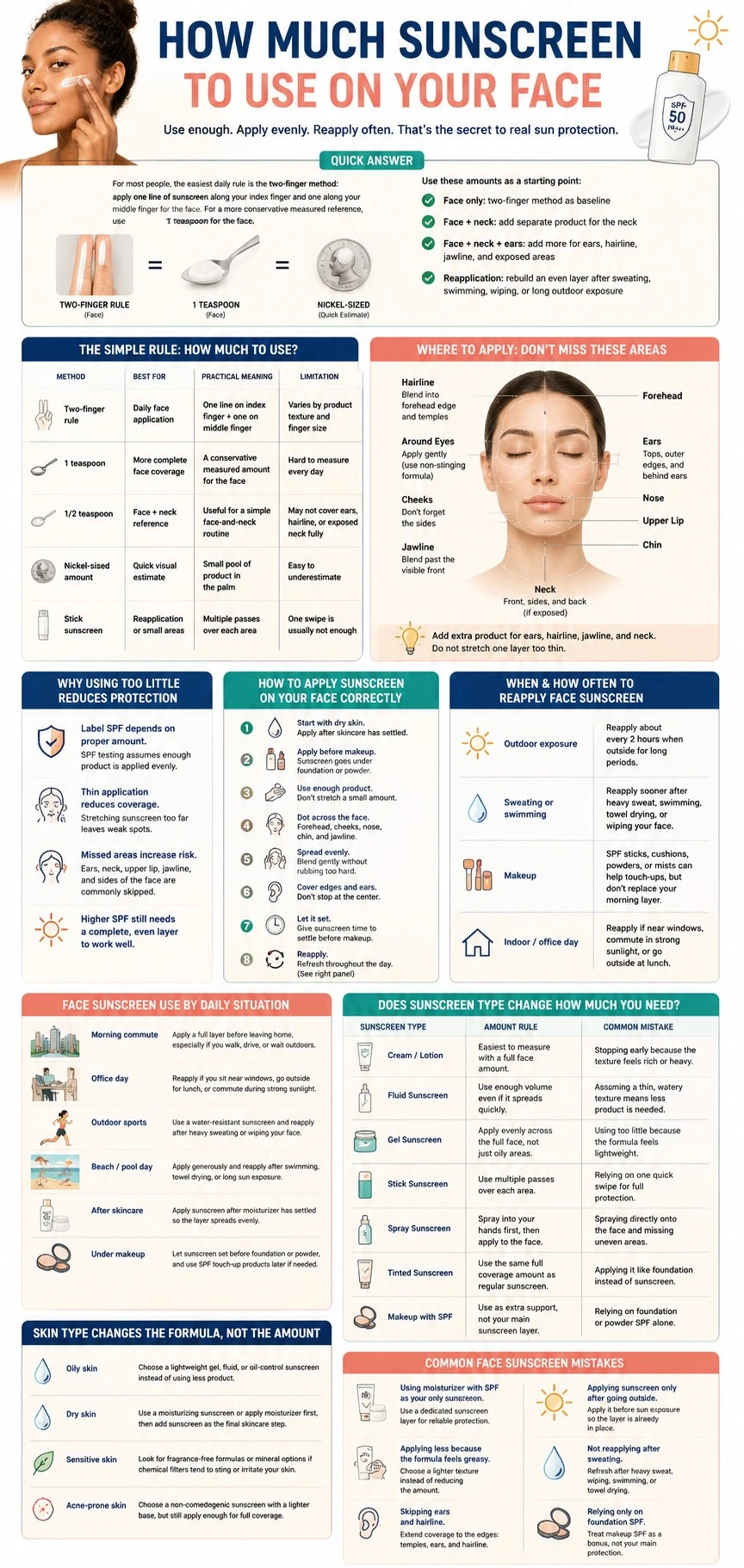
The Simple Rule: Two Fingers, Teaspoon, or Nickel-Sized Amount?
Different sunscreen amount rules exist because they serve different needs. The two-finger rule is the easiest daily method. A teaspoon is a more conservative measured reference. A nickel-sized amount is quick, but it often leads people to apply too little.
Texture also affects how sunscreen feels during application. Fluids spread fast, creams feel heavier, sticks need repeated passes, and tinted formulas are often applied too thinly because people treat them like makeup.
| Method | Best For | Practical Meaning | Limitation |
|---|---|---|---|
| Two-finger rule | Daily face application | One line on the index finger and one on the middle finger | Can vary by product texture and finger size |
| 1 teaspoon | More complete face coverage | A more conservative measured amount for the face | Hard to measure every day |
| 1/2 teaspoon | Face + neck reference | Useful for a simple face-and-neck routine [3] | May not cover ears, hairline, or exposed neck fully |
| Nickel-sized amount | Quick visual estimate | A small pool of product in the palm | Easy to underestimate |
| Stick sunscreen | Reapplication or small areas | Multiple passes over each area [4] | One swipe is usually not enough |
How Much Sunscreen for Face, Neck, Ears, and Hairline?
Face sunscreen should not stop at the center of the face. Most missed spots are along the edges: ears, hairline, jawline, and neck. Start with your face amount, then add more product for exposed areas instead of trying to stretch one layer too thin.
Check these areas every time:
Face: cover forehead, cheeks, nose, upper lip, and chin evenly
Neck: apply to the front and sides of the neck
Ears: cover the tops, outer edges, and behind the ears
Hairline: blend sunscreen into the forehead edge and temples
Around eyes: use a formula that does not sting, and apply carefully
Jawline and sides of face: blend past the visible front of the face
Back of neck: apply if your hair, hat, or clothing does not cover it
For daily use, the best amount is the amount that fully covers every exposed area without leaving thin or missed patches.
Why Using Too Little Sunscreen Reduces Protection

SPF numbers are based on controlled testing, not on a thin layer stretched across the skin. Many people apply only 25% to 50% of the recommended amount of sunscreen, which means real-world protection can be lower than the label suggests. [2]
Label SPF depends on proper amount: SPF testing assumes enough product is applied evenly.
Thin application reduces coverage: Stretching sunscreen too far can leave weak spots around high-exposure areas.
Missed areas increase risk: Ears, neck, upper lip, jawline, and the sides of the face are commonly skipped.
A higher SPF product still needs a complete, even layer to work well.
How to Apply Sunscreen on Your Face Correctly
Correct application helps sunscreen form an even layer before makeup, sweat, or daily movement affects coverage.
- Start with dry skin: Apply sunscreen after skincare has settled, not while the face is wet or slippery.
Apply before makeup: Sunscreen should sit under foundation, concealer, or powder.
Use enough product: Apply a full face amount instead of stretching a small amount across the skin.
Dot across the face: Place product on the forehead, cheeks, nose, chin, and jawline before spreading.
Spread evenly: Blend gently without rubbing too aggressively.
Cover edges and ears: Do not stop at the center of the face.
Let it set: Give sunscreen time to settle before applying makeup.
For a full step-by-step routine, read our guide on how to apply sunscreen on your face.
When and How Often to Reapply Face Sunscreen
Reapplication depends on exposure, sweat, water, and how much the sunscreen layer is disturbed during the day.
Outdoor exposure: Reapply about every two hours when you are outside for long periods. [1]
Sweating or swimming: Reapply sooner after heavy sweating, swimming, towel drying, or wiping your face. [1]
Makeup: SPF sticks, cushions, powders, or mists can help with touch-ups, but they should not replace a proper morning sunscreen layer.
Office or indoor day: Reapplication is still useful if you sit near windows, commute during strong sunlight, or spend time outside at lunch.
For a more detailed routine, use our guide on how often to reapply sunscreen.
Face Sunscreen Use by Daily Situation
Your daily routine affects when you apply or reapply sunscreen, but it should not reduce the amount needed for exposed skin.
| Situation | How to Apply |
|---|---|
| Morning commute | Apply a full layer before leaving home, especially if you walk, drive, or wait outdoors. |
| Office day | Reapply if you sit near windows, go outside for lunch, or commute during strong sunlight. |
| Outdoor sports | Use a water-resistant sunscreen and reapply after heavy sweating or wiping your face. |
| Beach / pool day | Apply generously and reapply after swimming, towel drying, or long sun exposure. |
| After skincare | Apply sunscreen after moisturizer has settled so the layer spreads evenly. |
| Under makeup | Let sunscreen set before foundation or powder, and use SPF touch-up products later if needed. |
Does Sunscreen Type Change How Much You Need?
Different sunscreen textures can make the same amount feel lighter, heavier, thinner, or harder to measure. The rule does not change: you still need enough product to create an even layer across all exposed skin.
| Sunscreen Type | Amount Rule | Common Mistake |
|---|---|---|
| Cream / Lotion | Easiest to measure with a full face amount. | Stopping early because the texture feels rich or heavy. |
| Fluid Sunscreen | Use enough volume even if it spreads quickly. | Assuming a thin, watery texture means less product is needed. |
| Gel Sunscreen | Apply evenly across the full face, not just oily areas. | Using too little because the formula feels lightweight. |
| Stick Sunscreen | Use multiple passes over each area. | Relying on one quick swipe for full protection. |
| Spray Sunscreen | Spray into your hands first, then apply to the face. [4] | Spraying directly onto the face and missing uneven areas. |
| Tinted Sunscreen | Use the same full coverage amount as regular sunscreen. | Applying it like foundation instead of sunscreen. |
| Makeup with SPF | Use as extra support, not your main sunscreen layer. | Relying on foundation or powder SPF alone. |
Skin Type Changes the Formula, Not the Amount
Your skin type does not reduce the amount of sunscreen you need. It only changes which texture or formula is easier to apply consistently.
Oily skin: Choose a lightweight gel, fluid, or oil-control sunscreen instead of using less product.
Dry skin: Use a moisturizing sunscreen or apply moisturizer first, then add sunscreen as the final skincare step.
Sensitive skin: Look for fragrance-free formulas or mineral options if chemical filters tend to sting or irritate your skin.
Acne-prone skin: Choose a non-comedogenic sunscreen with a lighter base, but still apply enough for full coverage.
Common Face Sunscreen Mistakes
Most sunscreen mistakes come from using too little, missing exposed areas, or treating SPF makeup as a full sunscreen replacement. These fixes are simple but make daily protection more reliable.
Using moisturizer with SPF as your only sunscreen: Use a dedicated sunscreen layer when you need reliable facial protection.
Applying less because the formula feels greasy: Choose a lighter texture instead of reducing the amount.
Skipping ears and hairline: Extend coverage to the edges of the face, temples, ears, and exposed scalp line.
Applying sunscreen only after going outside: Apply it before sun exposure so the layer is already in place.
Not reapplying after sweating: Refresh sunscreen after heavy sweat, wiping, swimming, or towel drying.
Relying only on foundation SPF: Treat makeup SPF as a bonus, not your main protection.
Final Takeaway
For most people, the two-finger rule is the easiest daily starting point for face sunscreen. It gives a repeatable amount without daily measuring. The neck, ears, hairline, jawline, and sides of the face often need extra product. Good protection comes from enough sunscreen, even coverage, and timely reapplication. A high-SPF product will not work well if the layer is too thin, patchy, or missing key areas.


