


What Is Tinted Sunscreen?
Tinted sunscreen is sunscreen with added pigment or mineral colorants. It should be used as sunscreen first, not as makeup with SPF. Some formulas use iron oxides or similar pigment systems that can add visible light support. [2][3]
Tinted sunscreen can help with:
reducing white cast, especially from mineral sunscreen
evening out uneven tone
providing sheer, natural-looking coverage
supporting visible light protection when formulated with iron oxides
simplifying a light makeup routine
Tinted sunscreen should not be treated as a treatment for melasma, dark spots, or post-acne marks. Its main value is protection, coverage, and daily wearability.
What Is Untinted Sunscreen?
Untinted sunscreen has no cosmetic shade or pigment. Depending on the formula, it may look clear, translucent, white, or invisible after blending. It is not weaker than tinted sunscreen for basic UV protection when it is broad-spectrum and applied properly. The main difference is finish, not whether it “works.”
Untinted sunscreen is often a better fit for:
people who dislike pigment or makeup-like coverage
users who want a clear or invisible finish
people who wear foundation over sunscreen
simple skincare routines
users who struggle to find a matching tint
people who prefer gels, fluids, or serum-like sunscreens
The best untinted sunscreen is one you can apply generously without fighting white cast, greasiness, or an uncomfortable texture.
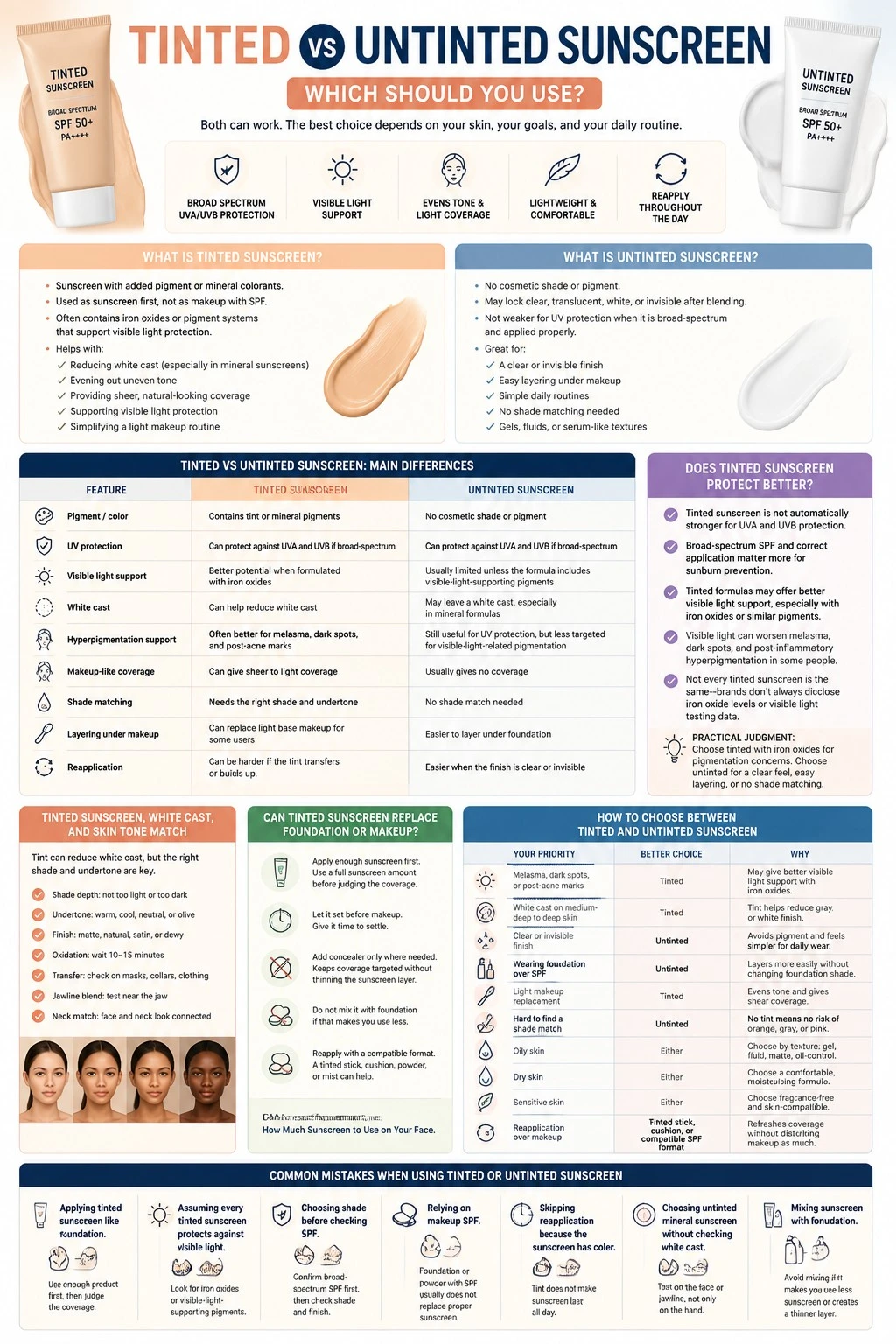
Tinted vs Untinted Sunscreen: Main Differences
Tinted and untinted sunscreens differ in more than color. The main differences are finish, white cast, visible light support, coverage, shade match, and how easily the formula fits into your daily routine.
| Feature | Tinted Sunscreen | Untinted Sunscreen |
|---|---|---|
| Pigment / color | Contains tint or mineral pigments | No cosmetic shade or pigment |
| UV protection | Can protect against UVA and UVB if broad-spectrum | Can protect against UVA and UVB if broad-spectrum |
| Visible light support | Better potential when formulated with iron oxides | Usually limited unless the formula includes visible-light-supporting pigments |
| White cast | Can help reduce white cast | May leave a white cast, especially in mineral formulas |
| Hyperpigmentation support | Often better for melasma, dark spots, and post-acne marks | Still useful for UV protection, but less targeted for visible-light-related pigmentation |
| Makeup-like coverage | Can give sheer to light coverage | Usually gives no coverage |
| Shade matching | Needs the right shade and undertone | No shade match needed |
| Layering under makeup | Can replace light base makeup for some users | Easier to layer under foundation |
| Reapplication | Can be harder if the tint transfers or builds up | Easier when the finish is clear or invisible |
Does Tinted Sunscreen Protect Better?
Tinted sunscreen is not automatically stronger for UVA and UVB protection. A broad-spectrum untinted sunscreen can work very well when applied correctly. The added value of some tinted formulas is visible light support, especially when they contain iron oxides or similar pigments. [2][3]
For sunburn prevention, broad-spectrum SPF and correct application matter more than tint.
For pigmentation concerns, tinted sunscreen can be more useful because visible light can worsen melasma, dark spots, and post-inflammatory hyperpigmentation in some people. [2][3]
Iron oxides are the key reason many tinted formulas are discussed for visible light support.
Not every tinted sunscreen provides the same benefit, because brands do not always disclose iron oxide levels or visible light testing data. [3]
Practical judgment: If your main concern is melasma, dark spots, or post-acne marks, choose a broad-spectrum tinted sunscreen that lists iron oxides. If your main priority is a clear feel, easy layering, or no shade matching, a good untinted sunscreen can still be the better daily choice.
Tinted Sunscreen, White Cast, and Skin Tone Match
White cast is one of the biggest reasons people compare tinted and untinted sunscreen. Untinted mineral sunscreens can look white or gray, especially on medium-deep to deep skin tones. Tinted formulas can reduce that problem when the shade and undertone fit well.
A poor tint can still look orange, pink, gray, ashy, too light, or too dark. One-shade tinted sunscreens rarely work for everyone, so the best choice depends on more than “tinted or not tinted.”
Check these before choosing a tinted sunscreen:
Shade depth: make sure the color is not too light or too dark.
Undertone: check whether it looks warm, cool, neutral, or olive on your skin.
Finish: decide whether you prefer matte, natural, satin, or dewy.
Oxidation: wait 10–15 minutes to see if the color changes.
Transfer: check whether it rubs onto masks, collars, or clothing.
Jawline blend: test near the jaw, not only on the hand.
Neck match: make sure the face and neck still look connected.
Can Tinted Sunscreen Replace Foundation or Makeup?
Tinted sunscreen can replace light base makeup for some people, especially if you want a more even tone without foundation. It usually gives sheer to light coverage, not full coverage. Keep the sunscreen layer generous even when the tint looks like makeup.
Apply enough sunscreen first. Use a full sunscreen amount before judging the coverage.
Let it set before makeup. Give it time to settle so it does not move under concealer or powder.
Add concealer only where needed. This keeps coverage targeted without thinning the sunscreen layer.
Do not mix it with foundation if that makes you use less. Mixing can reduce even coverage and make the SPF layer harder to control.
Reapply with a compatible format. A tinted stick, cushion, powder, or mist can help, but it should support—not replace—the main sunscreen layer.
For exact face amount, use the guide How Much Sunscreen to Use on Your Face.
How to Choose Between Tinted and Untinted Sunscreen
Choose based on the problem you are trying to solve: pigmentation support, white cast, shade match, makeup layering, skin feel, or daily comfort. The table below keeps the decision practical without repeating the science behind visible light or iron oxides.
| Your Priority | Better Choice | Why |
|---|---|---|
| Melasma, dark spots, or post-acne marks | Tinted sunscreen | It may give better visible light support when formulated with iron oxides. |
| White cast on medium-deep to deep skin | Tinted sunscreen | Tint can help reduce the gray or white finish common in some mineral formulas. |
| Clear or invisible finish | Untinted sunscreen | It avoids pigment and usually feels simpler for daily wear. |
| Wearing foundation over SPF | Untinted sunscreen | It layers more easily without changing foundation shade. |
| Light makeup replacement | Tinted sunscreen | It can even tone and give sheer coverage while acting as sunscreen. |
| Hard to find a shade match | Untinted sunscreen | No tint means no risk of looking orange, gray, pink, or too light. |
| Oily skin | Either | Choose by texture: gel, fluid, matte, or oil-control finish. |
| Dry skin | Either | Choose a formula with a comfortable, moisturizing feel. |
| Sensitive skin | Either | Choose fragrance-free and skin-compatible formulas over tint alone. |
| Reapplication over makeup | Tinted stick, cushion, or compatible SPF format | A touch-up format can refresh coverage without disturbing makeup as much. |
Common Mistakes When Using Tinted or Untinted Sunscreen
Tinted and untinted sunscreens fail most often when they are under-applied, treated like makeup, or not reapplied. Use these checks before judging whether a formula works for you.
Applying tinted sunscreen like foundation: Use enough product first, then judge the coverage.
Assuming every tinted sunscreen protects against visible light: Look for iron oxides or visible-light-supporting pigment systems.
Choosing shade before checking SPF: Confirm broad-spectrum SPF first, then check shade and finish.
Relying on makeup SPF: Foundation or powder with SPF usually does not replace a proper sunscreen layer.
Skipping reapplication because the sunscreen has color: Tint does not make sunscreen last all day.
Choosing untinted mineral sunscreen without checking white cast: Test it on the face or jawline, not only on the hand.
Mixing sunscreen with foundation: Avoid mixing if it makes you use less sunscreen or creates a thinner, uneven layer.
Final Takeaway: Tinted or Untinted Sunscreen?
Tinted and untinted sunscreen can both work when they are broad-spectrum and applied correctly. Choose tinted sunscreen if visible light support, hyperpigmentation concerns, white cast, or light coverage matter most. Choose untinted sunscreen if you prefer a clear finish, easy makeup layering, or simple daily wear. The best option is the one you apply enough, wear comfortably, and reapply consistently.


