


Azelaic acid is a dicarboxylic acid used in both skincare and dermatology for acne, papulopustular rosacea, and some forms of uneven pigmentation. It is unusual among active ingredients because it can help clogged pores, inflammation, acne-like bumps, and post-acne marks without behaving exactly like an AHA, BHA, retinoid, or antibiotic.
The best way to use it depends on what you are treating, the strength and formulation, and how reactive your skin is. Cosmetic products and medicinal azelaic acid are not regulated the same way in every country, so concentration alone does not tell you how a product should be used.
What Is Azelaic Acid and How Does It Work?

Azelaic acid is a naturally occurring dicarboxylic acid used in topical skincare and dermatology. Unlike an ingredient that works mainly through exfoliation, it acts through several pathways: it can reduce inflammation, limit the growth of acne-associated bacteria, normalize abnormal keratin buildup inside follicles, and interfere with excess pigment production.[1][4]
These actions give azelaic acid both comedolytic and pigment-regulating properties while also helping calm inflammatory skin changes. Its effects are therefore broader than simply removing surface dead skin cells.
Azelaic acid is sometimes grouped with glycolic or salicylic acid because all three can influence skin-cell turnover, but the comparison is incomplete. It should not be treated as a stronger version of a daily exfoliant; its anti-inflammatory, antimicrobial, follicular, and pigment-regulating actions are equally important.
What Can Azelaic Acid Help With?
Azelaic acid has the clearest role in acne and papulopustular rosacea, with additional value for post-inflammatory pigmentation and some other forms of uneven tone. How useful it is depends on the cause of the skin concern rather than the presence of redness, bumps, or dark marks alone.
| Skin Concern | How Azelaic Acid Fits | Important Limit |
|---|---|---|
| Blackheads and whiteheads | Helps normalize follicular cell buildup and reduce comedones | Persistent congestion may respond better to a broader acne routine |
| Inflammatory acne | Helps reduce inflammation while addressing follicular blockage and acne-associated bacteria | Moderate or severe acne may need additional treatment |
| Papules and pustules from rosacea | Can reduce inflammatory acne-like bumps | Flushing, visible vessels, and persistent background redness may need different treatment |
| Post-acne hyperpigmentation | Can help fade excess pigment while also reducing new acne lesions, making it useful when active acne and post-acne marks occur together | Improvement is gradual, and ongoing sun exposure can keep marks visible |
| Post-inflammatory erythema | May improve red post-acne marks in some people | Not all facial redness has the same cause |
| Melasma | Can be included in a broader pigment-control routine by helping reduce abnormal excess pigment production | Melasma is influenced by factors such as sun and visible-light exposure, hormones, genetics, and heat, so azelaic acid is rarely the entire treatment plan |
| Visible pores | Clearing congestion can make clogged pores look less noticeable | It does not permanently shrink pore anatomy |
| Acne scars | Can help reduce new acne lesions that may later leave marks or scars | It does not rebuild established depressed or raised scars |
Clinical evidence supports azelaic acid when active acne and post-inflammatory pigmentation occur together.[5] This makes it particularly practical for people who want to reduce new breakouts while gradually improving the marks they leave behind. Melasma requires a broader approach, with sun protection and trigger management remaining important alongside pigment-targeting treatment.[4] If acne remains the primary problem, use azelaic acid within a complete Acne-Prone Skincare Routine rather than treating it only as a brightening ingredient.
What Strength of Azelaic Acid Should You Use?
Azelaic acid is sold in different strengths and product categories around the world. Lower-strength cosmetic formulas and 15% or 20% medicinal products can all exist, but availability, approved uses, prescription status, and directions vary by country.[1]
| Product Type | Practical Starting Point | What Matters Most |
|---|---|---|
| Lower-strength cosmetic formula | Useful when you want to introduce azelaic acid gradually or target mild congestion and uneven tone | Judge the complete formula, not the percentage alone |
| 15% medicinal product | Commonly used in clinical treatment of rosacea and, in some markets, acne | Follow the medicine label or clinician’s directions because approved uses vary by country |
| 20% medicinal product | Commonly used in some markets for acne and also studied for hyperpigmentation and melasma | Higher strength does not automatically mean better tolerance or faster results |
Do not assume that a 20% cream is universally “stronger” in practice than a 15% gel. Vehicle design affects delivery, spread, absorption, and tolerability. If you are using a medicinal product, the local datasheet and prescribing instructions take priority over generic skincare advice.
How to Use Azelaic Acid
- Cleanse gently: Use a mild cleanser and avoid scrubbing before applying the active.
- Let the skin dry: Applying to very damp or freshly irritated skin can increase stinging for some people.
- Use a thin layer: Apply enough to cover the affected area rather than using a thick spot-treatment layer.
- Start at a tolerable frequency: Many medicinal products are used once or twice daily, while sensitive skin may need a slower introduction. Follow the specific product directions first.[1][3][7]
- Add moisturizer: Use a simple moisturizer when dryness or tightness appears.
- Use sunscreen in the morning: Azelaic acid is not classically photosensitizing, but sun protection remains important when treating post-acne pigmentation, melasma, rosacea, or uneven tone. Ongoing UV and visible-light exposure can make pigmentation harder to improve.[1][4]
If your skin reacts easily, introduce the product to a small area first and avoid changing several active products at once. The Patch Testing Guide explains a cautious way to introduce a new formula.
Can You Use Azelaic Acid With Other Skincare Ingredients?
Azelaic acid does not have a long list of absolute ingredient incompatibilities. The main problem is usually cumulative irritation when several active treatments are layered together.
| Ingredient | Can They Be Used Together? | Practical Approach |
|---|---|---|
| Niacinamide | Usually yes | A simple pairing for redness, oiliness, or uneven tone; reduce layers if the routine becomes irritating or pills |
| Vitamin C | Usually yes | Use together if tolerated, or separate morning and evening when layering causes stinging |
| Retinoids | Can be used in the same treatment plan | Introduce one active first and separate applications if dryness, peeling, or burning develops |
| Salicylic acid | Possible, but often more exfoliation than a beginner needs | Alternate routines or use one active for the main concern rather than automatically stacking both |
| Benzoyl peroxide | Can be combined in acne treatment | Watch for dryness and simplify if the skin becomes tight or inflamed |
| AHA exfoliants | Possible but not necessary for most routines | Avoid layering several exfoliating products simply to speed results |
If you already use a retinoid, keep the role of each product clear rather than adding another active because it is popular. See our Retinol Guide for tolerance and layering principles, and our Niacinamide Guide for a lower-irritation supporting active.
Side Effects and Signs You Are Using Too Much
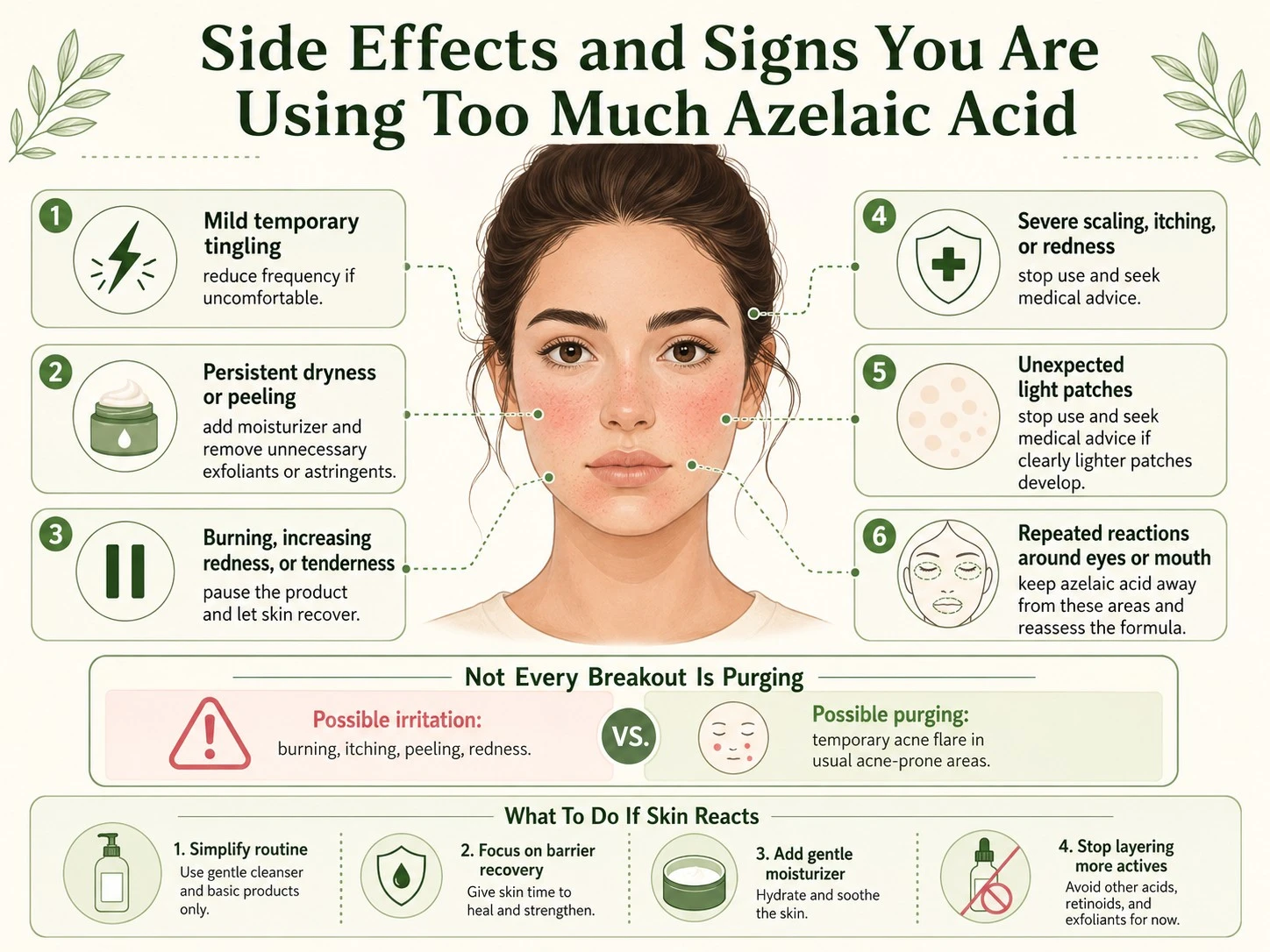
Azelaic acid is generally well tolerated, but mild burning, stinging, itching, dryness, scaling, and redness can occur, especially when treatment starts or when the formula is combined with other irritating products.[1][3][7]
- Mild temporary tingling: Reduce frequency if it becomes uncomfortable rather than automatically increasing use.
- Persistent dryness or peeling: Add moisturizer and remove unnecessary exfoliants or astringents.
- Burning, increasing redness, or tenderness: Pause the product and let the skin recover.
- Severe scaling, itching, or redness: Stop use and seek medical advice.[1]
- Unexpected light patches: Azelaic acid is intended to reduce abnormal excess pigmentation, not uniformly lighten normal surrounding skin. Stop use and seek medical advice if clearly lighter patches develop, especially when the change is persistent.[1]
- Repeated reactions around the eyes or mouth: Keep the active away from these areas and reassess the formula.
Do not label every new breakout after starting azelaic acid as “purging.” Irritation can also look like worsening acne, especially when the skin is burning, itchy, or peeling. Use Skin Purging vs Breakout to separate a temporary acne change from a reaction that needs a routine adjustment.
If several products suddenly sting, focus on barrier recovery before adding more treatment. Review the signs of a Damaged Skin Barrier or see Why Does Skincare Burn? when discomfort persists.
Azelaic Acid for Rosacea and Persistent Redness
Azelaic acid is an established topical option for papulopustular rosacea, especially when inflammatory bumps and pustules are prominent.[1][2] It can also improve some associated color change, but it should not be treated as a universal solution for every type of facial redness.
Persistent background redness, flushing, and visible blood vessels can have different treatment needs. If the main problem is redness without acne-like bumps, a rosacea diagnosis and a treatment plan are more useful than simply moving to a stronger azelaic acid product.[2]
Rosacea-prone skin is also more likely to react to alcohol-heavy cleansers, strong acids, fragrance, scrubs, and excessive product layering. Keep the surrounding routine gentle so irritation from other steps is not mistaken for treatment failure.
Can You Use Azelaic Acid During Pregnancy?
Topical azelaic acid is commonly considered an option for acne during pregnancy because systemic absorption from topical use is low and it is used as an alternative when retinoids are avoided.[6]
Pregnancy care should still be individualized. Check the exact product, strength, treatment area, and other active medications with your obstetric clinician, dermatologist, or pharmacist, particularly if the skin is broken or the product is used over a large area.
How Long Does Azelaic Acid Take to Work?
Azelaic acid is not an overnight treatment. Acne often begins to improve after about four weeks, while rosacea may take several weeks to a few months before the change becomes clear.[1][3] Pigment changes can take longer because both inflammation control and pigment turnover need time.
Judge progress by the problem you are treating. Fewer new clogged pores, fewer inflammatory lesions, less persistent post-acne pigmentation, or fewer rosacea papules are more meaningful than expecting every concern to improve at the same speed.
If acne is deep, painful, scarring, or not improving after a consistent treatment period, move beyond repeated ingredient changes and get a dermatology assessment.
Common Azelaic Acid Mistakes
- Choosing the highest percentage without considering the formula or local medicine directions.
- Using azelaic acid as if it were only an exfoliating acid and building the routine around unnecessary peels or scrubs.
- Expecting it to permanently shrink pores or erase established acne scars.
- Assuming every form of facial redness is rosacea that should be treated with azelaic acid.
- Using a medicinal 15% or 20% product according to generic online advice instead of its local label or prescription directions.
- Ignoring sunscreen while treating melasma or post-inflammatory pigmentation.
- Changing products every few days before the active has enough time to work.
Final Thoughts
Azelaic acid is one of the more versatile topical actives because it can address acne, inflammatory rosacea, and uneven pigmentation through different mechanisms. Its strongest advantage is not that it does everything, but that it can cover several related problems without relying on aggressive exfoliation.
Choose the product by your main concern, follow the directions for the exact formulation, and build frequency according to tolerance rather than percentage alone. If the skin becomes persistently irritated or the condition is moderate to severe, a treatment plan is more useful than continuing to add stronger skincare products.
FAQs About Azelaic Acid for Skin
Can I use azelaic acid every day?
Yes, many products are designed for daily use, and medicinal products may be used once or twice daily. Follow the specific label and reduce frequency if persistent stinging, dryness, or peeling develops.[1][3][7]
Should azelaic acid go before or after moisturizer?
A leave-on azelaic acid treatment is usually applied to clean skin before moisturizer. If your skin is reactive, a clinician or product direction may allow moisturizer to be used first as a buffer. Follow medicinal-product instructions when they differ.
Is azelaic acid good for blackheads?
It can help because it has comedolytic and keratolytic activity that reduces abnormal follicular buildup. Salicylic acid may be another option when blackheads and oily congestion are the dominant concern.
Does azelaic acid fade acne marks?
It can help post-inflammatory hyperpigmentation and may improve some post-inflammatory erythema while also reducing new acne lesions.[4][5] Established acne scars need different treatment.
Is 10% azelaic acid enough?
A 10% cosmetic formula can be a practical starting point, especially when tolerance is the priority, but results from medicinal 15% and 20% products should not be assumed to transfer directly to every lower-strength cosmetic formula. Availability and approved uses differ by country.
Does azelaic acid make skin more sensitive to the sun?
Azelaic acid is not classically photosensitizing.[1] Sunscreen is still important because UV and visible-light exposure can worsen post-inflammatory pigmentation, melasma, and rosacea-related discoloration.
Sources
[1] DermNet. Azelaic Acid
[2] American Academy of Dermatology. Rosacea: Diagnosis and Treatment
[3] NHS. Acne: Treatment
[4] King S, et al. A Systematic Review to Evaluate the Efficacy of Azelaic Acid in the Management of Acne, Rosacea, Melasma and Skin Aging
[5] Lv Y, et al. Effects of 15% Azelaic Acid Gel in the Management of Post-Inflammatory Erythema and Post-Inflammatory Hyperpigmentation in Acne Vulgaris
[6] MotherToBaby. Topical Acne Treatments
[7] MedlinePlus. Azelaic Acid Topical


