


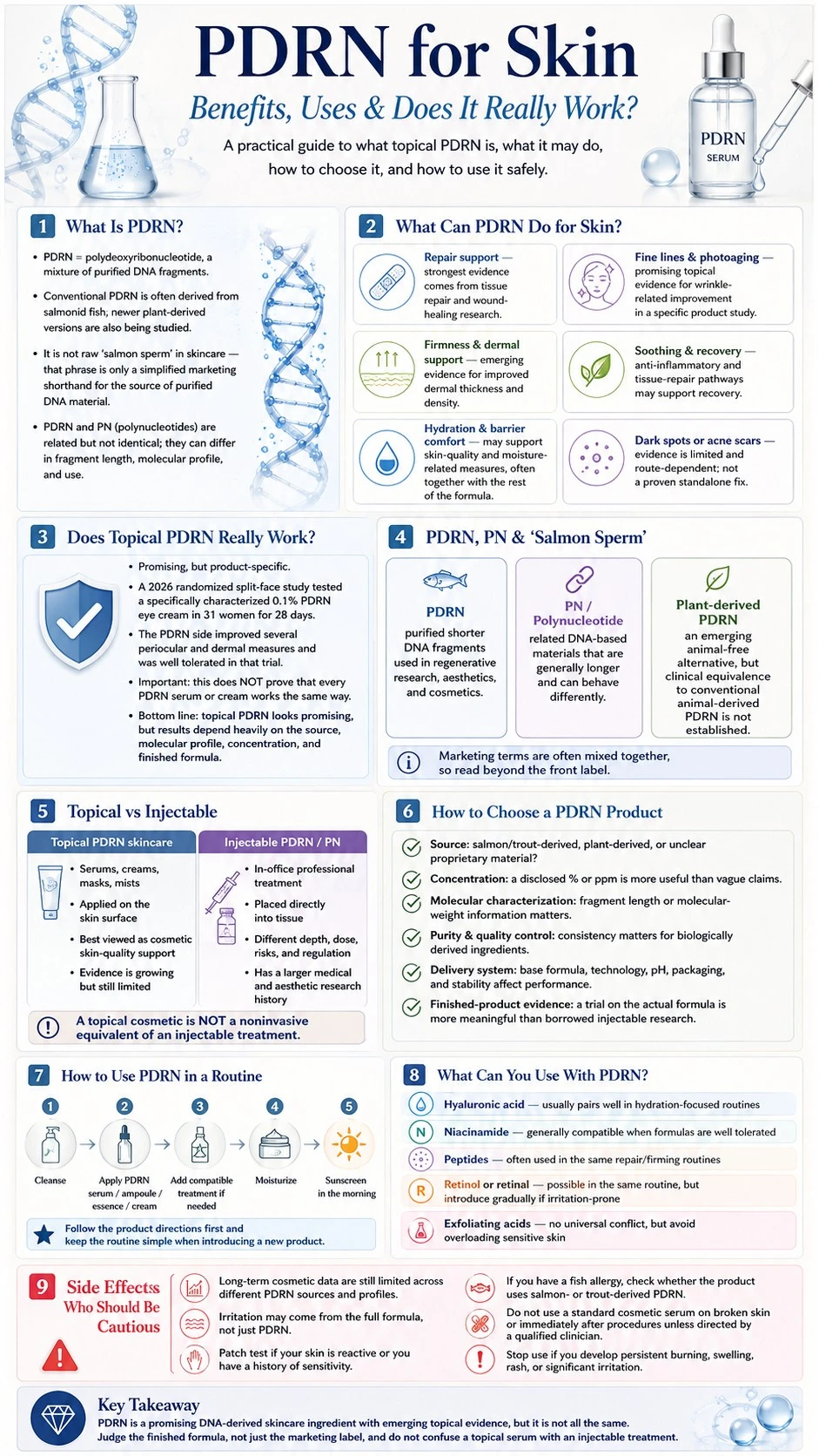
PDRN has moved quickly from regenerative medicine and aesthetic clinics into serums, creams, masks, and mists. The problem is that the evidence behind “PDRN” is not one single body of research: wound-healing studies, injectable treatments, laboratory experiments, and topical cosmetics use different materials and delivery routes.
That distinction matters. PDRN is a promising ingredient, but a topical serum should not be assumed to reproduce the effects of an injectable treatment. The most useful way to judge a PDRN product is to look at the source, molecular characteristics, concentration, finished formula, and evidence for that specific format.
What Is PDRN in Skincare?

PDRN stands for polydeoxyribonucleotide. It is a mixture of purified DNA fragments. Traditional pharmaceutical and aesthetic PDRN materials are commonly derived from salmonid fish, while newer plant-derived and other non-animal preparations are now being studied.[1][4][5]
PDRN is not raw “salmon sperm” added to skincare. That phrase is a simplified marketing shorthand for the biological source used to obtain and purify DNA fragments in many conventional PDRN materials.
PDRN is also not the same thing as every product marketed as a polynucleotide. PDRN and PN are related DNA-based biomaterials, but they can differ in fragment length, molecular-weight distribution, physical behavior, and clinical use.[1] If you want a broader framework for evaluating active ingredients rather than marketing names alone, see our skincare active ingredients overview.
What Does PDRN Do for Skin?
PDRN has been studied most extensively for tissue repair and wound healing. Proposed biological effects include adenosine A2A receptor signaling and support for nucleotide salvage pathways, which can influence inflammatory signaling, cell growth, angiogenesis, and tissue repair.[1][3][4]
For ordinary topical skincare, the evidence is newer and more product-specific. The table below separates what is reasonably supported from what is still being extrapolated.
| Potential benefit | What the evidence supports | How to interpret it for topical skincare |
|---|---|---|
| Skin repair support | PDRN has substantial preclinical and clinical literature in wound-healing and regenerative settings.[3][4] | This supports biological plausibility, but it does not mean a cosmetic serum can treat wounds or replace medical care. |
| Fine lines and photoaged skin | A 2026 randomized split-face study of a specific 0.1% medium-length PDRN eye cream reported improvements in periocular wrinkles and several dermal measures over 28 days.[2] | Promising, but the result applies to one characterized material and formula, not every product labeled PDRN. |
| Firmness and dermal support | The same topical study reported changes in dermal thickness and density, while laboratory work showed extracellular-matrix-related activity.[2] | Evidence is emerging; broader independent trials and longer follow-up are still needed. |
| Soothing and recovery | PDRN has anti-inflammatory and tissue-repair evidence in medical and experimental settings.[3][4] | A topical product may feel soothing, but the full formula—including humectants, emollients, and other actives—can contribute heavily to that effect. |
| Hydration and barrier comfort | Some newer topical and dermatology research reports improvements in skin-quality and barrier-related measures.[2][4] | Do not assume PDRN is the only ingredient responsible. Ingredients such as hyaluronic acid or ceramides may be doing part of the hydration work. |
| Dark spots or acne scars | Regenerative and aesthetic literature has explored pigmentation and scar-related outcomes, but evidence varies by route and treatment context.[4][6] | Topical PDRN should not be treated as a proven standalone treatment for hyperpigmentation or acne scarring. |
Does Topical PDRN Actually Work?
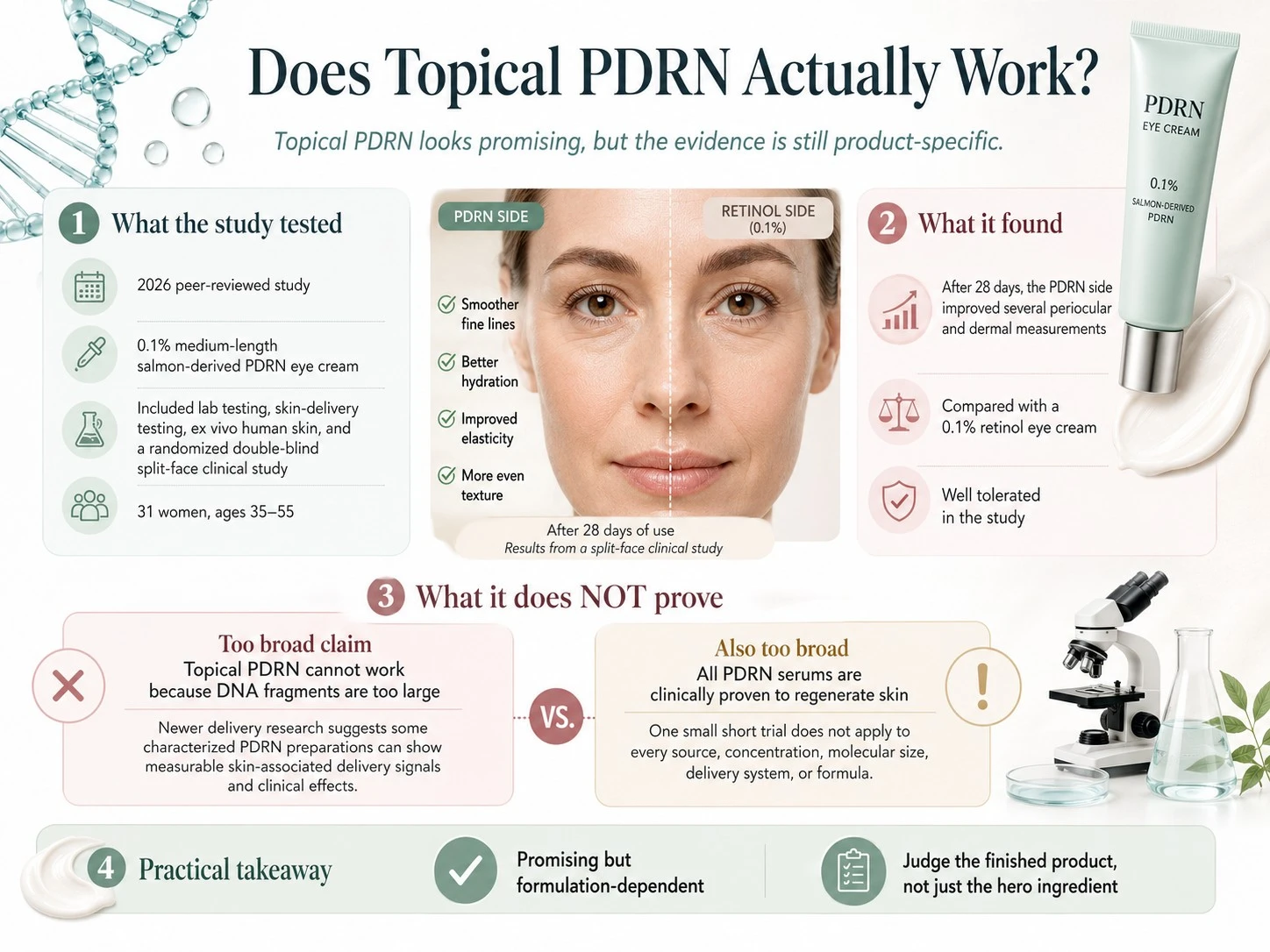
The answer is now more nuanced than “there is no topical evidence.” A 2026 peer-reviewed study tested a specifically characterized medium-length salmon-derived PDRN preparation in a 0.1% eye cream. The research included laboratory models, skin-delivery testing, ex vivo human skin, and a randomized double-blind split-face clinical study in 31 women aged 35–55.[2]
After 28 days, the PDRN side showed improvements in several periocular and dermal measurements compared with a 0.1% retinol eye cream, and the formula was well tolerated in that study.[2] This is meaningful topical evidence, but it is still one relatively small, short trial using one defined PDRN material and one formulation.
That means two opposite claims are both too broad:
- “Topical PDRN cannot work because DNA fragments are too large.” Newer delivery research suggests that at least some characterized PDRN preparations can produce measurable skin-associated delivery signals and clinical effects.[2]
- “All PDRN serums are clinically proven to regenerate skin.” The available topical evidence does not justify transferring one study result to every molecular size, source, concentration, delivery system, or finished formula.
For consumers, the practical conclusion is that topical PDRN is promising but formulation-dependent. It belongs in the same evidence-conscious mindset you would use for peptides: judge the finished product, not only the hero ingredient on the front label.
PDRN, Polynucleotides, and “Salmon Sperm” Skincare
These terms are often mixed together in beauty marketing, but they are not automatically interchangeable.
| Term | What it generally means | What to watch for |
|---|---|---|
| PDRN | Purified mixtures of relatively shorter DNA fragments used in regenerative research, pharmaceuticals, biomaterials, aesthetic medicine, and increasingly cosmetics.[1][4] | Source, purity, fragment distribution, molecular weight, concentration, and delivery system can vary. |
| PN / polynucleotide | Related DNA-based polymers that are generally longer and can have different physical and biological behavior from PDRN.[1] | Do not assume clinical evidence for one PN material automatically applies to PDRN, or vice versa. |
| “Salmon sperm” skincare | A consumer shorthand for products using purified DNA-derived material traditionally sourced from salmonid reproductive cells. | The finished ingredient is purified DNA material, not untreated biological tissue. |
| Plant-derived or “vegan PDRN” | Emerging plant-derived DNA-fragment or polynucleotide preparations intended as animal-free alternatives. | Current evidence is mostly preclinical, and clinical equivalence to conventional animal-derived PDRN has not been established.[5] |
The source alone does not determine performance. From a formulation perspective, two ingredients carrying the same broad PDRN label can differ in purity, fragment length, degradation profile, stability, and how they are delivered in the finished product. Those differences are particularly important when a brand makes strong “regenerative” or “clinical” claims.
Topical PDRN vs Injectable PDRN or PN
Topical skincare and injectable aesthetic treatments should be treated as different categories. Injection places material directly into tissue, while a serum or cream has to remain stable in the package, release from the formula, cross or interact with the skin barrier, and reach the relevant skin layers.
| Factor | Topical PDRN skincare | Injectable PDRN / PN treatments |
|---|---|---|
| Delivery | Applied to the skin surface in a serum, cream, mask, mist, or similar cosmetic format | Placed into tissue by a qualified medical professional |
| Evidence | Growing, with recent product-specific human topical data but still limited breadth[2] | Larger historical body of medical, regenerative, and aesthetic literature, although materials and study quality vary[3][4][6] |
| Expected role | Cosmetic skin-quality support; results depend strongly on the formula | Professional treatment with different exposure, depth, dosing, risks, and regulatory status |
| Can one substitute for the other? | No. A topical cosmetic should not be described as a noninvasive equivalent of an injectable treatment. | |
Regional rules for injectable PDRN and PN products differ. If you are considering an in-office treatment, use a qualified clinician and evaluate the specific product and local regulatory status rather than relying on skincare marketing language.
How to Choose a PDRN Skincare Product
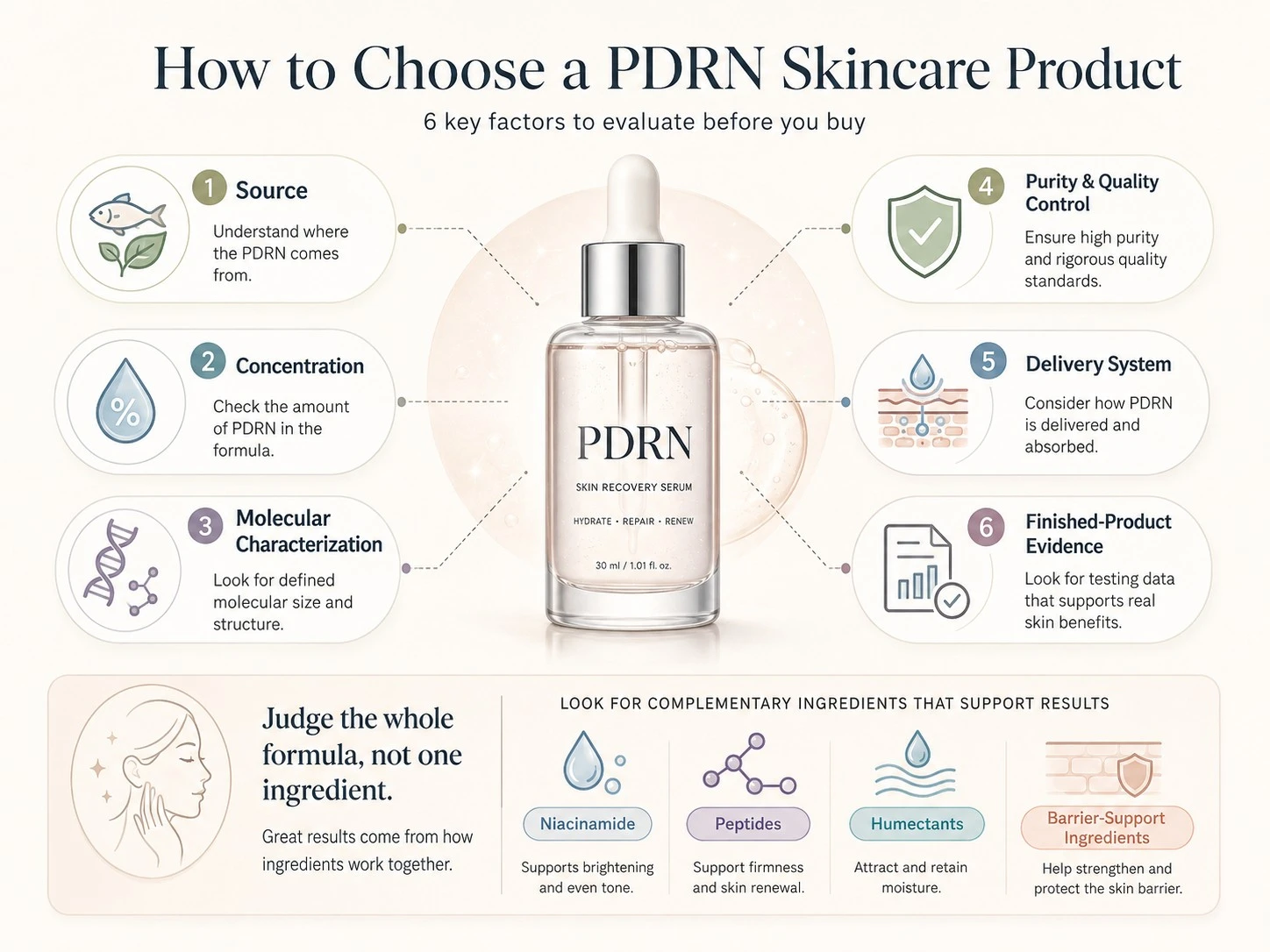
PDRN is a good example of why an ingredient name alone is not enough to judge a formula. When product information is available, look for the following:
- Source: is the PDRN salmon/trout-derived, plant-derived, or described only with a vague proprietary name?
- Concentration: a disclosed percentage or ppm value is more informative than “powered by PDRN,” but concentration alone does not prove effectiveness.
- Molecular characterization: fragment length or molecular-weight information can matter because PDRN materials are not necessarily interchangeable.[1][2][5]
- Purity and quality control: DNA purity, residual material, degradation, and batch consistency matter for a biologically derived ingredient.[5]
- Delivery system: the base formula, encapsulation or delivery technology, pH, packaging, and stability can affect how the material behaves before it reaches your skin.
- Finished-product evidence: a trial on the actual formula is more useful than citing injectable PDRN research to market a topical serum.
This is also why a PDRN serum containing niacinamide, peptides, humectants, or barrier-support ingredients may perform well even when the exact contribution of PDRN is difficult to isolate. If your main goal is barrier recovery, compare the whole formula with the principles in our skin barrier guide rather than chasing one ingredient name.
How to Use PDRN in a Skincare Routine
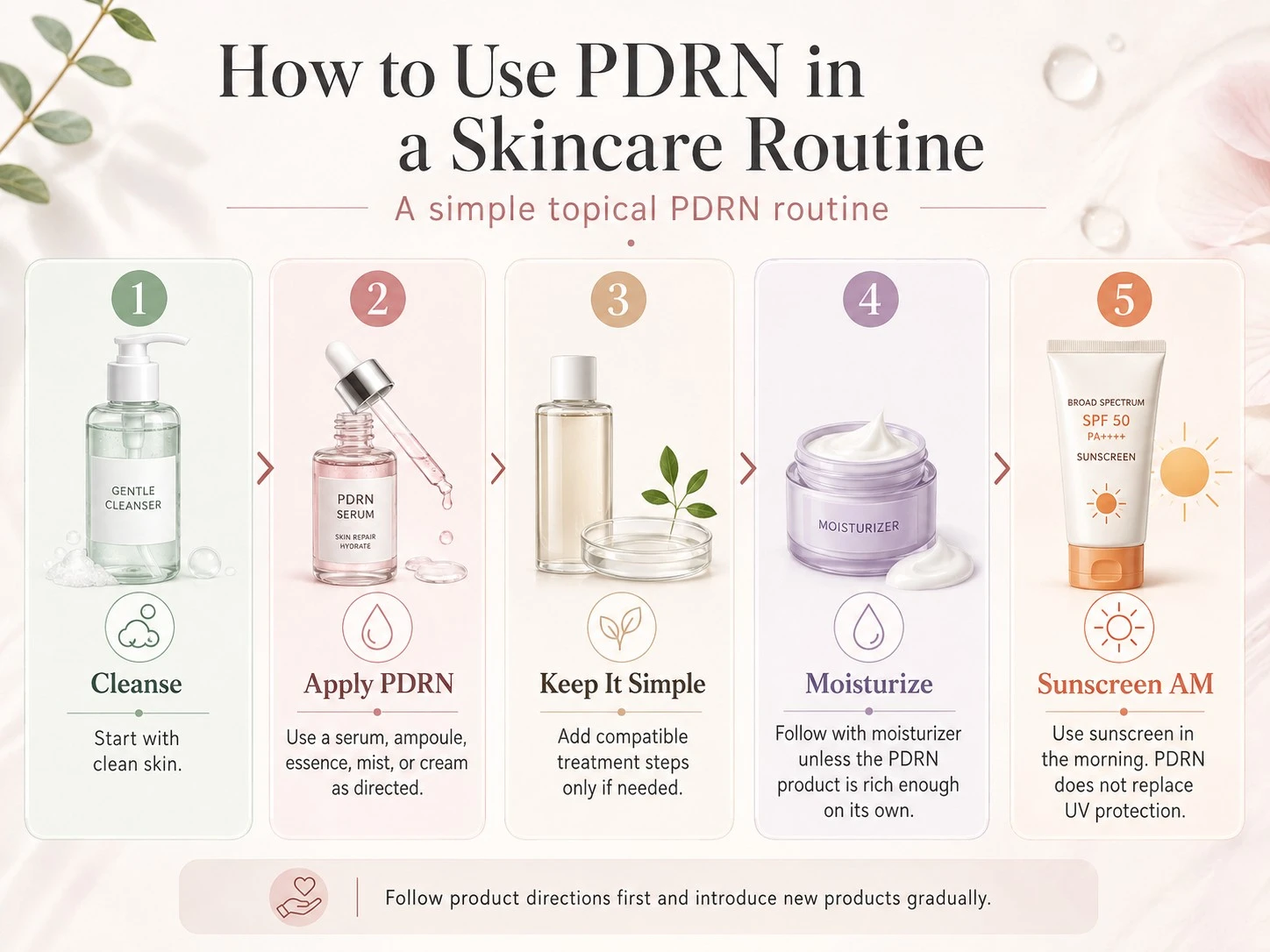
Topical PDRN does not require a universal special routine. Follow the finished product directions first, then place it according to its format and texture.
- Cleanse. Start with clean skin using a cleanser appropriate for your skin type.
- Apply the PDRN product. Use a serum, ampoule, essence, mist, or cream according to the label.
- Add compatible treatment steps if needed. Keep the routine simple when introducing a new product so you can judge tolerance.
- Moisturize. Follow with moisturizer unless the PDRN product itself is a sufficiently moisturizing cream.
- Use sunscreen in the morning. PDRN does not replace daily UV protection.
For the full sequence of common skincare steps, see our skincare routine order.
What Can You Use With PDRN?

There is no established blanket rule that topical PDRN must be separated from common cosmetic actives. In practice, compatibility depends more on the complete formula and your tolerance than on the PDRN name itself.
- Hyaluronic acid: commonly fits well in hydration-focused routines.
- Niacinamide: can be used in the same overall routine when the formulas are well tolerated; see our niacinamide guide.
- Peptides: often appear in the same “repair” or firming formulas, but their benefits should still be evaluated separately.
- Retinol or retinal: they can exist in the same routine, but introduce new actives gradually if you are irritation-prone. PDRN should not be treated as a substitute for retinol.
- Exfoliating acids: there is no universal PDRN-specific conflict, but avoid overloading sensitive skin with multiple irritating products at once.
Side Effects and Who Should Be Cautious
Small topical studies have reported good tolerability for specific PDRN formulations, but long-term cosmetic data across different sources and molecular profiles are still limited.[2][4]
As with any new skincare product, irritation can come from the complete formula rather than PDRN itself. Fragrance, acids, retinoids, preservatives, botanical extracts, or other actives may be more relevant to a reaction than the headline ingredient.
- Patch test a new product if your skin is reactive or you have a history of cosmetic sensitivity.
- If you have a known fish allergy, check the PDRN source and product guidance before using a salmon- or trout-derived formula.
- Do not apply a standard cosmetic serum to broken skin or immediately after microneedling, laser, or another procedure unless that use is specifically directed by a qualified clinician.
- Stop use if you develop persistent burning, swelling, rash, or other significant irritation.
For a practical introduction method, see How to Patch Test Skincare Products Before Using Them.
Final Thoughts
PDRN is more than a social-media novelty, but the evidence needs to be separated by route and material. Medical and regenerative research gives PDRN a credible biological foundation, and newer topical research now provides early human evidence that a specifically characterized PDRN formula can improve some measures of photoaged skin.[2][3][4]
What that does not prove is that every PDRN serum, cream, mask, or “vegan PDRN” product will produce the same result. Source, purity, fragment profile, concentration, stability, delivery system, and the rest of the formula all matter. For now, topical PDRN is best viewed as a promising supportive active rather than a replacement for sunscreen, retinoids, proven pigmentation treatments, or medical procedures.
FAQs About PDRN for Skin
Is PDRN the same as salmon sperm?
No. Traditional PDRN is commonly produced from highly purified DNA obtained from salmonid reproductive cells. The finished ingredient is a purified mixture of DNA fragments, not raw sperm or untreated tissue.[1][4]
Is plant-based or vegan PDRN the same as salmon-derived PDRN?
Not necessarily. Plant-derived DNA-fragment and polynucleotide preparations are an emerging research area, but current evidence is still mainly preclinical and does not establish clinical equivalence to conventional animal-derived PDRN.[5]
Is PDRN better than retinol?
There is not enough evidence to say that broadly. One 2026 split-face study found stronger improvements in several periocular measures with a specific 0.1% PDRN eye cream than with 0.1% retinol over 28 days, but that small product-specific trial does not overturn the much larger evidence base for retinoids or prove that PDRN is generally superior.[2]
Can I use PDRN with retinol?
Usually, they can be used within the same overall routine if the finished products are compatible and your skin tolerates them. If you are starting either product, introducing them separately can make irritation easier to identify.
Is PDRN suitable for sensitive skin?
It may be, but suitability depends on the whole formula. A recent topical study included participants with self-reported sensitive skin and reported good tolerability for the tested PDRN eye cream, but that does not guarantee every PDRN product will be non-irritating.[2]
How long does topical PDRN take to work?
There is no established universal timeline. The 2026 topical eye-cream trial measured changes at 14 and 28 days, but different PDRN materials, concentrations, product types, skin concerns, and study methods can produce different results.[2]
Sources
[1] Kim J et al. Comparison of Polynucleotide and Polydeoxyribonucleotide in Dermatology: Molecular Mechanisms and Clinical Perspectives
[2] Ye R et al. Topical Medium-Length PDRN Enhances Dermal Extracellular Matrix Repair in Photodamaged Skin via PI3K–Akt/TGF-β–Regulated Pathways
[3] Squadrito F et al. The Effects of Polydeoxyribonucleotide on Wound Healing and Tissue Regeneration: A Systematic Review of the Literature
[4] Applied Sciences. Polydeoxyribonucleotides as Emerging Therapeutics for Skin Diseases: Clinical Applications, Pharmacological Effects, Molecular Mechanisms, and Potential Modes of Action
[5] Journal of Functional Biomaterials. Plant-Derived Polynucleotides/Polydeoxyribonucleotides in Skin Biomaterials: Delivery Platforms and Bioactivity Attribution
[6] Lampridou S et al. The Effectiveness of Polynucleotides in Esthetic Medicine: A Systematic Review


