


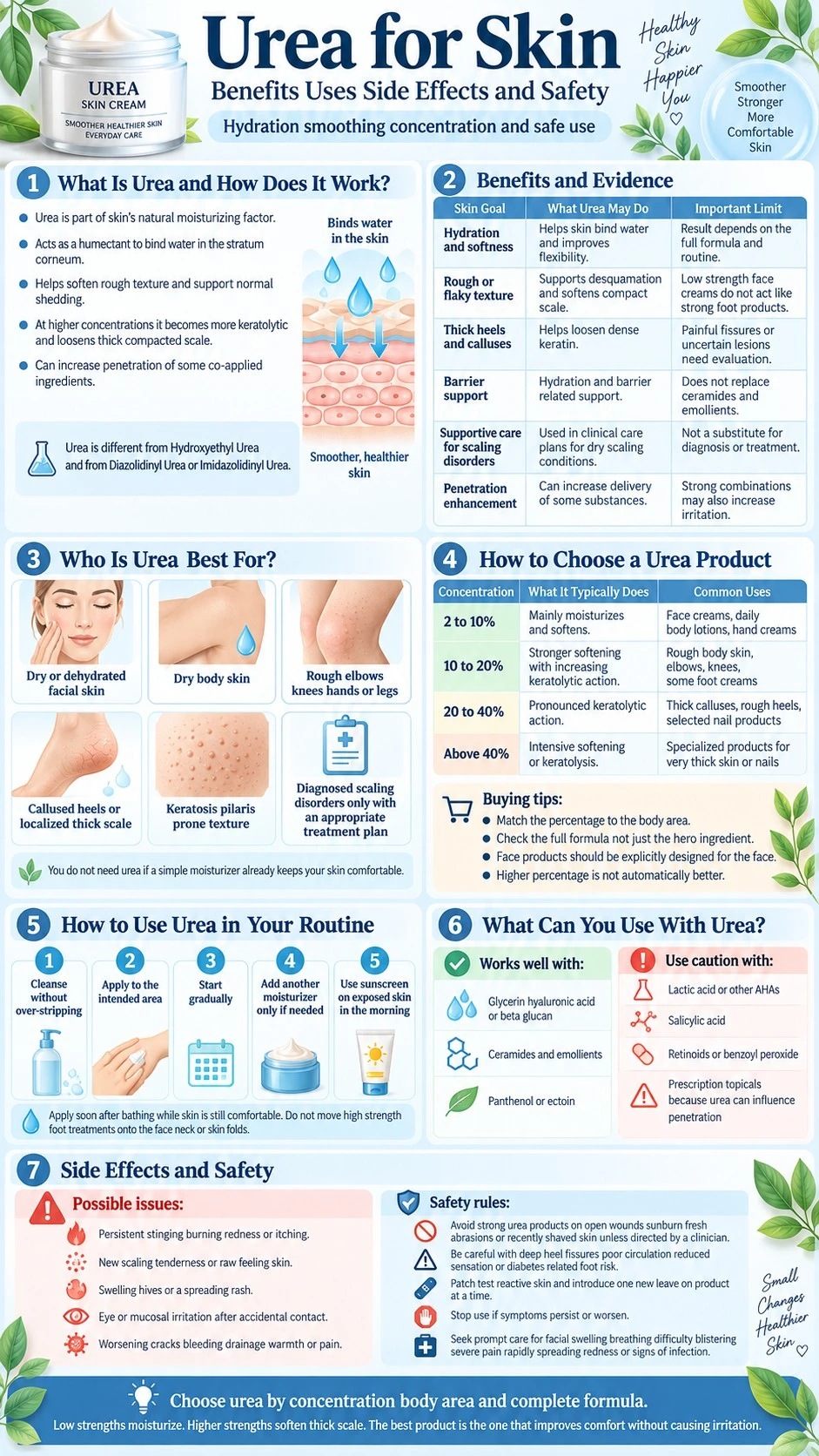
Urea may sound harsh because it is also present in urine, but cosmetic and pharmaceutical urea is manufactured and purified to specification. In healthy skin, urea is one of the small water-binding compounds in the natural moisturizing factor of the stratum corneum, the outermost skin layer.
Its practical advantage is range. A low-strength facial cream can function mainly as a moisturizer, while a high-strength heel treatment is designed to soften much thicker scale. Online advice often ignores that difference and discusses every urea product as though it were interchangeable.
What Is Urea and How Does It Work in Skincare?
Urea is a small molecule that is highly soluble in water. On the skin, it acts as a humectant by helping the stratum corneum bind water. Better hydration can make dry skin feel softer and more flexible and can support the enzymes involved in normal shedding.
At higher concentrations, urea also changes the structure and interactions of keratin. This reduces the cohesion of compacted surface cells and creates a keratolytic effect. In plain language, it helps soften and loosen thick scale rather than simply adding water. Reviews therefore describe topical urea as moisturizing, desquamation-regulating, barrier-supporting, and keratolytic, with the balance depending on concentration and vehicle.[1]
Urea can also increase the penetration of some substances through the skin. That can be useful when a finished formula is deliberately designed around the effect, but it is not a reason to combine strong urea products casually with several exfoliants or medicated treatments.[5]
Mechanistic research suggests that urea does more than sit on the surface. Topical exposure has influenced genes involved in epidermal differentiation, barrier function, and antimicrobial defense in human and laboratory research.[2] Those findings help explain its dermatological use, but they do not mean an ordinary cosmetic can treat eczema, psoriasis, infection, or another skin disease.
Check the ingredient list carefully. Urea is not the same INCI ingredient as Hydroxyethyl Urea, Diazolidinyl Urea, or Imidazolidinyl Urea. Hydroxyethyl Urea is a different humectant, while diazolidinyl urea and imidazolidinyl urea are preservatives. The concentration guide in this article applies to Urea, not to every ingredient whose name contains the word “urea.”
Urea Benefits for Skin and What the Evidence Shows
Urea’s most established benefits are moisturization and softening of dry or hyperkeratotic skin. Evidence also supports barrier effects and clinical use in several scaling conditions, but results from a medicated product or disease-specific study should not be transferred automatically to every cosmetic lotion.[1]
| Skin goal | What urea may contribute | Evidence context | Important limit |
|---|---|---|---|
| Hydration and softness | Helps the outer skin bind water and improves flexibility | Low-concentration urea is widely used in moisturizers; controlled research has measured changes in hydration and barrier properties.[3] | Results depend on the full formula, frequency, and condition of the skin |
| Rough or flaky texture | Supports normal desquamation and softens compact scale | Moisturizing and keratolytic actions overlap as concentration rises.[1] | A low-strength face cream will not act like a high-strength callus product |
| Thick heels and calluses | Loosens dense keratin so thickened areas become easier to soften | Higher-concentration products are used on localized hyperkeratotic skin.[1] | Deep fissures, pain, bleeding, or uncertain lesions need appropriate evaluation |
| Barrier function | Improves hydration and has influenced barrier-related biological pathways | Human and laboratory evidence supports effects beyond simple surface wetting.[2] | Urea does not replace ceramides, emollients, or protection from ongoing irritation |
| Supportive care for scaling disorders | Can be included in treatment plans for conditions associated with dryness and scale | Clinical literature covers atopic dermatitis, ichthyosis, psoriasis, and related uses.[4] | A cosmetic article cannot diagnose these conditions or replace medical treatment |
| Penetration enhancement | Can increase delivery of certain co-formulated or co-applied substances | Skin-absorption research and safety reviews recognize this property.[5] | Strong combinations can also increase irritation or unwanted exposure |
The concentration ranges used online are practical bands, not guarantees. Vehicle, pH, contact time, supporting ingredients, application area, and skin thickness change performance. A 10% facial emulsion, a 10% body lotion, and a 10% foot cream can feel and perform differently.
Urea also should not be sold as a universal “anti-aging” ingredient. Better hydration can temporarily reduce the appearance of fine dehydration lines and make the surface look smoother. That is not the same as reversing deep wrinkles, rebuilding lost collagen, or replacing sunscreen and evidence-based aging-care products.
Who Is Urea Best For?
Urea is most useful when dryness comes with roughness, flaking, or thickened texture. The appropriate concentration and product type still depend on the area being treated.
- Dry or dehydrated facial skin: A low-strength product formulated for the face may reduce tightness and flaking. Sensitive or barrier-damaged skin can still sting.
- Dry body skin: Lotions and creams can combine urea with glycerin, emollients, and occlusives for both water binding and longer-lasting comfort.
- Rough elbows, knees, hands, or legs: Moderate-strength products can soften uneven texture when a basic moisturizer is not enough.
- Callused heels or localized thick scale: Higher-strength foot products may be useful on intact, thick skin when used according to their directions.
- Keratosis pilaris–prone texture: Urea can be part of a smoothing body formula, especially when dryness is also present. Persistent or inflamed bumps may need a different approach.
- Skin with diagnosed scaling disorders: Urea has established dermatological uses, but the product strength and treatment plan should match the diagnosis rather than a self-selected percentage.[4]
Urea is not necessary for everyone. If a simple moisturizer already keeps your skin comfortable and smooth, you do not need to move to a keratolytic product simply because urea is trending.
How to Choose a Urea Skincare Product
Start with the body area and goal, then choose the concentration and texture. Do not compare percentages without checking whether the products are intended for the face, body, feet, or nails.
| Approximate urea level | Main role | Typical product use | Key caution |
|---|---|---|---|
| About 2–10% | Humectancy, softening, and barrier support | Facial moisturizers, daily body lotions, hand creams | Can still sting very irritated or freshly exfoliated skin |
| About 10–20% | Stronger softening with increasing keratolytic action | Rough body skin, elbows, knees, and some foot creams | May be too active for sensitive facial skin |
| About 20–40% | Pronounced keratolytic action | Thick calluses, rough heels, and selected nail products | Keep use localized and follow the product directions |
| Above 40% | Intensive softening or keratolysis | Specialized preparations for very thick skin or nails | Not a general daily moisturizer; professional guidance may be appropriate |
Next, judge the complete formula:
- Facial lotion or cream: Choose a product explicitly designed for the face. Fragrance, acids, retinoids, alcohol, and other actives may affect tolerability more than the featured urea claim.
- Body lotion: Useful for broad areas of dry, rough skin. A pump lotion is convenient, but very dry skin may prefer a richer cream with more emollient or occlusive support.
- Hand cream: Consider wash frequency, cracks, and whether the finish interferes with work. A strong product can sting around damaged cuticles.
- Foot cream: Match the strength to the degree of thickening. A high percentage is intended for localized thick skin, not the entire body.
- Nail product: Follow its labeled purpose closely. Nail-softening preparations are not interchangeable with ordinary moisturizers.
Do not assume the ingredient-list position reveals the exact percentage. If concentration materially affects your choice and the brand does not disclose it, ask the manufacturer or select a product with clearer labeling. Also confirm that “urea” is the actual featured INCI rather than a differently functioning urea derivative.
If hydration is the main goal, product balance matters more than collecting high percentages. Glycerin, hyaluronic acid, panthenol, amino acids, and beta-glucan can add humectant or conditioning support, while ceramides, fatty acids, squalane, silicones, and petrolatum can improve softness or reduce evaporation. The broader skin barrier system includes both water-binding components and lipids.
How to Use Urea in Your Skincare Routine
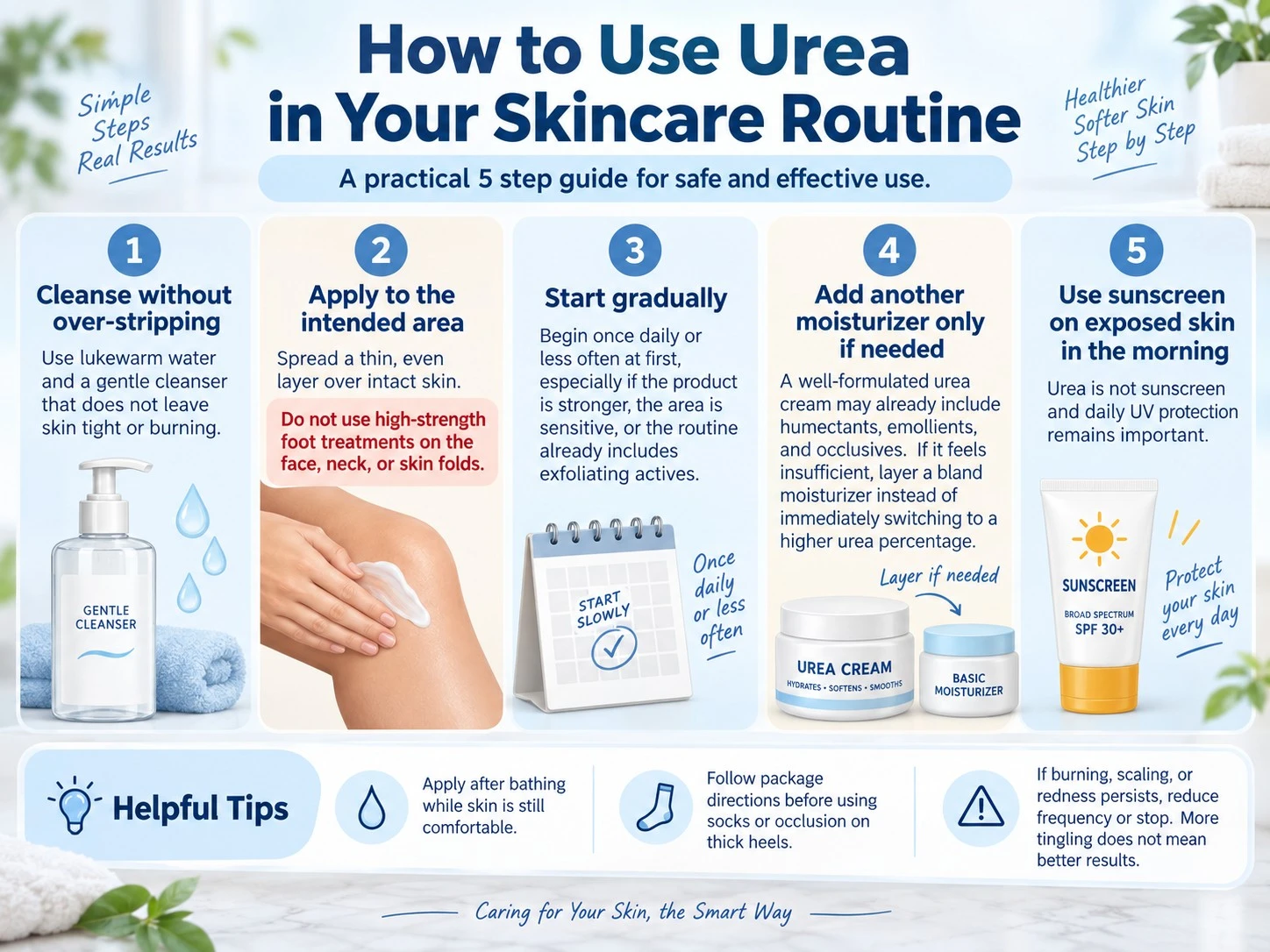
Follow the directions for the exact product, especially above ordinary moisturizing strengths. For a leave-on urea lotion or cream, this sequence is a practical starting point:
- Cleanse without over-stripping. Use lukewarm water and a cleanser that does not leave the skin persistently tight or burning.
- Apply to the intended area. Spread a thin, even layer over intact skin. Do not move a high-strength foot treatment onto the face, neck, or folds.
- Start gradually. Use once daily or less often at first if the product is stronger, the area is sensitive, or your routine already contains exfoliating actives.
- Add another moisturizer only if needed. A well-formulated urea cream may already provide humectants, emollients, and occlusives. If it feels insufficient, apply a bland moisturizer over it rather than immediately increasing the urea percentage.
- Use sunscreen on exposed skin in the morning. Urea is not a sunscreen. Daily UV protection remains part of a complete routine, especially when other exfoliants or retinoids are used.
Applying a body moisturizer soon after bathing can help trap water before it evaporates. Pat the skin dry rather than leaving it dripping, then apply the product while the skin is still comfortable. On thick heels, follow the package directions before adding socks or occlusion; covering a strong product can increase its effect and is not appropriate for every formula.
If a product causes persistent burning, scaling, or redness, reduce frequency or stop it. More tingling does not mean more effective exfoliation. The goal is steady improvement in comfort and texture without creating new barrier damage.
What Can You Use With Urea?
Urea has no universal timing conflict with most skincare ingredients, but its penetration-enhancing and keratolytic effects make the strength of the complete routine important.
- Glycerin, hyaluronic acid, or beta-glucan: These can complement urea’s water-binding role. A guide to hyaluronic acid for skin explains why humectants work best inside a balanced moisturizing formula.
- Ceramides and emollients: These provide lipid and surface-smoothing support that urea does not supply by itself.
- Panthenol or ectoin: These may add hydration and comfort. Combining several supportive ingredients is optional; the finished formula matters more than a long active list.
- Lactic acid or other AHAs: Both can smooth rough skin, but using them together may increase stinging and over-exfoliation. Begin with one exfoliating product and assess tolerance.
- Salicylic acid: This can be useful in some rough-skin products, yet the combination may be too strong for delicate or already irritated areas.
- Retinoids or benzoyl peroxide: A low-strength urea moisturizer can fit into the same broader routine, but avoid assuming it will cancel irritation. Separate applications or alternate days when introducing the combination.
- Prescription topicals: Because urea can influence penetration, follow the prescriber’s or pharmacist’s directions instead of layering a strong urea product over medication on your own.[5]
When irritation appears, simplify the routine and identify the cause. Adding more soothing or hydrating layers does not fix an exfoliant that is too strong, too frequent, or used on the wrong area.
Urea Side Effects and Safety Limits
Topical urea is generally considered safe in cosmetic use, but burning and irritation are recognized effects, especially on diseased, abraded, or sensitive skin and in stronger formulas. Sensitization appears uncommon in the reviewed evidence, although a finished product can cause a reaction to urea or another ingredient.[5]
Possible signs that a product or strength does not suit you include:
- persistent stinging, burning, redness, or itching;
- new scaling, tenderness, or raw-feeling skin;
- swelling, hives, or a spreading rash;
- eye or mucosal irritation after accidental contact; or
- worsening cracks, bleeding, drainage, warmth, or pain.
Avoid applying strong urea products to open wounds, actively inflamed skin, fresh abrasions, sunburn, or recently shaved areas unless a clinician has directed that use. Be especially careful with deep heel fissures, reduced sensation, poor circulation, diabetes-related foot risk, or an uncertain growth or lesion; those situations need appropriate foot or medical assessment rather than aggressive self-exfoliation.
Introduce one new leave-on product at a time. If your skin is reactive, patch test the skincare product on a small area before broader use. A home test can identify some reactions but cannot guarantee that irritation or delayed allergy will not occur.[6]
Stop using the product if symptoms persist or worsen. Seek prompt care for breathing difficulty, facial or eye swelling, widespread hives, blistering, severe pain, rapidly spreading redness, or signs of infection. Ongoing eczema-like symptoms, painful cracks, or unexplained thickening should be diagnosed rather than managed by repeatedly increasing the urea percentage.
The final safety boundary is evidence misuse. Urea’s medical applications do not make every cosmetic a treatment, and higher concentration is not automatically superior. Use facial products on the face, localized keratolytics on the areas named on the label, and disease-specific products within an appropriate care plan.
FAQs About Urea for Skin
Can you use urea on your face every day?
Yes, a lower-strength product formulated for facial use may be suitable once or twice daily if it remains comfortable. Start gradually when your skin is sensitive or you also use retinoids, acids, or acne treatments. Do not use a strong foot cream as a face moisturizer.
Is 10% urea too strong for the face?
Not necessarily, but 10% can sting sensitive, freshly exfoliated, or barrier-damaged facial skin. Formula design matters, so choose a product intended for the face and reduce frequency if irritation develops.
Can urea cause purging?
Urea does not cause a predictable acne purge. New bumps may reflect irritation, occlusion, another ingredient in the formula, or an unrelated breakout. Persistent acne-like or itchy uniform bumps should be assessed rather than treated as a required adjustment phase.
Can you use urea with retinol or exfoliating acids?
Yes, but combining them in the same session can increase dryness or stinging, especially when the urea concentration is high. Introduce one active at a time, consider alternate nights, and reduce the irritating product if discomfort continues.
Is skincare urea made from urine?
No. Urea occurs naturally in the body and is a component of skin’s natural moisturizing factor, but urea used in modern cosmetic and pharmaceutical products is manufactured and purified under controlled specifications.
Sources
[1] Piquero-Casals J et al. Urea in Dermatology: A Review of Its Emollient, Moisturizing, Keratolytic, Skin Barrier Enhancing and Antimicrobial Properties
[2] Grether-Beck S et al. Urea Uptake Enhances Barrier Function and Antimicrobial Defense in Humans by Regulating Epidermal Gene Expression
[3] Lodén M. Urea-Containing Moisturizers Influence Barrier Properties of Normal Skin
[4] Pan M et al. Urea: A Comprehensive Review of the Clinical Literature
[5] Cosmetic Ingredient Review Expert Panel. Final Report of the Safety Assessment of Urea
[6] American Academy of Dermatology Association. How to Test Skin Care Products


