Compare sunscreen spray vs lotion for coverage, safety, face and body use, kids, outdoor protection, and when lotion is the better daily SPF choice.
Table of Contents
Quick Answer: Sunscreen Spray vs Lotion
Spray and lotion sunscreen can both protect your skin when used correctly. Lotion is usually more reliable for full, even coverage because you can see, spread, and control the amount more easily. Spray is more convenient for body touch-ups, outdoor reapplication, and hard-to-reach areas, but it is easier to underapply or miss spots.
The better choice depends on where and how you use it:
Lotion = better for daily face use, kids, and first full application
Spray = better for body touch-ups and hard-to-reach areas
Spray must be applied generously and rubbed in
Spray should not be sprayed directly on the face
Spray should not be inhaled or used near flames [1][2]
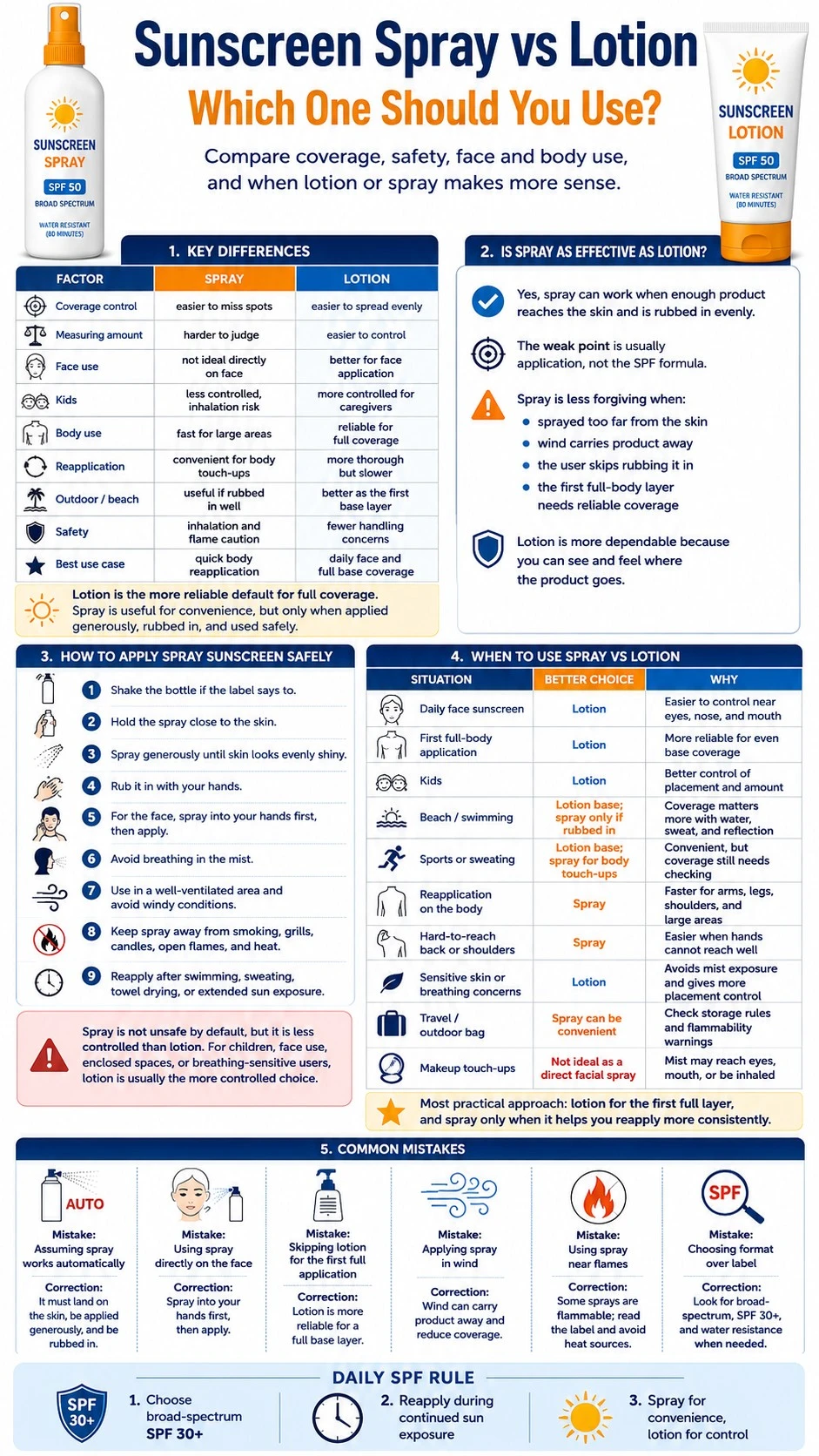
Sunscreen spray vs lotion infographic
Sunscreen Spray vs Lotion: Key Differences
Lotion sunscreen is applied by hand and spread across the skin. Spray sunscreen is delivered as a mist, usually from an aerosol or pump spray bottle. Both formats can offer broad-spectrum SPF 30+ and water resistance if the label says so. [2]
The main difference is control. Lotion is easier to measure and verify on the skin. Spray is faster, but the mist can miss areas, drift in the air, or be applied too lightly.
Feature
Spray Sunscreen
Lotion Sunscreen
Coverage control
Easier to miss spots
Easier to spread evenly
Ease of measuring amount
Harder to judge
Easier to control
Face use
Not ideal directly on face
Better for face application
Kids
Less controlled; inhalation risk
More controlled for caregivers
Body use
Fast for large areas
Reliable for full coverage
Reapplication
Convenient for body touch-ups
More thorough but slower
Outdoor / beach use
Useful if rubbed in well
Better as the first base layer
Safety concerns
Inhalation and flame caution
Fewer handling concerns
Best use case
Quick body reapplication
Daily face and full base coverage
Key takeaway: Lotion is the more reliable default for full coverage. Spray is useful for convenience, but only when applied generously, rubbed in, and used safely.
Is Spray Sunscreen as Effective as Lotion?
Spray sunscreen can be effective when enough product lands on the skin and is spread evenly. The weak point is usually application, not the SPF formula. [2][3]
With spray, product can drift into the air, especially in wind. It is also easy to spray too lightly, miss curved areas, or assume the mist has covered more skin than it has. Lotion is more dependable because you can see and feel where the product goes.
Spray is effective but less forgiving when:
It is sprayed too far from the skin
Wind carries product away
The user skips rubbing it in
The first full-body layer needs reliable coverage
How to Apply Spray Sunscreen Safely
Spray sunscreen can work well, but it needs more careful handling than lotion. The goal is simple: get enough product onto the skin, spread it evenly, and keep the mist away from the eyes, mouth, lungs, and heat sources. [2][3]
Use spray sunscreen this way:
Shake the bottle if the label says to.
Hold the spray close to the skin.
Spray generously until the skin looks evenly shiny.
Rub it in with your hands.
For the face, spray into your hands first, then apply.
Avoid breathing in the mist.
Use spray in a well-ventilated area and avoid windy conditions when possible.
Keep spray away from smoking, grills, candles, open flames, and heat. [1][2]
Spray sunscreen is not unsafe by default, but it is less controlled than lotion. For children, face use, enclosed spaces, or breathing-sensitive users, lotion is usually the more controlled choice.
See also:How to Use Sunscreen Correctly for Full Protection
When to Use Spray vs Lotion Sunscreen
The best format depends on the body area, exposure level, and how much control you need. Use lotion when reliable coverage matters most. Use spray when convenience helps you reapply on the body.
Use Case
Better Choice
Why
Daily face sunscreen
Lotion
Easier to control near eyes, nose, and mouth.
First full-body application
Lotion
More reliable for even base coverage.
Kids
Lotion
Caregivers can control placement and amount better.
Beach / swimming
Lotion base; spray only if rubbed in
Water, sweat, and reflection make coverage more important.
Sports or sweating
Lotion base; spray for body touch-ups
Spray can be convenient, but coverage still needs checking.
Reapplication on the body
Spray
Faster for arms, legs, shoulders, and large areas.
Hard-to-reach back or shoulders
Spray
Easier to apply when hands cannot reach well.
Sensitive skin or breathing concerns
Lotion
Avoids mist exposure and gives more placement control.
Travel / outdoor bag
Spray can be convenient
Check storage rules and flammability warnings.
Makeup touch-ups
Not ideal as a direct facial spray
Mist may reach eyes, mouth, or be inhaled.
The most practical approach is lotion for the first full layer and spray only when it helps you reapply more consistently.
Common Mistakes When Comparing Spray and Lotion Sunscreen
Many spray sunscreen problems come from use, not the SPF formula itself. The format is convenient, but it is less forgiving when people spray too lightly, skip rubbing, or use it in the wrong setting.
Mistake: Assuming spray works automatically
Correction: Spray must land on the skin, be applied generously, and be rubbed in.
Mistake: Using spray directly on the face
Correction: Spray into your hands first, then apply.
Mistake: Skipping lotion for the first full application
Correction: Lotion is more reliable for a full base layer.
Mistake: Applying spray in wind
Correction: Wind can carry product away and reduce coverage. [2]
Mistake: Using spray near flames
Correction: Some sprays are flammable; read the label and avoid heat sources. [1]
Mistake: Choosing format over label
Correction: Look for broad-spectrum, SPF 30+, and water resistance when needed. [1][2]
Final Takeaway: Sunscreen Spray vs Lotion
Lotion sunscreen is the more reliable default for full, even coverage because it is easier to apply, spread, and check on the skin. Spray sunscreen is useful for body reapplication, convenience, and hard-to-reach areas, but it needs more careful use.
Apply spray generously, rub it in, avoid breathing in the mist, and never spray it directly on the face. For daily protection, choose a broad-spectrum SPF 30+ sunscreen and reapply during continued sun exposure. [1][2]
FAQs About Sunscreen Spray vs Lotion
Is spray sunscreen as good as lotion?
Spray sunscreen can be as protective as lotion when enough product reaches the skin and is rubbed in evenly. The issue is application control. Spray is easier to underapply or lose in the air, so lotion is usually more reliable for full coverage.
Is lotion sunscreen better than spray?
For the first full application, yes. Lotion is better because you can see where it goes, control the amount, and spread it evenly. Spray is better for convenience, body touch-ups, and hard-to-reach areas when used carefully.
Should I rub in spray sunscreen?
Yes. Spray sunscreen should be rubbed in after application. Spraying alone can leave uneven coverage, especially around curves, joints, shoulders, and legs. A good rule is to spray until the skin looks evenly shiny, then rub it in with your hands.
Can I spray sunscreen on my face?
Do not spray sunscreen directly on your face. Spray it into your hands first, then apply it to your face while avoiding the eyes, nose, and mouth. Lotion is usually the cleaner and more controlled option for daily face sunscreen.
Is spray sunscreen safe for kids?
Spray sunscreen can be used carefully, but lotion is usually better for kids. Children may inhale the mist, move during application, or get uneven coverage. If using spray, apply it to your hands first or spray away from the face and rub it in well.
Which is better for daily use, spray or lotion?
Lotion is better for daily face use and the first full layer because it gives more control. Spray is useful for body reapplication and hard-to-reach areas. For most routines, lotion first and spray for body touch-ups is the best balance.
Lucy has 8 years of skincare industry experience in global sales, product communication, and market support. Her writing is based on industry knowledge, international market exposure, and practical product experience.


 Spray sunscreen can work well, but it needs more careful handling than lotion. The goal is simple: get enough product onto the skin, spread it evenly, and keep the mist away from the eyes, mouth, lungs, and heat sources. [2][3]
Use spray sunscreen this way:


