


MoCRA turned the company behind a U.S. cosmetic label into an active compliance owner. For a private label brand, choosing the name and address on the package is therefore more than an artwork decision: it can determine which company FDA treats as the Responsible Person for that product.
The role should be resolved before launch because product listing, safety substantiation, adverse-event intake and post-market response depend on information held by several parties. The brand, contract manufacturer, testing laboratories, packaging suppliers and regulatory service provider need one documented operating model rather than separate assumptions.
Who Is the Responsible Person Under MoCRA?
The Responsible Person is the manufacturer, packer or distributor of a cosmetic product whose name appears on its label under the applicable labeling provisions.[1] This is a product-specific statutory definition, not simply the individual whom a company appoints as its compliance contact.
If a private label moisturizer states “Distributed by” or “Manufactured for” followed by the brand company’s name and place of business, that named distributor is commonly the Responsible Person. If the contract manufacturer’s qualifying name appears instead, the result may be different. Review the actual U.S. label rather than relying on purchase orders, brand ownership or who submitted data through an FDA portal.
A company outside the United States can qualify as the Responsible Person when it meets the definition and appears on the label. The product must still provide a domestic address, domestic phone number or electronic contact information, which may be a website, through which adverse-event reports can be received.[2]
How Is the Responsible Person Different From the Factory or U.S. Agent?
Private label projects often combine several regulatory roles. One company can perform more than one role, but the roles should not be treated as interchangeable.
| Role | How the role is determined | Typical responsibility |
|---|---|---|
| Responsible Person | Qualifying manufacturer, packer or distributor whose name appears on the product label | Product listing, safety substantiation, adverse-event duties and product-level compliance coordination |
| Facility owner or operator | Entity that owns or operates a facility manufacturing or processing cosmetics for U.S. distribution | Facility registration, required amendments and biennial renewal |
| Contract manufacturer | Factory engaged by the brand to manufacture, process, fill or pack the product | Manufacturing records, specifications, testing, traceability and facility obligations applicable to its activities |
| U.S. agent for a foreign facility | Contact identified in a foreign facility registration | Communication relating to the foreign facility; this role does not automatically make the agent the product’s Responsible Person |
| Authorized submission agent or consultant | Service provider authorized to prepare or transmit information | Administrative or technical support; it becomes the Responsible Person only if it independently meets the statutory definition |
Owners or operators generally register manufacturing or processing facilities and renew those registrations every two years. The Responsible Person lists marketed products. In a contract-manufacturing arrangement, either the contract manufacturer or a Responsible Person whose products are made at that facility may submit the facility registration, but this submission option does not merge the two legal roles.[2]
What Duties Does the MoCRA Responsible Person Have?
The Responsible Person’s main duties continue after the initial product launch. They require an operating system that connects the released formula and label to safety evidence, complaint intake and FDA submissions.
| Duty | Legal or regulatory action | Useful private label control |
|---|---|---|
| Cosmetic product listing | List each marketed cosmetic product with FDA and provide annual updates | Maintain one approved data record linking the label name, category, ingredients and manufacturing facilities |
| Safety substantiation | Ensure and retain records supporting adequate substantiation of safety | Approve a product-specific safety dossier before commercial release |
| Serious adverse-event reporting | Report qualifying serious adverse events within 15 business days and submit qualifying follow-up information | Operate intake, medical escalation, assessment and reporting procedures with deadline tracking |
| Adverse-event records | Maintain adverse-event records for the applicable retention period and make them accessible when legally required | Preserve original communications, assessments, labels, lot details, follow-up and submission evidence |
| Label contact route | Provide a compliant way for consumers to submit adverse-event reports | Monitor the address, phone number, email or website workflow and test that reports reach trained staff |
| Recall and FDA response | Evaluate safety signals and respond when FDA exercises records-access, suspension or recall authorities | Maintain distribution traceability, decision authority and a documented recall procedure |
Facility registration and product listing are not FDA approval programs. FDA does not issue certificates proving that a facility registration or product listing makes a cosmetic compliant, and the assigned numbers must not be promoted as FDA approval.[3]
How Does Cosmetic Product Listing Work for a Private Label Brand?
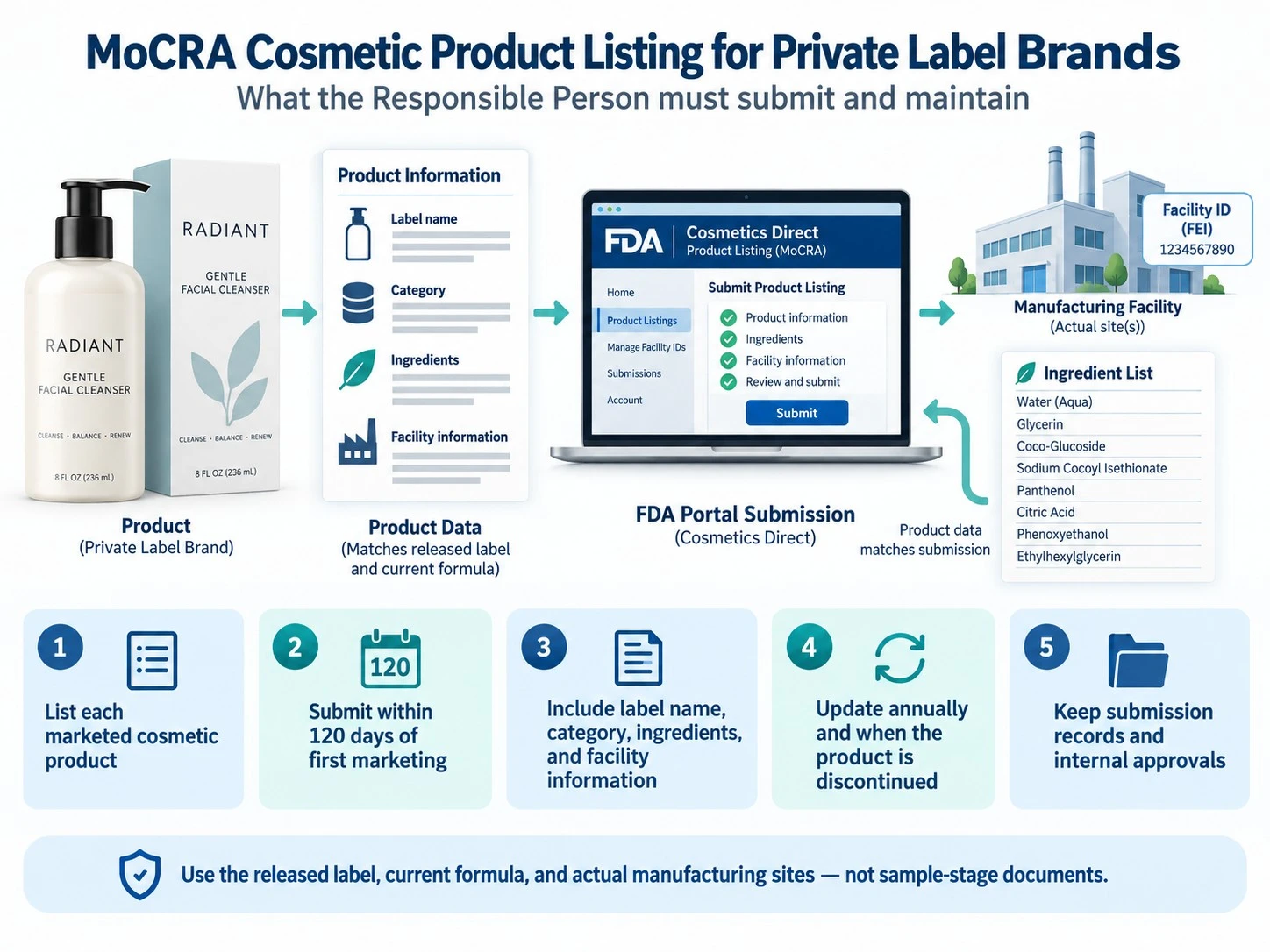
The Responsible Person must submit—or ensure submission of—a listing for each marketed cosmetic product. For a product first marketed after December 29, 2022, the statutory timing is within 120 days of marketing it in interstate commerce. The listing must then be updated annually, including an update when the product has been discontinued.[2]
A product listing requires the Responsible Person’s name and contact number, the product name as shown on the label, product category, manufacturing or processing facility information and an ingredient list. The Responsible Person therefore needs the relevant facility registration or FDA Establishment Identifier information from each manufacturer or processor. When a facility is exempt and has no registration number, the listing process allows its name and address to be provided instead.[2]
- Match the marketed product: Use the released label identity, current formula and actual manufacturing sites rather than a sample-stage document.
- Control formula families: One submission may cover multiple products with identical formulas or formulas differing only in colors, fragrances, flavors or quantity of contents when the statutory conditions are met.
- Track every facility: Obtain identifiers for all facilities that manufacture or process the product, not only the final shipping location.
- Update from change control: Route formula, fragrance, color, category, product-name, facility and discontinuation changes to the listing owner.
- Keep submission evidence: Retain the submitted data, FDA response and internal approval rather than relying on a screenshot or an alleged “FDA certificate.”
Cosmetics Direct is one FDA submission option, but a portal account does not replace data governance. The listing should be generated from the same controlled formula and finished cosmetic product specification used for production release.
What Safety Substantiation Should the Brand Maintain?
The Responsible Person must ensure and maintain records supporting adequate substantiation of safety. FDA does not prescribe one universal test package, and animal testing is not required for marketing a cosmetic; the evidence must nevertheless come from scientifically robust methods and support the finished product under labeled or customary use.[1]
The appropriate dossier depends on formula, exposure, packaging, user group and claims. A practical private label safety file may include:
- the complete quantitative formula and ingredient identities;
- supplier specifications, certificates of analysis and relevant toxicological or safety information;
- finished-product specifications and release criteria;
- stability and packaging-compatibility evidence for the intended shelf life;
- preservative efficacy and appropriate cosmetic microbiological testing for susceptible products;
- exposure assumptions, warnings, directions and foreseeable-use considerations;
- support for claims that affect how consumers use or understand the product; and
- an expert safety assessment or other documented evaluation appropriate to the available evidence.
Product listing data and safety substantiation are separate deliverables. A correctly listed serum can still lack adequate safety evidence, while a well-tested formula can still have an inaccurate or overdue listing. The Responsible Person should approve both before treating the launch file as complete.
How Should the Brand Handle Adverse Events?
Every consumer contact route should feed one adverse-event process. A serious adverse event associated with cosmetic use in the United States must be reported to FDA within 15 business days, together with a copy of the label on or within the retail packaging. If new medical or other qualifying information is received within one year of the initial report, it must also be sent within 15 business days.[4]
Serious outcomes include death, a life-threatening experience, inpatient hospitalization, persistent or significant disability or incapacity, congenital anomaly or birth defect, infection, significant disfigurement, or an intervention needed to prevent one of those outcomes. Significant disfigurement can include serious and persistent rashes, second- or third-degree burns, significant hair loss or persistent significant alteration of appearance.[4]
The workflow should capture the product and shade or variant, lot or batch code, dates of purchase and use, event description, reporter contact, medical treatment, photographs when voluntarily provided, current label and distribution information. Preserve original correspondence and the rationale for classifying the event as serious or non-serious. Adverse-event records generally must be retained for six years, or three years for a qualifying small business.[5]
A monitored website form or email can satisfy the MoCRA contact route, but only if reports are found and escalated. Connect complaints to cosmetic batch codes and traceability so the Responsible Person can identify affected production and distribution records. A broader comparison of U.S. and EU reporting duties is available in ZICAIL’s cosmetic adverse event reporting guide.
What Should the Private Label Agreement Cover?
A manufacturing agreement cannot rewrite the statutory definition of Responsible Person, but it can determine whether the named company receives the information needed to comply. Attach a responsibility matrix or quality agreement that assigns the following work:
- Label identity: Confirm which legal entity appears as manufacturer, packer or distributor and who approves U.S. artwork.
- Facility information: Supply current facility names, addresses, FEIs or registration information, exemption status and change notices.
- Formula disclosure: Provide the ingredient information needed for listing, labeling and safety review, including a secure process for confidential formula data.
- Safety file: Define which party obtains raw-material evidence, testing, expert review and finished-product documentation.
- Change control: Require written approval before changes to formula, supplier, fragrance, color, package, facility, process, specifications or claims.
- Complaint escalation: Set same-day or other appropriately rapid transfer rules for potential serious events, with follow-up responsibilities and protected personal data handling.
- Investigation support: Define timelines for batch records, retain samples, test results, root-cause work and corrective actions.
- Recall readiness: Assign decision authority, notification, stock control, customer lists, reconciliation and effectiveness checks.
- Record access: Preserve the Responsible Person’s right to obtain records needed for FDA response and ongoing substantiation.
Avoid a vague clause stating that one party will “handle FDA compliance.” Facility registration, product listing, safety, labeling and post-market surveillance should each have an owner, source record, deadline and backup contact.
Do Small-Business Exemptions Remove Responsible Person Duties?
No. MoCRA provides qualifying small businesses with exemptions from certain GMP, facility-registration and product-listing requirements, but it does not create a blanket exemption from cosmetic safety, labeling or adverse-event obligations. Eligibility is based on the statutory sales test and other conditions, not merely the number of employees or units ordered.[1]
The exemptions also do not apply to specified product categories, including products that regularly contact the eye’s mucous membrane, injected products, products intended for internal use, and products intended to alter appearance for more than 24 hours when consumer removal is not part of customary or usual use.[2] Eye-area products require particular care: FDA guidance gives eye shadow, eye makeup remover, liquid or mucosal eyeliner, false-eyelash adhesive and similar products as examples that may fall outside the exemption, while ordinary facial cleansers, moisturizers and serums generally would not be expected to contact the eye’s mucous membrane regularly.[2]
Classification also comes first. A product promoted to treat or prevent disease or affect body structure or function may be a drug, or both a drug and a cosmetic, and different registration, listing, manufacturing and labeling rules can apply.[6] Review acne, dandruff, antiperspirant, skin-lightening, SPF and other therapeutic claims before relying on a cosmetics-only MoCRA plan.
Eight Steps to Set Up the Responsible Person Role
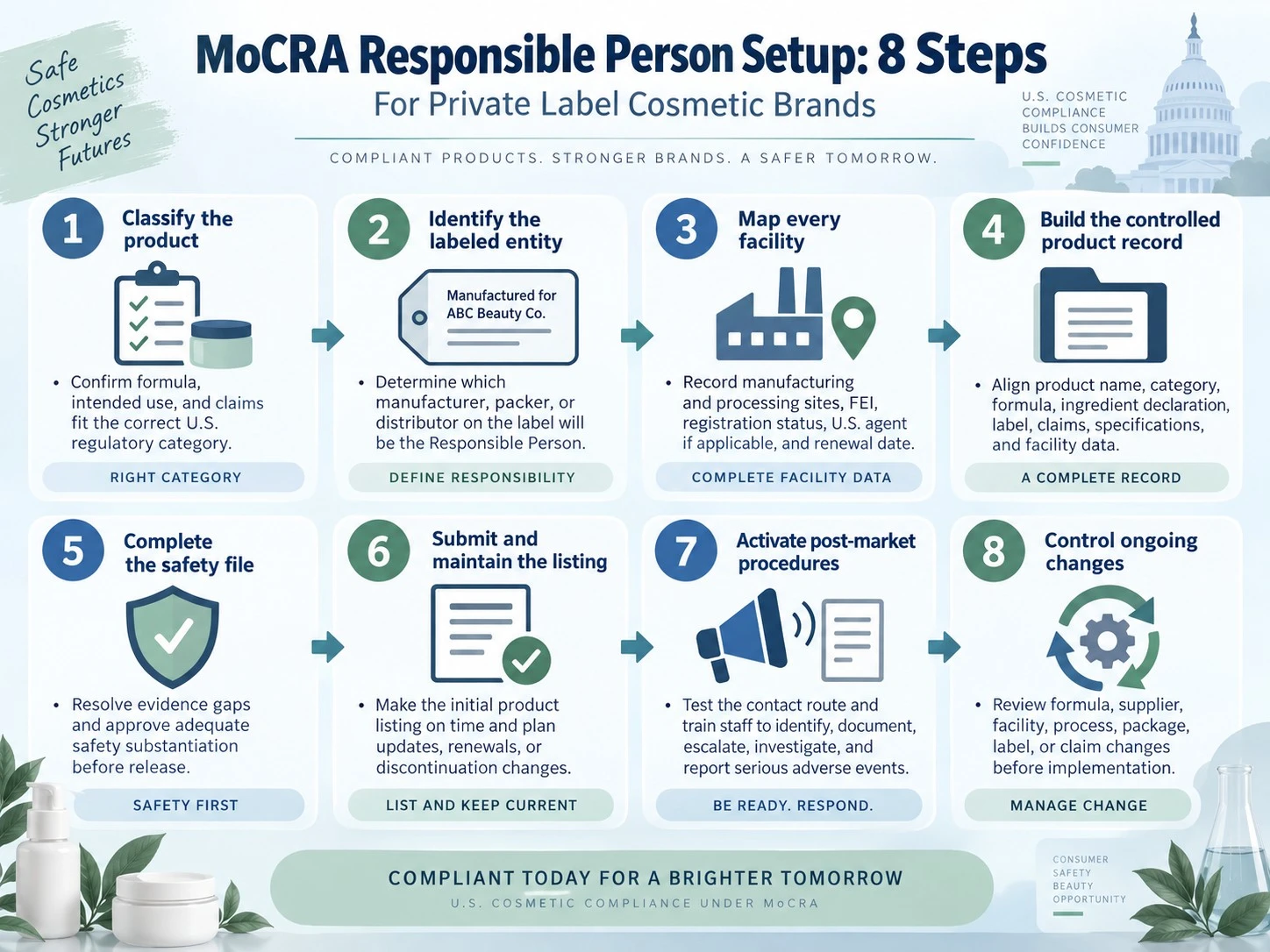
- Classify the product: Confirm that the formula, intended use and claims place it in the correct U.S. regulatory category.
- Identify the labeled entity: Decide which qualifying manufacturer, packer or distributor will appear on the label and therefore act as Responsible Person.
- Map every facility: Record each manufacturing and processing site, its owner or operator, FEI, registration status, U.S. agent where applicable and renewal date.
- Build the controlled product record: Align the product name, category, formula, ingredient declaration, label, claims, specifications and facility data.
- Complete the safety file: Resolve evidence gaps and approve adequate safety substantiation before commercial release.
- Submit and maintain the listing: Make the initial product listing within the applicable timeframe and schedule annual updates, renewals or discontinuation changes.
- Activate post-market procedures: Test the label contact route and train staff to identify, document, escalate, investigate and report serious adverse events.
- Control ongoing changes: Review each formula, supplier, facility, process, package, label or claim change for listing, safety and regulatory consequences before implementation.
Common Responsible Person Mistakes
- Assuming the contract factory is automatically the Responsible Person because it makes the product.
- Treating a U.S. agent, consultant or portal submitter as the Responsible Person without checking the label definition.
- Using an outdated sample formula or incomplete fragrance information for product listing.
- Confusing a facility registration number or product listing number with FDA approval or a compliance certificate.
- Collecting test reports without a documented product-specific safety conclusion.
- Publishing a contact form that nobody monitors for adverse events.
- Starting the 15-business-day review only after every medical detail has been obtained instead of escalating promptly from receipt.
- Failing to link complaints and serious-event records to the relevant label version and batch.
- Relying on a small-business exemption without checking both the current sales test and excluded product categories.
- Allowing formula or facility changes without notifying the person who maintains the FDA listing and safety file.
FAQs About the MoCRA Responsible Person
Is the private label brand always the Responsible Person?
Not automatically. The Responsible Person is the qualifying manufacturer, packer or distributor whose name appears on the cosmetic label. A private label brand is commonly the Responsible Person when its legal name appears after wording such as “Distributed by” or “Manufactured for.”
Can a foreign company be the MoCRA Responsible Person?
Yes. FDA guidance states that a company outside the United States can be the Responsible Person when it meets the statutory definition and its name appears on the label. The label must still provide a domestic address, domestic phone number or electronic contact information through which adverse-event reports can be received.[2]
Is a foreign facility’s U.S. agent the same as the Responsible Person?
No. The U.S. agent is a contact associated with a foreign facility registration. The Responsible Person is determined by the qualifying company named on the product label. One company could perform both roles, but appointment as U.S. agent alone does not establish Responsible Person status.
Can the manufacturer or a consultant submit the product listing?
A service provider can prepare or transmit a submission when properly authorized, and the Responsible Person can ensure that another party makes the required submission. Outsourcing the filing does not change which qualifying company is the Responsible Person or remove its need to verify the submitted data.
Does FDA issue a MoCRA registration certificate?
No. FDA states that it does not issue certificates or verification documents proving cosmetic facility registration, product listing or exemption status. Registration and listing numbers do not indicate FDA approval.[3]
Build a MoCRA-Ready Private Label Documentation Plan
This guide is most useful for skincare brands, importers and distributors that need to coordinate U.S. product-level duties with an overseas manufacturing partner. Prepare the target formula, claims, product variants, label company, U.S. contact route, expected launch date and sales channels before requesting compliance documentation.
ZICAIL can support a private label skincare project with controlled formula and product specifications, ingredient and facility information, testing coordination, packaging inputs and traceable production records. The brand should appoint qualified U.S. regulatory support for final classification, exemption analysis, FDA submissions and serious-event decisions. Contact ZICAIL during product planning so the documentation and change-control workflow can be agreed before artwork and mass production.
Sources
[1] U.S. Food and Drug Administration. Modernization of Cosmetics Regulation Act of 2022 (MoCRA)
[2] U.S. Food and Drug Administration. Guidance for Industry: Registration and Listing of Cosmetic Product Facilities and Products
[3] U.S. Food and Drug Administration. FDA Clarifies It Does Not Provide Certificates or Other Documents to Verify Compliance for Cosmetic Product Facility Registration
[4] U.S. Food and Drug Administration. How to Report a Cosmetic Product Related Complaint
[5] U.S. Food and Drug Administration. FDA Issues Draft Guidance for Industry: FDA Records Access Authority for Cosmetics Products
[6] U.S. Food and Drug Administration. Small Businesses and Homemade Cosmetics: Fact Sheet


